Goal Tracker Printable: Free Custom Sheets That Turn Goals Into Habits
A goal tracker printable is a one-page grid that closes the gap between wanting something and doing something about it daily: your goals — translated into repeatable actions — go down the side, days go across the top, and every day you act on a goal, you mark the box. Goals fail in the fog between "someday" and "today"; a printed tracker burns that fog off every single morning. The fastest way to get one built around your actual goals is the free printable habit tracker builder: type your goal actions as rows, pick a layout, and print.
Want one now? Open the free builder, write each goal as a daily or weekly action ("Write 200 words," "Run 3× this week"), choose a layout, and hit print. No sign-up, no watermark, no app subscription standing between you and your own goals.
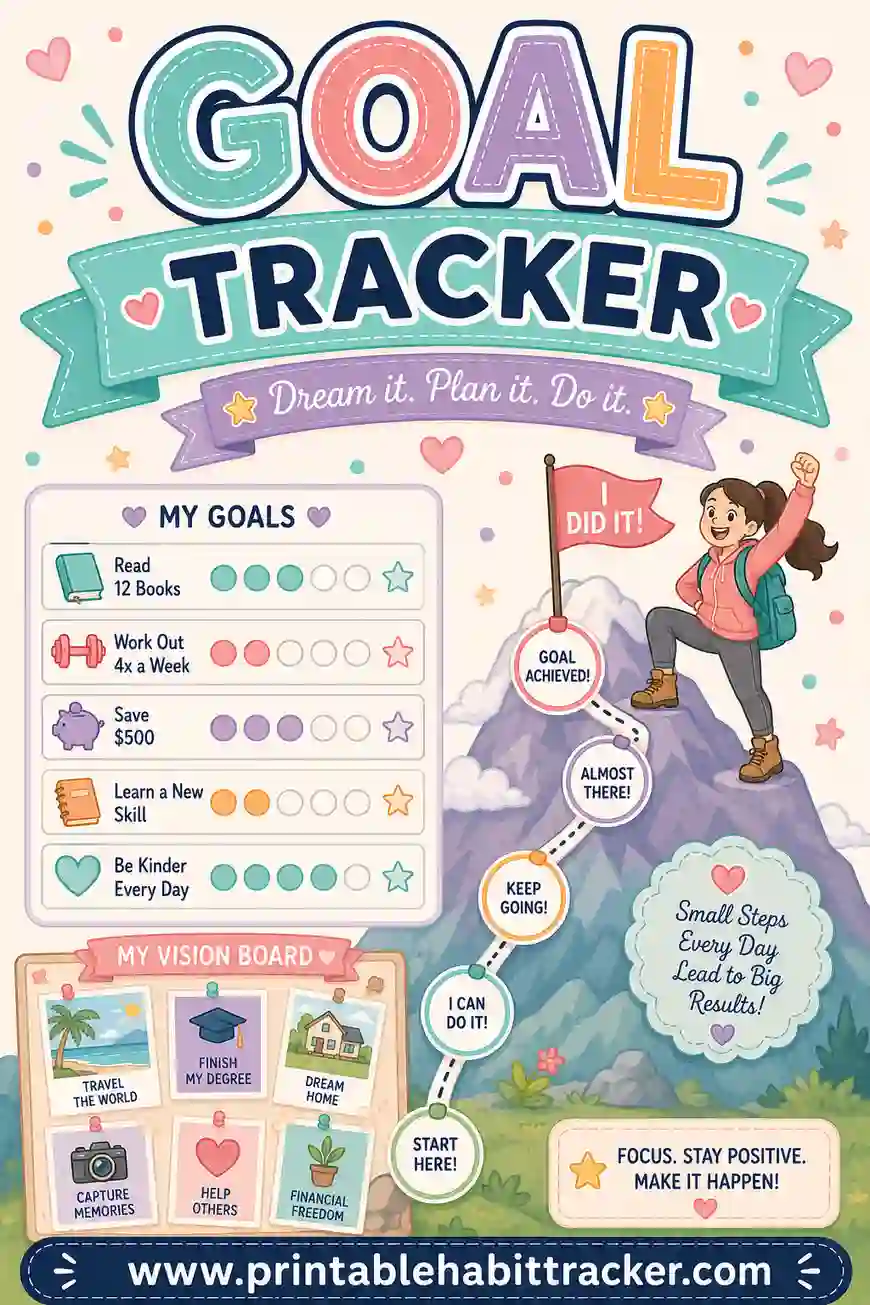
What Is a Printable Goal Tracker?
It's a grid that tracks actions, because actions are the only part of a goal you control. "Get fit" isn't checkable. "Trained today" is. The tracker's whole trick is forcing that translation: every goal on the sheet has to be rewritten as something you can do — and mark — on an ordinary Tuesday.
Structurally it's simple: each row is a goal-action, each column is a day (or week, or month, depending on layout), and each mark is a day you showed up for the goal. Over weeks, the rows fill and the sheet becomes something no vision board ever manages to be: evidence. Proof you're becoming the kind of person who does the thing — or an honest picture of which goal you keep dodging, which is just as valuable.
One note on fit: this is a consistency grid, not a project planner. It won't hold task lists, deadlines, or sub-steps — and it doesn't do math, so number-based targets go in the row names ("Save — move $50 every Friday") with running notes in the notes box. What it does hold is the daily showing-up, which is the part most goal systems skip and most goals die without.
Why Writing Goals on Paper Works
- A goal you see daily stays a goal. January's resolutions fail in February mostly because nobody looks at them in February. A tracker on the fridge is looked at 20 times a day whether you mean to or not.
- The action translation is half the battle. Rewriting "read more" as "read 10 pages" — which the tracker forces — is the moment a wish becomes a plan.
- Streaks create momentum. Every marked box makes the next one easier to want. Chains of checkmarks are the cheapest, oldest motivation trick there is, and they still beat every app notification.
- Blank rows tell the truth kindly. Three empty weeks in the "guitar practice" row isn't failure — it's information. Maybe the action's too big, maybe the goal isn't really yours. Either way, now you know, and you can fix the row instead of quietly feeling bad.
- Paper has no algorithm. Nothing to open, nothing to update, no streak-shaming push notifications. Just a sheet and a pen and your own word.
How to Turn Goals Into Trackable Rows
The translation formula: goal → smallest repeatable action → row name with the number in it. Copy this pattern into the builder:
| Big goal | Trackable row | Rhythm |
|---|---|---|
| Get fit | Move 30 min | Daily |
| Write a book | Write 200 words | Daily |
| Save an emergency fund | Move $50 to savings — Fridays | Weekly |
| Learn Spanish | 10 min practice app | Daily |
| Read 24 books this year | Read 20 pages | Daily |
| Grow the side business | 1 outreach message | Weekdays |
| Run a 10K | Follow training plan — Tue/Thu/Sat | 3× weekly |
| Declutter the house | One drawer or shelf | Weekends |
Two rules make or break this. First, the action must be small enough to do on your worst day — 200 words survives a bad Tuesday; "work on book" doesn't. Second, three to five goal rows, maximum. Every goal you add steals attention from the others; a tracker with eight goals is a tracker with none.
Put the milestone in the notes box
The grid tracks the showing-up; the notes box tracks the score. "Words so far: 14,600." "Savings: $650 of $1,000." Update it weekly by hand — the arithmetic takes ten seconds and writing the number yourself is weirdly motivating in a way autocalculated cells never are.
How to Make a Goal Tracker in 4 Steps
- Translate your goals. In the free builder, write three to five goal-actions, one per line, numbers included: "Read 20 pages," "Outreach ×1," "Run — Tue/Thu/Sat."
- Pick the layout that matches your horizon. Weekly for tight focus, monthly for the classic 30-day view, yearly to watch a whole year of consistency build on one page — or the chain layout for one big goal tracked across all 365 days.
- Choose your style and theme. The color-in square style turns months into a satisfying heat map of effort; checkboxes keep it crisp. Bold if the sheet needs to shout, Sage if it needs to calm.
- Print or save as PDF. Letter or A4, portrait or landscape. Tick "Print all 12 months" and the entire year's goal system prints in one job — twelve dated sheets before your coffee cools.
Your setup saves locally in your browser, so when a goal levels up ("Run 3km" becomes "Run 5km"), it's a ten-second edit and a reprint.
Goal Tracker Layouts for Different Goals
The 30-day sprint
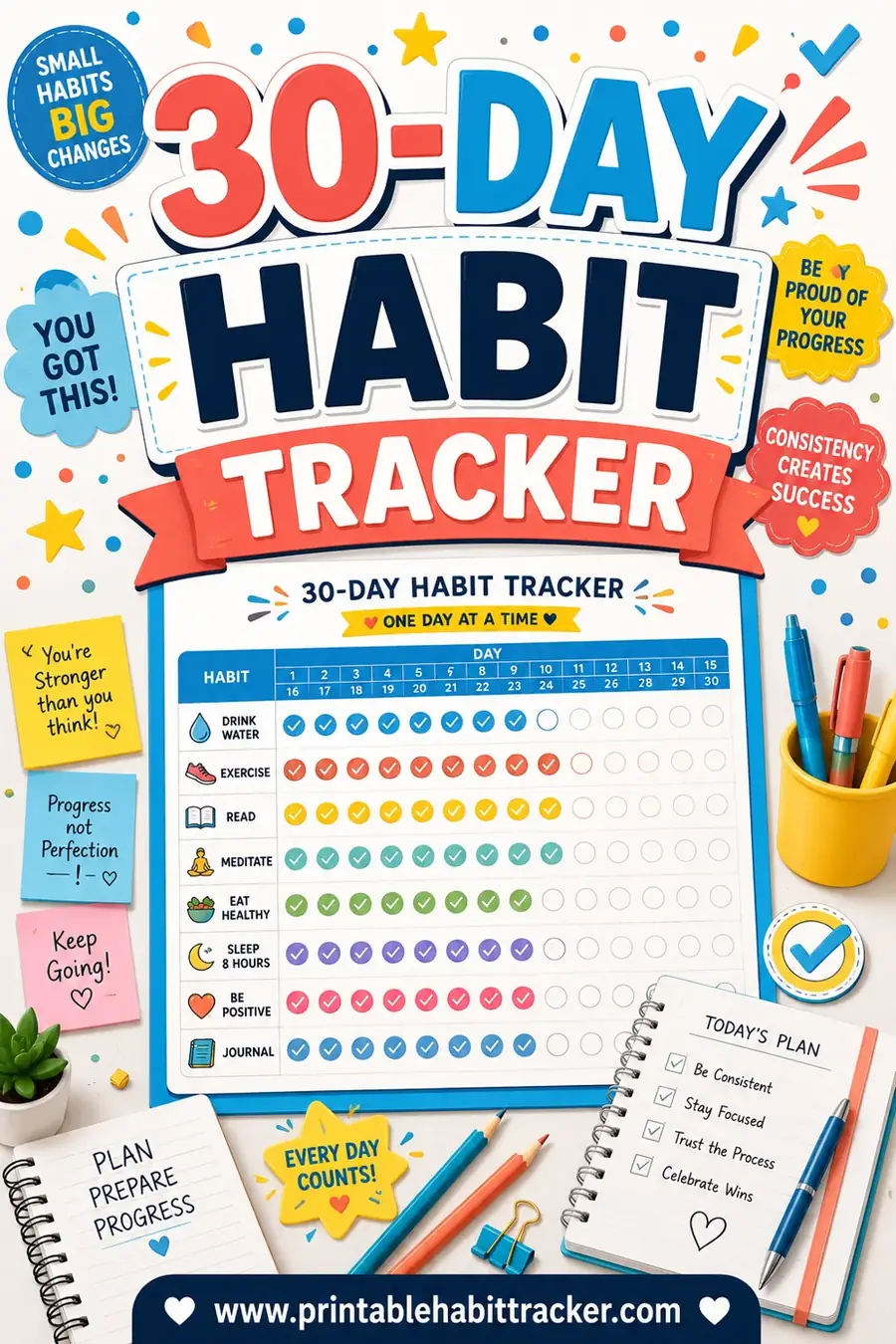
One month, one page, three rows. Perfect for testing a new goal's fit or building the first month of momentum — the 30-day habit tracker approach, pointed at a goal. Most "year goals" are really twelve 30-day sprints wearing a trench coat.
The yearly overview
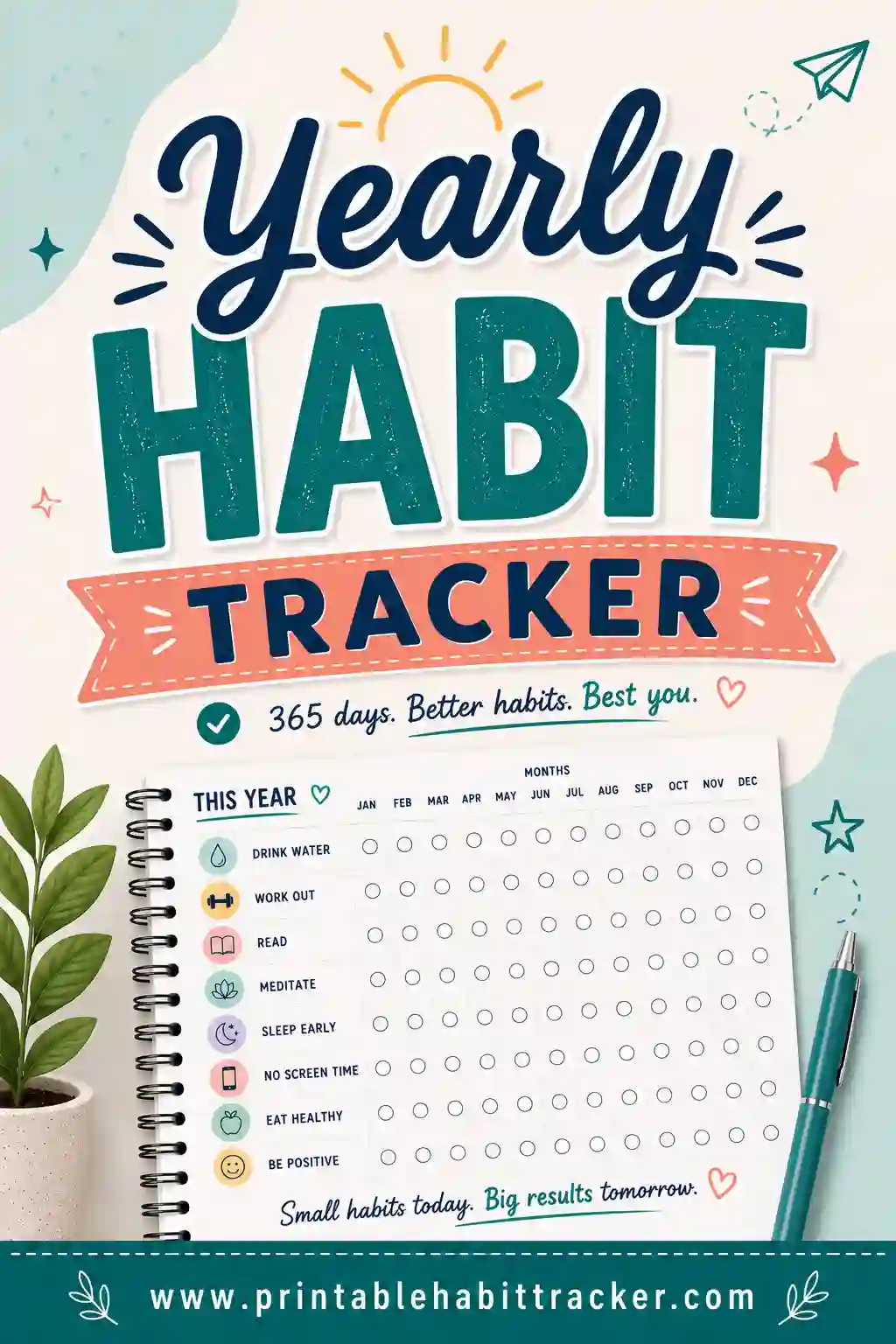
Goal rows with twelve month-columns across — did each goal get worked each month, all year, on one page. The yearly habit tracker format is unbeatable for the long game: marathon training, book writing, savings targets.
The one-goal chain
The chain layout gives a single goal all 365 days as a color-in grid. For the one goal that matters most this year, nothing focuses the mind like a wall calendar of your own follow-through — every colored square a day you kept your word.
The quarterly reset
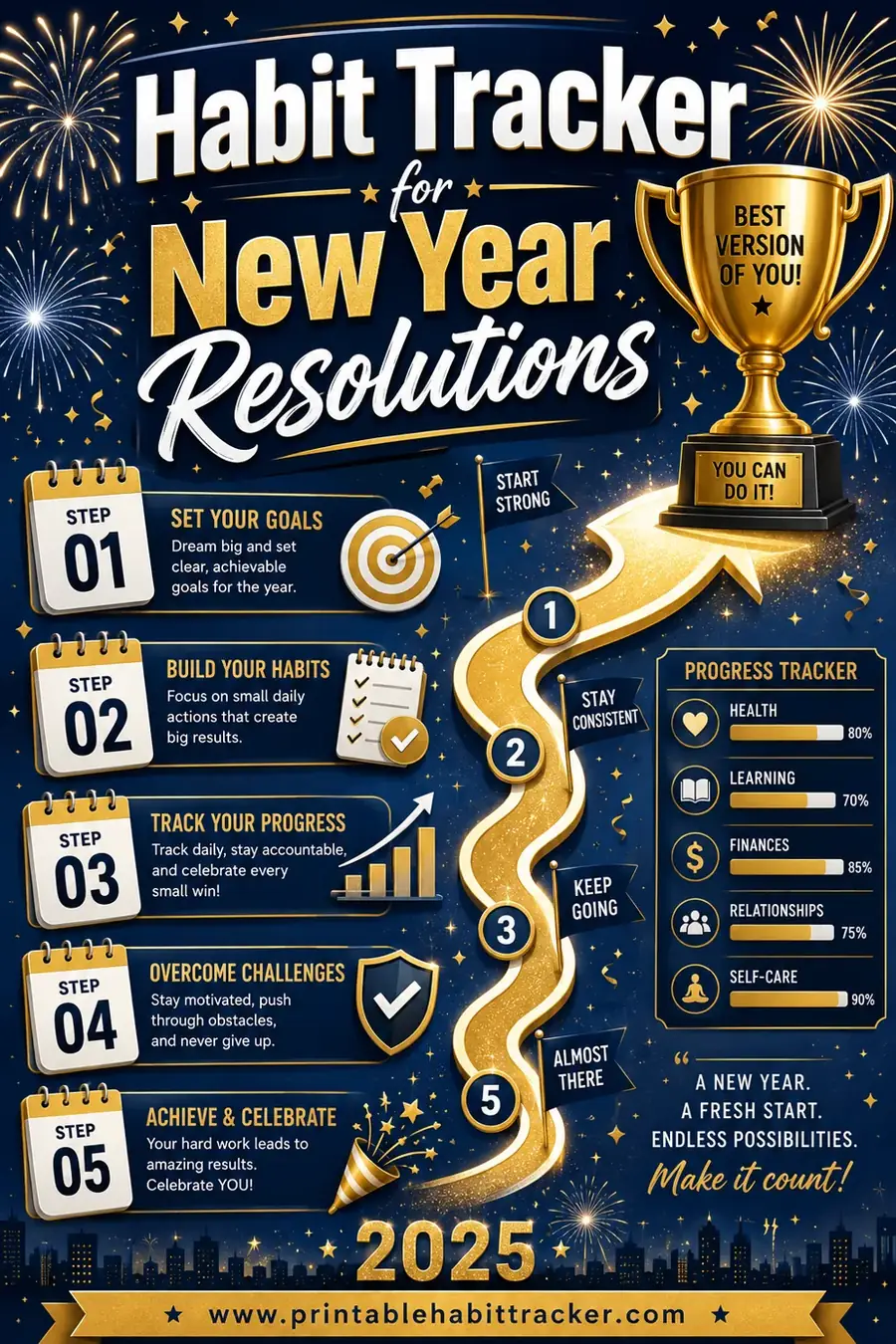
Print three months at a time and re-choose your rows each quarter. Goals age; a quarterly reprint is the honest checkpoint where finished goals graduate off the sheet and stale ones get rewritten or cut. New Year's resolution folks: this is the difference-maker — see the resolutions tracker guide.
A Simple Weekly Goal Ritual
The sheet works daily; the thinking happens weekly. Ten minutes, ideally Sunday:
- Count the week's marks for each row. No judgment, just the number.
- Update the notes box — pages read, dollars moved, words written.
- Ask one question per thin row: too big, or not really wanted? Shrink the action or cut the goal. Both are wins.
- Set the week's one focus. Write it at the top: "This week: the run row." A tracker plus one weekly priority beats any productivity system twice its weight.
A Sample Filled-In Goal Tracker
Two weeks into a month, three goals — copy the shape into the builder:
| Goal action | Week 1 | Week 2 |
|---|---|---|
| Write 200 words | ✓ ✓ ✓ ☐ ✓ ✓ ☐ | ✓ ✓ ✓ ✓ ☐ ✓ ✓ |
| Move 30 min | ✓ ☐ ✓ ✓ ☐ ✓ ✓ | ✓ ✓ ☐ ✓ ✓ ☐ ✓ |
| Save $50 — Fri | — — — — ✓ — — | — — — — ✓ — — |
Notes box: "Words: 4,400 total. Savings: $100/$1,000. Best writing streak: 4 days." Reward box: "20 writing checks this month = new keyboard." Eleven writing days out of fourteen — that's a book happening, visibly, two hundred words at a time.
Printing Tips
- Print the year in January — all 12 months, one print job, stapled by quarter. Future-you has no setup excuse in July.
- One sheet per big goal if your goals live in different rooms: the writing tracker on the desk, the fitness one on the fridge.
- Color-in style for wall sheets — filled squares read from across the room; checkboxes need a closer look.
- Classic black-and-white for planner inserts; Bold theme for the wall chart you want to feel accountable to.
- Laminate the chain-layout year sheet — it's up for 365 days and deserves to survive them.
Common Goal Tracker Mistakes
- Tracking outcomes instead of actions. "Lose 5kg" can't be checked on Tuesday; "walked 30 min" can. Outcomes go in the notes box; actions get the rows.
- Too many goals. Five rows of half-attention lose to three rows of real attention. Cut the third-priority goal — it'll still be there next quarter.
- Actions sized for your best day. Rows must survive your worst day. "10 minutes" outlasts "1 hour" every time — and 10 minutes usually becomes 30 once you've started.
- All-or-nothing spirals. A missed day costs one box, not the goal. The rule that saves everything: never miss twice in a row.
- Never revisiting the rows. A goal tracker with stale goals is a guilt poster. Quarterly reprint, honest edit, fresh sheet.
Frequently Asked Questions
Is the goal tracker printable really free?
Yes — completely. The builder has no sign-up, no account, and no watermark. Build your printable goal tracker, print it or save it as a PDF, and reprint every week, month, or quarter all year.
How many goals should I track at once?
Three to five rows. If everything is a goal, nothing is. Some people run one sheet with three rows plus a single-goal chain page for the year's headline goal — focus stacked on focus.
Can it track progress numbers, like money saved or pages written?
Not automatically — it's a printed grid and doesn't do math. Put targets in the row names ("Save $50 — Fridays") and keep the running total in the notes box, updated at your weekly review. Hand-writing the new number is its own tiny reward.
What's the difference between a goal tracker and a habit tracker?
Mostly the horizon. Habits are forever-behaviors; goals have finish lines. In practice the sheet is the same — goal-actions are habits with a deadline — which is why one builder makes both. When a goal completes, its row retires; a habit's row just keeps going.
What if I abandon a goal halfway through the month?
Ask the only question that matters: too big, or not truly yours? Shrink the action if it's the first; cross the row out without guilt if it's the second, and reprint without it. A tracker that reflects your real goals is worth ten that reflect your imagined ones.
Ready to Put Your Goals on Paper?
Pick your top three goals, translate each into its smallest daily action, and open the free goal tracker builder. Type the rows, choose your layout, print, and post it where tomorrow-you can't miss it. It's free, it takes five minutes, and it turns "someday" into a box you can check before breakfast — which is the only place goals ever actually happen.