How to Create a Daily Routine You'll Actually Keep
To create a daily routine, start with a few fixed anchors (your wake time, meals and bedtime), add a short morning and evening routine, then block out your main work, school or home time in between. Keep each block simple, track it for two weeks, and adjust what doesn't fit. A routine isn't a schedule for every minute; it's a reliable shape for your day, so you spend less energy deciding what comes next.
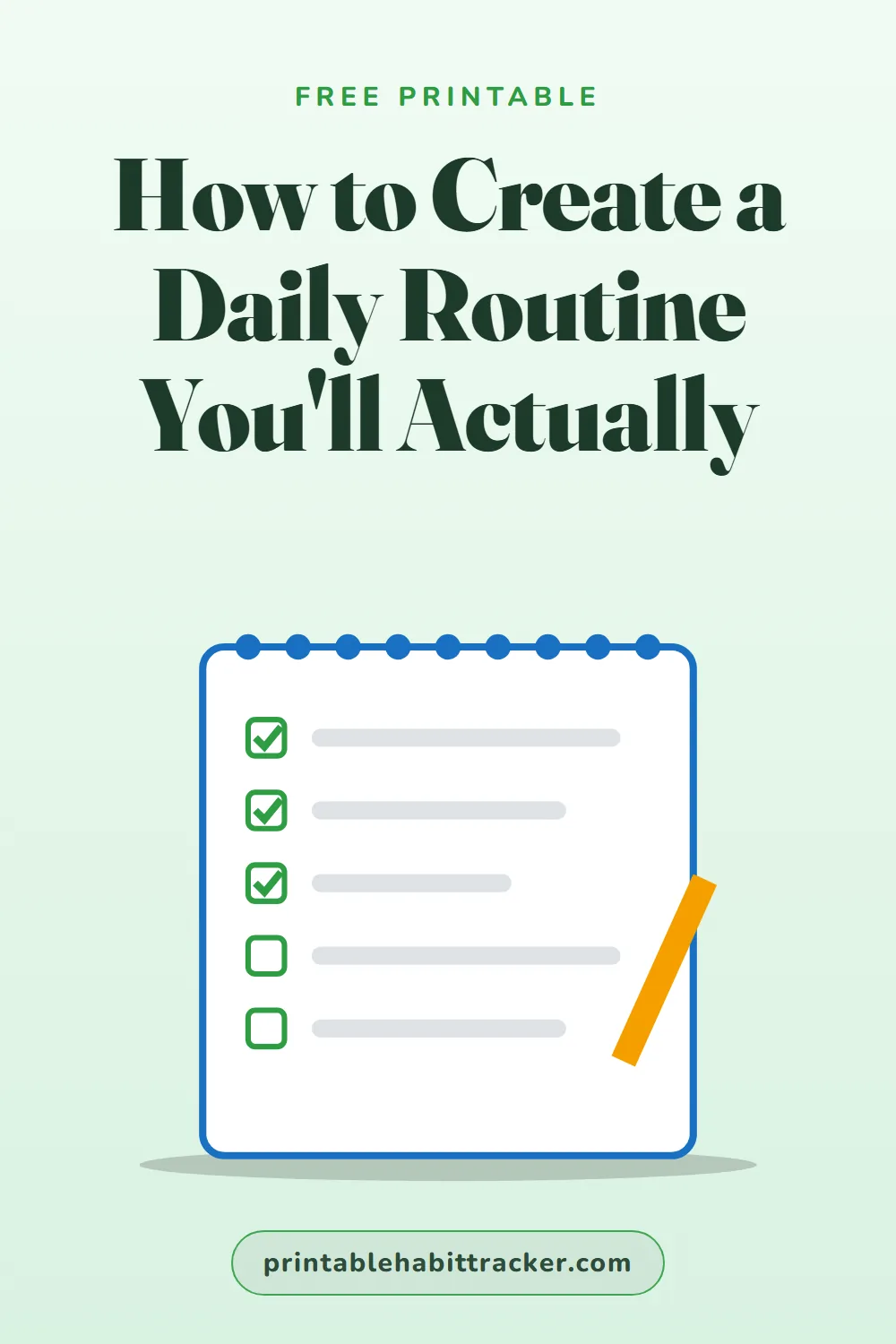
Here's a daily routine tracker with eight blocks. Tick each one you hit, change them to fit your day, then print it free:
✅ Try this tracker for one week
Tap a box each day you do the habit. Your ticks stay on this device.
How to create a daily routine in 6 steps
- Write down what your day looks like now. For two or three days, jot down when you wake, eat, work and sleep. You can't fix a routine you can't see.
- Set your anchors. Pick a wake time, meal times and a bedtime. These hold everything else in place. Try to keep them within about an hour on weekends.
- Build a short morning routine. Three to five steps, like water, get dressed, make the bed, breakfast and a quick plan. Our guide on how to build a morning routine goes deeper.
- Block your main time. Put your most important work or study in your best-energy hours. For most people, that's the morning.
- Add an evening routine. A 10-minute tidy, prep for tomorrow, then wind down without screens.
- Track and adjust. Tick each block for two weeks. If one keeps slipping, make it smaller or move it.
Daily routine template
| Block | Time | What goes here |
|---|---|---|
| Wake up | Same time daily | Light, water, no phone for the first few minutes |
| Morning routine | 20 to 45 minutes | Get ready, breakfast, plan the top three tasks |
| Focus block | 90 minutes to 3 hours | The most important work, school or project |
| Lunch break | 30 to 60 minutes | A real meal away from your desk |
| Movement | 20 to 30 minutes | A walk, a workout or stretching |
| Afternoon block | 2 to 3 hours | Emails, errands, meetings, lighter tasks |
| Dinner and family time | 1 to 2 hours | Cook, eat, talk |
| Evening reset | 10 to 15 minutes | Tidy, lay out tomorrow's things |
| Wind-down | 30 to 60 minutes | Read, stretch, screens off |
| Bedtime | Same time daily | Lights out |
Sample daily routines for adults
Office or hybrid worker
| Time | Routine |
|---|---|
| 6:30 | Wake, water, get ready |
| 7:00 | Breakfast, plan the day |
| 7:30 | Commute or a short walk |
| 8:30 | Focus block, notifications off |
| 12:00 | Lunch and a 15-minute walk |
| 1:00 | Meetings and email |
| 5:30 | Workout or errands |
| 6:30 | Dinner |
| 8:30 | Evening reset |
| 9:30 | Wind-down, read |
| 10:30 | Bed |
Stay-at-home parent with young kids
| Time | Routine |
|---|---|
| 6:00 | Wake before the kids, coffee or tea, five quiet minutes |
| 7:00 | Breakfast together |
| 8:00 | School drop-off or outside play |
| 9:30 | One household task |
| 12:00 | Lunch, then nap or quiet time; you rest or do a focus task |
| 3:00 | Snack and park or library |
| 5:00 | Dinner prep with kid helpers |
| 7:00 | Kids' bedtime routine |
| 8:00 | 10-minute reset, then your own time |
Work-from-home
Working from home makes a routine more important, not less. Get dressed for the day, start and stop work at set times, take a real lunch away from the desk, and "close the office" at the end of the day with a short walk. That walk is a fake commute, and it helps your brain switch off.
How to stick to a daily routine
- Start smaller than you think. A 3-step morning routine you keep beats a 12-step one you skip.
- Stack blocks onto anchors. "After breakfast, I plan my top three tasks."
- Prep the night before. Clothes out, lunch packed, bag by the door.
- Protect bedtime. Almost every routine falls apart after a late night.
- Plan for bad days. Write a "minimum routine": wake time, meals, bedtime. That's enough on hard days.
- Review weekly. Look at your chart on Sunday. Which block slipped most?
How long does it take for a routine to feel normal?
It's different for everyone and for every habit. Many people feel a new routine start to settle after a few weeks, and some habits take a couple of months. The first week often feels clunky. That's normal. The chart helps you see progress before it feels easy.
Weekday vs weekend routine
Keep your wake time and bedtime close on weekends, within about an hour. Let the middle of the day relax. A lot of people keep a "weekend routine" with just three blocks: same wake time, something active, and an evening reset to get ready for Monday.
Starting a new routine in January
A new year is a natural time for a fresh routine. Instead of changing everything on Friday, January 1, 2027, pick your anchors first. In week two, add a morning routine. In week three, add the evening reset. Building it in layers is slower, but much more likely to last. If you like the idea of habits that match who you want to be, see identity based habits.
Common mistakes
- Scheduling every minute. Leave buffer time between blocks.
- Copying someone else's 5 a.m. routine. Build around your life and energy.
- Ignoring the evening. A good morning starts the night before.
- Giving up after a messy day. Just start again at the next block.
How to print your daily routine tracker
- Open the free habit tracker maker with the button above. It opens in the weekly layout with the routine blocks.
- Edit the rows to your own blocks, up to 10.
- Add your times to the row names if you like, like "6:30 Up."
- Print it and keep it on your desk or fridge.
Want more detail on one part of the day? Try our morning routine tracker or the night routine tracker. When you're ready, open the free maker and print your routine.
Frequently Asked Questions
How do I create a daily routine?
Start with fixed anchors like wake time, meals and bedtime. Add a short morning and evening routine, block your main work or school time, and leave space for breaks. Track it for two weeks and adjust.
What is a good daily routine for adults?
A simple one: wake at the same time, a short morning routine, focused work in the morning, a real lunch break and a short walk, lighter tasks in the afternoon, dinner, an evening reset and a regular bedtime.
How long does it take to get used to a new routine?
It varies a lot by person and habit. Many people feel a new routine settle in after a few weeks, but some habits take longer. Keep going even when it feels clunky.
Should my routine be the same every day?
Your anchors (wake time, bedtime, meals) work best when they're mostly the same, even on weekends. The middle of the day can flex. Many people keep a weekday and a weekend version.
What should be in a daily routine template?
Wake time, a morning routine, main work or school blocks, meals, movement, an evening reset, wind-down time and bedtime. Check off each block as you go.