30 Day Jump Rope Challenge: A Beginner Plan and Printable Tracker
A 30 day jump rope challenge is a simple plan to jump rope a little every day for a month, starting with short rounds and building up. For beginners, that usually means starting with about five rounds of 30 seconds of jumping and 30 seconds of rest, and working up to 1-minute rounds by the end of the month. It's a great indoor workout for winter, and if you start on Friday, January 1, 2027, you'll finish on Saturday, January 30.
Here's a jump rope tracker for the month. Color a box each day you jump, then print it free:
✅ Try this tracker for one week
Tap a box each day you do the habit. Your ticks stay on this device.
Before you start
- Check with your doctor first if you have a heart or lung condition, joint pain, are pregnant, or haven't exercised in a long time.
- Wear sneakers with good cushioning.
- Pick a good surface: a gym floor, a wood floor, a rubber mat or smooth concrete. Skip carpet (the rope catches) and slippery tile.
- Check the ceiling height if you're indoors. Basements and garages often work well.
- Size your rope: stand on the middle with one foot. The handles should reach about your armpits.
The 30-day jump rope plan for beginners
Each round is jumping, then the same time resting, unless it says otherwise. Sundays are easy days.
| Days (2027) | Plan | Total jumping |
|---|---|---|
| Days 1 to 2 (Jan 1 to 2) | 5 rounds of 30 seconds | 2.5 minutes |
| Day 3 (Sun Jan 3) | Easy day: 3 rounds of 30 seconds, then stretch | 1.5 minutes |
| Days 4 to 9 (Jan 4 to 9) | 6 rounds of 30 seconds | 3 minutes |
| Day 10 (Sun Jan 10) | Easy day: practice the basic bounce slowly | 2 minutes |
| Days 11 to 16 (Jan 11 to 16) | 6 rounds of 45 seconds, 30 seconds rest | 4.5 minutes |
| Day 17 (Sun Jan 17) | Easy day: try the alternate-foot step | 2 minutes |
| Days 18 to 23 (Jan 18 to 23) | 8 rounds of 45 seconds, 30 seconds rest | 6 minutes |
| Day 24 (Sun Jan 24) | Easy day: 4 rounds of 30 seconds | 2 minutes |
| Days 25 to 29 (Jan 25 to 29) | 6 rounds of 1 minute, 30 seconds rest | 6 minutes |
| Day 30 (Sat Jan 30) | Test day: jump as long as you comfortably can, then compare with day 1 | Your choice |
Starting on a different day? Just number the boxes 1 to 30 and follow the same plan. If a week feels too hard, repeat it before moving on. That's not falling behind; that's doing it right.
Kids jump rope challenge
For kids, counting jumps is more fun than a timer. Here's a simple version:
| Week | Daily goal | Bonus skill |
|---|---|---|
| Week 1 | 20 jumps (stopping is fine) | Jump with feet together |
| Week 2 | 40 jumps | 10 in a row without stopping |
| Week 3 | 60 jumps | Hop on one foot 5 times |
| Week 4 | 100 jumps | Jump backward (rope swings from front) |
A grown-up can count out loud, or kids can sing a jump rope rhyme. Keep it on a flat, dry surface, and give everyone plenty of room.
How to jump rope: the basic bounce
- Hold the handles at hip height, elbows close to your sides.
- Turn the rope with your wrists, not your whole arms.
- Jump just high enough to clear the rope, about an inch or two.
- Land softly on the balls of your feet with knees a little bent.
- Keep your eyes forward and breathe steadily.
Can't get the rhythm yet? Practice the jump without the rope, then swing the rope to one side while you jump. Put them together when the timing feels right.
Jump rope moves to add later
- Alternate foot step: like jogging in place over the rope.
- Side to side: small hops left and right.
- Boxer step: shift your weight from one foot to the other.
- High knees: a harder version of the alternate step.
Warm-up and cool-down
Before jumping, march in place, roll your ankles and shoulders, and do a few slow calf raises for about three minutes. After, stretch your calves, the fronts of your thighs and your shoulders. Drink some water. Your calves will probably feel it in the first week, which is normal. Sharp pain isn't: stop, rest and check with your doctor if it doesn't go away.
Common beginner mistakes
- Jumping too high. An inch or two is enough.
- Using your arms, not your wrists. Big arm circles tire you out fast.
- Doing too much in week 1. Sore calves can stop the challenge on day 3.
- The wrong rope length. Too long and it drags, too short and it hits your head.
- Landing flat-footed. Stay on the balls of your feet.
Why a 30-day challenge works
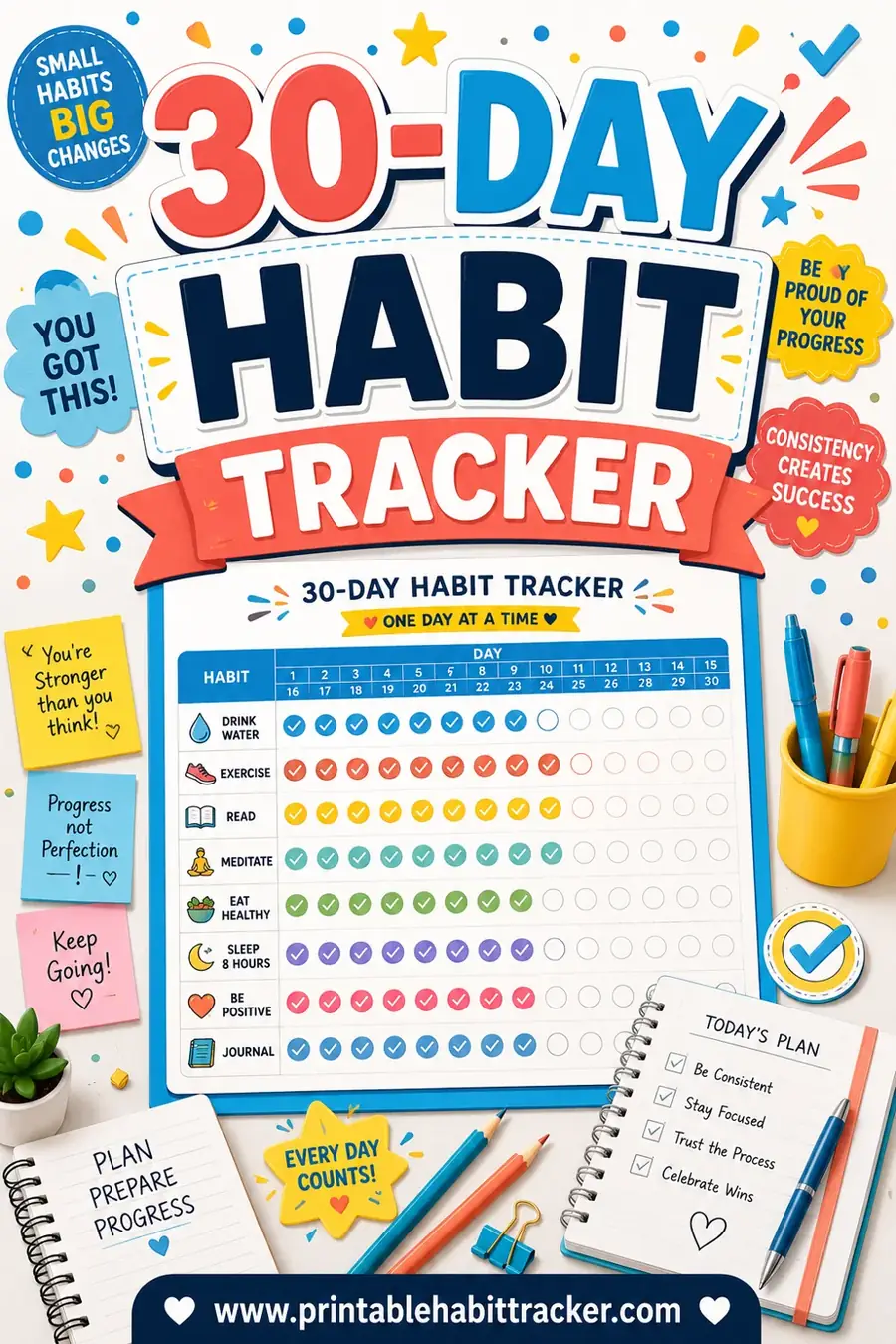
A month is long enough to feel real progress and short enough to commit to. The streak on your chart becomes its own reason to keep going. If you like the format, our guide on how to do a 30-day challenge has more tips, and the 30-day habit tracker works for any goal.
How to print your jump rope tracker
- Open the free habit tracker maker with the button above. It opens in the monthly color-in layout.
- Pick January 2027 if you're starting on New Year's Day.
- Keep the rows or add your own, like "Learned a new move."
- Print it and tape it near where you jump.
Want to track more workouts after the month? Use our fitness habit tracker or the workout tracker. When you're ready, open the free maker and print your challenge.
Frequently Asked Questions
Is a 30 day jump rope challenge good for beginners?
Yes, if you start small. Begin with short rounds, like 30 seconds of jumping and 30 seconds of rest, and build up slowly over the month. Check with your doctor first if you have health conditions or joint pain.
How long should I jump rope each day as a beginner?
Five to ten minutes in total, split into short rounds with rest, is plenty to start. You can add a round or a few seconds each week.
What size jump rope do I need?
Stand on the middle of the rope with one foot. For most beginners, the handles should reach about your armpits. Kids need a shorter rope than adults.
Can kids do a jump rope challenge?
Yes. Kids can count jumps instead of timing rounds: 20 jumps on day 1, then a few more each day. Jump on a flat, non-slip surface with sneakers on.
What if I miss a day?
Just pick up where you left off. The chart has rest days built in, and missing one day won't undo your progress.