Atomic Habits Summary: The 4 Laws Made Simple
Atomic Habits by James Clear argues that big results come from tiny, repeated improvements, not dramatic overhauls. The core idea is that getting 1% better every day compounds into massive change over time, and that the smartest way to change your habits is to design your environment and systems rather than rely on willpower. Clear boils it all down to four laws: make a good habit obvious, attractive, easy, and satisfying. One of the most practical tools the book recommends is habit tracking.
Want to put the book into action right now? Open the free habit tracker, add a habit, and print a clean grid to start making your habits "satisfying" today. No sign-up, no cost.
The Big Idea: 1% Better Every Day
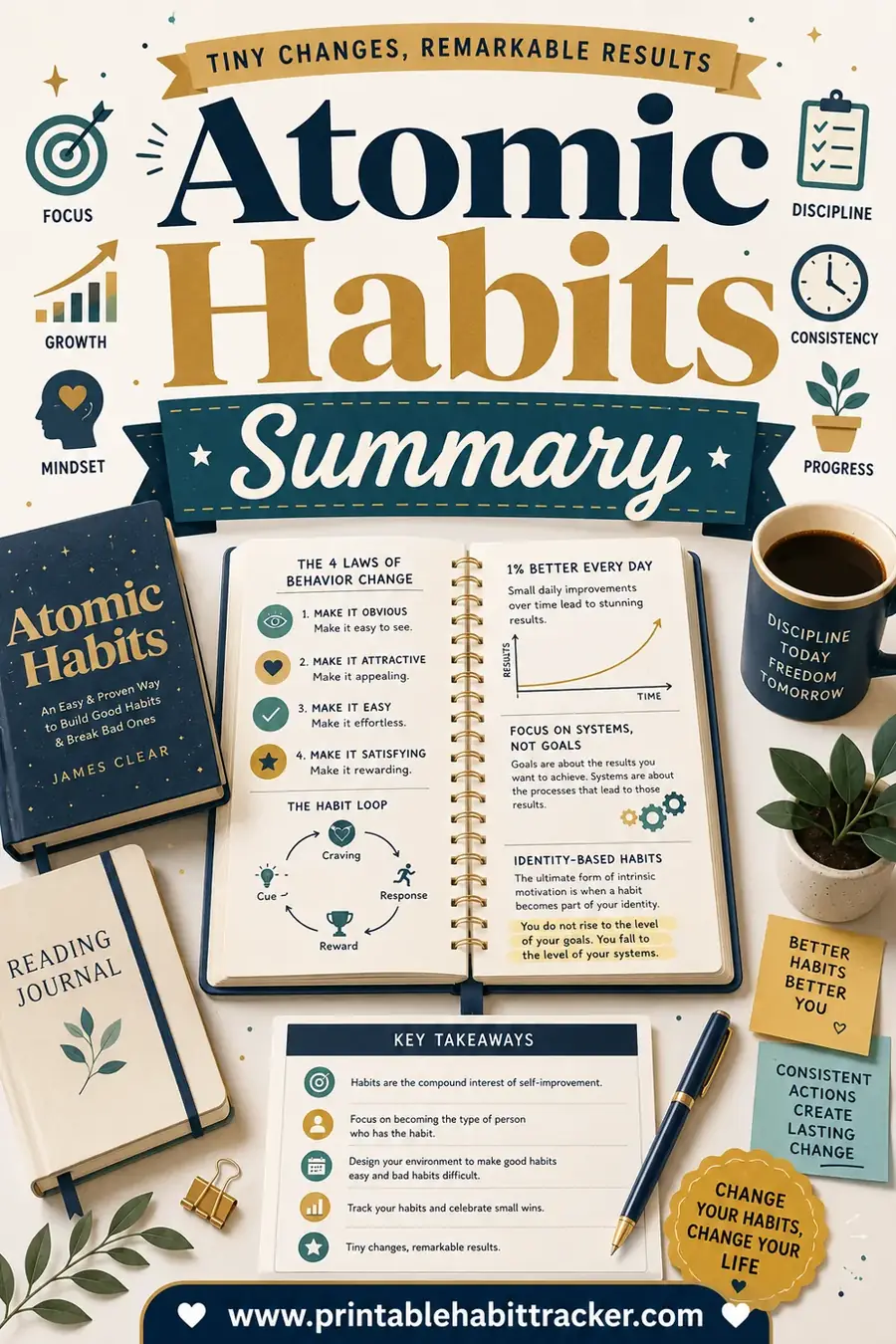
The heart of Atomic Habits is the power of small improvements. James Clear points out that getting just 1% better each day doesn't feel like much in the moment, but it compounds. Do the math over a year and a 1% daily improvement makes you roughly 37 times better by the end. Slide 1% backward each day, and you nearly drop to zero.
The lesson is that habits are the compound interest of self-improvement. A single workout won't transform your body. A single page won't make you well-read. But repeated daily, those tiny actions stack into huge results. Clear calls them "atomic" habits because they're small, like atoms, yet they're the building blocks of remarkable change.
This reframes how you should think about goals. Instead of chasing one giant transformation, you focus on showing up for small habits consistently and letting time do the heavy lifting.
Forget Goals, Focus on Systems
One of the book's most quoted lines is: "You do not rise to the level of your goals. You fall to the level of your systems."
Clear's point is that everyone has goals. The winners and losers of a race share the same goal of finishing first. What separates them is their systems, the daily processes they follow. So instead of obsessing over the outcome you want, you should design a good system and trust it to deliver results.
A habit tracker is a perfect example of a system. You're not just hoping to "be healthier," you're running a daily process: do the habit, mark the box, repeat. The outcome takes care of itself when the system is solid.
Identity-Based Habits
Here's an idea from the book that quietly changes everything: the most lasting habits aren't about what you want to achieve, they're about who you want to become.
Clear describes three layers of change:
- Outcomes — what you get (losing weight, a finished book).
- Processes — what you do (your routines and habits).
- Identity — what you believe about yourself.
Most people start with outcomes. Clear says you should start with identity. Don't aim to "read a book," aim to "become a reader." Each time you act in line with that identity, you cast a vote for it. Marking a box on your tracker is a small piece of evidence: "I am the kind of person who shows up."
This is why tracking feels so motivating. Every checked box is proof of the identity you're building, not just a task you completed.
The Habit Loop: How Habits Work
Before giving you the four laws, Clear explains the four-step loop behind every habit. Understanding it makes the laws click into place.
| Step | What it is | Example |
|---|---|---|
| Cue | The trigger that starts the habit | You wake up |
| Craving | The desire or motivation behind it | You want to feel alert |
| Response | The actual habit you perform | You drink a glass of water |
| Reward | The satisfaction you get | You feel refreshed |
Every habit, good or bad, runs through this loop: cue, craving, response, reward. The genius of the book is that the four laws map directly onto these four steps, giving you a lever for each one.
The 4 Laws of Behavior Change
This is the practical core of Atomic Habits. To build a good habit, run it through these four laws.
Law 1: Make It Obvious (the cue)
You can't do a habit you forget about. So make the cue impossible to miss.
- Design your environment. Put the running shoes by the door, the book on your pillow, the fruit on the counter.
- Use habit stacking. Attach a new habit to an existing one: "After I pour my coffee, I write one line in my journal."
- State your intention. Decide in advance: "I will meditate for five minutes at 7am in the living room."
Law 2: Make It Attractive (the craving)
We repeat things we look forward to. So make the habit appealing.
- Pair it with something you enjoy. Only listen to your favorite podcast while exercising (temptation bundling).
- Join a group where your habit is normal. We copy the people around us, so surround yourself with the behavior you want.
Law 3: Make It Easy (the response)
The easier a habit is, the more likely you'll do it. Reduce friction.
- Start tiny. Use the "two-minute rule": shrink any habit to something you can do in two minutes. "Read before bed" becomes "read one page."
- Remove obstacles. Lay out your gym clothes the night before so there's nothing in your way.
Law 4: Make It Satisfying (the reward)
We repeat what feels good. So give yourself an immediate sense of reward.
- Track your habits. This is the big one. Marking a box gives instant satisfaction and visible proof of progress.
- Never miss twice. One slip is fine. Just get back on track the next day so the habit survives.
That fourth law is exactly where a habit tracker earns its keep, which we'll cover next.
Why Atomic Habits Loves Habit Trackers
Clear devotes real attention to habit tracking, and it's no accident. A tracker hits the fourth law directly: it makes the habit satisfying. But it actually delivers on three fronts at once.
- It's obvious. A tracker on your fridge is a built-in cue. Seeing it reminds you to do the habit.
- It's attractive. A growing streak is motivating. You start to crave the feeling of adding another mark.
- It's satisfying. The act of marking a box is a small, immediate reward, and it gives you visible proof you're moving forward.
Clear's famous advice here is "don't break the chain." Each marked day adds to a streak you won't want to ruin. That simple visual pull keeps people going long after motivation fades.
The best part is that you don't need anything complicated. A printable grid does everything the book describes. The free habit tracker lets you print one in seconds, so you can apply the fourth law starting today.
How to Apply Atomic Habits Starting Today
Reading the book is one thing. Here's how to actually use it this week.
| Law | One thing to do today |
|---|---|
| Make it obvious | Put a cue in plain sight (shoes by the door, tracker on the fridge) |
| Make it attractive | Pair the habit with something you enjoy |
| Make it easy | Shrink the habit to a two-minute version |
| Make it satisfying | Start a habit tracker and mark your first box |
Pick one small habit, run it through these four laws, and track it daily. That's the whole book in practice. Pair it with a realistic timeline, since habits take weeks to months to settle in, which you can read about in how long it takes to build a habit.
What About Breaking Bad Habits?
Clear flips the four laws to break bad habits, too. To stop a habit, you do the opposite:
- Make it invisible. Remove the cue. Hide the snacks, delete the app.
- Make it unattractive. Reframe it. Focus on what the bad habit costs you.
- Make it difficult. Add friction. Unplug the TV, log out of the site.
- Make it unsatisfying. Add a cost. Tell a friend, or use an accountability partner.
It's the same loop, simply reversed. Make good habits easy and bad habits hard, and you stack the deck in your favor.
Frequently Asked Questions
What is the main message of Atomic Habits?
That small habits, repeated consistently, lead to big results over time. James Clear argues you should focus on tiny 1% improvements and good daily systems rather than dramatic goals or willpower. Build habits around the identity you want, and let small actions compound.
What are the 4 laws of Atomic Habits?
Make it obvious, make it attractive, make it easy, and make it satisfying. Each law targets one part of the habit loop (cue, craving, response, reward). To break a bad habit, you flip them: make it invisible, unattractive, difficult, and unsatisfying.
What is the 2-minute rule in Atomic Habits?
It's a way to make habits easy by shrinking them to a two-minute version. "Do yoga" becomes "roll out the mat." "Read a chapter" becomes "read one page." The idea is to make starting effortless, since showing up is the hardest part.
Why does Atomic Habits recommend habit tracking?
Because tracking makes a habit satisfying, the fourth law of behavior change. Marking a box is an instant reward and visible proof of progress, and a growing streak motivates you to keep going. A printable tracker is a simple, effective way to do exactly this.
Does the 1% better idea really work?
Mathematically, small daily gains compound dramatically. Improving 1% a day makes you roughly 37 times better over a year. The point isn't the exact number, it's that consistency beats intensity, and tiny habits add up to major change when repeated.
How do I start using Atomic Habits today?
Pick one small habit, then run it through the four laws: put a cue in plain sight, pair it with something enjoyable, shrink it to two minutes, and track it daily. Start a habit tracker and mark your first box to lock in that satisfying fourth law.
Ready to Put Atomic Habits Into Action?
That's the Atomic Habits summary: tiny 1% gains compound, systems beat goals, and the four laws (obvious, attractive, easy, satisfying) make change stick. The single most practical step the book recommends is to track your habits, because it makes them satisfying and turns progress into a streak you'll protect. Open the free habit tracker, add a habit, and print a clean grid to start today. It's free, there's no sign-up, and your first box is one tap away.
Keep going: learn how to use a habit tracker day to day, get the truth on the 21/90 rule, or see how long it really takes to build a habit.