Free Printable Chore Charts for Adults: Grown-Up Charts That Work
Free printable chore charts for adults are the same honest grid that works for kids — chores down the side, days across the top, a box checked per job done — minus the cartoon frogs and plus the problems grown-ups actually have: invisible labor in couples, roommate standoffs over the dishes, and the executive-function tax of running a home solo. Nobody outgrows the need for a visible system; we just stop being given one. The fastest way to build yours is the free printable habit tracker builder: type your chores, pick a layout and a theme that doesn't look like a kindergarten wall, and print.
Want one before the sink fills up again? Open the free builder, list the chores one per line, choose weekly or monthly, pick a clean theme like Sage or Classic, and hit print. No sign-up, no watermark.
Why Adults Need Chore Charts (Maybe More Than Kids Do)
Kids have parents running their chore system. Adults have... vibes. And vibes produce three predictable failures a printed chart fixes:
- The invisible-labor problem. In most shared homes, one person carries the mental list — what needs doing, when, by whom — and that carrying is itself unpaid work nobody sees. A chart moves the list out of one partner's head and onto the wall, where it becomes everyone's.
- The "I did it last time" problem. Memory is self-serving; paper isn't. When the boxes show who scrubbed the bathroom the last three Saturdays, the conversation changes from dueling recollections to a fifteen-second glance.
- The executive-function problem. Living alone doesn't mean chores organize themselves. For busy people — and especially for ADHD adults — "just remember to clean" is the whole problem. A chart at eye level replaces remembering with seeing.
There's also the quiet motivational truth adults don't like admitting: checking a box feels good at 38 exactly like it did at 8. Use that. It's free.
What Goes on an Adult Chore Chart
Adult chores split into dailies, weeklies, and the deep-cycle jobs that ambush you quarterly. The grid handles all three — dailies get checked every day, scheduled jobs carry their day in the row name. Copy this starter set into the builder:
| Frequency | Chores | Row-name tip |
|---|---|---|
| Daily | Kitchen reset (dishes + counters), 10-min tidy, mail & papers processed | Keep to 2–3 dailies max |
| Weekly | Laundry, bathroom clean, floors, sheets, groceries, trash & recycling out, plants | Name the day: "Bathroom — Sat" |
| Monthly-ish | Fridge purge, oven, car clean-out, filing, budget review | Park on the monthly layout |
| Seasonal | Filters, gutters, wardrobe swap, deep-clean one room | "(Q)" tag, monthly sheet |
The "kitchen reset" trick deserves a note: bundling dishes-counters-sink into one named routine turns three nagging micro-chores into one satisfying checkable unit. Adults respond to well-named rows — "10-minute tidy" gets done on days "clean the living room" wouldn't be touched.
For shared homes: rows carry names too
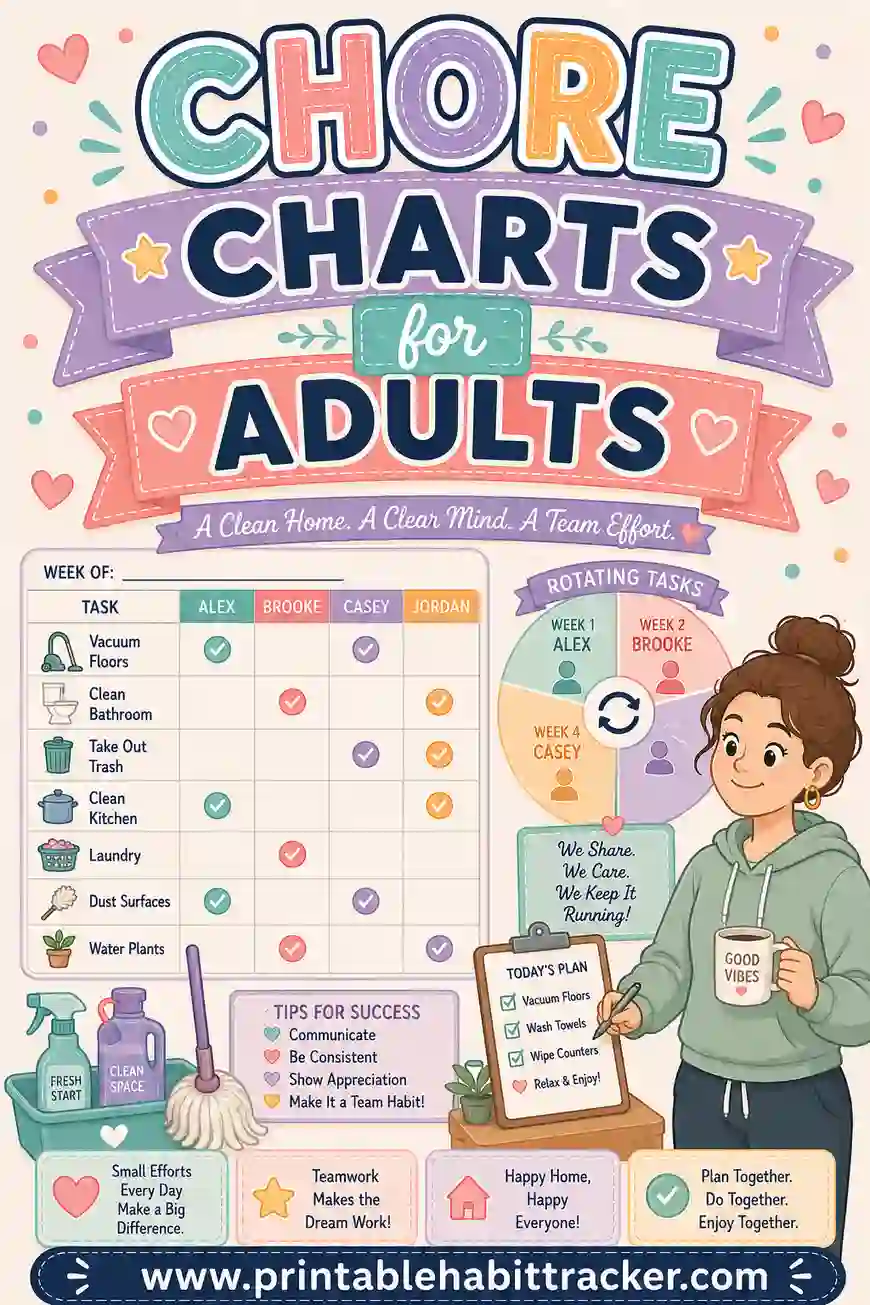
"Dishes — Sam (M/W/F), Alex (T/Th/Sa)." Or give each person their own chart. Or — cleanest of all — turn on color-coding so each person's chores print in their color with a key at the bottom. One glance settles whose Tuesday it is.
How to Make an Adult Chore Chart in 4 Steps
- List what actually needs doing. In the free builder, type each chore one per line, days and names included. Do this with your partner or housemates present — the negotiation is the system's foundation.
- Pick your layout. Weekly for the standing routine; monthly for a real date grid that catches the deep-cycle jobs; yearly if you want twelve months of "did the filters get changed?" visible on one page.
- Choose an adult-looking style and theme. Checkboxes, Classic or Sage theme, portrait or landscape. It'll look like it belongs in a home office, not a preschool — which matters more than it should for whether you'll actually hang it up.
- Print or save as PDF. Letter or A4. Print the month, or tick "Print all 12 months" and be set until next year. Your chart saves locally in your browser, so rebalancing rows after a house meeting takes a minute.
Adult Chore Chart Setups That Work
The couples' split
One shared weekly chart, color-coded per person, posted where you both pass daily. The chart's real gift to couples isn't enforcement — it's that the full list becomes visible to both people, usually for the first time. Many couples discover the split was 70/30 when both would've guessed 55/45. Rebalance the rows, reprint, and revisit monthly.
The roommate rotation
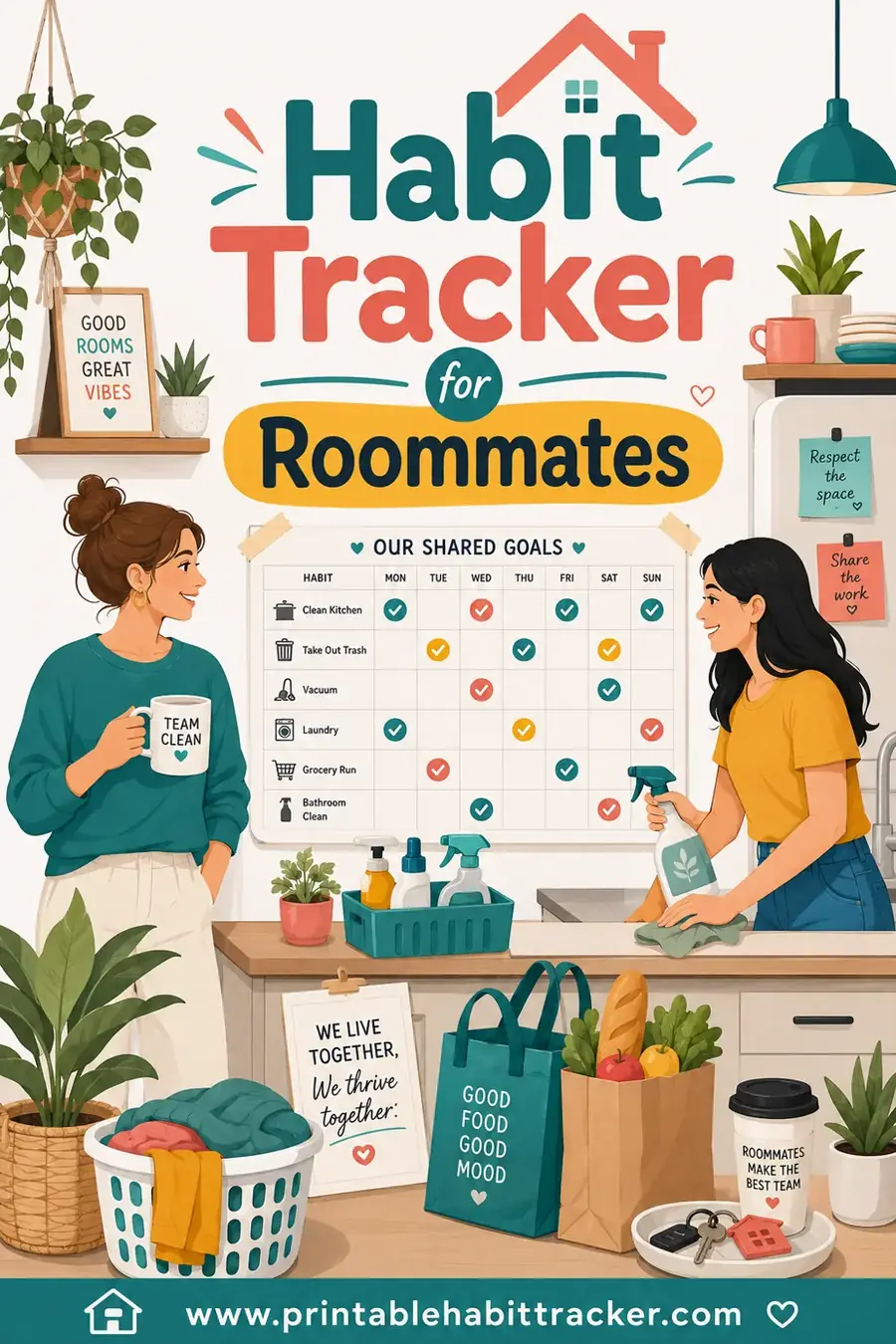
Rotating rows beat permanent assignments — nobody owns toilet duty for life. Week one: Sam has kitchen, Alex has bathroom; week two, swap. Keep the chart saved in the browser and the Sunday swap is a one-minute edit. Pair it with a house-meeting rhythm and you've solved 80% of roommate friction; the roommates tracker guide goes deeper.
The solo operator
Living alone, the chart is a kindness to future-you: two daily rows, four weekly rows with named days, and suddenly Saturday isn't a guilt-fog of "I should clean" — it's two specific boxes. Add a reward box that means it: "Full week = takeout Friday, zero guilt."
The ADHD-friendly board
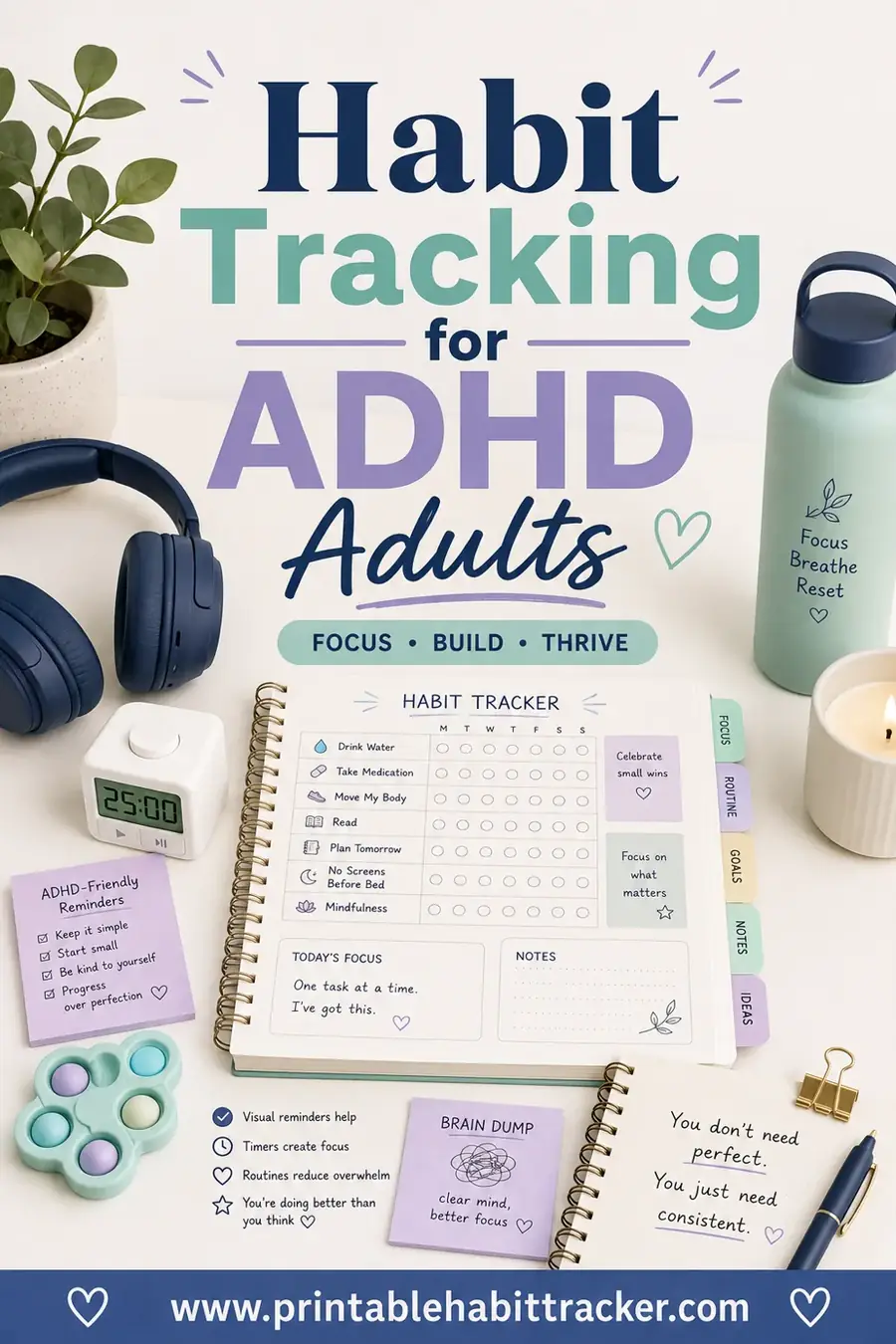
Fewer rows, bigger squares (the color-in style), one chore visible per time-of-day, posted exactly where the task happens — laundry row above the hamper, kitchen row on the cabinet. Out of sight is out of existence, so make the chart the sight. The ADHD adults guide covers the fuller toolkit; the chart is its load-bearing wall.
A Sample Adult Chore Chart, Filled In
A realistic week for a two-person household — copy it into the builder and rebalance for yours:
| Chore | Mon | Tue | Wed | Thu | Fri | Sat | Sun |
|---|---|---|---|---|---|---|---|
| Kitchen reset — alternate | J | A | J | A | J | A | J |
| 10-min tidy — both | ✓ | ✓ | ☐ | ✓ | ☐ | ✓ | ✓ |
| Laundry — A (Wed) | ✓ | ||||||
| Bathroom — J (Sat) | ✓ | ||||||
| Floors — A (Sat) | ☐ | ||||||
| Trash out — J (Tue/Fri) | ✓ | ✓ | |||||
| Plants — A (Sun) | ✓ |
Initials instead of checkmarks make the alternating rows self-documenting. Notes box: "Floors skipped — moved to Sun. Swap laundry/bathroom next month?" That note is a house meeting that took nine words.
Running the Chart Like a Grown-Up
- Anchor the marking to an existing moment. After dinner, with the kettle on, whenever you feed the cat. Charts die from forgotten marking, not forgotten chores.
- Hold a five-minute weekly reset. Sunday evening: glance at the week, note what got skipped, swap any rows, wipe or reprint. This tiny ritual is the difference between a system and a poster.
- Track effort, not perfection. A 70% week in a busy season is a win. The chart exists to keep the house functional and the resentment low — not to gamify yourself into burnout.
- Renegotiate without drama. When a row keeps going unchecked, the row is wrong — wrong person, wrong day, wrong size. Edit it. Paper is cheap; resentment isn't.
- Let it be satisfying. Yes, you're an adult using a chore chart. You're also the adult whose sink is clean and whose Saturday is free. Check the box with pride.
Printing Tips
- Laminate the weekly chart and run it with a dry-erase marker — the Sunday wipe-clean is faster than reprinting and oddly satisfying.
- Classic or Sage themes read "home office," not "homework." Landscape fits rows with names and days.
- Print all 12 months in January for the monthly deep-cycle chart — a year of household management, one print job.
- Post it where the work happens — kitchen for the kitchen chart, hallway for the shared board. A chart in a drawer is a to-do list in witness protection.
- Print a spare for the first month; new systems survive on low friction.
Common Mistakes on Adult Chore Charts
- Transplanting a kid-chart's tone. Star stickers and smiley faces make adults quietly abandon the system. Clean grid, real chores, adult theme.
- Listing every chore you can imagine. Fifteen rows is a fantasy of the person you'll be someday. Eight rows of the person you are beats it every week.
- Using the chart as a scorekeeping weapon. In couples, the chart informs the conversation; it doesn't win arguments. The moment it becomes evidence-for-the-prosecution, it stops getting filled in at all.
- No named days on weekly chores. "Bathroom — sometime" becomes "bathroom — never." Every weekly row gets a day.
- Quitting after a skipped week. Vacations and crunch weeks happen. The chart isn't disappointed in you; it's paper. Reprint and resume.
Frequently Asked Questions
Are the chore charts for adults really free to print?
Yes — completely. The builder has no sign-up, no account, and no watermark. Build your chart, print it or save it as a PDF, and reprint printable chore charts for adults as often as your household changes.
What's the best chart setup for roommates?
One shared weekly grid with rotating rows and color-coding per person, plus a five-minute Sunday reset to swap assignments. Rotation kills the "why is this always my job" resentment that sinks fixed splits.
How is an adult chore chart different from a cleaning schedule?
A cleaning schedule says when things should happen; a chore chart records whether they did. The grid does both at once — days in the row names supply the schedule, checkmarks supply the accountability. It's the follow-through half that most printable cleaning schedules are missing.
Can I combine chores with personal habits on one sheet?
Absolutely — rows are rows. Plenty of adults run "gym," "read 20 min," and "kitchen reset" on the same weekly grid. If the habits outnumber the chores, you've drifted into general chore chart and habit-tracker territory, and one sheet is still fine.
My partner won't use a chart. Now what?
Start with a chart that only tracks your chores, posted visibly. No lecture, no assignment — just your own boxes filling up. In a surprising number of homes, the second column appears within a month. Visible systems recruit better than arguments do.
Ready to Print Your Chore Chart?
List the eight chores that actually run your home, open the free chore chart builder, give each weekly job a named day, pick a theme you'd let guests see, and print. It's free, it takes five minutes, and the next "did anyone take the trash out?" can be answered by a wall instead of a debate. Grown-up problems, kindergarten-simple fix.