Good Behavior Chart Printable: Free Custom Charts That Focus on Wins
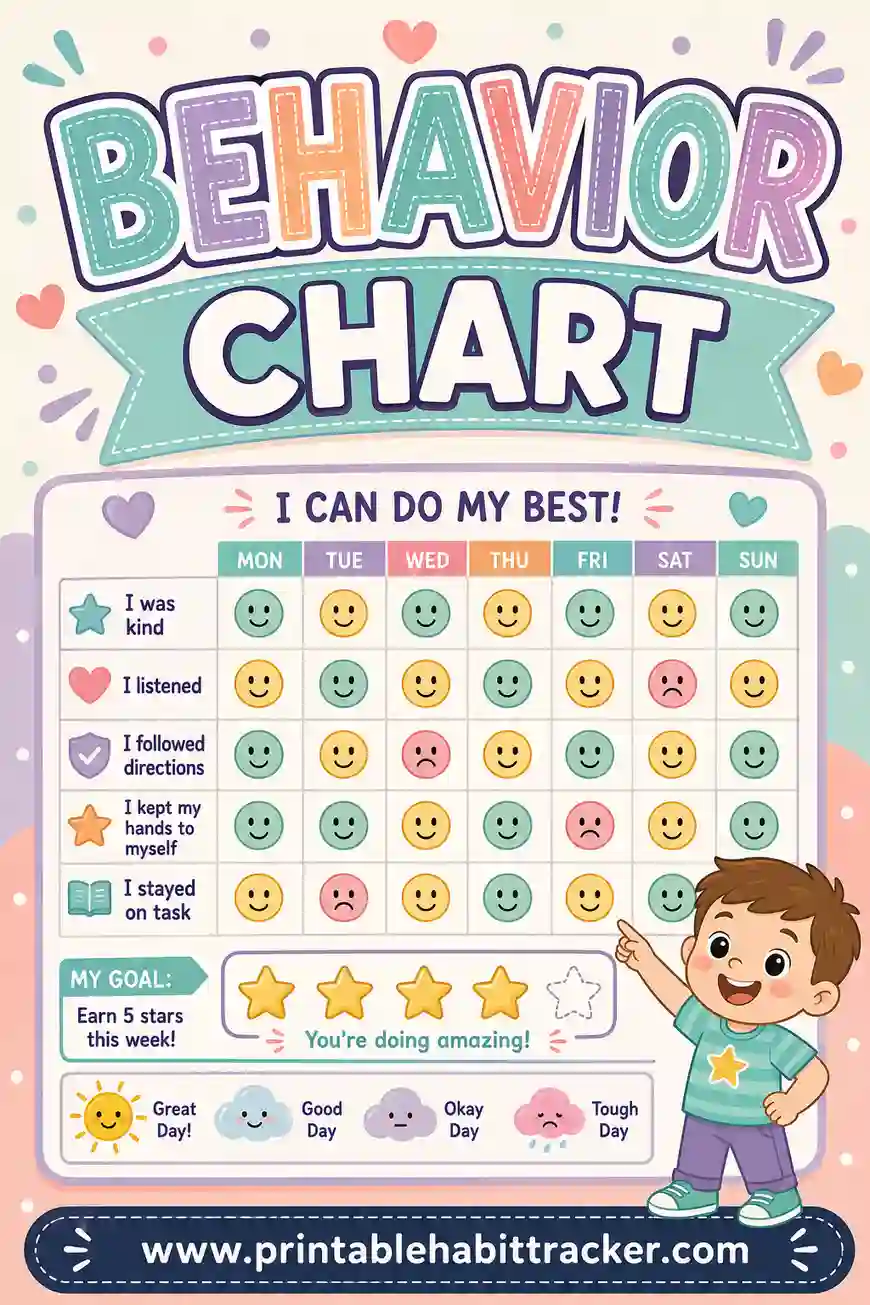
A good behavior chart printable is a simple grid that catches your child doing things right: the positive behaviors you want to see listed down the side, days of the week across the top, and a box to check or sticker every time it happens. Unlike charts that log problems, this one only tracks wins — which is exactly why it works. The fastest way to get one is with a free printable habit tracker builder — type in the behaviors you want to grow, pick a layout, and print a chart made for your kid.
Want one right now? Open the free builder, type each good behavior on its own line, choose the weekly layout and big color-in squares, and hit print. No sign-up, no watermark, and a fresh chart every Sunday costs nothing.
What Is a Good Behavior Chart?
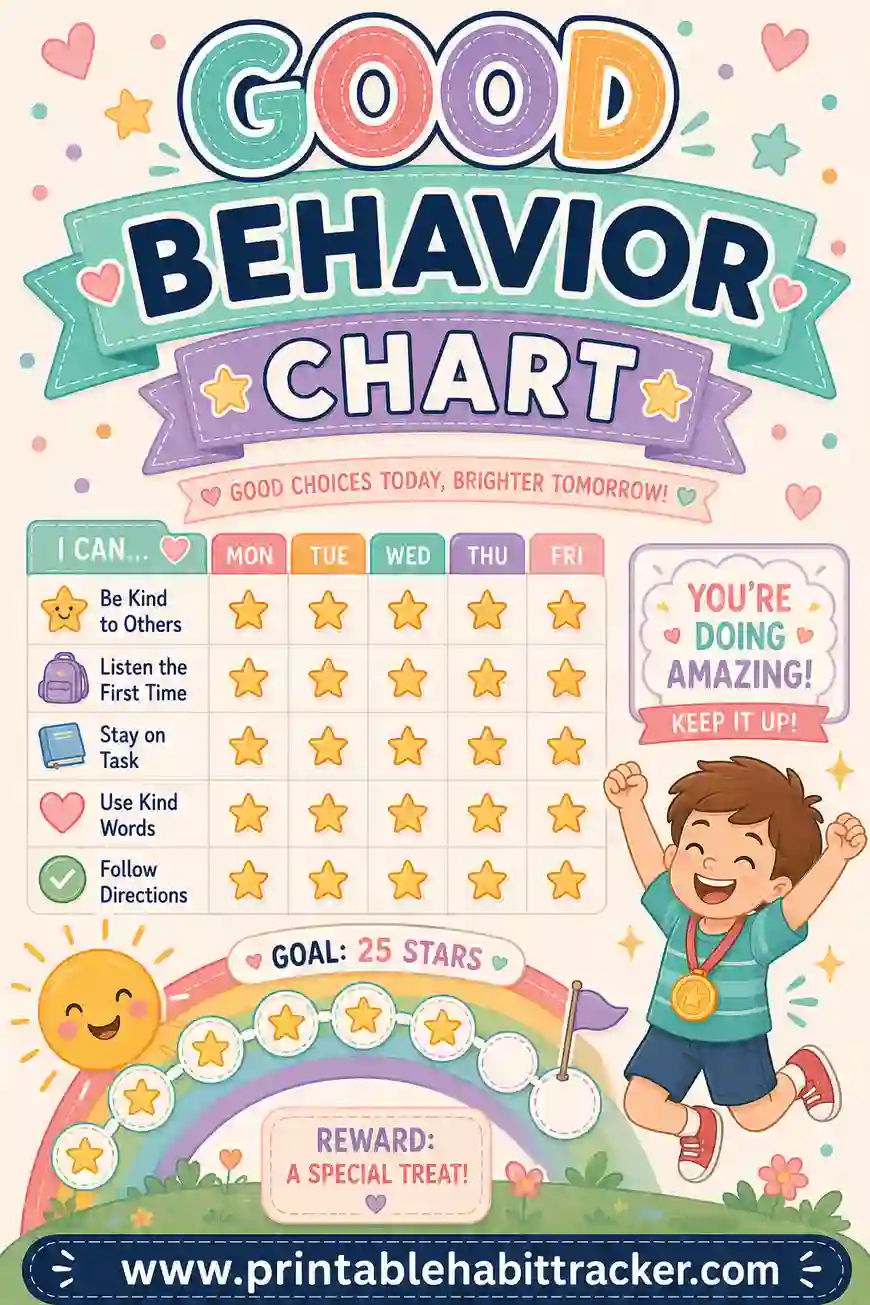
It's a scoreboard where the only thing that scores is the good stuff. Each row names a positive behavior — "used kind words," "listened the first time," "shared with your sister" — and every time it happens, the box for that day gets a check, a sticker, or a colored-in square.
The word good is doing real work in that name. A general behavior chart sometimes tracks problems ("no hitting," "didn't interrupt"), and those charts have their place. But a good behavior chart flips the frame entirely: it never mentions the problem behavior at all. It names what you want instead and makes that the thing your child gets noticed for.
Because you build it yourself in the free tool, the rows match the behaviors your family is actually working on this month — not a generic template's guesses.
Why Tracking Good Behavior Beats Punishing Bad
This isn't just feel-good parenting talk — it's how attention works with kids.
- Attention is the reward, whatever you attend to. Kids repeat what gets noticed. If misbehavior gets the big reactions, misbehavior wins. A chart forces the spotlight onto the good moments.
- "Don't" is hard to picture. "Stop yelling" gives a child nothing to do. "Used an inside voice" is a concrete action they can succeed at — and check off.
- Wins build identity. A row of checkmarks next to "helped without being asked" slowly becomes "I'm a helpful kid." That self-image outlasts any sticker.
- **It cools you down too.** On hard days, the chart reminds you to hunt for one good moment. That changes the whole evening's temperature.
The chart isn't a bribe machine. It's a noticing machine — and being genuinely noticed is what most kids are after in the first place.
Good Behaviors to Put on the Chart, by Age
The right rows are specific, positive, and doable today. Copy these into the builder and adjust:
| Age | Good behavior rows | How many |
|---|---|---|
| 2–3 | Gentle hands, helped tidy up, said please | 1–2 |
| 4–5 | Used kind words, shared a toy, listened first time, stayed in bed | 2–3 |
| 6–8 | Helped without being asked, told the truth, was patient, finished homework calmly | 3–4 |
| 9–12 | Spoke respectfully, resolved a fight with words, kept a promise, helped a sibling | 3–5 |
Phrase every row as the thing you WANT
This is the golden rule of a good behavior chart. Not "no whining" but "asked in a big-kid voice." Not "no hitting" but "gentle hands all day." The chart should read like a list of wins waiting to happen — because for your child, checking a "no" box feels like being reminded of the crime, while checking a "did" box feels like a trophy.
How to Make a Good Behavior Chart Printable in 4 Steps
- Pick two or three behaviors. Just the ones you're working on right now. In the free builder, type each on its own line and put your child's name in the chart title.
- Choose the weekly layout. Behaviors down the side, Mon–Sun across the top. One week is the right horizon for a young child — long enough to build a pattern, short enough to feel winnable.
- Pick a style your kid will love. Big color-in squares are perfect for little ones (they scribble the box in), checkboxes suit older kids, and every square fits a standard small sticker. Choose a bright theme, or Classic black-and-white they can decorate.
- Add the reward box and print. Write the week's goal in it — "15 checks = park picnic Saturday." Letter or A4, one clean page.
Make one per child and hang them side by side. Turn on color-coding if you'd rather run one shared family chart with each kid's rows in their own color, printed with a key.
Chart Styles That Work
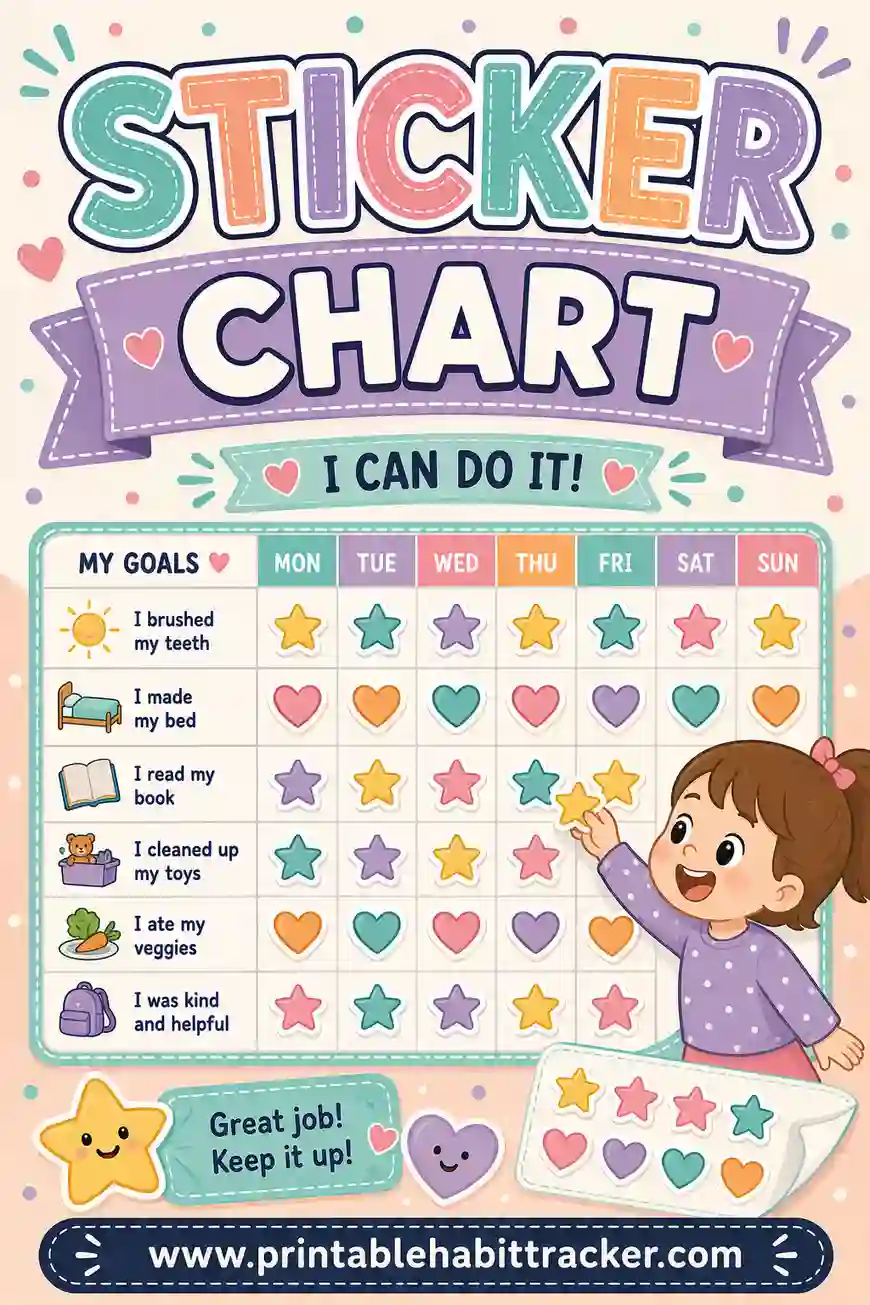
The weekly sticker version
Color-in squares sized right for stickers, one row per behavior. For the under-six crowd, placing the sticker is the reward — see the sticker chart guide for making the most of it.
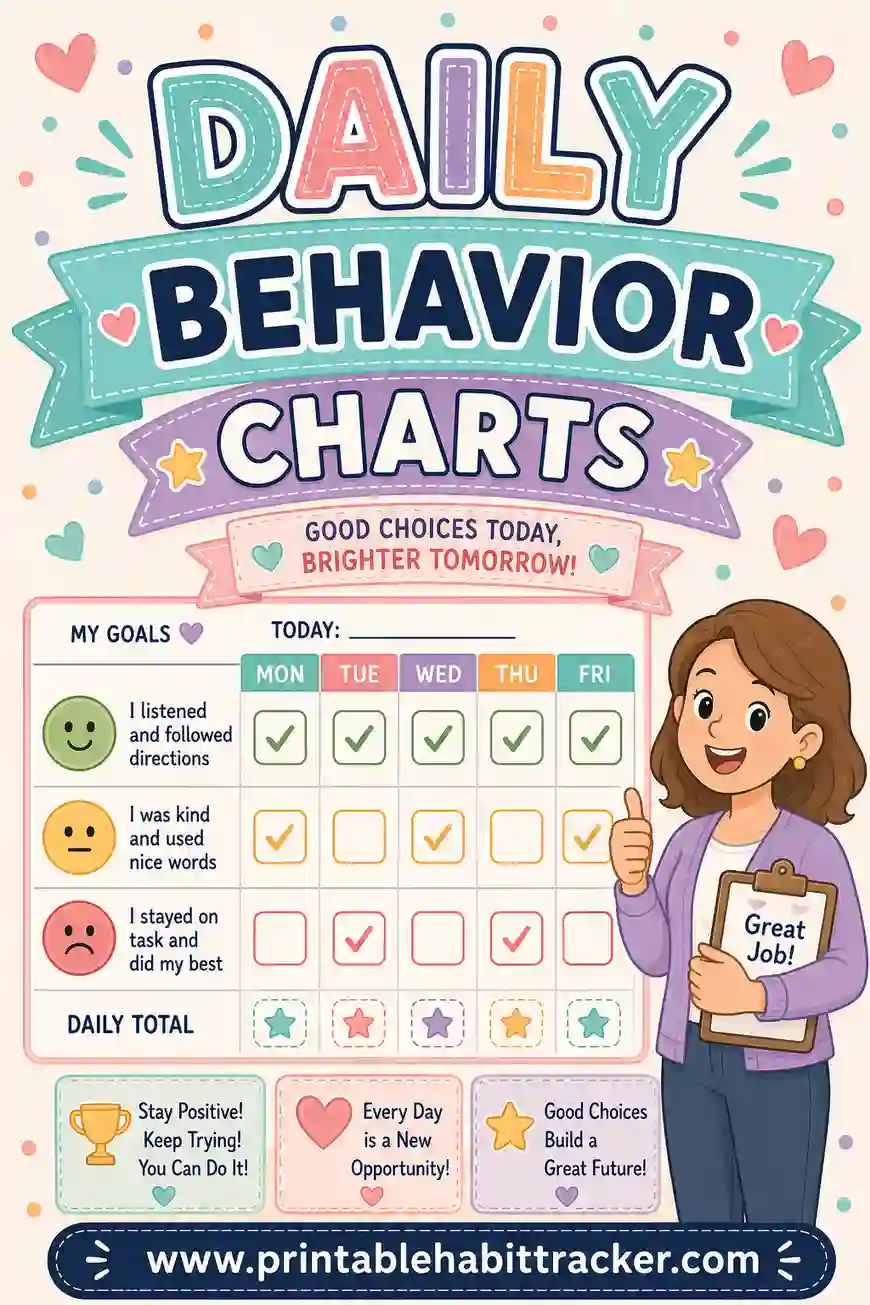
The daily focus chart
Some kids (and some weeks) need a single day at a time. A one-day checklist keeps the horizon short and every morning a fresh start — the daily behavior chart approach, ideal for school-day structure.
The streak builder
For kids seven and up, turn on the streak boxes. "Kind words, five days running" becomes a chain they don't want to break — the same psychology adults use, and honestly, kids feel it stronger.
The whole-family chart
Parents get rows too — "kept calm at homework time" is a fine grown-up row. Kids take a chart far more seriously when they get to check whether you earned your box.
How to Run the Chart So It Actually Works
- Catch them fast. Check the box within minutes of the behavior, not at bedtime. Young kids need the connection to be immediate.
- Narrate the win. "You shared your blocks with your brother — that goes on the chart!" The sentence matters more than the sticker.
- Never remove a check. A check that can be un-earned teaches kids the chart is a trap. Bad moments have their own consequences; the chart only records wins, permanently.
- Keep the bar reachable. Fifteen checks out of twenty-one possible is a great week. Perfection targets teach kids to give up by Tuesday.
- Review together Sunday. Count checks, hand over the reward, pick next week's focus. Five warm minutes.
What to do when a behavior "graduates"
When a row gets checked almost every day for two or three weeks straight, that behavior has become who your child is — retire the row with a little ceremony ("kind words is just what you do now!") and swap in the next thing you're working on. Rotating rows keeps the chart alive and keeps your child growing. A chart still tracking January's wins in April is a chart nobody looks at anymore.
Printing Tips
- Print fresh weekly on regular paper — the ritual of a new chart each Sunday is part of the fun.
- Laminate one copy and use dry-erase markers if you'd rather reuse it.
- Landscape orientation fits longer behavior phrases like "helped without being asked."
- Let them decorate. The Classic black-and-white theme leaves room for a kid to make the chart theirs — ownership doubles buy-in.
- Hang it at their eye level, not yours. It's their scoreboard.
Common Good Behavior Chart Mistakes
- Tracking behaviors phrased as "no" and "stop." The whole point is the flip. Every row names the win.
- Too many rows. Two or three behaviors at a time. Master them, celebrate, swap in new ones.
- Rewards too big or too far away. A theme-park trip next month means nothing on Tuesday. Small, soon, and certain beats big and distant.
- Using it as a threat. "Keep that up and no sticker" turns the noticing machine into a punishment machine. If you hear yourself doing it, take a breath and go back to catching wins.
- Quitting after a bumpy week. Charts take two or three weeks to change the weather in a house. Stay boring and consistent — that's what works.
A Sample Filled-In Good Behavior Chart
Here's a week for a five-year-old working on kindness and listening:
| Good behavior | Mon | Tue | Wed | Thu | Fri | Sat | Sun |
|---|---|---|---|---|---|---|---|
| Used kind words | ✔ | ✔ | ✔ | ✔ | ✔ | ✔ | |
| Listened the first time | ✔ | ✔ | ✔ | ✔ | ✔ | ||
| Helped tidy up | ✔ | ✔ | ✔ | ✔ | ✔ |
Reward box: "14+ checks = choose Saturday's movie." Total: 16. Wednesday was rough on kind words and nobody mentioned it twice — Thursday's fresh boxes did the talking. That's the chart working exactly as designed.
Frequently Asked Questions
Is the good behavior chart printable really free?
Yes — the builder is completely free, with no sign-up and no watermark. Build the chart, print or save as PDF, and reprint a fresh copy every week forever.
What's the difference between a good behavior chart and a regular behavior chart?
Framing. A general behavior chart may track problem behaviors or use color-level systems; a good behavior chart only records positive actions, phrased as what you want to see. For most kids — especially sensitive ones — the positive-only version gets better results with fewer tears.
What rewards work best?
Small, soon, and experience-based: choosing dinner, an extra bedtime story, picking the weekend movie, twenty minutes of one-on-one time. Most kids care less about the prize than about the winning — and the noticing.
Should I take away checks for bad behavior?
No — this is the most important rule. Earned checks are permanent. Misbehavior can have its own consequence in the moment, but if checks can vanish, the chart stops feeling safe and kids disengage. The chart records wins, full stop.
At what age do good behavior charts work?
From about age two and a half — with one row, instant stickers, and lots of narration — up through the preteen years, where streaks and privileges take over from stickers. The format grows with them: just edit the rows in the builder and reprint.
Ready to Print Your Good Behavior Chart?
Pick two behaviors you'd love to see more of this week, phrase them as wins, and open the free good behavior chart builder. Choose the weekly layout, big squares, a theme your kid will grin at, and print. It's free, it takes five minutes, and by Sunday you'll have a page of proof that the good stuff was there all along — you were just finally keeping score of it.