Habit Tracker Calendar: Month-at-a-Glance Layouts
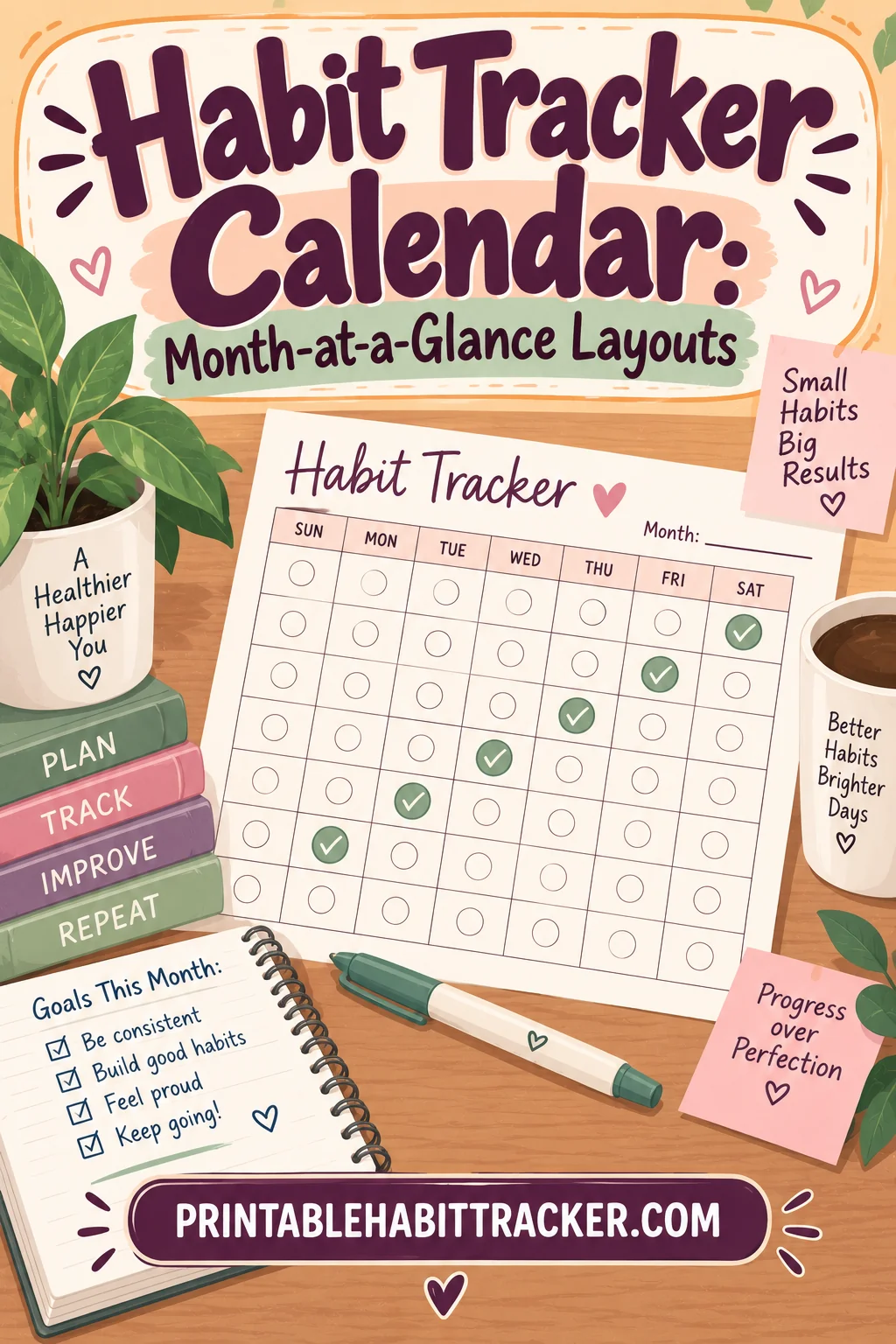
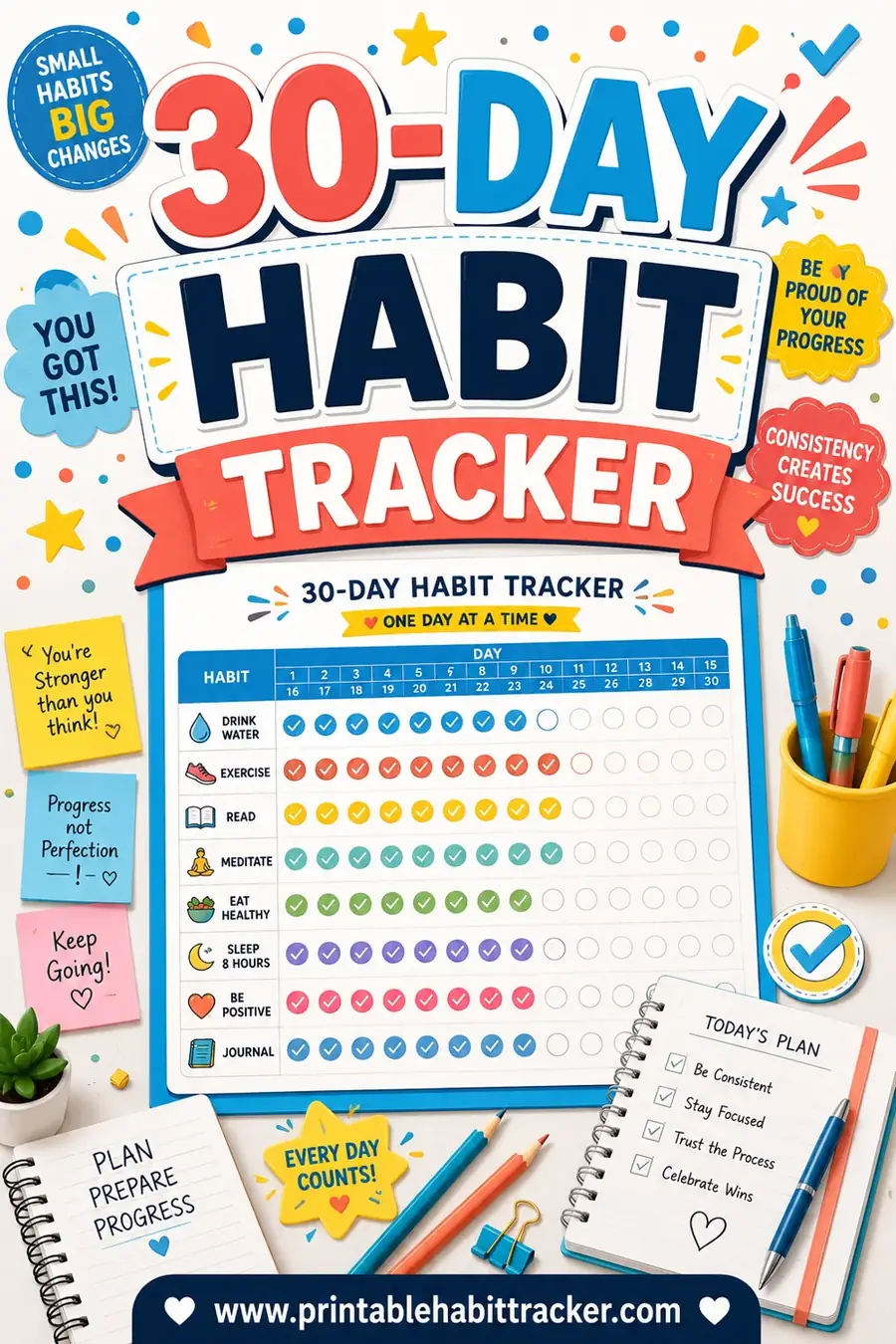
A habit tracker calendar is a one-page month where every day gets a box, so a streak and a gap are both visible from across the room without you reading a single word. The most useful version puts your habits down the left side and the numbered days across the top, giving you one row per habit and one column per day.
That grid is the workhorse layout, but it is not the only shape a month can take, and the shape you choose changes what you notice. This is a guide to picking the right one and setting it up so the first week does not fall apart.
The Two Shapes a Month Can Take
Almost every habit tracker calendar is one of two things, and people often print the wrong one for what they want.
The grid. Habits as rows, days 1 through 31 as columns. Several habits fit on one page, each gets its own line, and you read a habit by scanning left to right. This is the layout for anyone tracking more than one thing.
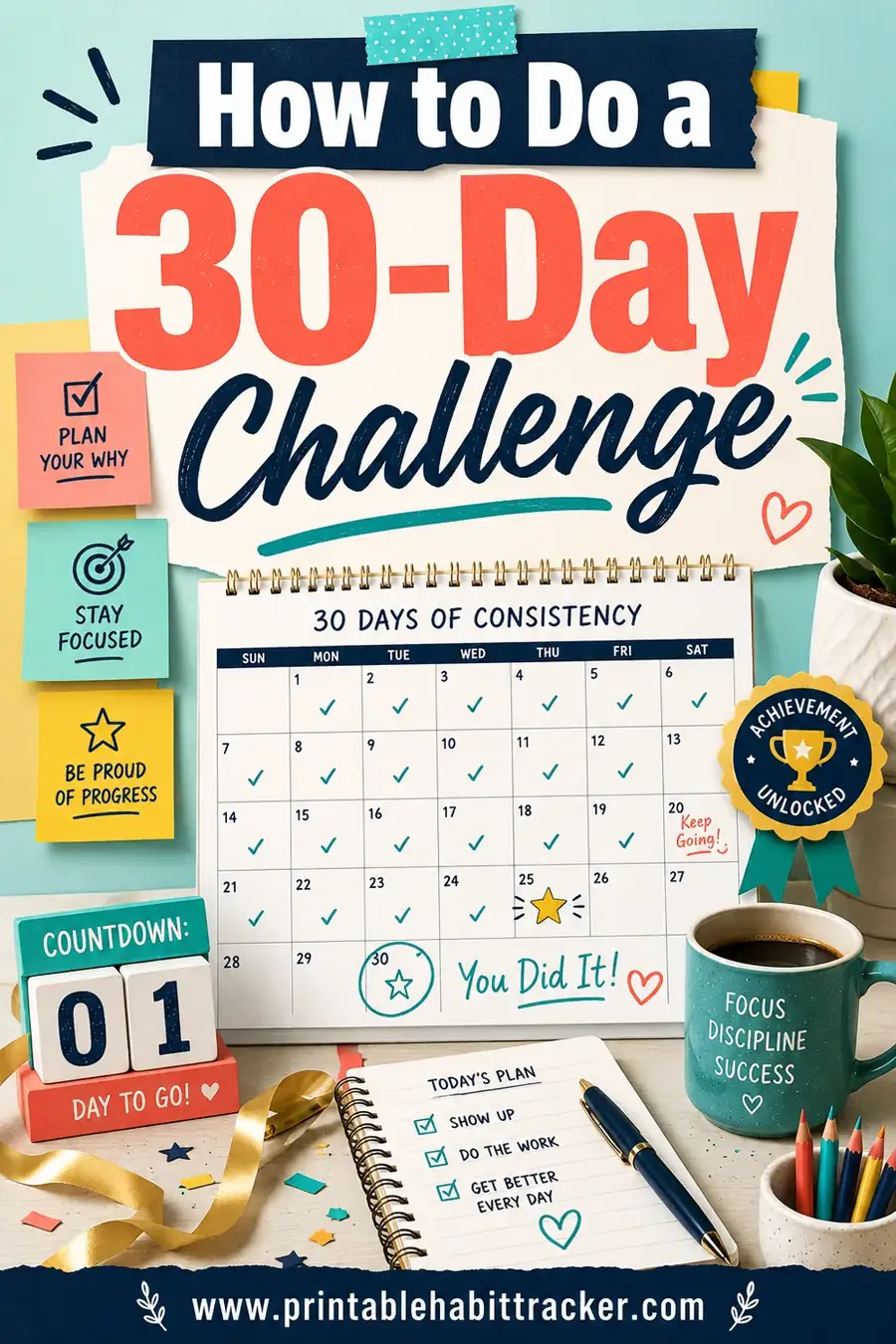
The calendar block. The familiar seven-column month, weeks as rows, one box per date. It matches how you already think about a month, weekends line up in the same place every week, and it holds one habit comfortably. Trying to squeeze three habits into a single date square produces a box too small to mark cleanly.
The rule of thumb is simple. One habit and you want the month to look like a month, use the calendar block. Two or more habits, use the grid. The grid is less pretty and considerably more informative.
What a Month at a Glance Actually Shows You
The reason to print a whole month rather than a week is that a month is long enough for patterns to appear and short enough to still fit on paper.
Clusters, not totals. Twenty-two marks out of thirty tells you very little. Twenty-two marks with all eight blanks landing on weekends tells you something you can act on. Gaps almost never scatter randomly; they pile up on a particular weekday, on the days you commute, or in the week something disrupted your routine.
The shape of the drop-off. Most abandoned habits do not stop abruptly. The row thins out: five days, then four, then two, then nothing. On a monthly page you can see that thinning while it is happening, which is the only point at which it is easy to fix.
Which habit is carrying the others. When one row is nearly solid and another is nearly empty, you are usually looking at a habit that fits your day and a habit that does not. That is a scheduling insight, not a character flaw, and you can only see it when the rows sit next to each other.
The recovery. A blank stretch followed by a solid stretch is worth noticing, because it is the thing that separates people who keep habits from people who do not. A weekly sheet hides it, since the bad week gets thrown away and replaced.
Layouts Worth Printing
| Calendar layout | Habits per page | Reads best as | Watch out for |
|---|---|---|---|
| Habit rows, day columns | 3 to 6 | A pattern of streaks and gaps | Narrow columns if you add too many habits |
| Seven-column month block | 1 | A familiar wall calendar | No room for a second habit |
| Circle or ring month | 1 to 2 | A visual, low-pressure record | Hard to see which date is which |
| Two-month spread | 2 to 3 | Progress across a longer arc | Very small boxes |
| Week-per-row with notes | 2 to 4 | A journal you can also read | Uses more vertical space |
The printable habit tracker on this site will build any of these, and it prints the correct number of days for the month and year you choose, which matters more than it sounds like it should.
Getting the Days Right
A month is not thirty boxes. It is 28, 29, 30 or 31, and a generic sheet with thirty-one columns leaves you crossing out phantom days at the end of February.
Let the month be printed for you. Choosing the month and year before printing means the dates are already correct, and it means the weekday letters can sit under the numbers. That second part is what makes weekend patterns visible.
Weekday letters are worth the space. A row of numbers 1 to 31 tells you nothing about rhythm. The same row with M T W T F S S repeating underneath makes "I never do this on Saturdays" jump out immediately.
Shade the weekends lightly, or mark them yourself. A subtle tint on Saturday and Sunday columns turns the page into a calendar rather than a number line. If your sheet prints in black and white, run a pencil line down the weekend columns before you start the month.
Print the whole year at once if you know you will keep going. Twelve sheets in a folder means the first of the month never becomes a reason to stop, because there is no setup step waiting for you.
Setting Up a New Month in Five Minutes
Do this on the last day of the old month, not the first day of the new one. The gap between the two is where trackers die.
- Review the finished sheet. Count marks per row, and look at where the blanks cluster.
- Decide what carries over. Solid habits can come off the sheet; nearly empty ones get shrunk or dropped.
- Rename anything ambiguous. If you argued with yourself about whether something counted, the name is the problem.
- Print the new month, with the correct dates and the correct number of days.
- Put it in the same place as the old one and move the pen with it.
- Keep the old sheet. A stack of finished months is the most motivating object in this whole system.
That last step is underrated. One page shows you a month. Six pages in a folder show you half a year of showing up, and that is a much harder thing to walk away from.
Where the Sheet Lives
A habit tracker calendar only works if you see it without deciding to look at it, which rules out most of the places people put one.
Good spots: the refrigerator door, the inside of a cabinet you open every morning, the bathroom mirror, the wall directly beside your desk, the back of the bedroom door.
Bad spots: inside a notebook, in a drawer, on a corkboard behind you, anywhere you have to turn around or open something to see it.
If a habit has a specific location, put the tracker there. A stretching habit belongs on the wall where you stretch. A water-drinking habit belongs on the kitchen counter. Splitting one habit onto its own small sheet in the right room usually beats keeping it in a row on a page in the wrong room.
Keep a pen taped or clipped to the sheet. Hunting for something to write with is a trivial obstacle, and trivial obstacles are exactly what defeat a thirty-second daily action.
Colors, Keys and Marking
A month gives you enough space to say more than "done" and "not done," if you want to.
One color per habit turns the finished page into a chart. Consistency shows up as a solid band, and you can read the month from a distance without processing any text.
A two-mark system handles the reality that most habits have a full version and a minimum version. A filled box for the real thing and a diagonal line for the minimum keeps the streak honest while still recognizing the day you did one push-up instead of thirty. Write the key at the bottom of the sheet so you still understand it in three weeks.
Resist a third and fourth symbol. Systems with five mark types are fun to design and get abandoned by the tenth of the month, because the daily action is now a decision rather than a reflex.
Use one pen. Switching between four markers each evening adds friction and the sheet ends up half-finished in a drawer with three markers missing.
What a Month Cannot Tell You
Some honesty about limits is useful, because people read more into these pages than the pages contain.
A blank box does not distinguish between "I chose not to" and "I was in an airport at midnight." A solid row does not prove the habit is automatic; it may just be a month where your schedule cooperated. And a page full of marks for a habit you picked for the wrong reason is still a page full of marks for a habit you do not want.
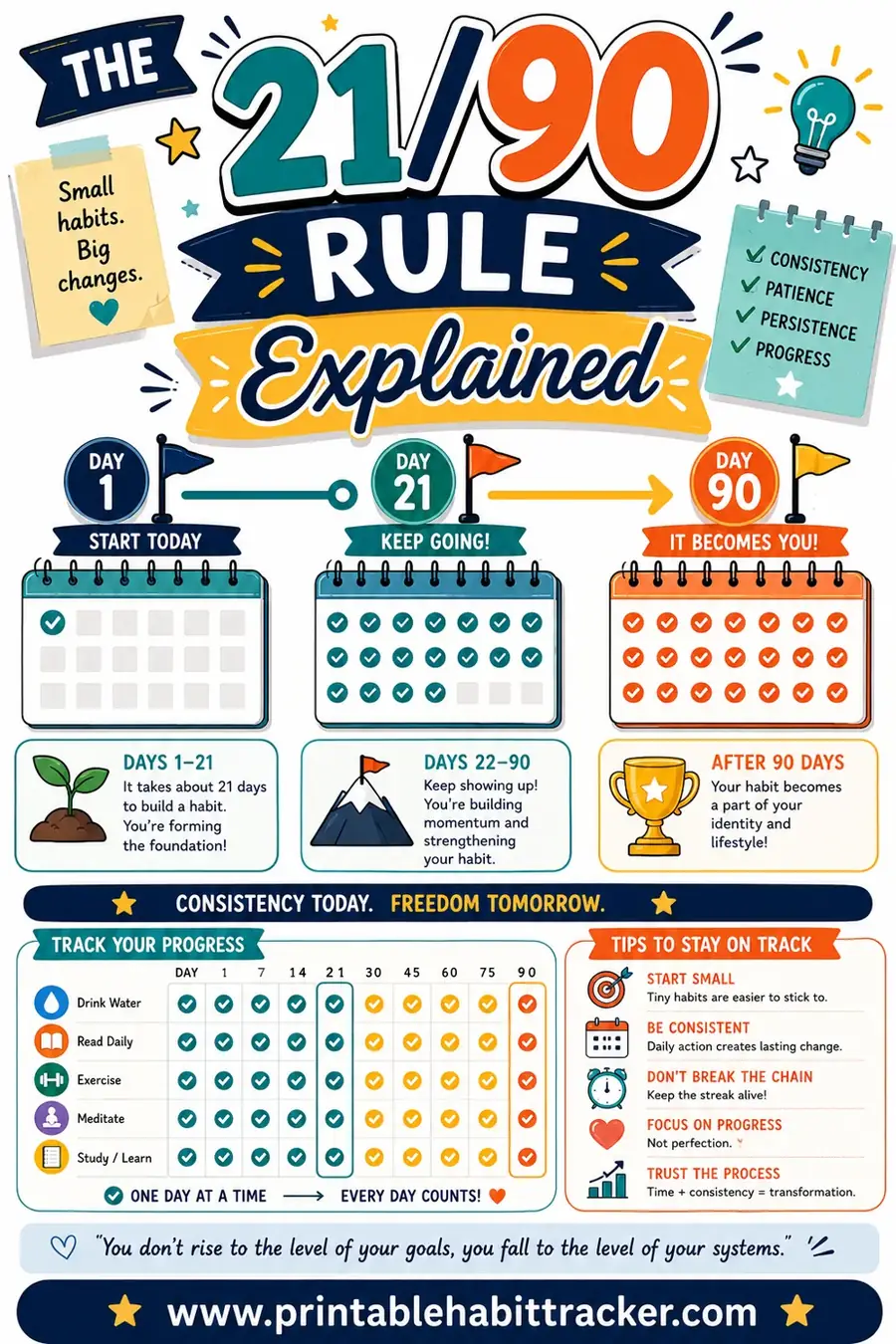
It is also worth putting the common myth to rest. The idea that a habit is locked in after twenty-one days is not a research finding. It comes from a mid-century observation about how long people took to adjust to a change in their appearance, and it got repeated until it sounded like science. The research that actually exists on automatic behavior points to a wide range that depends on the person and on how demanding the habit is: some simple routines settle in a few weeks, others take many months. Practically, that means there is no graduation date. A tracker still running in month four is not a sign you failed to finish; it is the normal case.
Calendar, Spreadsheet or Planner
There are three ways to keep a month of habit data, and it is worth being clear about what each one is good at.
A printed habit tracker calendar is the strongest option for actually doing the habits, because it is ambient. It sits in your visual field, requires no unlocking, and produces a physical record you can stack.
A habit tracker spreadsheet is the strongest option for analyzing them. Conditional formatting can shade completed days automatically, a formula can count your longest streak without you counting boxes, and twelve tabs give you a year you can chart. The weakness is that a habit tracker spreadsheet has to be opened, and a tracker you have to open is competing with everything else on your screen.
A planner with habit tracker pages built in suits people who already carry a planner and do not want a second object to manage. The trade-off is real: the tracker is now inside a closed cover, so the daily glance depends on you opening the book. If you use a planner with habit tracker spreads, keep it open on the desk rather than closed in a bag, and treat the open page as the wall.
The hybrid that works well needs no effort. Mark the printed month by hand every day, then once a month type the row totals into a sheet if you want the longer view. Paper does the behavior, the file does the memory.
Habits That Suit a Monthly View, and Habits That Do Not
Not every habit belongs on a month grid.
Daily habits are the natural fit. Anything you intend to do every day reads perfectly as a row of boxes, and any gap is instantly meaningful.
Several-times-a-week habits need a target written on the sheet. "Run three times a week" on a daily grid looks like a failure every single day if you do not note the target somewhere, because four blank boxes out of seven is the successful outcome. Write "3x/wk" at the end of the row and count weekly instead of daily.
Avoidance habits work, with a rewording. "No soda" tracks fine, but a box that means "I did not do the thing" is psychologically weaker than one that means "I did something." "Water with lunch" is the same behavior framed as an action, and the row feels different at the end of the month.
Weekly or monthly habits do not belong here. A habit you do once a month does not need thirty boxes; it needs a note on a calendar. Putting it on the grid gives you a row that is 97 percent empty, which drags down how the whole page reads.
A Free Habit Tracker Template Is the Easy Part
You can spend an evening comparing one free habit tracker against another and end up with a beautiful page and no habit. The habit tracker template is genuinely the least important variable in this. A hand-ruled grid on notebook paper works fine, and so does a habit tracker template you customize in two minutes and print.
What determines whether it lasts is everything the page cannot decide for you: keeping the habit count to three or four, naming each one so the box is unarguable, putting the sheet somewhere you cannot avoid it, and having a plan for the day you miss. That plan is short: never miss twice, do not backfill from memory, and do not reprint a clean page to escape a messy one. A page with history is worth protecting.
So print the first reasonable month grid you find and start today. If it is wrong, a week will show you exactly how, and reprinting takes a minute.
Reading the Finished Month
When the sheet is full, give it five minutes before you file it.
Count each row separately rather than judging the page as a whole, because one weak habit makes a strong month look bad. Then find the blanks and ask what they have in common. Same weekday, same time of month, same week you were away from home? A cluster is a scheduling problem you can solve. Scattered singles are just life, and they do not need solving.
Finally, be honest about a row with three or four marks. That is not a discipline result, it is a design result. The habit is too big, badly timed, or something you thought you should want rather than something you do. Shrink it to a version you would do on your worst day, move it to a different anchor in your routine, or cut it and give the space to something with a chance.
Frequently Asked Questions
What is the best layout for a habit tracker calendar? Habits as rows and days as columns, for anyone tracking more than one habit. The familiar seven-column calendar block looks better on a wall but really only holds one habit, because a single date square is too small to mark for three different things.
How many habits fit on one monthly page? Three to six, depending on the layout. Beyond six the columns get too narrow to mark comfortably, and more importantly a crowded page produces mixed results almost every day, which is the fastest way to stop looking at it.
Should I reprint if I have a bad week? No. Leave the gaps and keep going on the same sheet. A fresh page has no history to protect, which removes the main thing making the tracker work, and a month with twenty-two marks and eight blanks is still a good month.
How do I track a habit I only do three times a week? Write the target at the end of the row and count weekly rather than daily. On a daily grid, four blanks out of seven is the successful outcome, and without the target written down the row will read as failure every time you look at it.