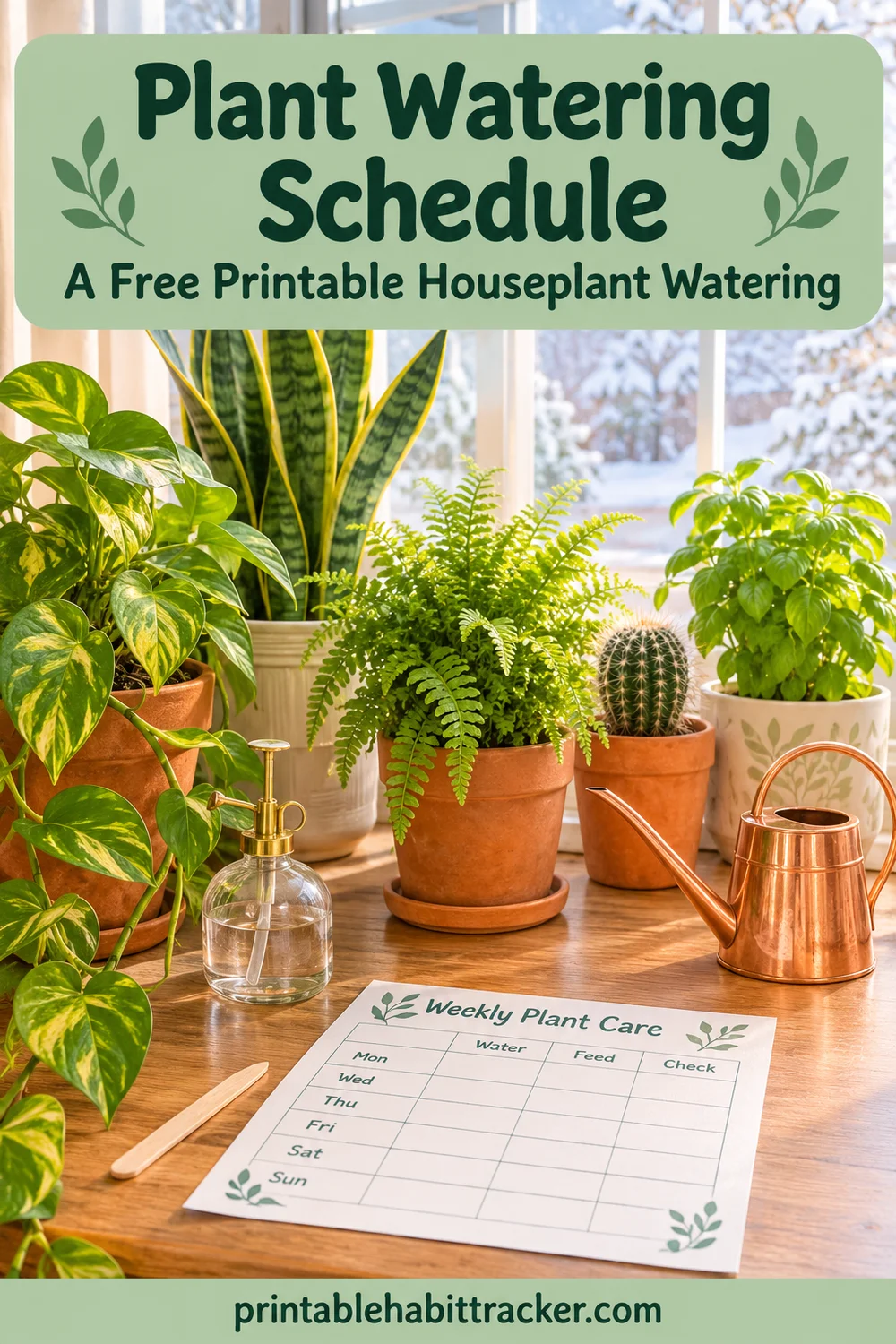
Plant Watering Schedule: A Free Printable Houseplant Watering Chart
A plant watering schedule is a simple weekly chart with each plant in a row and the days across the top, so you can see which plants are due for a drink and which already had one. The golden rule is to check the soil first: most houseplants want water when the top inch or two of soil feels dry, not on a fixed calendar day. Use the chart to remind you to check, not to water blindly.
Here's a plant watering chart with eight plants filled in. Swap in your own, then print it free:
✅ Try this tracker for one week
Tap a box each day you do the habit. Your ticks stay on this device.
Why a schedule helps (and why to check the soil first)
Most houseplants don't die from too little water. They die from too much. A chart gives you a quick look at what you did and when, so you don't water the same plant twice or forget one in the corner. But the chart is a reminder, not an order. In winter, indoor air is dry but plants grow more slowly, so they often drink less. Always check the soil by pressing a finger in about an inch before you pour.
How often should you water houseplants?
There's no single answer, because it depends on the plant, the pot, the light, the temperature and the season. Here's a rough guide, and your own home may be different.
| Plant type | Typical winter pattern | How to check |
|---|---|---|
| Succulents and cacti | Every few weeks, sometimes less | Soil is dry all the way through |
| Snake plant and ZZ plant | Every 2 to 4 weeks | Soil is dry well below the surface |
| Pothos and philodendron | About every 1 to 2 weeks | Top inch or two of soil is dry |
| Ferns and prayer plants | About once a week | Soil is just slightly damp, never soggy |
| Herbs on a windowsill | About every few days to weekly | Top of the soil is dry |
| Christmas cactus | When the top inch of soil is dry, a little less often in fall bloom | Soil is dry on top, never wet feet |
These are approximate. A big pot in a bright room dries faster than a small pot in a dim one.
Signs of too much or too little water
Too much
- Yellow, soft or droopy leaves
- Soil that stays wet for days
- Mold or a musty smell
- Soft, brown stems near the soil
Too little
- Dry, crispy leaf edges
- Soil that pulls away from the pot
- Wilting that perks up after watering
- Slow growth
How to water the right way
- Check the soil first with your finger or a wooden skewer.
- Water slowly until it comes out the drainage hole.
- Empty the saucer after about 15 minutes so roots don't sit in water.
- Use room-temperature water. Very cold water can shock roots.
- Water in the morning if you can, so plants dry before night.
- Tick the box on your chart.
A sample week
| Plant | Mon | Tue | Wed | Thu | Fri | Sat | Sun |
|---|---|---|---|---|---|---|---|
| Pothos | Check | Water | |||||
| Snake plant | Check | ||||||
| Fern | Check | Water | Water | ||||
| Herbs | Check | Water | Water | Water | |||
| Succulent | Check |
Most days, just check and move on. Only water the plants whose soil is dry.
Other jobs to add to your chart
- Turn the pot a quarter turn so plants grow evenly
- Wipe dusty leaves with a damp cloth
- Pick off dead leaves
- Check for pests under the leaves
- Fertilize lightly in spring and summer, less in winter
Plants and pets
If you have cats or dogs, check each plant's safety before bringing it home. For example, poinsettia, holly, mistletoe, amaryllis and lilies can be harmful to pets (lilies are very dangerous to cats), while the Christmas cactus is listed as non-toxic by the ASPCA. If your pet nibbles a plant, call your vet or the ASPCA Animal Poison Control Center.
More houseplant help
Our sister site, gardenadviceguide, has houseplant care pages for individual plants, from snake plants to Christmas cactus. To make plant care a daily habit, try the daily habit tracker or the monthly habit tracker, and keep a regular chore page like the weekly chore chart next to it. Kids can help too, as a small job on the kids chore chart.
How to print your plant watering schedule
- Open the free habit tracker maker with the button above. It opens in the weekly layout.
- Rename it ("Plant Care") and swap in your own plants.
- Print it and put it near your plants, on the fridge or inside a cabinet door.
- Tick a box when you check or water, and start a new page each week.
When you're ready, open the free maker and print your schedule.
Frequently Asked Questions
How often should I water my houseplants?
It depends on the plant, pot, light and season. Many want water when the top inch or two of soil is dry, while succulents and snake plants can go a few weeks. Check the soil first.
Should I water on a fixed schedule?
Use a chart as a reminder to check, not to water blindly. Always feel the soil before you pour.
How do I know if I'm overwatering?
Yellow, soft or droopy leaves, soil that stays wet, mold, or a musty smell are common signs. Let the soil dry and empty the saucer.
Do houseplants need less water in winter?
Often, yes. Growth slows, so many plants dry out more slowly. Keep checking the soil, since heated rooms can be dry.
Is the Christmas cactus safe for pets?
The ASPCA lists the Christmas cactus as non-toxic to cats and dogs. Poinsettia, holly, mistletoe, amaryllis and lilies are not safe, so call your vet or the ASPCA Animal Poison Control Center if a pet nibbles one.
Can I make a plant care chart for free?
Yes. Open the free maker, list your plants as rows, rename the page and print it.