Free Printable Weekly Chore Chart: Custom Charts for the Whole Week
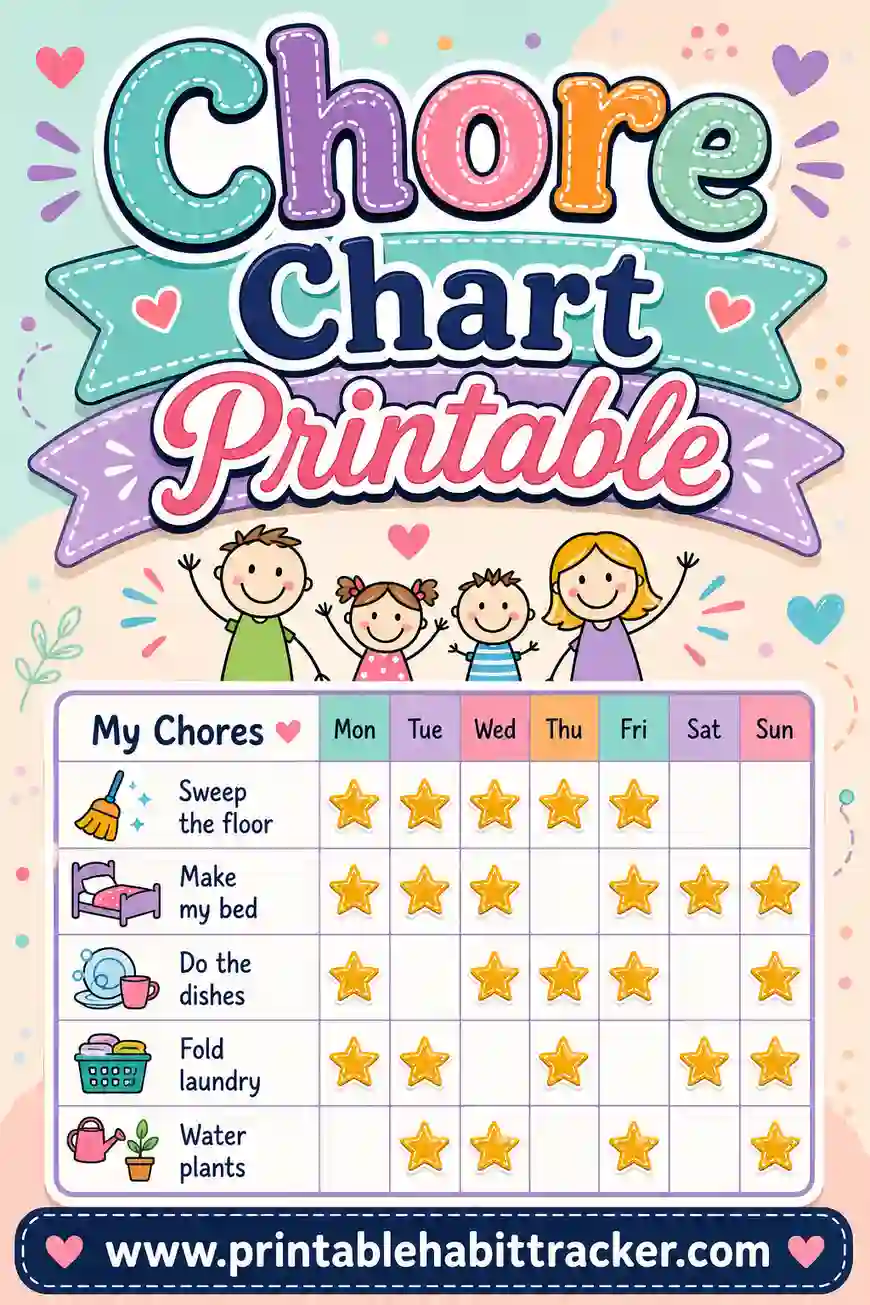
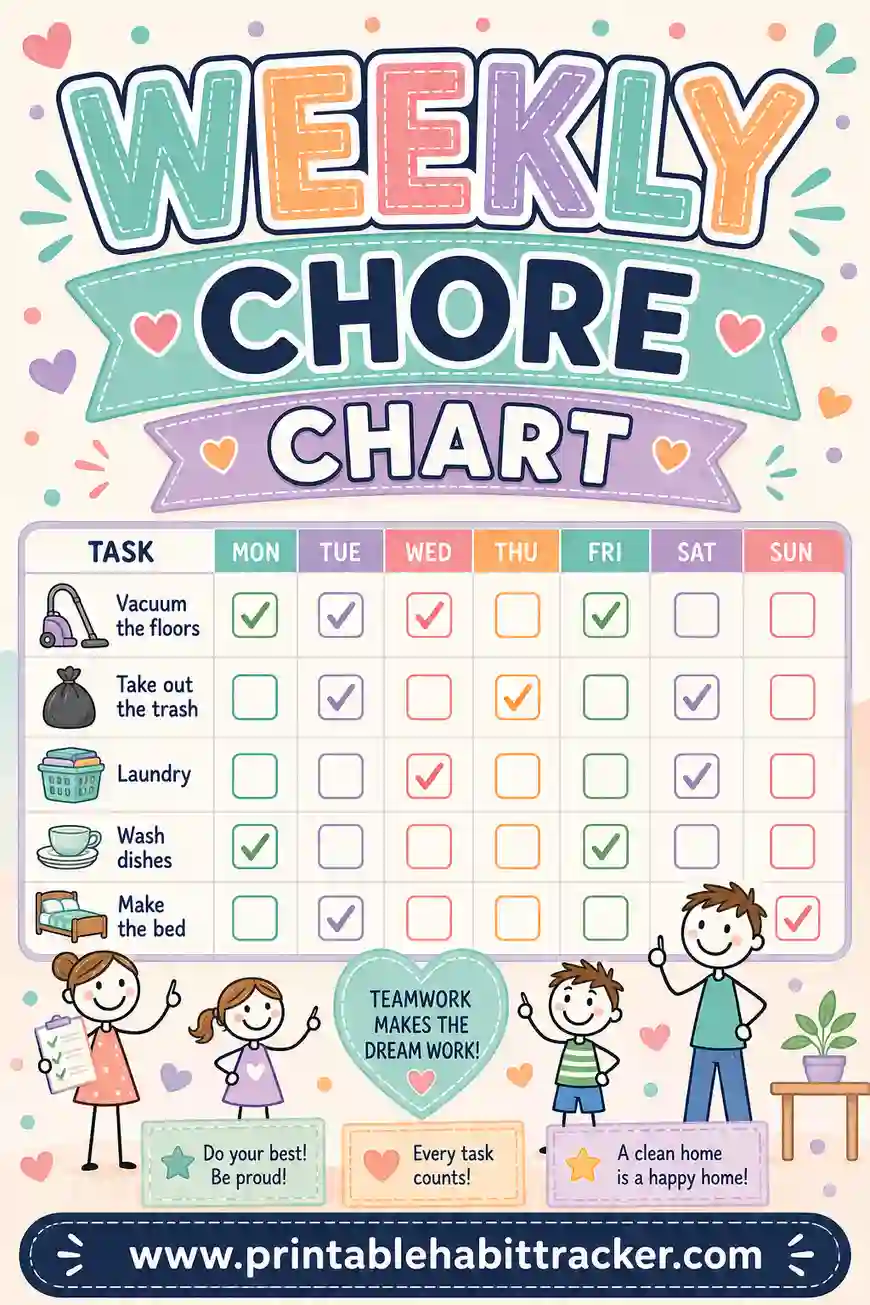
A free printable weekly chore chart is a one-page grid built around the rhythm most households actually run on: the week. Chores go down the side, Monday through Sunday goes across the top, and every finished job earns a checkmark in its box. Print a fresh one each Sunday and the whole family starts Monday knowing exactly who does what. The fastest way to get one that matches your house is the free printable habit tracker builder — type your chores, pick the weekly layout, and print.
Want one before the laundry pile grows? Open the free builder, type each chore on its own line, choose the weekly layout, and hit print. No sign-up, no watermark, and a new copy every week costs you one click.
Why the Week Is the Right Size for a Chore Chart
Chore charts come in every timespan, but the weekly grid is the one families keep using, and there's a reason: the week is how home life actually moves. School runs Monday to Friday. Trash goes out Tuesday. Weekends have their own shape. A weekly chore chart printable mirrors that rhythm instead of fighting it.
A week is also the perfect motivational length. Seven days is long enough for a satisfying streak of checkmarks to build, but short enough that a rough Tuesday doesn't sink the whole chart. Every Sunday the slate wipes clean — new sheet, fresh start, no baggage. Kids who had a bad week get a genuine do-over, and kids who had a great one get to chase a repeat.
Compare that with a monthly chart, where a bad first week leaves 24 days of guilt staring back. Monthly grids are great for spotting patterns (the chore chart guide covers when to use each), but for day-to-day family operations, weekly wins.
What Goes on a Weekly Chore Chart
The grid handles two kinds of chores at once, and that's its quiet superpower.
Daily chores get a checkmark every day — feed the pet, make the bed, clear the table. Their rows should end the week full.
Once-or-twice-a-week chores — trash night, watering plants, changing sheets — get checked only on their agreed days. The rest of the row just stays blank (or gets crossed out with a marker after printing).
Here's a starter set you can copy straight into the builder:
| Chore | Frequency | Good for |
|---|---|---|
| Make the bed | Daily | Age 4+ |
| Feed the pet | Daily | Age 5+ |
| Clear own plate | Daily | Age 4+ |
| Empty dishwasher | Daily | Age 8+ |
| Take out trash | Tue & Fri | Age 8+ |
| Water the plants | Mon & Thu | Age 6+ |
| Vacuum living room | Saturday | Age 9+ |
| Change bed sheets | Sunday | Age 10+ |
| Wipe bathroom sink | Wed & Sat | Age 9+ |
Adults and teens can carry the heavier weekend rows; little ones own the daily quick wins. If most of your crew is under ten, the kids chore chart guide has age-by-age lists worth borrowing.
Name the days for non-daily chores
Write the schedule right into the row name: "Trash — Tue & Fri," "Vacuum — Sat." Now the chart answers "when?" as well as "what?", and nobody can claim Thursday was secretly trash-free.
Ready-Made Weekly Chore Charts You Can Print Today
Not sure where to start? Pick the setup closest to your household below. Each link opens the builder with the chores already filled in and the weekly layout selected — change any row, add a name to the title, and print.
- Preschooler Weekly Chore Chart — Ages 3–5. Big color-in squares and tiny, doable jobs. Chores: Toys in the bin, Clothes in hamper, Help feed the pet, Put shoes away, Clear my cup. Open this chart in the free builder
- Kids Weekly Chore Chart (Ages 6–9) — Daily basics plus one bigger weekend job. Chores: Make my bed, Feed the pet, Clear my plate, Tidy my room, Homework done, Help fold laundry — Sat. Open this chart in the free builder
- Tween Weekly Chore Chart (Ages 10–12) — More independence, a couple of household jobs. Chores: Make bed, Pack school bag, Load dishwasher, Take out trash — Tue & Fri, Vacuum my room — Sat, Change my sheets — Sun. Open this chart in the free builder
- Teen Weekly Chore Chart — Real household responsibility with set days. Chores: Do my laundry — Sun, Clean bathroom — Sat, Dishes after dinner, Take out trash & recycling, Mow or yard work — Sat, Cook one dinner — Wed. Open this chart in the free builder
- Whole-Family Weekly Chore Chart — One shared sheet for the house — turn on color-coding in the builder so each person gets a color. Chores: Dishes, Trash — Tue & Fri, Vacuum — Sat, Wipe kitchen counters, Laundry — Sun, Feed the pet, Water plants — Mon & Thu. Open this chart in the free builder
- Roommate Weekly Chore Chart — Shared spaces only, so nobody argues about whose mug that is. Chores: Kitchen counters & stove, Take out trash & recycling, Clean bathroom — Sat, Vacuum common areas — Sun, Empty fridge leftovers — Fri, Restock shared supplies. Open this chart in the free builder
- Adult Weekly Cleaning Chart — A simple weekly reset for one person or a couple. Chores: Dishes done before bed, Laundry — Sun, Clean bathroom — Sat, Vacuum & mop — Sat, Meal prep — Sun, Tidy 10 minutes. Open this chart in the free builder
- Weekend Reset Chart — For busy families who save the bigger jobs for Saturday and Sunday. Chores: Strip & change beds — Sat, Clean bathrooms — Sat, Vacuum whole house — Sat, Grocery list & shop — Sun, Plan the week's meals — Sun, Lay out school clothes — Sun. Open this chart in the free builder
Every preset is just a starting point. Rename chores to match the words your family already uses (“dish duty” beats “load dishwasher” if that is what everyone says), and cut any row that does not fit your home. A chart that sounds like your house gets used.
How to Make a Weekly Chore Chart in 4 Steps
The whole build takes under five minutes.
- List the week's chores. In the free builder, type each chore on its own line, with days named for the non-daily ones. Put the person's name in the chart title — "Maya's Week" — if each family member gets their own sheet.
- Pick the weekly layout. That gives you the classic Mon–Sun columns. The preview updates as you type, so you can see the chart take shape.
- Choose a style and theme. Checkboxes for teens and adults, big color-in squares for younger kids who'd rather scribble than tick. Themes like Ocean or Sunset make it fridge-friendly; Classic black-and-white saves ink.
- Print or save as PDF. One clean page, Letter or A4, portrait or landscape. Print one per person and hang them side by side.
Your chart saves locally in your browser, so Sunday night reprints take seconds — open, adjust a row if needed, print.
Weekly Chore Chart Setups That Work
One shared family grid
All the week's chores on one sheet, with the color-coding option turned on so each person's chores print in their own color with a key at the bottom. One page runs the whole house. This works best for four to ten shared chores; more than that and individual sheets breathe better.
One chart per person
Each family member gets their own printable weekly chore chart with their name in the title. No arguing over whose row is whose, and each person owns their own streaks. Print them all in one sitting — the builder remembers your setup between prints.
The rotating roster
Sibling fairness, solved: keep the same chore rows but swap whose sheet they appear on each week. Week one, Maya has dishes and Leo has trash; week two they trade. Because your chart is saved in the browser, the Sunday-night swap is a thirty-second edit, not a rebuild.
The chore-plus-routine combo
Add routine rows under the chores — "homework before dinner," "screens off by 8:30," "backpack packed." The weekly grid doesn't care whether a row is a chore or a habit, and one sheet at kid height beats two taped side by side. For a deeper version of this, see the weekly habit tracker guide.
Weekly Chore Chart for Roommates and Adults
A weekly chore chart is not just for kids. Roommates, couples, and adults living alone use the same grid for the same reason families do: it ends the “I thought you were doing it” conversation before it starts. The difference is in how you set it up.
For roommates: chart the shared spaces only
Keep personal rooms off the chart. A roommate chart should cover only the spaces everyone uses — kitchen, bathroom, living room, trash. Agree on the list together, then rotate who owns each row every week so the worst job (usually the bathroom) never sticks to one person.
| Shared chore | How often | Who |
|---|---|---|
| Kitchen counters & stove | After each use, deep wipe once a week | Rotate weekly |
| Trash & recycling | On pickup days | Rotate weekly |
| Bathroom clean | Once a week | Rotate weekly |
| Vacuum or sweep common areas | Once or twice a week | Rotate weekly |
| Fridge clear-out | Before trash day | Rotate weekly |
| Shared supplies (soap, paper towels) | Check every week | One owner per month |
Put each roommate’s name next to their rows for the week, print one copy, and tape it inside a kitchen cabinet door. Our guide to a habit tracker for roommates has more ideas for shared homes.
For adults: use the chart as a weekly reset
For a single adult or a couple, the weekly chart works best as a reset list: the handful of jobs that keep the home running, each with a set day. Laundry on Sunday, bathroom on Saturday, groceries on Sunday afternoon. Checking boxes sounds childish until you try it — then the satisfaction of a full row is surprisingly motivating. See chore charts for adults for grown-up layouts.
For couples: split by preference, not just by fairness
A perfectly even split is less important than a split you both feel good about. Many couples trade: one person hates dishes but does not mind laundry, the other is the reverse. Write the agreed split on the chart so neither of you has to keep it in your head.
How to Color-Code a Weekly Chore Chart
Color turns a busy grid into something you can read from across the kitchen. There are four common ways to do it:
- By person. The most useful for families. Turn on color-coding in the builder and each person’s rows print in their own color with a key at the bottom. Little kids can spot “their color” before they can read.
- By room. Kitchen jobs in one color, bathroom in another, outdoor jobs in a third. Handy for roommates and adults. Mark the rows with highlighters after printing.
- By frequency. Daily chores in one color, weekly chores in another. This makes the blank boxes on twice-a-week rows look intentional instead of missed.
- By effort. Quick jobs in a light color, big jobs in a bold one. Great for setting up a points system where bigger jobs count more.
Pick one system and stick with it. Mixing two color systems on one chart makes it harder to read, not easier.
Turning Your Weekly Chart Into a Chore Calendar
If some jobs only happen every other week or once a month — cleaning the fridge, washing windows, changing air filters — a weekly chart alone can lose track of them. Two simple fixes:
- Add a “This week only” row. On Sunday night, look at the month ahead and add any occasional job to this week’s chart. Delete it next week.
- Print four weeks at once. Build the weekly chart, print four copies, and write the dates at the top of each. Pencil in the monthly jobs on the right week before you hang them up. You now have a month of chore calendar in one sitting.
For the everyday jobs that need a box every single day, a daily chore chart is a good companion to the weekly grid.
Running the Week: A Simple Rhythm
A chart is only as good as the routine wrapped around it. This one takes minutes:
- Sunday night: reset. Print the new week's sheet (or wipe the laminated one), make any chore swaps, and stick it back on the fridge. Two minutes.
- Daily: the after-dinner check. Everyone marks their own boxes at the same time each evening. Kids do their own checking — the ownership is half the lesson.
- Saturday or Sunday: the payoff. Count the week's checkmarks together. If you use the reward box, this is when it pays out: "20+ checks = Sunday pancakes" or "full pet-feeding row = Friday movie pick."
That weekly payoff moment matters more than the chart itself. Seven days of effort deserves thirty seconds of being noticed.
A Sample Weekly Chore Chart
Here's a finished chart for a nine-year-old, mid-week — copy it into the builder and swap in your own rows.
| Chore | Mon | Tue | Wed | Thu | Fri | Sat | Sun |
|---|---|---|---|---|---|---|---|
| Make my bed | ✓ | ✓ | ✓ | ☐ | ☐ | ☐ | ☐ |
| Feed the dog | ✓ | ✓ | ✓ | ☐ | ☐ | ☐ | ☐ |
| Clear my plate | ✓ | ✓ | ☐ | ☐ | ☐ | ☐ | ☐ |
| Trash — Tue & Fri | ✓ | ☐ | |||||
| Vacuum — Sat | ☐ | ||||||
| Homework before dinner | ✓ | ✓ | ✓ | ☐ | ☐ |
Reward box: "22+ checks = Saturday bike ride." Notice it's set below perfection — 22 of a possible 26 leaves room for an off day, which keeps the goal feeling reachable on Thursday instead of already lost.
Printing Tips for a Chart That Lasts the Week
- Regular paper is perfect for a sheet you'll replace every Sunday anyway.
- Laminate one copy and run it with dry-erase markers if you'd rather wipe than reprint — the weekly reset becomes a ten-second wipe.
- Landscape orientation gives the seven day-columns more elbow room when chore names run long.
- Classic theme for ink savings, or let the kids color the header of a black-and-white chart themselves — instant buy-in.
- Print a test page first and check the grid fits before running a copy for every family member.
- Hang it low. Fridge door at kid height, or the kid's bedroom door. A chart they can't reach is a chart you'll be checking for them.
Common Weekly Chore Chart Mistakes
- Overloading the week. Ten rows per kid looks productive on Sunday and demoralizing by Wednesday. Start with three to five and grow from there.
- All-daily thinking. Forcing weekly jobs like vacuuming into daily rows creates fake empty boxes. Name the days in the row and let blanks be blanks.
- Skipping the reset. A week-old chart full of stale checkmarks teaches everyone to ignore it. The Sunday reset is the heartbeat of the system — protect it.
- Parents marking the boxes. If you check it for them, it's your chart. Hand over the marker.
- No payoff moment. A week of effort that nobody counts feels pointless fast. End every week by noticing the full rows out loud.
Frequently Asked Questions
Is the weekly chore chart really free to print?
Yes — completely. The builder has no sign-up, no account, and no watermark. Build your chart, print it or save it as a PDF, and reprint a fresh free printable weekly chore chart every single Sunday if you like.
Should the week start on Monday or Sunday?
Whichever matches how your family talks about the week. Most households reset chores on Sunday night for a Monday start, which is why Mon–Sun is the classic. There's no wrong answer — pick one and stay consistent so streaks make sense.
How do I handle chores that only happen twice a week?
Give them a row with the days in the name — "Trash — Tue & Fri" — and only those boxes count. Leave the other days blank or cross them out with a marker after printing. Kids adapt to this instantly.
What about weeks that go sideways — sick days, travel?
Cross the day off the whole chart and carry on. A weekly chart's short horizon is exactly what makes recovery easy: even a wrecked week is over in a few days, and Sunday brings a clean sheet. Never let one lost week kill the system.
Can I make a weekly chart for multiple kids on one page?
Yes. List everyone's chores on one sheet and turn on color-coding, so each child's rows print in their color with a key at the bottom. If the list tops eight or ten rows, switch to one chart per kid — the chore chart guide walks through both setups.
Should kids be paid for chores?
Families do this differently, and there is no single right answer. A common approach is to split chores into two groups: everyday “family member” jobs that everyone does without pay (making the bed, clearing plates), and extra jobs that can earn an allowance or a reward. The weekly chart works for either — use the reward box at the bottom to write down what a full week earns, whether that is screen time, a special outing, or extra allowance.
How do I make an Excel or Google Sheets weekly chore chart?
Put chores in column A, then type Mon through Sun across the top row. Insert checkboxes in the day cells (both Excel and Google Sheets have a checkbox option), widen column A so long chore names fit, and set the print area to one page. If you just want a clean printable without fiddling with cell sizes, the free builder does the layout for you and saves as a PDF.
How do I color-code chores on a weekly chart?
The easiest way is by person: turn on color-coding in the builder and each person’s chores print in their own color with a key. You can also color by room, by how often a chore happens, or by how big the job is — just pick one system so the chart stays easy to read.
What are the benefits of a weekly chore chart?
A weekly chart makes expectations clear, so there is less nagging and fewer arguments about who does what. Kids get practice with responsibility and real life skills, and everyone can see their progress building up across the week. For adults and roommates, it simply keeps shared jobs fair and visible.
Can roommates use a weekly chore chart?
Yes. List only the shared spaces — kitchen, bathroom, common areas, and trash — and rotate who owns each row every week. Print one copy and keep it somewhere everyone sees it, like inside a kitchen cabinet door.
How do I make a weekly chore calendar?
Build your weekly chart once, print four copies, and write the week’s dates at the top of each. Add monthly or every-other-week jobs to the right week by hand. That gives you a simple chore calendar for the whole month in a few minutes.
Ready to Print This Week's Chart?
Pick three to five chores per person, open the free weekly chore chart builder, choose the weekly layout and a theme your crew will actually look at, and print. It's free, it takes five minutes, and by next Sunday you'll be counting checkmarks instead of repeating yourself. The week runs better when it's written down.