Night Shift Routine Tracker: Sleep, Meals and Light Habits for Shift Workers
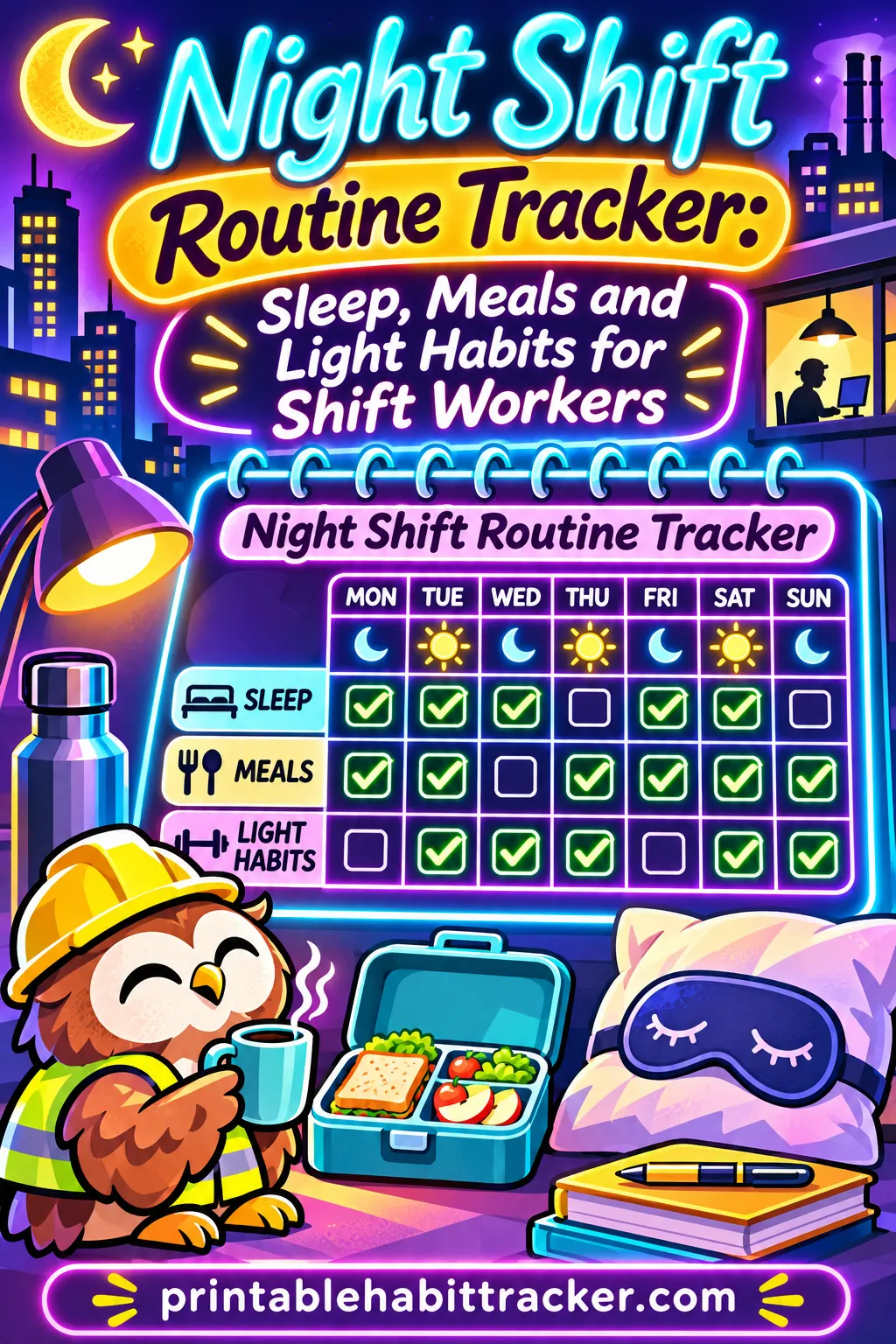
A night shift routine works when you stop thinking in "morning" and "evening" and start thinking in "before shift," "on shift" and "after shift," then track the same few habits in each phase: a protected main sleep block, a real meal before work, a light snack and water during the shift, and a dark, calm wind-down when you get home. Your clock flips, but the order of your day doesn't. Track the order, not the hour, and the routine travels with you through night stretches, days off and rotations.
You can print this tracker for free with the habit tracker maker on our homepage. This link will build this exact tracker with the title, seven phase-grouped habits, weekly layout and checkbox style already filled in.
Below you'll find how to set up the phases, sample sleep schedules for common shift patterns, meal and light timing, a plan for switching back on days off, the exact tool settings, versions for different jobs and a troubleshooting table.
A quick note before we start: this is a practical routine guide, not medical advice. Shift work affects everyone differently. If you have trouble sleeping, feel very drowsy at work or while driving, or have a health condition, talk to your doctor and follow their advice. Use the tracker to support that plan.
✅ Try this tracker for one week
Tap a box each day you do the habit. Your ticks stay on this device.
Why a Normal Habit Tracker Doesn't Fit Night Shifts
Most printable habit trackers assume a standard day. Habits get labeled "morning" and "evening," and the grid assumes you wake up when the sun does. That falls apart on nights for a few reasons.
Your "morning" happens at 4 p.m. A "morning routine" row makes no sense when you wake up as everyone else is finishing work. Some night workers end up ticking nothing because the labels don't match their lives.
Your workday crosses midnight. If you work from 7 p.m. to 7 a.m., which day does the shift belong to? A standard grid makes you split one shift across two columns, which is confusing to fill in.
Your schedule changes week to week. Many shift workers do three or four nights, then a few days off, then nights again. Some rotate between days, evenings and nights. A tracker built for the same schedule seven days a week doesn't cope with that.
The habits that matter are different. For a day worker, "drink water" or "go to bed by 10" might be the focus. For a night worker, the habits that make or break the week are things like keeping the bedroom dark during the day, eating a proper meal before leaving and not loading up on caffeine late in the shift.
The fix is simple: name your habits by shift phase, not by clock time. "After shift: wind-down" means the same thing if you get home at 7 a.m. or at 3 a.m. The order of your day (wake, eat, work, come home, wind down, sleep) stays roughly the same even when the clock doesn't. That order is what you track.
The Before-Shift, On-Shift, After-Shift Tracker Layout
The habit tracker maker uses days of the week as columns and your habits as rows. So instead of relabeling columns, you build the phases into your habit names. Start each habit with "Before:", "On shift:" or "After:", and list them in the order you'll do them. Reading down the sheet then walks you through a whole shift cycle.
Here's the full set of habits from this guide, grouped by phase, with what each one means in practice.
| Phase | Habit (as written on the tracker) | What counts as a tick |
|---|---|---|
| After shift | After: shades on going home | Sunglasses or dimmed light on the trip home |
| After shift | After: wind-down 20 min | Shower, light snack, no bright screens, then bed |
| After shift | After: main sleep block | Your main sleep, in a dark, quiet room |
| Before shift | Before: real meal | A proper meal in the hours before you leave |
| Before shift | Before: light and movement | Bright light and a short walk or stretch after waking |
| On shift | On shift: water and snack | Water bottle refilled, a planned light snack |
| On shift | On shift: caffeine cutoff | No caffeine in the last stretch before your sleep |
You don't have to track all seven. Pick the three or four that matter most for you right now. Most people start with the main sleep block, the wind-down and the pre-shift meal, since those tend to set up everything else.
Which day does a shift belong to?
Choose one rule and use it every time. The simplest: log the shift under the day it started. If you start Monday at 7 p.m. and finish Tuesday at 7 a.m., your pre-shift meal, on-shift habits, trip home, wind-down and post-shift sleep all go in the Monday column. It keeps one shift in one column, which makes the sheet much easier to read.
Write your rule in the Notes/goals box at the bottom of the tracker so you don't second-guess it at 6 a.m.
What to do on days off
Days off are where night shift routines usually go sideways. Don't leave those columns blank, and don't pretend they're work days. Instead:
- Write "OFF" at the top of the column.
- Tick the habits that still apply, like the main sleep block (even if it's at night), a real meal before your main waking hours and light and movement after waking.
- Leave the on-shift rows empty, or put a small dash so you know it was intentional.
That way the sheet still shows whether your sleep and meals held up on days off, which is often where the hardest part of shift work hides.
Why "after shift" comes first on the list
You may notice the after-shift habits are at the top of the tracker, not the before-shift ones. That's on purpose. For many night workers, the trip home and the first hour after the shift decide how well they sleep, and sleep sets up everything else. Putting those rows first makes them the first thing you see when you pick up the pen.
Sleep After Night Shift: Building Your Main Sleep Block
Sleep is the habit that holds up the whole routine. When it slips, meals get skipped, caffeine creeps up and everything feels harder. So the first goal of your tracker is a main sleep block: one long, protected stretch of sleep in the same window as often as you can manage.
Pick a window and protect it
Look at your shift times and choose a sleep window that you can repeat on most work days. Many night workers find one of these two patterns works best:
- Sleep soon after you get home. Go to bed within an hour or two of arriving, and wake up in the early afternoon. This suits people who feel sleepy right after work.
- Split sleep. Sleep a shorter block in the morning, then a nap before your shift. This suits people who have family time in the afternoon or who wake up early no matter what.
Neither is "right." Try one for two weeks and see what your tracker says about how you feel. Whichever you choose, write the window on your sheet, like "Main sleep: 8:30 a.m. to 3:30 p.m."
Here are sample windows for common shift patterns. Treat them as starting points to adjust, not rules.
| Shift | Home by | Wind-down | Main sleep block | Pre-shift meal |
|---|---|---|---|---|
| 7 p.m. to 7 a.m. (12 hours) | 7:45 a.m. | 7:45 to 8:15 a.m. | About 8:15 a.m. to 3:15 p.m. | About 4:30 to 5:30 p.m. |
| 11 p.m. to 7 a.m. (8 hours) | 7:30 a.m. | 7:30 to 8 a.m. | About 8 a.m. to 3 p.m. | About 8 to 9 p.m. |
| 10 p.m. to 6 a.m. (8 hours) | 6:30 a.m. | 6:30 to 7 a.m. | About 7 a.m. to 2 p.m. | About 7 to 8 p.m. |
| 7 p.m. to 7 a.m., split sleep | 7:45 a.m. | 7:45 to 8:15 a.m. | About 8:15 a.m. to 12:30 p.m., then a nap about 3 to 4:30 p.m. | About 5 to 5:45 p.m. |
| 3 p.m. to 11 p.m. (evenings) | 11:30 p.m. | 11:30 p.m. to midnight | About 12:30 to 8 a.m. | About 1 to 2 p.m. |
Adjust the hours to your own commute, family schedule and how much sleep you need. The key is repeating the same window across your run of work days.
Make daytime sleep easier
Sleeping while the world is awake is hard. Light, noise and interruptions all get in the way. These are the changes night workers mention most often:
- Make the room truly dark. Blackout curtains, a blackout blind, foil or cardboard behind curtains in a pinch, and an eye mask. Cover small lights from chargers and clocks.
- Block noise. A fan, a white noise machine or earplugs can cover traffic, deliveries and household sounds.
- Keep the room cool. Most people sleep better in a cooler room, and daytime bedrooms heat up fast.
- Put the phone away. Turn on do-not-disturb with exceptions for true emergencies, and charge it away from the bed if you can.
- Tell your household. Put a sign on the door. Let family and close friends know your sleep window so they don't call or drop by.
- Silence the doorbell if your home has one you can turn off, or leave a note asking for packages to be left without ringing.
The habit "After: main sleep block" can mean "slept in a dark, quiet room during my window." Some people tick it only if they got close to their planned hours. Pick a definition and write it down.
The wind-down still matters, even at 8 a.m.
People on days have an evening wind-down to signal that bedtime is coming. You need one too, just at a different time. Twenty minutes is enough:
- Change out of work clothes.
- Take a warm shower.
- Eat a small snack if you're hungry, so hunger doesn't wake you.
- Keep the lights low and skip bright screens.
- Do something calming: a few pages of a book, stretching, a short journal note.
- Get into bed in the same order every time.
Doing the same steps in the same order teaches your body that sleep comes next, no matter what the clock says. That's the "After: wind-down 20 min" habit on the tracker. The night routine tracker has more wind-down ideas you can borrow; just do them after your shift instead of at night.
If you often lie awake despite all this, or you're struggling to stay alert at work, please talk to your doctor. Ongoing sleep trouble is worth a proper conversation, and they can help with options that fit your situation.
Meals, Water and Light: Timing Around Your Shift
Night workers often fall into one of two patterns: skipping meals because the clock feels wrong, or grazing all night from the vending machine. A simple meal structure helps, and so does paying attention to light, which plays a big part in how alert or sleepy you feel.
A simple meal plan for night shifts
Think of your day as starting when you wake, not at midnight. Then:
- First meal after waking. Like a breakfast, whatever the clock says. Eat something you'd be happy to have in the morning.
- Real meal before your shift. This is your main meal. Aim for something filling with protein and vegetables so you're not starving by midnight. On the tracker, this is "Before: real meal."
- Light snack in the middle of the shift. Many night workers find a lighter snack sits better overnight than a big plate. Pack it ahead so you're not relying on whatever's in the break room.
- Small snack before sleep, if needed. Just enough that hunger doesn't wake you.
| When | Meal | Ideas |
|---|---|---|
| After waking | First meal | Eggs and toast, oatmeal with fruit, yogurt and granola |
| 1 to 3 hours before shift | Main meal | Rice or potatoes, a protein, vegetables, soup and a sandwich |
| Middle of shift | Light snack | Fruit, nuts, cheese and crackers, a small wrap, hummus and vegetables |
| After shift, before sleep | Small snack if hungry | A banana, a small bowl of cereal, toast, warm milk |
Packing food ahead is a habit in its own right. If you often end up grabbing snacks from a machine, add "Packed shift food" as a row on your tracker. And if you'd like to log what you eat in more detail, the meal and nutrition tracker works alongside this one.
Water through the shift
Long shifts are easy to get through on coffee alone and very little water. Keep a bottle at your station and refill it at set points, like the start of the shift and each break. "On shift: water and snack" covers both. If you want to count glasses, a separate water intake tracker prints a simple cup-by-cup grid.
Caffeine: when to stop
Caffeine helps many night workers stay alert, but late caffeine can make daytime sleep harder. A common approach is to have it early in the shift and stop several hours before your planned sleep. Pick a cutoff time that works for you, write it on the sheet, and tick "On shift: caffeine cutoff" on days you stick to it. If you have a health condition or take medication, ask your doctor what's right for you.
Light: your most underrated habit
Light is one of the strongest signals your body uses to tell day from night. Night workers can use that on purpose:
- Bright light after waking. Open the curtains, step outside or turn on bright lights when you get up. This tells your body that your "day" has started. It's the "Before: light and movement" habit, often paired with a short walk or stretch.
- Keep work areas well lit during the first part of the shift, when you need to be most alert.
- Dim light on the way home. Many night workers wear sunglasses on the trip home to cut down on bright morning light before bed. That's "After: shades on going home."
- Dark room for sleep. As covered above, the darker the better.
A safety note on driving home: feeling drowsy after a night shift is common, and driving drowsy is dangerous. If you feel too sleepy to drive, don't. Take a short nap before leaving, use public transport, carpool or arrange a ride. Wear sunglasses as a passenger too. Never trade safety for a habit tick.
Days Off and Rotating Shifts: Switching Back and Forth
Your work nights are only half the routine. The other half is what happens on days off, and for rotating workers, during the switch from one shift to another.
Two common day-off strategies
Night workers usually pick one of these:
Stay mostly on night time. Keep sleeping in the day and staying up late on days off, just shifted a little earlier. This makes going back to nights easier but can be hard with family and daytime errands.
Flip back to days. Switch to a normal schedule on days off so you can see family and friends. This is more social but means adjusting every time you go back to nights.
Many people land in the middle: they go to bed later and get up later on days off than a day worker would, which keeps the switch smaller. Whatever you choose, the tracker helps by showing how your sleep and meals hold up across the switch.
The "switch day" plan
The first day off after a run of nights is usually the hardest. A plan helps:
- Come home and sleep a shorter block, maybe half your usual, so you're tired enough to sleep that night.
- Get up, open the curtains and get outside in daylight for a bit.
- Eat meals at roughly normal times.
- Stay active in the afternoon, but avoid long naps late in the day.
- Go to bed a little earlier than usual that night.
When you go back to nights, reverse it: stay up a bit later the night before, sleep in, and take a nap before your first shift if you can.
On your tracker, mark switch days with "SW" at the top of the column. You'll quickly see whether switch days are where your routine breaks down, which tells you where to focus.
Rotating shifts
If you rotate between days, evenings and nights, keep the same habit names on every sheet. That's the beauty of phase-based habits: "Before: real meal" and "After: wind-down 20 min" work on any shift. Only the clock times change.
Print a fresh sheet for each rotation block and write the shift times at the top. Over a few rotations, you'll see which shift is hardest on your routine and can plan extra support for those weeks, like batch cooking before a night stretch.
How to Make It in the Free Tool
You can print this night shift routine tracker in about a minute. The quickest way is to build this exact tracker, which opens the maker with everything below filled in. To set it up yourself or change it, open the free habit tracker maker and use these settings.
| Setting | What to choose | Why |
|---|---|---|
| Title | Night Shift Routine Tracker | Or add your unit or shift, like Nights Block 3 |
| Template chip | Sleep, then replace the habits | Starts you near a sleep-focused list |
| Your habits (one per line) | The seven phase habits below | Grouped by after, before and on shift |
| Layout | Weekly | Fits a run of nights plus days off |
| Style | Checkbox | Quick to tick when you're tired |
| Color theme | Ocean or Classic B&W | Easy on the eyes, prints well |
| Options | Notes/goals, Mood row, Reflection | Explained below |
| Paper | Letter or A4 | Whichever your printer uses |
| Orientation | Landscape | Longer habit names fit on one line |
Your habits, one per line:
- After: shades on going home
- After: wind-down 20 min
- After: main sleep block
- Before: real meal
- Before: light and movement
- On shift: water and snack
- On shift: caffeine cutoff
How to use the options:
- Notes/goals holds your rules: your sleep window, your caffeine cutoff time and "log each shift under the day it started."
- Mood row lets you jot a quick face or word for how you felt each day. Over a few weeks, you can compare your mood with your sleep ticks.
- Reflection gives you a few lines at the end of the week to note what helped and what didn't.
If you like seeing the phases at a glance, turn on Color-code habits so the after, before and on-shift rows stand apart. Streak boxes can count nights in a row with a full main sleep block, though streaks matter less here than steady patterns, because days off will naturally break them.
Then press Print / Save PDF. Print enough sheets for your next rotation and clip them inside a locker door, on the fridge or in your work bag.
Smaller and bigger versions
- Three-habit starter: After: main sleep block, After: wind-down 20 min, Before: real meal. Good for your first month on nights.
- Sleep-only version: If sleep is the only thing you want to watch, the sleep tracker gives you a dedicated grid for bedtimes, wake times and hours.
- Monthly view: Switch the layout to Monthly if you want to see a whole schedule, including every days-off block, on one page. Track three or four habits only so the grid stays readable.
Sample Routines for Different Night Shift Jobs
Night work looks different depending on the job. Here's how the tracker can bend to fit a few common situations. Swap in your own times.
12-hour night shifts (three or four in a row)
Long shifts leave little time for anything else on work days, so keep the work-day list short and save bigger habits for days off.
- Work days: main sleep block, wind-down, pre-shift meal, water and snack.
- Days off: light and movement, a longer walk or workout, batch-cook meals for the next run.
- Tip: prep food and lay out work clothes on your last day off, so the first night of the run starts easy.
8-hour permanent nights
A steady night schedule is easier to build habits around because the times don't move much. This is where all seven habits can fit.
- Use the same sleep window every work day.
- Try keeping a similar sleep window on days off, just a little earlier, so the switch stays small.
- Add one personal habit, like reading or a short workout, before your pre-shift meal.
Rotating shifts
Use the same habit names on every sheet and write the shift type and times at the top. Mark switch days with "SW." Your tracker becomes a record of which rotation is hardest on you.
Parents working nights
Childcare, school runs and family time can break up daytime sleep. A split-sleep plan often works better than one long block.
- Sleep right after drop-off, then nap before your shift if you can.
- Ask a partner, relative or trusted helper to cover a fixed sleep window on work days.
- Add "Family time" as a row so the tracker also shows the moments you protected for the people you love.
Healthcare, security and warehouse workers
Long stretches on your feet, irregular breaks and busy nights all make meals and water easy to skip. Pack shift food the day before, set your water refills to fixed points like the start of each break, and keep your caffeine cutoff consistent. If your workplace has guidance on breaks, rest or fatigue, follow it first.
| Job pattern | Must-track habits | Optional extras |
|---|---|---|
| 12-hour nights | Main sleep block, wind-down, pre-shift meal | Packed shift food, days-off workout |
| 8-hour permanent nights | All seven phase habits | One personal habit like reading |
| Rotating shifts | Main sleep block, pre-shift meal, light and movement | Switch-day plan, shift times on each sheet |
| Parents on nights | Main sleep block, nap before shift, pre-shift meal | Family time |
| Long-commute night workers | Shades going home, wind-down, main sleep block | Safe ride plan when drowsy |
Troubleshooting Your Night Shift Routine
No routine runs smoothly every week, and shift work throws in extra curveballs. Here's what to try when the tracker shows a pattern you don't like.
| Problem you see on the tracker | Possible reason | What to try |
|---|---|---|
| Main sleep block missed most days | Room too bright or noisy, or interruptions | Blackout curtains, white noise, sign on the door, phone on do-not-disturb |
| Sleep is fine on work days but falls apart on days off | Big flip back to a day schedule | Try a smaller shift on days off; follow the switch-day plan |
| Pre-shift meal often skipped | Waking up too close to leaving | Move your wake time earlier or prep the meal the day before |
| Heavy snacking overnight | No planned snack, long gaps | Pack a light snack and set a time to eat it |
| Caffeine cutoff often missed | Tiredness late in the shift | Move water and a short walk into that slot; ask your doctor if tiredness is constant |
| Wind-down skipped | Coming home wired | Same order every time: clothes, shower, snack, dim lights |
| Ticks fine but still feel exhausted | Not enough total sleep, or another cause | Track hours on a sleep log and talk to your doctor |
| Sheet forgotten | Kept somewhere you don't see after shifts | Keep it by your bed or in your work bag with a pen |
When to talk to a professional
Your tracker can show patterns, but it can't explain them. Talk to your doctor if you have trouble sleeping most days, feel very sleepy at work or while driving, notice your mood dropping, or have any health concern linked to your schedule. Bring your filled-in sheets; a few weeks of notes can make that conversation easier.
Keep the bar realistic
A night shift routine will never look as neat as a 9-to-5 one, and that's fine. Aim for most work days, not every day. Missed ticks on a hectic night or a family emergency aren't failures, just information. When things settle, start again with the main sleep block and build from there.
Ready to try it? Build this exact tracker, print a week, and see what your first run of nights tells you.
Frequently Asked Questions
What is a good night shift routine?
A good night shift routine follows the same order every work day: wake and get bright light, eat a real meal, work with water and a light snack, head home with dim light, wind down and sleep in a dark room. The clock times change with your shift, but the order stays the same. Tracking that order is what keeps it steady.
How do I track habits when my days and nights flip?
Name your habits by shift phase instead of time of day, such as "Before: real meal" or "After: wind-down 20 min." Log each shift under the day it started so one shift fits in one column. On days off, write "OFF" at the top and tick the habits that still apply.
How should I sleep after a night shift?
Many night workers sleep in one main block soon after getting home, while others prefer a shorter morning sleep plus a nap before the next shift. Keep the room dark, quiet and cool, and follow the same short wind-down each time. If sleep stays hard, talk to your doctor.
When should I eat on night shift?
Think of your first meal as breakfast whenever you wake, then have your main meal a few hours before work and a lighter snack in the middle of the shift. A small snack before sleep can help if hunger wakes you. Packing food ahead keeps you from relying on vending machines.
Should I stay on a night schedule on my days off?
It depends on your life. Staying close to your night schedule makes going back easier, while flipping to days helps with family time. Many people choose something in between, and a tracker shows which approach works better for your sleep and mood.
How do I handle rotating shifts with a habit tracker?
Use the same phase-based habit names on every sheet and write the shift type and times at the top. Mark switch days so you can see where the routine slips. Over a few rotations, you'll know which shift needs extra planning.
Is it safe to drive home after a night shift?
Drowsy driving is dangerous, and feeling sleepy after a night shift is common. If you're too tired to drive, don't; nap first, take public transport or get a ride. Check any fatigue or rest guidance from your workplace too.
What habits matter most for night shift workers?
For most people, the main sleep block, a short wind-down after the shift and a real meal before work matter most. Light, water and a caffeine cutoff are useful next steps. Start with three habits and add more once those feel steady.
Can I print a night shift tracker for free?
Yes. The habit tracker maker on our homepage prints a weekly tracker with your own title and habits for free. Use the settings in this guide, or open the preset link to get the night shift version already filled in.