Puppy Potty Training Log: Track Trips, Successes and Accidents
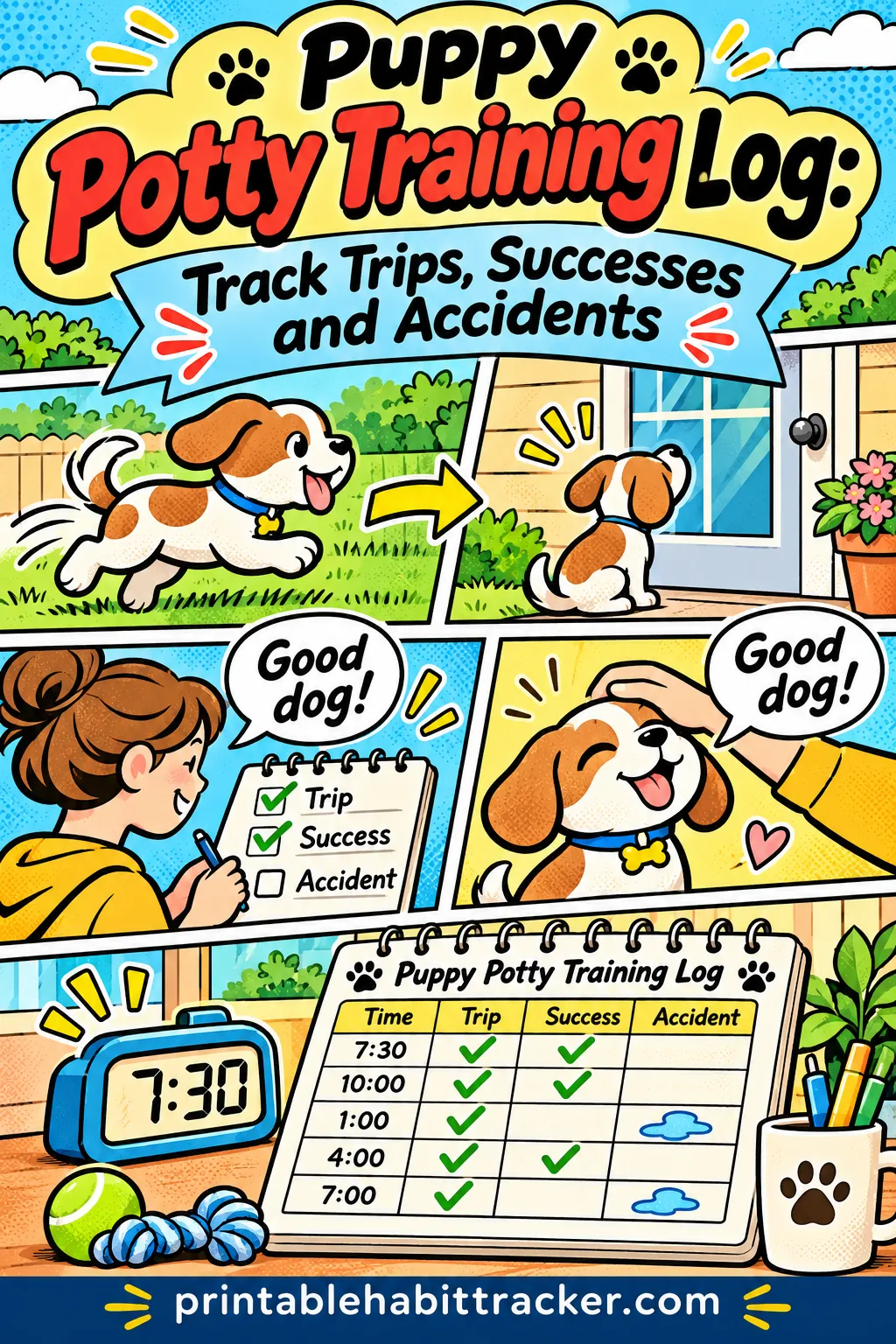
A puppy potty training log is a sheet with one row per hour (or per trigger) where you write a quick code every time your puppy goes out: P for pee, B for poop, O for a trip outside with nothing, and X for an accident indoors. Log every trip for one to two weeks and the pattern jumps off the page, so you can take your puppy out right before the moments accidents usually happen.
You don't need an app or a special notebook. You can build this exact tracker in the free printable habit tracker maker, print it, and clip it to the fridge next to the back door. This guide gives you the codes, the hourly layout, a starter schedule built around common trigger times, the exact tool settings, and a simple way to read a week of notes so the accidents start to drop.
✅ Try this tracker for one week
Tap a box each day you do the habit. Your ticks stay on this device.
Why a Log Beats Trying to Remember
Ask any new puppy owner when the puppy last peed and you'll usually get a pause. Was it after breakfast or before? Did someone else take her out at lunch? Did that trip count, or did she just sniff the grass and come back in?
That fuzziness is the real problem. Puppies are on a fast clock, and most accidents happen when the humans lose track of time, not because the puppy is being stubborn. A log fixes the memory problem in three ways.
It shows the last trip at a glance. Anyone in the house can look at the sheet and see that the last pee was 9:40, so a trip is due soon.
It shows the pattern behind accidents. One accident is just an accident. Five accidents that all happen about 20 minutes after play sessions are a pattern you can fix.
It keeps everyone consistent. When three people share puppy duty, a shared sheet stops "I thought you took him out" from happening twice a day.
Trainers and puppy guides commonly suggest logging every trip for the first week or two, along with the times of meals, naps and play. That's exactly what this sheet is built for.
What you're really tracking
You're tracking three things at once:
- When your puppy goes out. Every trip, successful or not.
- What happened. Pee, poop, nothing, or an accident inside.
- What came right before. Waking up, eating, drinking, playing, a long crate stretch, excitement from a visitor.
The third one is the secret. Accidents almost always follow a trigger, and once you know your puppy's triggers, you can beat the accident to the door.
The P, B, O and X Codes
Keep the codes short so writing one takes two seconds with a puppy tugging at your sleeve. Write this key at the top of every sheet.
| Code | Meaning | When to write it |
|---|---|---|
| P | Pee outside | Puppy peed in the right spot |
| B | Poop (bowel movement) outside | Puppy pooped in the right spot |
| O | Out, nothing happened | You went out for a few minutes, no pee or poop |
| X | Accident inside | Pee or poop happened indoors |
| XP / XB | Accident, with type | Optional: which kind of accident |
| M | Meal | Puppy ate a meal |
| W | Water | Puppy had a big drink |
| N | Nap or crate time started | Puppy settled to sleep |
| Pl | Play session | Puppy had active play |
The first four are the core codes. The extra codes (M, W, N, Pl) are optional, but they're what turn a list of trips into a real pattern. If you only have the energy for four letters, use P, B, O and X, and write the meal times in the margin.
A successful trip can have two codes. If your puppy pees and poops on the same trip, write PB in the box. A trip with nothing is just O. An accident followed by a trip outside is X in one box and whatever happened outside in the next.
Write the minute, not just the hour
If you use hourly rows, write the minute next to the code: "P :15" in the 7 AM row means a pee at 7:15. It only takes a moment and makes the pattern much clearer. "Accident at 2 o'clock" is vague. "Accident at 2:05, nap ended 1:50" tells you exactly what happened.
A Starter Schedule Built Around Trigger Times
Every puppy is different, and your vet is the right person to ask about your puppy's own needs. But most puppy guides agree on the common triggers: right after waking up, soon after eating or drinking, after play, and before being left alone or going to bed. Many owners also add regular timed trips in between.
Here's a sample day for a young puppy, built around those triggers. Use it as a starting point, then adjust it to what your log shows.
| Time | What happens | Potty trip? |
|---|---|---|
| 6:00 AM | Wake up | Yes, straight outside |
| 6:30 AM | Breakfast | Yes, a short while after eating |
| 7:00 AM | Play and training | Yes, after play |
| 7:30 AM | Nap in crate | Yes, right when the nap ends |
| 9:30 AM | Wake up | Yes, straight outside |
| 10:00 AM | Play, chew time | Yes, after play |
| 11:00 AM | Nap | Yes, right when the nap ends |
| 12:30 PM | Lunch | Yes, a short while after eating |
| 1:00 PM | Short walk or yard time | Usually covers the after-lunch trip |
| 2:00 PM | Nap | Yes, right when the nap ends |
| 4:00 PM | Play and training | Yes, after play |
| 5:30 PM | Dinner | Yes, a short while after eating |
| 7:00 PM | Family time, calm play | Yes, after play |
| 9:00 PM | Last water for the evening (ask your vet about timing) | — |
| 10:00 PM | Bedtime | Yes, last trip before the crate |
| Overnight | One or more night trips, depending on age | Yes, quick and quiet |
That looks like a lot of trips, and it is. Young puppies need to go out often. The good news is the log helps you trim the schedule over time. After a week, you'll see which trips always get a P and which ones are usually an O, and you can stretch the gaps where your puppy is clearly ready.
A rough guide for how long between trips
Many trainers share a rule of thumb that a puppy can hold it for roughly one hour per month of age, plus one, during the day. It's only a loose starting point, and plenty of puppies need to go out sooner, especially right after waking, eating or playing. Treat your own log as the real answer. If your log says your 12-week-old needs out every 90 minutes, believe the log. If your puppy seems to need to go far more often than you'd expect, or strains, or has accidents that seem different from normal, check in with your vet.
Night trips
Night trips are where a log really saves your sanity. Write the time of each one, even half asleep. After a week, you'll know whether your puppy reliably wakes at 2 AM, or whether it's random. Many owners find the night trip moves later and later on its own as the puppy grows, until one morning you realize everyone slept through. Your log will show you that happening, one night at a time.
Keep night trips boring: out, potty, praise quietly, back to the crate. No play, no big greetings. Write the code and go back to bed.
How to Make It in the Free Tool
The free habit tracker maker builds this log in a couple of minutes. There are two good ways to set it up. The hourly version gives you the clearest pattern. The trigger version is quicker to fill in and works well once you know the basics.
Setup 1: The hourly log (best for the first two weeks)
- Title. Type "Puppy Potty Training Log" or add your puppy's name, like "Biscuit's Potty Log."
- Template chip. Skip the chips. The Potty Training chip on the site is designed for toddlers, so start from an empty habits box instead.
- Your habits (one per line). Paste one row per hour of your puppy's waking day. For a 6 AM to 10 PM puppy, that's:
- 6 AM
- 7 AM
- 8 AM
- 9 AM
- 10 AM
- 11 AM
- 12 PM
- 1 PM
- 2 PM
- 3 PM
- 4 PM
- 5 PM
- 6 PM
- 7 PM
- 8 PM
- 9 PM
- 10 PM
- Overnight
- Layout. Choose Weekly. Each hour becomes a row, and each day of the week becomes a column. That grid is what lets you see the pattern: if the 2 PM row has an X on four days, you know exactly where to add a trip.
- Style. Choose Checkbox. You won't actually tick the boxes. You'll write your P, B, O or X code inside them, so plain boxes work best.
- Color theme. Classic B&W is easiest to read and write on, and it's light on ink since you'll print a few copies.
- Options. Turn on Notes/goals so you have space to write meal times, the code key and anything unusual ("visitors came at 4"). Reflection gives you a spot for a weekly summary. Leave Mood row and Reward box off for this one, unless you want to plan a treat for yourself after a good week.
- Paper. Choose Letter or A4 to match your printer, and Portrait so all 18 rows fit with room to write.
- Print. Tap 🖨️ Print / Save PDF. Print two weeks' worth at once so you're never hunting for a fresh sheet on a hectic morning.
If 18 rows feel cramped, trim the list to match your puppy's real day. A puppy that sleeps until 7 doesn't need a 6 AM row.
Setup 2: The trigger log (quicker, good from week two on)
Once you know the basics, you can switch to rows based on triggers instead of hours. This is the version the button at the top of this page opens.
Paste these into the habits box:
- Out right after waking
- Out after each meal
- Out after naps
- Out after play
- Out before bed
- Night trip
Choose Weekly layout and Checkbox style. In each box, write the code and the time: "P 7:05." Since a puppy has several naps a day, you'll often write two or three codes in the "after naps" box, so keep them small.
If you'd rather have one big page per day with more room for notes, choose the Daily layout instead. A full day on one page is roomy and calm to fill in, and the daily habit tracker layout suits owners who like to jot down details like where the puppy went and how long it took.
Which setup should you use?
| You want... | Use this setup | Layout |
|---|---|---|
| To find out when accidents happen | Hourly rows | Weekly |
| A quick log after the first week | Trigger rows | Weekly |
| Lots of room for notes each day | Hourly or trigger rows | Daily |
| A one-page summary of a whole month | Trigger rows, a single tick for an accident-free day | Monthly |
| A sheet the whole family can read fast | Trigger rows with big boxes | Weekly, Landscape |
Reading Your Log After One Week
A week of codes is where the log starts paying you back. Sit down with the sheet and a highlighter for ten minutes. Here's how to read it.
Step 1: Highlight every X. Use a bright color so accidents stand out.
Step 2: Look straight up and down each column. Did the accidents on Tuesday all cluster in the afternoon? Was Saturday messier than weekdays?
Step 3: Look across each row. This is the key step on the hourly log. If the same hour has an X on three or more days, that hour needs an extra trip or an earlier one.
Step 4: Check what came right before each X. Was it 15 minutes after a meal? Right after a nap? During a play session? Look at your notes and extra codes.
Step 5: Count the O codes. Lots of O's at one time means your puppy usually doesn't need to go then. That trip might be one you can stretch or drop.
Step 6: Make one change. Pick the single biggest pattern and change one thing. Then log another week and see if it worked.
A sample week, read out loud
Here's a simplified look at a few rows from an imagined week for a young puppy, to show what a pattern looks like on paper.
| Row | Mon | Tue | Wed | Thu | Fri | Sat | Sun |
|---|---|---|---|---|---|---|---|
| 6 AM | PB | P | PB | P | PB | P | PB |
| 9 AM | O | O | P | O | O | P | O |
| 11 AM | X | P | X | P | X | P | X |
| 2 PM | P | P | P | O | P | P | P |
| 5 PM | B | X | B | B | X | B | B |
| 10 PM | P | P | P | P | P | P | P |
What does this tell you?
- The 6 AM and 10 PM trips are working. Nearly every one is a success. Keep them exactly as they are.
- The 9 AM trip is mostly empty. Lots of O's suggests this puppy isn't ready to go then. That trip might work better a little later.
- The 11 AM row is a problem. Accidents on four days. Looking at the notes, this puppy naps from about 9:30 to 10:45. The fix is to take her out the moment she wakes, rather than waiting until the 11 o'clock trip.
- The 5 PM row has two accidents. Both happened on days dinner was early. The fix is to plan a trip a short while after dinner, whenever dinner is.
That's the whole method: find the row with the X's, look at what came before, and move the trip to beat it.
Common patterns and what they usually mean
| What your log shows | What it often means | What to try |
|---|---|---|
| Accidents shortly after naps | Puppy wakes and goes right away | Take puppy out the moment she stirs |
| Accidents during or after play | Excitement and movement trigger the need | Add a trip mid-play and right after |
| Accidents a while after meals | Digestion kicks in after eating | Plan a trip a short time after each meal |
| Lots of O's, then an X soon after coming in | Puppy got distracted outside | Stay out a little longer, on leash, in one spot |
| Accidents in one room only | Puppy may not see that room as "home" | Supervise closely there or limit access for now |
| Accidents mostly on busy days | Schedule slipped when people were distracted | Set phone reminders on those days |
| Accidents when one person is in charge | Different routines between family members | Go over the log together and agree on the schedule |
| Sudden jump in accidents after good progress | Could be a change in routine, or something health-related | Check for changes, and call your vet if it continues |
The last row matters. If your puppy was doing well and suddenly has lots of accidents, seems uncomfortable, or pees much more often than usual, don't just adjust the schedule. Call your vet. A potty log is great to bring to that appointment, because it shows exactly when things changed.
Accidents and Crate Time
Accidents and crate time are the two parts of the day that show up most on a potty log, so it helps to have a plan for both.
What to do the moment an accident happens
Your log will have X's in it, especially in the first week. That's expected. How you handle each one matters more than how many there are.
If you catch it mid-accident, calmly interrupt with a cheerful sound, scoop up or lead your puppy outside, and wait. If she finishes outside, praise warmly. Then write X in the box for the accident and P or B in the next box for the finish outside.
If you find it afterward, just clean it up. Your puppy won't connect a scolding to something that happened earlier, so there's nothing to gain from it. Write the X with your best guess at the time, and add a note like "found at 3:10, last trip 1:45."
Never punish an accident. Yelling, rubbing a puppy's nose in it, or any kind of harsh correction tends to teach a puppy to hide when she needs to go, which makes training harder. The log is your tool for preventing the next one, not a record of bad behavior.
Clean thoroughly. Puppies are drawn back to spots that smell like a bathroom. Use a cleaner made to break down pet messes, and follow the directions on the label. Write "cleaned" in the note so everyone knows it's done.
Praise the good trips, right away. When your puppy goes in the right spot, praise her the moment she finishes, outside, not after you come back in. A small treat right then helps too. Many owners keep a little pouch of treats by the door for exactly this.
The crate and potty schedule together
If you use a crate, it fits naturally into the log. The crate gives your puppy a cozy place to rest, and most puppies try not to soil the spot where they sleep. That makes the time right after crate time one of the most predictable potty moments of the day.
Add these habits to your log to track crate and potty time together:
- Crate in (write the time)
- Crate out (write the time)
- Out right after crate
When you see a crate-out time followed by a P within a few minutes, day after day, you know the routine is working. If you see an X right after crate time, you may be waiting too long between opening the crate and getting outside. Carry a small puppy straight out, or clip the leash on before you open the door.
Crate time should feel safe and calm. How long a puppy can comfortably stay crated depends on age and the individual dog, so ask your vet or a qualified trainer what's right for yours. Your log will also show you how long your puppy tends to rest before needing out.
Sharing the Log With Your Household
A potty log works best when everyone uses it. If one person logs every trip and another forgets, the pattern gets muddy. Here's how to keep it simple for a whole family.
Put the sheet where the leash lives. The best spot is right by the door you use for potty trips, at adult eye level. Tie a pen to it with string. If the pen walks off, the log stops.
Add initials. Ask each person to write their initial after the code: "P 7:05 J." That way you know who took the trip, and nobody has to ask.
Use the same words outside. Agree on one potty cue word, like "go potty," and have everyone use it. Write it at the top of the sheet so visitors and sitters use it too.
Give kids a job they can do. Younger kids can't always manage the trips, but they can help with praise or with coloring in a box when a trip is a success. Older kids can take daytime trips and write the codes. If your family already uses a shared chores sheet, the ideas in family chore habit tracker work well for splitting puppy duties too.
Leave a quick note for sitters. If someone else is watching the puppy for a day, the log tells them everything: when she last went, when she usually needs to go, and what word to use.
| Who | What they log | Tip |
|---|---|---|
| Main caregiver | Every trip, meals, naps, notes | Do the weekly review |
| Partner or roommate | Trips on their shifts | Add initials |
| Older kids | Daytime trips after school | Keep a treat pouch by the door |
| Younger kids | Color in success boxes | Let them choose the color |
| Sitter or dog walker | Trips during their visit | Leave the code key on the sheet |
Changing the Log as Your Puppy Grows
Your puppy won't need an hourly log forever. As the accidents drop, change the log to match. Here's a rough path many owners follow. Go at your puppy's pace, not the calendar's.
| Stage | What your log looks like | Signs it's time to move on |
|---|---|---|
| First week or two home | Hourly rows, every trip logged with codes and times | You can predict most trips before they happen |
| Settling in | Trigger rows, codes and times | Accidents are rare and usually explained by a change in routine |
| Getting reliable | Trigger rows, a tick for success, X only for accidents | Several weeks with very few or no accidents |
| Mostly trained | Monthly sheet, one tick per accident-free day | A long run of accident-free days |
| Done | No log, or log only during changes like travel or a move | — |
Keep your old sheets. When something changes, like a move, a new baby, a vacation, or a new family member, accidents can come back for a bit. Pulling out a fresh hourly log for a week is often the quickest way to get back on track. For a calm, one-page summary of a month, a habit tracker with notes gives you a small space each day to write what happened.
When to stop logging
Most owners stop logging when they can't remember the last accident and the schedule has settled. There's no exact day. If you find yourself writing "P" in the same boxes every day without ever seeing an X, the log has done its job. Set it aside and keep the routine going.
Quick Checklist for Your First Day With the Log
Print this list and tape it beside your sheet:
- Code key at the top of the sheet (P, B, O, X)
- Pen tied to the clipboard or fridge
- Treat pouch by the door
- Leash hanging right next to the sheet
- One potty cue word agreed by everyone
- Meal times written in the notes
- Nap and crate times written as they happen
- Every trip logged, even the empty ones
- Every accident logged honestly, no backfilling
- A ten-minute review planned for the end of the week
Ready to print your puppy log
Here's the whole plan. Print a log. Write the code key at the top. Take your puppy out after every wake-up, meal, nap and play session, and write down what happened every single time. After one week, highlight the X's and look at what came right before each one. Change one thing and log another week.
You can build this exact tracker right now. It opens with the trigger rows, the weekly layout and checkbox style already filled in, so all you need to do is pick your paper size and print. If you'd rather use hourly rows, open the free printable tracker maker and paste in the hours from the setup above.
Frequently Asked Questions
What is a puppy potty training log?
It's a simple sheet where you write down every potty trip your puppy takes, what happened on that trip, and what came right before it. Most logs use short codes like P for pee, B for poop, O for nothing and X for an accident inside. After a week or two, the log shows you when your puppy usually needs to go.
What do P, B, O and X mean on a potty chart?
P means your puppy peed outside, and B means she pooped outside. O means you went out and nothing happened. X means there was an accident indoors, and you can add a P or B after it to note which kind.
How long should I keep a puppy potty training log?
Many puppy guides suggest logging every trip for the first one to two weeks. After that, you can switch to a simpler trigger-based log and keep using it until accidents are rare. Bring the log back for a week whenever your routine changes, like during travel or a move.
How often should I take my puppy out?
Young puppies usually need to go out right after waking, a short while after eating or drinking, after play, and before bed, plus regular trips in between. How often depends on your puppy's age, size and habits, so ask your vet for guidance. Your own log is the best way to fine-tune the schedule.
Should I log the trips where nothing happens?
Yes. The O trips are just as useful as the P and B trips. A row full of O's shows a time when your puppy usually doesn't need to go, so you can stretch that gap and spend your trips where they matter.
My puppy has accidents right after coming inside. What does that mean?
It often means your puppy got distracted outside and didn't finish. Try staying out a little longer, keeping her on leash in one spot, and waiting quietly until she goes. Log the time you spent outside so you can see what works.
Can I use the same log for an adult rescue dog?
Yes. Adult dogs who are new to a home sometimes need a refresher, and the same codes work well. Start with trigger rows rather than hourly rows, since adult dogs can usually wait longer between trips. If accidents continue, ask your vet to rule out any health cause.
Is the potty training chart on this site meant for puppies?
The site's Potty Training template is made for toddlers, with kid-friendly rows. For a puppy, use the setup in this guide instead: either hourly rows or trigger rows, with the P, B, O and X codes written in each box.