Holiday Eating Habit Tracker: Veggies First, Water and a Walk After Dinner
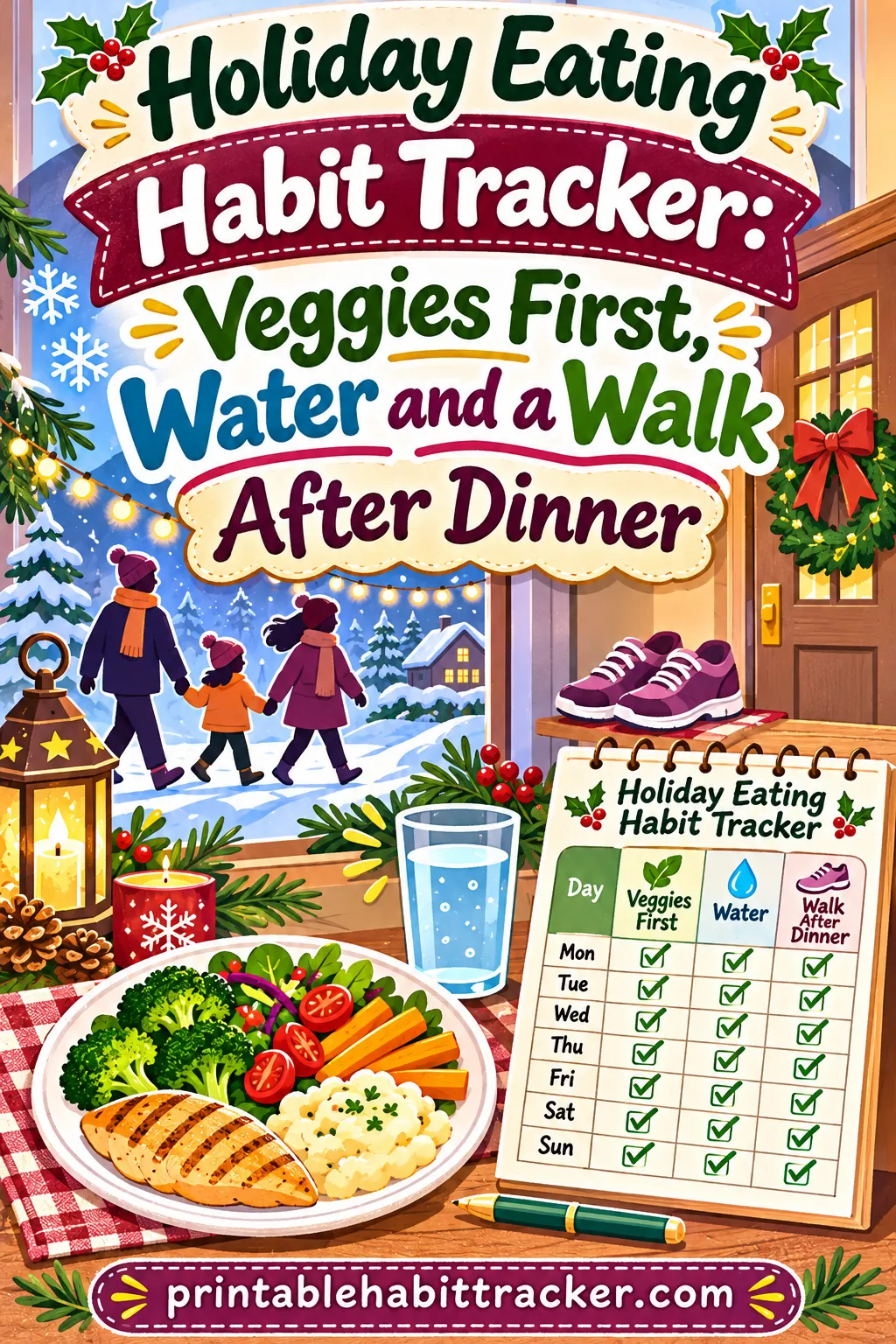
You don't need a holiday diet; you need four or five tiny eating habits you can check off around the meals you're already going to enjoy: a protein breakfast, vegetables first at big meals, a glass of water before a party, a 10-minute walk after dinner and getting back on track at the very next meal. Those habits leave room for the cookies and the big family dinner. They just stop one feast from turning into a month of grazing and guilt.
You can print this as a weekly sheet with our free printable habit tracker maker. Build this exact tracker and it opens with these five habits, a weekly layout and a color-in style already set, so you can print it today.
Below you'll find why each habit works, how to set up the sheet with exact settings, a party-day and a feast-day plan, a week-by-week plan from Thanksgiving to New Year's, a sample filled-in week, troubleshooting, and versions for hosts, travelers, families and shift workers.
A quick note before we start: this is a set of everyday habits, not a medical plan or medical advice. If you have diabetes, a heart condition, a history of disordered eating or any diet your doctor has given you, follow their advice first and talk to your doctor before changing how you eat.
✅ Try this tracker for one week
Tap a box each day you do the habit. Your ticks stay on this device.
Why Holiday Eating Goes Sideways (It's Not the Big Dinner)
Most people blame the big holiday meal. But one big meal is just one meal. What actually adds up over the season is everything around it.
The real culprits
Think about a typical December week:
- A box of cookies arrives at work and sits in the break room for five days.
- You skip breakfast because you're busy, then eat whatever's around by 11 a.m.
- You arrive at a party starving and spend two hours standing next to the appetizer table.
- Leftovers sit on the counter, so you nibble every time you walk through the kitchen.
- After a big dinner, you sit on the couch for three hours, and the next morning you think, "Well, I already blew it."
None of that is about the main meal. It's about meal timing, hunger, the environment and the all-or-nothing story that follows a big day.
The guilt spiral
That last point matters most. Many people treat one heavy meal as proof that the season is lost. They decide to "start over in January," and the result is weeks of eating with no structure at all, followed by a harsh January plan that rarely lasts.
A tracker flips this. Instead of judging the meal, you just ask, "Did I do my five small habits today?" A big dinner doesn't erase a check for protein at breakfast or a walk afterward. And the fifth habit, getting back on track at the next meal, makes recovery part of the plan instead of a failure.
Why habits instead of rules
Rules sound like "no dessert," "no second helpings" or "only one cookie." They're hard to keep at a family table and they tend to make food feel loaded. Habits sound like "eat vegetables first" or "walk after dinner." They add something rather than ban something, and they still work on a day with pie.
Well-known health sources, including university health centers and major health publishers, give the same handful of practical tips for the holidays: eat vegetables first, get protein earlier in the day, drink water, take short walks and get back to your normal eating at the next meal. This tracker simply turns that advice into five boxes.
The Five Habits and Why Each One Works
Each habit is small, easy to check and fits around holiday plans instead of fighting them.
1. Protein breakfast
Starting the day with some protein, such as eggs, Greek yogurt, cottage cheese, a smoothie with milk or a nut butter on toast, helps many people feel fuller through the morning. That makes you less likely to arrive at lunch, or a party, already ravenous.
Counts as a check: any breakfast with a clear protein source. Doesn't need: a big cooked breakfast. A yogurt cup and a piece of fruit is enough.
2. Veggies first at big meals
At a holiday dinner, put vegetables or salad on your plate first and start with them. You still get everything else. You just eat the vegetables while you're hungriest, which tends to leave a little less room for the third trip back to the rolls.
Counts as a check: at your biggest meal of the day, you started with vegetables or salad. On days with no big meal: check it if your main meal included vegetables.
3. Water before the party
Drink a full glass of water before you head out to a party or sit down to a big meal. Thirst can feel a lot like hunger, and a glass of water is also a small pause before the food starts. On days with no event, use it before dinner.
Counts as a check: a full glass of water before your main event or main meal.
4. 10-minute walk after dinner
A short walk after a big meal feels good, helps you get out of the "food coma" and gets everyone away from the leftovers. It's also an easy family activity on holiday evenings: walk to see the neighborhood lights, walk the dog, or just loop the block.
Counts as a check: about 10 minutes of walking after your largest meal. Bad weather? Walk indoors: stairs, the hallway, a mall loop or a few laps of the house while you tidy.
5. Back on track next meal
This is the habit that makes the other four work. After a big meal, a party or a day of nibbling, your next meal is a normal one. Not a skipped meal, not a punishment, not a "cleanse." Just your regular breakfast or lunch.
Counts as a check: your first meal after a big eating day was a normal, balanced meal. On ordinary days: check it if your meals were roughly normal. It's a way of noticing you never left the track.
Quick reference
| Habit | When you do it | What counts | Time it takes |
|---|---|---|---|
| Protein breakfast | Morning | Any breakfast with protein | 5 to 10 minutes |
| Veggies first at big meals | Your biggest meal | Start with vegetables or salad | No extra time |
| Water before the party | Before the main event or meal | One full glass | 1 minute |
| 10-minute walk after dinner | After the largest meal | About 10 minutes of walking | 10 minutes |
| Back on track next meal | The meal after a big one | A normal, balanced meal | No extra time |
That's under 25 minutes of extra effort a day, and most of it is the walk.
How to Make Your Holiday Eating Habits Tracker in the Free Tool
Setting this up takes about two minutes. If you used the preset link above, everything is already filled in. Otherwise, open the free printable habit tracker maker and use these settings.
Exact settings
| Setting | Choose | Why |
|---|---|---|
| Title | Holiday Eating Habits | Friendly and clear, no diet language |
| Start from a preset | Optional: Meals & Nutrition, then replace the rows | A head start if you're building your own list |
| Your habits (one per line) | Protein breakfast, Veggies first at big meals, Water before the party, 10-minute walk after dinner, Back on track next meal | Five short, specific rows |
| Layout | Weekly | Your habits down the side, 7 days across the top |
| Tracking style | Color-in | Quick to fill and shows a clear pattern |
| Color theme | Sage, Sunset or Classic (B&W) | Sage and Sunset feel seasonal; B&W saves ink |
| Color-code habits | On | Each habit gets its own color, so the week reads at a glance |
| Extras | Notes / goals, Reflection | Space for your event list and a weekly look-back |
| Paper | Letter or A4 | Whatever your printer uses |
| Orientation | Portrait or Landscape | Landscape gives wider day boxes |
Check the live preview, then press 🖨️ Print / Save PDF. Save the PDF too, because you'll want a fresh sheet each week from late November into early January.
Why weekly instead of monthly
Holiday eating changes week to week. One week has two parties, the next has a big family dinner, and the week after is quiet. A weekly sheet lets you look at your calendar every Sunday, write that week's events in the Notes box and start fresh. A missed week doesn't sit on the same page as a great one.
It also keeps the page from feeling like a month-long test. Seven days is easy to look at and easy to restart. If you'd rather see the whole season on one page, the Monthly layout works too.
Color-in and color-coding
With color-coding on, each habit row gets its own color. With the color-in style, you fill a square for each habit you hit. After a few days, you can see which habits are easy (a solid stripe) and which ones slip (gaps). Our page on the weekly habit tracker shows more layouts if you want to compare.
Where to put the sheet
On the fridge is the obvious spot, and it's a good one, because you see it right when you're deciding what to eat. Inside a kitchen cabinet works if you'd rather keep it private. Mark it after dinner, ideally right after the walk.
Party-Day and Feast-Day Plans
The tracker is easiest to use when you know ahead of time how each habit fits a specific kind of day. Here are simple plans for the three days that cause the most trouble.
The evening party
Parties are tricky because they usually come at the end of a long day, with snacks out for hours and no clear mealtime.
Before: - Eat your normal breakfast with protein and a normal lunch. Don't "save up" by skipping meals. Arriving starving makes the appetizer table much harder to walk past. - About an hour before you leave, have a small snack if dinner won't be served for a while: a piece of fruit with some cheese, or a handful of nuts. - Drink a full glass of water before you head out. Check the water box.
During: - Do one lap of the food table before picking anything up. Then fill a small plate with what you actually want, and start with any vegetables on offer. If there's a veggie tray, that counts for "veggies first." - Step away from the food table to talk. Conversations near the snacks tend to turn into grazing. - Keep a glass of water or sparkling water in your hand. It gives your hands something to hold.
After: - If you get home early enough, walk for 10 minutes. If not, take your walk the next morning and check it then. Be flexible here; the goal is the habit, not the clock. - Tomorrow's breakfast is your normal protein breakfast. That's your "back on track" check.
The big family dinner
This might be Thanksgiving, Christmas Eve, Christmas Day or any other holiday meal. It's a day to enjoy, so the plan is light.
Morning: - Eat breakfast. A protein breakfast keeps you steady through hours of cooking smells and kitchen tasting. - If you're cooking, keep a glass of water by the stove and finish it before guests arrive.
At the table: - Put vegetables on your plate first: green beans, salad, roasted carrots, whatever's there. Start with those. - Then take what you love. Skip the dishes you only eat out of habit and save room for your favorites. - Eat slowly and put your fork down while you talk.
After the meal: - Suggest a family walk before dessert, or right after. Ten minutes around the block works. Many families find this becomes a tradition kids look forward to. - Pack leftovers into containers and put them in the fridge before everyone settles in. Food out of sight gets nibbled a lot less.
Next day: - Normal breakfast, normal lunch, maybe a leftover plate for dinner. Check "back on track next meal" and move on.
The cookie-and-candy day at work
When treats show up in the break room, it's the all-day grazing that adds up, not one cookie.
- Have your protein breakfast before work so you're not hungry at 10 a.m.
- Decide on one treat, choose it on purpose, and eat it sitting down instead of standing in the break room.
- Bring a water bottle to your desk and refill it after lunch.
- Walk for 10 minutes after lunch if your workday makes an evening walk unlikely. It still counts for the walk habit that day.
Scripts for food pushers
Sometimes the hardest part isn't the food. It's the relative who keeps filling your plate. A few kind, simple lines:
- "Everything's so good. I'm going to finish this plate and see how I feel."
- "I'd love to take some home for tomorrow, if you have extra."
- "I'm saving room for your pie."
- "No thanks, I'm happily full."
You don't owe anyone an explanation about your eating habits. A warm "No thanks, it was wonderful" is enough.
A Week-by-Week Plan From Thanksgiving to New Year's
The holiday eating season usually runs about six weeks. Here's how to use the tracker through each stretch. Print one weekly sheet at a time, or print six copies at once and keep them in a folder.
| Week | What's usually happening | Focus habit | Tip |
|---|---|---|---|
| Thanksgiving week | Big dinner, leftovers for days | Walk after dinner | Start a family walk tradition on the big day |
| Early December | First parties, treats at work | Water before the party | Write each event in the Notes box on Sunday |
| Mid-December | Peak party season, baking | Protein breakfast | Never arrive at an event starving |
| Week before Christmas | Cooking, shopping, travel | Back on track next meal | Plan simple meals for busy days |
| Christmas week | Feasts, leftovers, guests | Veggies first at big meals | Put vegetables out first at every meal you host |
| New Year's week | Quieter days, more snacks at home | Walk after dinner | Use free afternoons for longer walks |
Each week still tracks all five habits. The "focus habit" is just the one to pay extra attention to that week.
Your Sunday setup (5 minutes)
Each Sunday, do three things:
- Print a fresh weekly sheet from your saved PDF.
- Look at your calendar and write the week's events in the Notes box, like "Wed office party, Sat family dinner."
- Look at last week's sheet. Which habit had the most gaps? Make a small plan for it, like "set out yogurt and fruit the night before" for breakfast.
That's the whole weekly routine. It takes less time than reading a recipe.
Your nightly check (30 seconds)
After dinner or after your walk, fill in the boxes for the day. Be honest: color only what you did. If you didn't hit a habit, leave it blank. Empty boxes aren't failures. They're information you'll use on Sunday.
If you miss marking the sheet one night, fill it in the next morning while you still remember.
A Sample Week on the Tracker
Here's what a realistic December week might look like. A filled square (■) means the habit was done; a blank means it wasn't.
| Habit | Mon | Tue | Wed | Thu | Fri | Sat | Sun |
|---|---|---|---|---|---|---|---|
| Protein breakfast | ■ | ■ | ■ | ■ | ■ | ■ | |
| Veggies first at big meals | ■ | ■ | ■ | ■ | ■ | ■ | |
| Water before the party | ■ | ■ | ■ | ■ | ■ | ■ | |
| 10-minute walk after dinner | ■ | ■ | ■ | ■ | ■ | ||
| Back on track next meal | ■ | ■ | ■ | ■ | ■ | ■ | ■ |
Notes box for this week: "Wed office party, Fri neighbor's open house, Sat family dinner at Mom's."
Reading the sample week
Add up the squares: 6 for protein breakfast, 6 for veggies first, 6 for water, 5 for the walk and 7 for back on track. That's 30 out of 35, or about 86 percent, in a week with three events.
A few patterns jump out:
- The walk slipped on Tuesday and Friday. Tuesday was a late workday and Friday was the open house. A lunchtime walk on busy days might fix both.
- Thursday's breakfast got skipped. That was the morning after the office party. It's worth setting out a quick breakfast the night before an event.
- Back on track stayed solid all week. That's the habit that matters most, because it means no single day turned into a week of grazing.
A worked example: one person's first two weeks
Sam usually skips breakfast, snacks all afternoon and ends up overeating at holiday events. Sam prints the preset with the build this exact tracker link and starts the Monday after Thanksgiving.
Week 1: Sam colors in 21 of 35 squares. The walk shows up only twice, and protein breakfast four times. Water and back on track are strong.
On Sunday, Sam looks at the gaps. Breakfast fails on rushed mornings, so Sam buys yogurt cups and keeps hard-boiled eggs in the fridge. The walk fails because dinner is late, so Sam switches to a walk after lunch on workdays and after dinner on weekends, writing that rule in the Notes box.
Week 2: Sam colors in 29 of 35 squares, with two parties that week. Breakfast happens six days out of seven. The walk happens five times. Sam notices that on days with a protein breakfast, the afternoon snacking is noticeably lighter, and writes that in the Reflection box.
Sam never followed a diet. Sam just added five small habits and adjusted the two that didn't fit.
Variations for Hosts, Travelers, Families and Shift Workers
The five habits work for most people as written, but a few small changes help them fit different holiday situations.
If you're hosting
Hosts face a special problem: they're around food all day, tasting while cooking, then eating late after everyone's served. Try these swaps:
| Original habit | Host version | Why |
|---|---|---|
| Water before the party | Water before guests arrive | You're already at the party, so tie it to the doorbell |
| Veggies first at big meals | Put a vegetable dish out first | Guests start with it too, and you set the tone |
| 10-minute walk after dinner | Lead a family walk | You get guests out of the kitchen while dishes soak |
One more tip: make yourself a real plate and sit down with it. Hosts often "eat" by picking at serving dishes all evening and never feel like they've had a meal.
If you're traveling
Travel days scramble meal timing. Airports, road trips and relatives' kitchens all make it harder to eat the way you normally do.
- Protein breakfast on the road: pack a few shelf-stable options such as nuts, nut butter packets or protein bars so breakfast isn't whatever the gas station has.
- Water: carry an empty bottle through security and fill it before boarding, or keep a filled one in the car.
- Walk: walk the terminal while you wait, or take a 10-minute loop at a rest stop.
Take a photo of your weekly sheet or fold it into your bag. Mark your squares when you get a quiet moment.
For families with kids
Kids can join in, and they often love having their own row to color. Keep the kid version simple and positive:
- "Ate something green"
- "Drank water at dinner"
- "Family walk"
Avoid any rows about how much a child eats, desserts or "good" and "bad" foods. The goal for kids is fun, shared habits, not food rules. A family walk to see the lights after dinner is an easy win that everyone can color in together.
For shift workers and holiday workers
If you work nights or long holiday shifts, "breakfast" and "dinner" might not line up with the clock. Rename the rows to match your day:
- "Protein at my first meal" instead of "Protein breakfast."
- "Walk after my main meal" instead of "after dinner."
- "Water before shift" instead of "before the party."
Each column is one of your days. The idea stays the same even if the times don't.
If five habits feel like too many
Cut to three: water before the party, veggies first and back on track next meal. Those three cost almost no time and cover the moments that matter most. Add the other two back when life is calmer.
Troubleshooting and Getting Back on Track
Even with tiny habits, some days won't go to plan. Here's what to do when things slip.
| Problem | What's probably happening | What to try |
|---|---|---|
| I keep skipping breakfast | Mornings are rushed | Set out a yogurt or boiled eggs the night before |
| I forget the water until I'm already eating | No cue before leaving | Drink it while putting your coat on, or set a phone reminder |
| The walk never happens after dinner | Late meals, cold dark evenings | Walk after lunch instead, or walk indoors |
| There are no vegetables at the party | Snack-only event | Eat a vegetable-rich snack at home first and check the box |
| I nibble leftovers all evening | Food is on the counter | Pack leftovers into containers right after the meal |
| One bad day turned into three | All-or-nothing thinking | Color in the next normal meal and move on, no catching up |
| I feel guilty looking at empty boxes | Treating the sheet like a test | Read it as information, then make one small change on Sunday |
| My whole week fell apart | Travel or illness | Start a fresh sheet tomorrow; you don't have to wait for Monday |
The "next meal" rule, in detail
This is the habit people find hardest, because it asks you to do nothing special. After a heavy day, there's a strong pull to "make up for it" by skipping breakfast or eating very little the next day. That often backfires: you get very hungry, and by afternoon you're grazing again.
The next-meal rule is simpler. After any big meal, the next one is just normal. A normal breakfast. A normal lunch. No skipping, no punishing. That's it. When you check this box, you're proving to yourself that a single meal is just a single meal.
If you notice you're often feeling out of control around food, stressed after eating or caught in a cycle of restricting and overeating, please talk to your doctor or a registered dietitian. A habit tracker is a helpful tool, but it isn't the right tool for every situation.
Carrying the habits into January
When the holidays end, you don't need a new plan. Keep the same sheet and change two words:
- "Water before the party" becomes "Water before dinner."
- "Veggies first at big meals" becomes "Veggies at lunch and dinner."
The protein breakfast, the walk after dinner and the next-meal rule stay exactly as they are. They're useful all year. Because you've been doing them through the hardest eating season, January doesn't feel like a fresh start from zero. If you want to track more food habits alongside these, the meal and nutrition tracker page has more ideas, and the water intake tracker is handy if hydration is a focus. Linking a new habit to something you already do also helps it stick; our guide to habit stacking explains how.
Print your first week
You don't have to choose between enjoying the holidays and feeling good in January. Five small habits on one weekly sheet let you have both: the pie, the cookies, the big dinner and a steady routine around them.
Build this exact tracker, print your first week, write your events in the Notes box and put it on the fridge. Then color in your first square tomorrow morning with a protein breakfast.
Frequently Asked Questions
What should I track on a holiday eating habits tracker?
Track small actions, not foods to avoid. A good starter set is a protein breakfast, vegetables first at big meals, a glass of water before parties, a 10-minute walk after dinner and getting back on track at the next meal. Each takes little time and fits around holiday plans.
Is this a diet?
No. Nothing on the tracker bans a food or counts calories. It's five small habits that add structure around the meals you're already going to enjoy. If you've been given a specific eating plan by your doctor, follow that first.
Can these habits help me avoid holiday weight gain?
They're common, practical tips that many health sources recommend for the holidays, and they help many people avoid weeks of grazing. Everyone's body is different, though, and this isn't medical advice. Talk to your doctor if you have questions about your weight or health.
Should I skip meals before a big holiday dinner?
It's usually better not to. Arriving very hungry makes it harder to eat the way you'd like once the food is out. Eat a normal breakfast with some protein, and have a small snack if dinner is late.
What if there's no time for a walk after dinner?
Walk at a different time that day, like after lunch, and check the box. An indoor walk, a few flights of stairs or a walk while you tidy up all count. The habit is moving a little after eating, not walking at one exact time.
Should I use a weekly or monthly layout?
Weekly is best for holiday eating because each week brings different events, and a fresh sheet every Sunday helps you plan for them. Monthly works if you'd rather see the whole season on one page. Both are free in the same tool.
Can kids use this tracker too?
Yes, with kid-friendly rows like "Ate something green," "Drank water at dinner" and "Family walk." Keep it positive and avoid rows about portion sizes or desserts. Let kids color in their own squares.
What do I do after a day when I overate?
Make your very next meal a normal one and check "back on track next meal." Don't skip meals or try to make up for it. One big day is just one day, and your tracker will show that the rest of the week stayed steady.