Holiday Gift Spending Tracker: Per-Person Limits and a Daily List Check
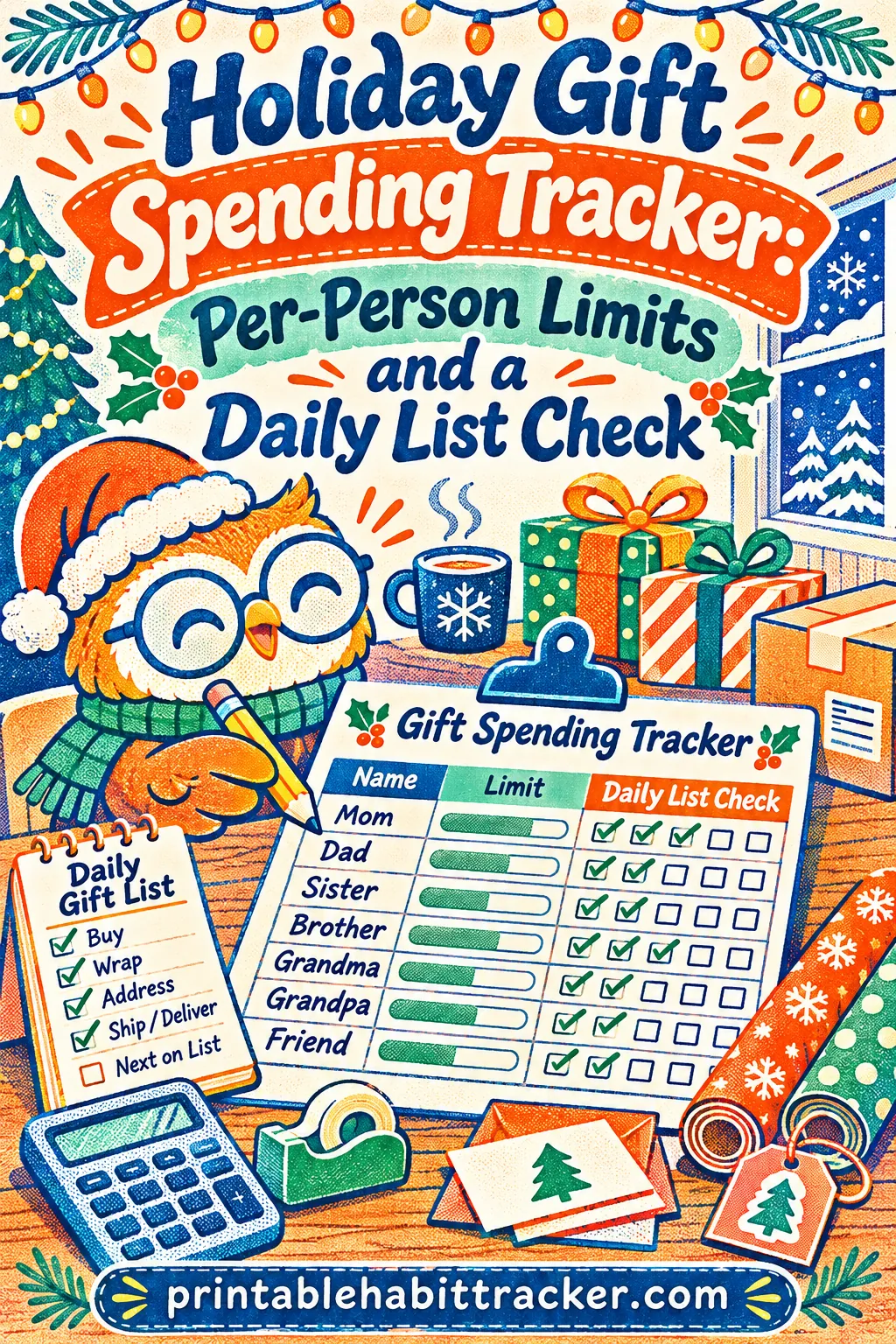
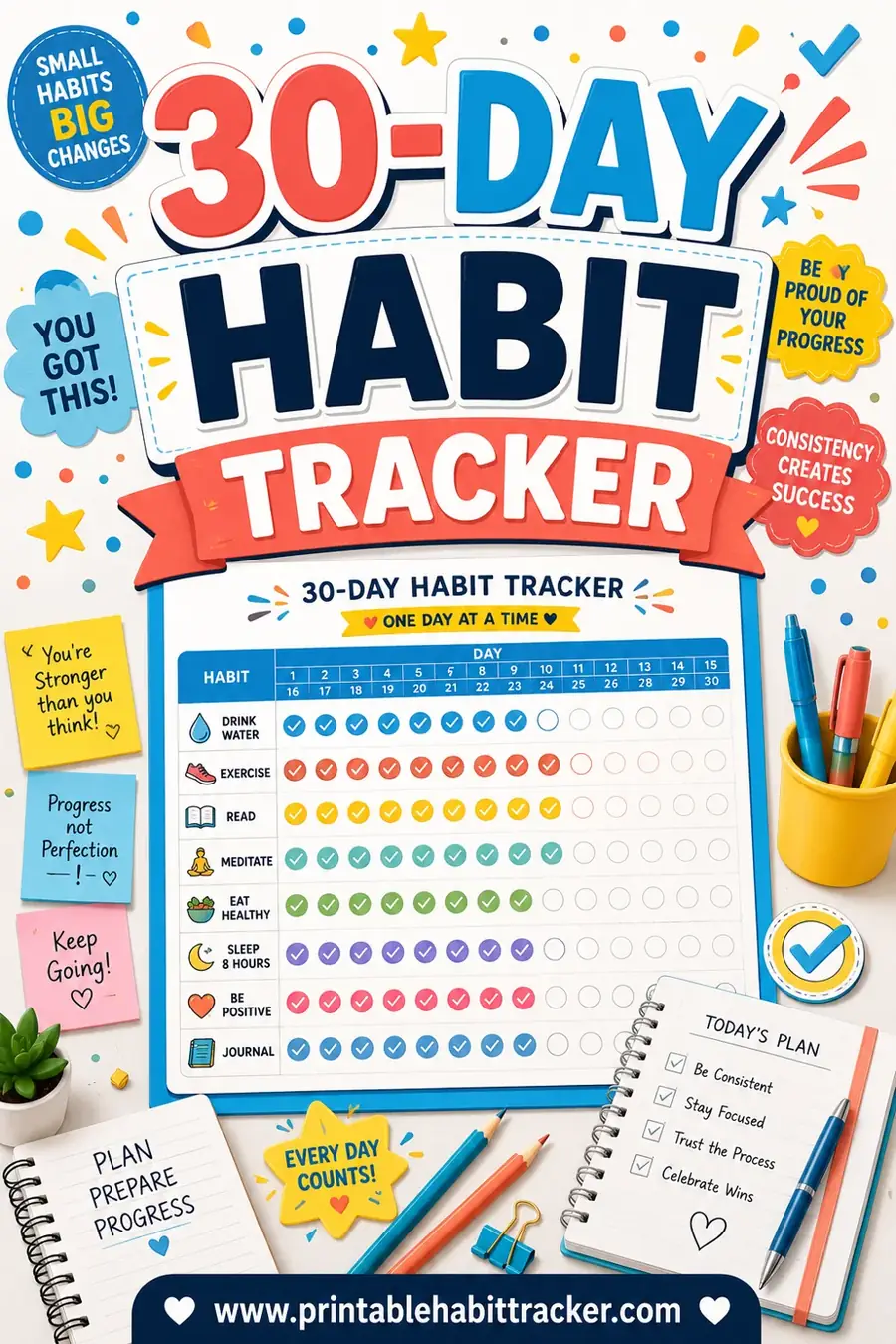
The simplest holiday spending tracker is a one-page December sheet where you check off five quick habits each day: log every gift the moment you buy it, check how many gifts are left on your list, stay inside each person's gift limit, skip rush buys, and look at the whole list once a week. Print it free with the habit tracker maker on this site, pair it with a gift list that sets a number of gifts per person, and you'll always know where you stand without adding up a single receipt.
You can set up the daily sheet in about two minutes with the free printable habit tracker maker, or build this exact tracker with the title, five habits, monthly layout and checkbox style already filled in.
This guide shows you how to set your gift plan in numbers (gifts per person, not amounts), what each daily check means, the exact tool settings, a worked example for a family planning 22 gifts, a week-by-week timeline from mid-November to Christmas Eve, a quick "does this gift fit the plan?" test, and fixes for the moments when the plan starts to slip.
✅ Try this tracker for one week
Tap a box each day you do the habit. Your ticks stay on this device.
Why Gift Plans Fall Apart in December
Most people do make a plan. Sometime in November, they sit down, list the people they buy for and decide roughly how much they'll give. It feels good. Then December arrives, and the plan quietly dissolves.
Here's how it usually happens:
- Gifts don't get written down. You grab a little something for your niece while picking up groceries. You order a sweater late at night. A week later, you can't remember if you already bought for your brother, so you buy again "just in case."
- The list lives in your head. Without a written list, every store trip turns into a fresh decision. And decisions made in a busy aisle tend to add items, not remove them.
- Extras sneak in. One gift becomes a gift plus a stocking stuffer plus "something small to open on Christmas Eve." Nobody planned the extras, so nobody counted them.
- Wrap, cards and shipping get forgotten. People plan the gifts and forget everything around them: wrapping paper, tape, tags, boxes for shipping, cards and stamps. These add trips, time and items you didn't plan for.
- The last week turns into panic buying. When you lose track of who's covered, the final days before Christmas become a rush to "make sure everyone has something," which is exactly when plans break.
Notice that none of these problems are about math. They're about tracking. People don't overspend because they can't add. They overspend because they stop looking at the list.
That's why a habit tracker works so well here. Instead of a complicated spreadsheet, you're building a few tiny daily habits that keep the list in front of you: write it down, check what's left, stick to the limit, wait before buying, review once a week. A checkbox for each one turns a fuzzy intention into something you can see.
Set Your Gift Plan in Numbers
Before you print anything, decide your plan. This tracker uses counts, not amounts. You decide how many gifts each person gets, and you track gifts against that number. If you also keep a household budget with amounts, keep it on its own sheet. The budget tracker page shows how to set up category rows for that.
Counting gifts has a few big advantages:
- It's quick. You don't need a receipt or a calculator. You just ask, "Is this gift number one or number two for Mom?"
- It's easy to share. A partner or older child can follow a count instantly.
- It catches the real problem. Most overspending comes from extra gifts and duplicate buys, and a count shows both right away.
Step 1: List everyone you buy for
Write down every person or household. Include the ones people tend to forget: teachers, coaches, a neighbor, a host gift for a holiday dinner, a gift exchange at work, a donation-drive item, and the "just in case" gifts some people keep on hand. If they'll get something, they go on the list.
Step 2: Group them and set a per-person limit
Put people into groups and give each group a gift count. Here's a sample setup many families use. Adjust it to fit your traditions.
| Group | Example people | Gifts per person | Notes |
|---|---|---|---|
| Your kids | Each child | 4 | One thing they want, one they need, one to wear, one to read |
| Partner | Your spouse or partner | 2 | One main gift and one small stocking gift |
| Close family | Parents, siblings | 1 | One thoughtful gift each |
| Nieces and nephews | Each child | 1 | Could be a shared family gift instead |
| Teachers and coaches | Each adult | 1 | A card plus one small item, or a group gift |
| Neighbors | Each household | 1 | Homemade treats count as one gift |
| Gift exchanges | Work or friend swap | 1 | The exchange rules set the item |
| Hosts | Anyone hosting you | 1 | Plan it now so it isn't a last-minute grab |
The "want, need, wear, read" idea for kids is a popular rule of thumb because it naturally caps the count at four while still covering the gifts kids enjoy most. Use it if it helps, or pick any number that fits your family.
Step 3: Add up your total gift count
Multiply each group by its limit and add the totals. This is your gift plan number, the one number you'll check against all month.
For example: 2 kids at 4 gifts each (8), 1 partner at 2 (2), 4 close family at 1 (4), 3 nieces and nephews at 1 (3), 2 teachers at 1 (2) and 1 gift exchange (1) adds up to 20 gifts.
Write that number big at the top of your gift list: Gift plan: 20.
Step 4: List the extras as items, too
Here's the step most people skip. Wrapping, cards and shipping aren't gifts, but they do need planning. Instead of guessing, list them as items you'll need, with a count:
| Extra | How to count it | Example |
|---|---|---|
| Wrapping paper | Rolls you need for your gift count | 20 gifts, about 2 rolls |
| Tape | Rolls | 2 rolls |
| Gift tags | One per gift | 20 tags |
| Gift bags | For odd shapes | 4 bags |
| Holiday cards | One per household on your card list | 25 cards |
| Stamps | One per card or package mailed | 25 stamps |
| Shipping boxes | One per mailed gift | 3 boxes |
| Batteries | For gifts that need them | 2 packs |
Check off each extra the day you buy it, just like a gift. That way the "Oh no, we're out of tape" trip on December 23 never happens. If you're shipping gifts, check your carrier's official holiday shipping dates and add your mail-by date to the list.
Step 5: Decide what "fits the plan" means
Agree on your rules before December, especially if two adults are buying. A gift fits the plan when:
- The person is on the list.
- It doesn't push that person over their gift count.
- It matches what you planned for them (the "need" gift is actually a need).
- You didn't buy it in a rush.
- You logged it the day you bought it.
If a gift fails any of these, it doesn't mean you have to return it. It just means you pause and decide on purpose, which is exactly what the daily checks are for.
The Five Daily Checks That Keep You on Plan
Your daily sheet has five rows. Each one takes less than a minute, and together they keep the gift list in front of you all month.
1. Log every gift I buy
The moment you buy a gift, write it on your gift list next to the person's name. Do it in the store parking lot, at the checkout screen or before you close the laptop. Then check the box for today.
If you didn't buy anything today, you can still check the box, because there was nothing to log. Some people prefer to leave the box blank on no-buy days so the row shows which days they shopped. Either way works. Just pick one and stick with it.
This is the most important habit on the sheet. Almost every plan that falls apart starts with one gift that never got written down.
2. Check gifts left on list
Once a day, glance at your gift list and count how many gifts are still unbought. Write the number in the margin of your daily sheet or in the notes box. "14 left" on December 2. "9 left" on December 8.
Watching that number go down is surprisingly satisfying. It also tells you, at a glance, if you're on pace or need to slow down or speed up.
3. Stay inside per-person cap
Before you buy, check that person's count. If Mom's limit is one gift and you already have one, the new idea goes on a "next time" list (her birthday, a spring visit) instead of in the cart. Check the box at night if every gift you bought today fit its person's limit.
4. No rush buys
A rush buy is anything you didn't plan and decided on in under a minute. A simple rule: if it's not on your list, wait 24 hours. Add it to a "maybe" line and look at it tomorrow. Most of the time, the urge has passed. Check the box if you didn't make any rush buys today.
5. Weekly look at the list
Once a week, usually Sunday evening, sit down for ten minutes with the whole list. Count gifts bought, gifts left, gifts wrapped and gifts delivered. Move any "maybe" items to yes or no. Check this box only on your review day.
Here's how the five checks line up with the problems they solve:
| Daily check | Problem it prevents | Time it takes |
|---|---|---|
| Log every gift I buy | Forgotten and duplicate gifts | 30 seconds per gift |
| Check gifts left on list | Losing track of who's covered | 1 minute |
| Stay inside per-person cap | Extras that pile up for one person | A quick look before buying |
| No rush buys | Unplanned grabs in busy stores | A 24-hour pause |
| Weekly look at the list | Last-week panic buying | 10 minutes on Sunday |
How to Build the Tracker in the Free Tool
You'll make two pages: the daily check sheet (the habit tracker) and a gift progress grid (one row per person). Both come from the free printable habit tracker maker.
Page 1: The daily check sheet
- Title. Type "December Gift Plan Check" or anything that fits, like "Our Holiday Gift Plan."
- Start from a preset (optional). The Budget chip loads a monthly, checkbox sheet with spending category rows, and the No-Spend chip loads a set of no-spend habits. You can look at either one for ideas, then replace the rows with the five checks below.
- Your habits (one per line). Type:
- Log every gift I buy
- Check gifts left on list
- Stay inside per-person cap
- No rush buys
- Weekly look at the list
- Layout. Choose Monthly. You'll get one column for every day of the month, with the day number and the first letter of the weekday.
- Month and year. Pick December and 2026. If you start shopping in November, print a November sheet too.
- Tracking style. Choose Checkbox. It's clean and quick. Circle works if you like to fill dots.
- Color theme. Classic (B&W) prints crisp and saves ink. Sage or Ocean look calm on the fridge.
- Options. Streak boxes adds a "Longest streak" strip numbered 1 to 30, handy if you like seeing how many days in a row you logged everything. Reflection adds a "This month's wins" box for your end-of-month notes.
- Notes / goals. Write your plan number and your rules here. For example: "Gift plan: 20. Wait 24 hours on anything not on the list. Review every Sunday." The box holds up to 400 characters.
- Paper and orientation. Choose Letter (or A4) and Landscape so all 31 days fit comfortably.
- Click 🖨️ Print / Save PDF.
Want to skip the typing? Build this exact tracker and just set the month.
Page 2: The gift progress grid
This second page shows where every gift stands. You can make it in the same tool with a couple of changes.
- Change the Title to "Gift Progress."
- In Your habits, type one line per person or household, like "Mom," "Dad," "Mia," "Jake," "Teachers" and "Neighbors." Six to eight lines fit best. If you buy for more people, group them ("Cousins," "Coworkers") or print two pages.
- Keep Monthly and December.
- Turn on Color-code habits so each person's row has its own color.
- Print.
Now use letters in the boxes instead of checks. On the day something happens for a person, write the letter in that day's box:
| Letter | Meaning |
|---|---|
| B | Bought (one B per gift) |
| W | Wrapped |
| S | Shipped or mailed |
| G | Given or delivered |
Write the person's gift count at the start of their row, like "Mia (4)." When Mia's row shows four B's, she's done. When it shows four W's, her gifts are wrapped. At a glance, you can see who's finished and who still needs something.
If you'd rather keep everything on one page, add your gift list to the notes box on the daily sheet ("Mom 1, Dad 1, Mia 4, Jake 4...") and tally on the sheet itself. But most people find the second page worth the extra minute.
Worked Example: One Family's 22-Gift Plan
Here's a real-life style example to show how the numbers work in practice.
The Rivera family buys for 13 people plus a family gift exchange: their two kids, each other, both sets of grandparents (4 people), two siblings, two nieces and one teacher.
Their gift plan
| Person or group | People | Gifts each | Total gifts |
|---|---|---|---|
| Kids (Mia and Jake) | 2 | 4 | 8 |
| Each other | 2 | 2 | 4 |
| Grandparents | 4 | 1 | 4 |
| Siblings | 2 | 1 | 2 |
| Nieces | 2 | 1 | 2 |
| Teacher | 1 | 1 | 1 |
| Family exchange | 1 | 1 | 1 |
| Total | 13 people + 1 exchange | 22 |
Their gift plan number is 22. They also listed 2 rolls of wrapping paper, 2 rolls of tape, 22 tags, 30 cards, 30 stamps and 3 shipping boxes as extras.
How December went
They started on Monday, November 30. Here's how the "gifts left" count moved, week by week:
| Date | Gifts bought so far | Gifts left | What happened |
|---|---|---|---|
| Nov 30 | 3 | 19 | Bought the 3 gifts that had to ship to faraway grandparents |
| Dec 6 | 9 | 13 | Sunday review: on pace, extras half done |
| Dec 13 | 16 | 6 | One duplicate caught: a second gift for Jake's "read" slot, so it moved to his birthday list |
| Dec 20 | 21 | 1 | Everything wrapped except the exchange gift |
| Dec 22 | 22 | 0 | Exchange gift bought, plan complete |
The duplicate on December 13 is exactly the kind of thing the daily log catches. Without the list, Jake would have had five gifts instead of four, and the slip would only have shown up on Christmas morning.
Their daily sheet
On a typical weekday, the Rivera daily sheet looked like this:
- Log every gift I buy: checked (bought one gift for a niece, logged it at checkout)
- Check gifts left on list: checked (wrote "12 left" in the margin)
- Stay inside per-person cap: checked
- No rush buys: blank (bought an extra stocking stuffer on the spot)
- Weekly look at the list: not a review day
That blank box wasn't a disaster. At the Sunday review, they decided to keep the stocking stuffer and swap it in for one of the planned small items, keeping the count at 22. One blank box led to one decision, made on purpose.
By the end of December, their daily sheet had 27 of 31 days checked for logging and only 3 days with a rush buy. More importantly, they ended on their plan number.
A Mid-November to Christmas Eve Timeline
Spreading your gift plan over five or six weeks keeps the count steady and the last week calm. In 2026, Thanksgiving falls on Thursday, November 26, and Christmas is on a Friday.
| Week | Dates (2026) | Gift plan focus | Target gifts left |
|---|---|---|---|
| Planning week | Nov 16 to Nov 22 | Make the list, set limits, list extras, print sheets | Full plan (for example, 22) |
| Week 1 | Nov 23 to Nov 29 | Buy gifts that ship far; buy extras like tape and tags | About 80% of plan left |
| Week 2 | Nov 30 to Dec 6 | Buy for kids and partner; start cards | About 55% left |
| Week 3 | Dec 7 to Dec 13 | Buy for family and teachers; mail anything far away by your carrier's dates | About 30% left |
| Week 4 | Dec 14 to Dec 20 | Finish buying; wrap as you go | 0 to 2 left |
| Final days | Dec 21 to Dec 24 | Wrap, deliver, give | 0 left |
For a 22-gift plan, those targets look like this: 22 left at the start, about 18 after week 1, about 12 after week 2, about 7 after week 3, and none by December 20. If your number is ahead of the target, great. If you're behind, the Sunday review is the time to plan which gifts to buy next.
Your Sunday review, step by step
Every Sunday, give yourself ten minutes and do these things in order:
- Count gifts bought and gifts left. Write both numbers on the daily sheet.
- Check every person's count. Is anyone over their limit? Anyone with zero gifts who should have one by now?
- Go through the "maybe" list. Each item gets a yes (it goes on the list for a specific person within their limit) or a no (it waits for another occasion).
- Check the extras. Do you have enough paper, tape, tags and stamps for what's left?
- Look at the coming week. Which days can you shop? Which gifts need to ship? Note any mail-by dates from your carrier.
- Check the "Weekly look at the list" box.
That's it. The review is the moment that keeps a small slip from turning into a big one.
Does This Gift Fit the Plan? A Quick Test
When you're holding something in a store or looking at it online, run through five quick questions. If you can answer yes to all five, buy it and log it. If not, pause.
- Is this person on my list?
- Do they still have an open gift slot? (Their count isn't full yet.)
- Does it match the slot I planned? (A "need" gift is something they need.)
- Have I thought about it for at least a day? (Or was it already on my list?)
- Will I log it right now?
Here's how the test plays out in common situations:
| Situation | Fits the plan? | What to do |
|---|---|---|
| A gift from your list for someone with an open slot | Yes | Buy it and log it today |
| A cute extra for a child who already has 4 gifts | No | Add it to a birthday or "later" list |
| A gift for someone not on the list (a new neighbor) | Not yet | Add them at your Sunday review and decide on their count |
| A "two for one" deal when you need one | Only one fits | Buy one, or give the second a planned spot on the list |
| A last-minute host gift | Yes, if planned | Next year, add hosts during planning week |
| A replacement for a gift that broke or didn't arrive | Yes | Log it as a swap, not an extra gift |
| Something for yourself while shopping | Not a gift | Keep it off the gift list and decide separately |
| A gift a child asks for in mid-December | Maybe | Swap it for a planned gift in the same slot instead of adding |
The swap idea is the key. When a new idea comes up, you don't have to choose between "never" and "add another gift." You can swap it in for a planned gift in the same person's slot, and the count stays the same.
Variations for Different Households
The same tracker fits many kinds of households. Here's how to adjust it.
Buying for yourself only
If you're single and buy for a small circle, your plan might be 6 to 10 gifts. Drop the gift progress grid and keep the list in the notes box on the daily sheet. Three daily rows may be enough: "Log every gift I buy," "No rush buys" and "Weekly look at the list."
Couples shopping together
Two people buying for the same list is where duplicates happen most. Keep one shared gift list on the fridge, not two separate lists on two phones. Agree on one rule: nobody buys a gift until it's written on the shared list with their initials. The daily sheet can have one row for each of you, like "Log my gifts (Sam)" and "Log my gifts (Alex)."
Large families
If you buy for 20 or more people, group them. Give extended family one shared family gift per household instead of individual gifts, and set up a name draw for cousins. Your gift plan number might drop from 40 to 18, and the list becomes something you can actually track.
Kids making their own gift list
Older kids can use the same idea for the gifts they give. A ten-year-old buying or making gifts for parents, siblings and grandparents might have a plan of 5 gifts. Make them a small daily sheet with "Make or pick one gift," "Wrap one gift" and "Write one card," and let them check their own boxes. Homemade gifts count, too.
Families who give experiences
Some families give fewer physical gifts and more experiences: a day trip, a class, a special outing. Count each experience as one gift on the list. The tracker still works the same way, and the "extras" list might include things like a printed card to give on Christmas morning.
When the Plan Starts to Slip
Even with a tracker, December pushes back. Here are the common problems and simple fixes.
| Problem | Why it happens | Try this |
|---|---|---|
| Forgot to log a gift | Bought it in a hurry | Check your order emails or bags once at the Sunday review and catch up |
| Bought a duplicate | Two people shopping, no shared list | Keep one list on the fridge; move the extra to a birthday or "later" slot |
| One person has way more gifts | Small extras added one at a time | Check their count before every buy; swap instead of adding |
| Lots of blank "No rush buys" boxes | Shopping when tired or rushed | Shop with the list only; wait 24 hours on anything not on it |
| Ran out of tape or tags in the last week | Extras weren't counted | List extras during planning week and check them off |
| Gifts arrive too late to ship | Mail-by date missed | Check your carrier's official holiday dates and put them on the sheet |
| Plan feels too tight | Limits were set too low | Raise one group's count at the Sunday review, on purpose, and update the plan number |
| Stopped using the sheet | One messy week | Start fresh tomorrow; a blank day doesn't erase the plan |
That last point matters most. If you miss a few days, don't throw the sheet away. Just start checking again and do a quick catch-up review. Our guide on what to do when you miss a day explains why getting back on track quickly counts for more than a perfect row.
After Christmas: a five-minute look back
On December 26 or 27, take five minutes with your daily sheet and gift list:
- Count your final gifts. Did you end on your plan number, above it or below?
- Count your checks. How many days did you log everything? How many rush buys?
- Write your wins. If you turned on Reflection, use the "This month's wins" box.
- Note changes for next year. Who did you forget to plan for? Which limit felt wrong?
Save the sheet with your holiday decorations or in a folder. Next November, you'll have a ready-made starting list. If the daily habit felt good, you can keep a simpler version going in January. The expense tracker page shows how to log everyday spending the same way.
Ready to print your holiday spending tracker?
A gift plan doesn't fail because of bad math. It fails because the list disappears in December. Five tiny daily checks and a per-person gift count keep the list in front of you, so you end the season on your plan number without a stack of surprises.
When you're ready, build this exact tracker with the title, five daily checks, monthly layout and checkbox style already filled in. Set the month to December, add your plan number in the notes box and print it for the fridge.
Frequently Asked Questions
What is a holiday spending tracker?
It's a simple sheet that helps you stick to your holiday gift plan. This version tracks gifts by count instead of amounts: you set how many gifts each person gets, log each gift the day you buy it, and check off a few quick daily habits. It shows at a glance how many gifts are left and whether anyone is over their limit.
Why track gift counts instead of amounts?
Counting gifts is fast, easy to share with a partner and catches the most common problems, like duplicate gifts and extras that pile up. You don't need receipts or a calculator. If you also keep a household budget with amounts, keep it on its own sheet.
How many gifts should each person get?
There's no right number, and it depends on your family's traditions. Many families use four gifts for kids (want, need, wear, read), two for a partner and one for extended family, teachers and neighbors. Pick numbers that feel right and write them down before December.
What should I do if I already bought too many gifts?
Don't panic or return everything. At your next weekly review, move extra gifts to a birthday, a spring visit or a "later" list. Then check each person's count before buying anything else.
How do I avoid buying duplicate gifts?
Keep one shared gift list, ideally on paper on the fridge, and log every gift the moment you buy it. If two adults are shopping, agree that nothing gets bought until it's written on the shared list. The daily "Log every gift I buy" box is the habit that makes this stick.
Should I count wrapping, cards and shipping?
Yes, as items rather than gifts. List how many rolls of paper, tags, cards, stamps and shipping boxes you'll need, and check them off as you buy them. For mailed gifts, check your carrier's official holiday shipping dates and add your mail-by date to the sheet.
When should I start my gift tracker?
Mid-November is a good time to make the list and set limits, so you can start buying the week of Thanksgiving. If you're already in December, start today. A tracker that starts late still beats no tracker at all.
Is the printable tracker free?
Yes. The habit tracker maker is free to use. Type your habits, choose your settings and print or save the sheet as a PDF.