Reset Your Kids' Sleep Before School: Step Bedtime Back 30 Minutes a Day
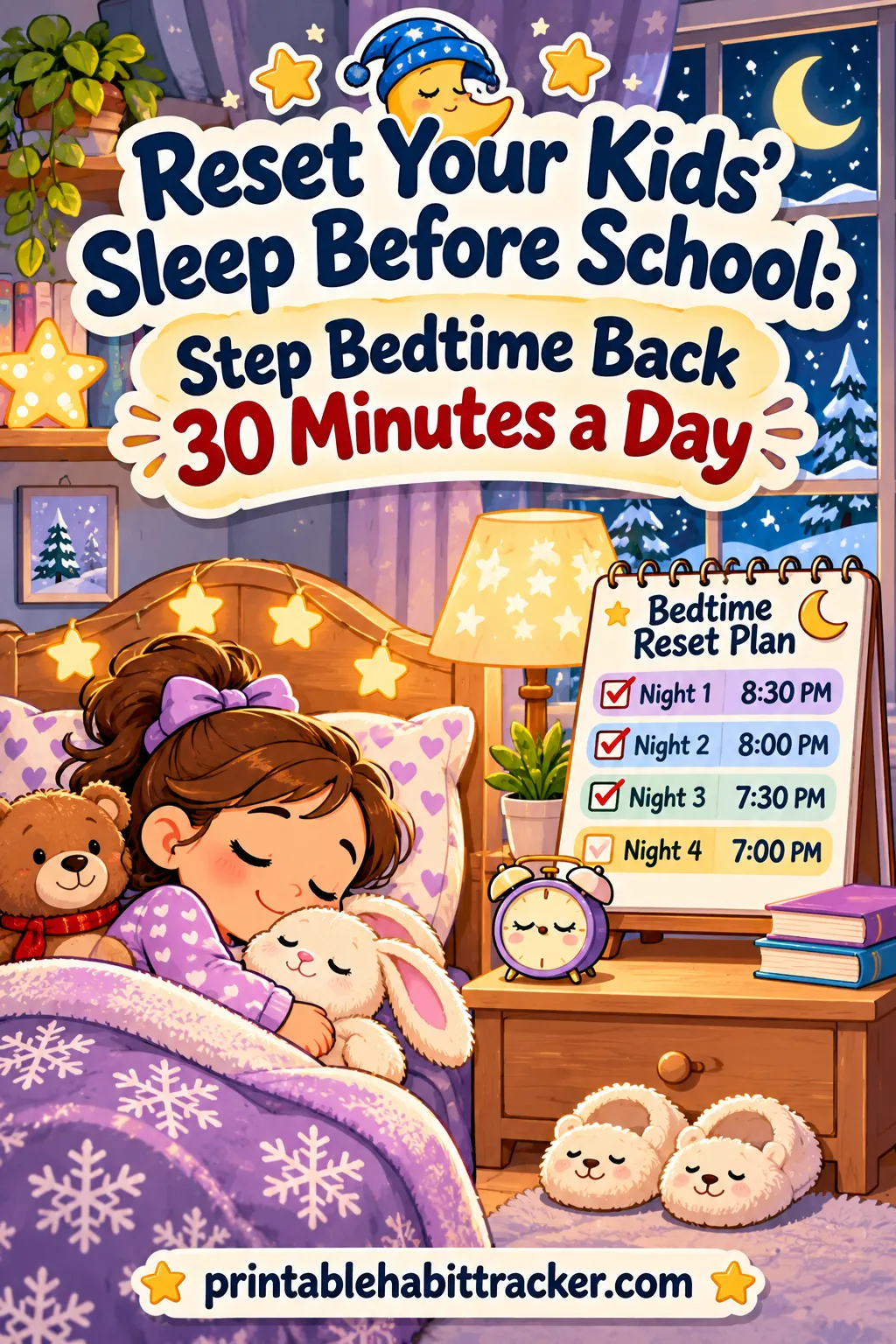
To fix a winter break sleep schedule, move your kids' wake-up time and bedtime back about 30 minutes a day, starting three to five days before school, and get them into morning daylight right after they wake. Wake time does most of the work, so set the alarm first and let the earlier bedtime follow. Count the gap between "break time" and "school time," divide by 30 minutes, and that's how many nights you need.
You can print the whole plan on one page with the free printable habit tracker maker on this site. Build this exact tracker and it opens with five sleep-reset rows, a weekly layout and the color-in style already set, so your child can fill a box each night and each morning.
This guide walks you through why bedtimes slide over the holidays, how to work out your family's exact step-back nights, a night-by-night chart for the 2026 to 2027 break, the tool settings, versions for toddlers through teens, and what to do when the plan wobbles. It's practical advice for ordinary holiday sleep drift, not medical advice. If your child has ongoing trouble sleeping, snores loudly or seems tired no matter how long they sleep, talk to your pediatrician.
✅ Try this tracker for one week
Tap a box each day you do the habit. Your ticks stay on this device.
Why Bedtimes Slide Over Winter Break
Almost every family has the same story. School lets out, the house relaxes, and bedtime starts creeping. A cousin sleeps over. There's a late family dinner, a movie that runs long and a New Year's Eve countdown. Nobody has to be anywhere at 7:30 in the morning, so the kids sleep until 9, then 9:30, then 10.
None of that is a problem during break. Sleeping in is one of the nice parts of a holiday. The trouble shows up on the first school morning, when a body that's used to waking at 9:45 gets dragged out of bed at 6:45. That child is being asked to function at what feels like the middle of their night.
Here's what's happening, in plain terms:
- The body clock moves later, fast. Kids' internal clocks follow light, meals and wake-up time. A week of late nights and late mornings shifts that clock later. It slides much more easily in the late direction than in the early one.
- Late evening light and screens push it further. Bright screens and bright rooms late at night tell the brain it's still daytime, so sleepiness shows up later.
- Late mornings remove the morning light signal. Morning daylight helps set the clock earlier. If a child sleeps through the bright part of the morning, the clock keeps drifting.
- "Just go to bed early on Sunday" rarely works. If a child's body thinks bedtime is 11, putting them in bed at 8 means two or three hours of lying awake, getting up for water and asking questions. You both end up frustrated, and they still wake up exhausted.
That last point is why a gradual reset beats a single early night. You can't force sleep to come earlier. You can move the wake-up time earlier, add morning light and let the body get sleepy a little sooner each evening. Thirty minutes at a time is a step most kids can adjust to without a fight.
The real cost of skipping the reset
When families skip the reset, the first school week often goes like this. Monday is rough but adrenaline helps. Tuesday is worse. By Wednesday, there are tears at breakfast, a meltdown after school and a child who finally falls asleep at a normal time from sheer exhaustion. Thursday and Friday start to settle. Then the weekend comes, everyone sleeps in, and Monday is hard all over again.
A three- to five-day reset at the end of break trades all of that for a few slightly earlier mornings while you're still at home. It's a much easier trade.
How the 30-Minute Step-Back Works
The idea is simple. Each day, move both wake-up time and lights-out about 30 minutes earlier than the day before, until you reach the school-night times. Keep everything else the same: the same bedtime routine, the same order of steps, the same calm last half hour.
Step 1: Write down the two numbers
You need two numbers for each child:
- Break time. What time is your child actually falling asleep and waking up right now? Not what you wish, what's really happening. Watch for two nights if you're not sure.
- School time. What time does your child need to be asleep on a school night, and what time do they need to wake up on a school morning?
Step 2: Find the gap and count the nights
Subtract school time from break time. That's your gap. Then divide by 30 minutes.
| Gap between break wake time and school wake time | Step-back nights at 30 minutes | When to start (school on Monday) |
|---|---|---|
| 30 minutes | 1 | Saturday night |
| 1 hour | 2 | Friday night |
| 1.5 hours | 3 | Thursday night |
| 2 hours | 4 | Wednesday night |
| 2.5 hours | 5 | Tuesday night |
| 3 hours | 6 | Monday night, a week before |
Most families land somewhere between 1.5 and 2.5 hours of drift, which means three to five nights. If your gap is bigger than three hours, you can take slightly bigger steps on the first couple of mornings (45 minutes), then switch to 30-minute steps. A small step every day still beats one giant jump.
Step 3: Lead with the wake-up time
This is the part most people miss. Move the morning first. On day one, wake your child 30 minutes earlier than they've been waking. That night, they'll be a little sleepier a little sooner, so the 30-minute-earlier lights-out actually works.
If you only move bedtime, you'll often get a child lying awake in the dark. If you move the wake-up time, the earlier bedtime has a reason to work.
Step 4: Add morning light and keep the evening dim
Two small habits make each step stick:
- Morning light outside. Within an hour of waking, get your child outside for about 10 to 15 minutes. A walk to the mailbox, a few minutes on the porch with breakfast, a quick lap around the block or walking the dog all count. Even on a cloudy winter day, outdoor light is much brighter than indoor light.
- Screens off 30 minutes early. Turn off tablets, phones, games and TV at least 30 minutes before the target lights-out, and dim the main lights. Many families find 60 minutes works better for older kids.
A worked example
Let's say your eight-year-old needs to be asleep by 8:30 p.m. and up by 7:00 a.m. on school days. Over break, they've been falling asleep around 10:30 p.m. and waking at 9:00 a.m.
- Break wake time: 9:00 a.m.
- School wake time: 7:00 a.m.
- Gap: 2 hours
- Nights needed: 2 hours divided by 30 minutes = 4 steps
School starts Monday, January 4, 2027. Four steps means the first earlier wake-up is Thursday morning, December 31,, and Monday is the real school morning.
| Day | Wake-up target | Lights-out target | Screens off by |
|---|---|---|---|
| Wed, Dec 30 (normal break night) | 9:00 a.m. | 10:30 p.m. | 10:00 p.m. |
| Thu, Dec 31 | 8:30 a.m. | 10:00 p.m. (see New Year's note below) | 9:30 p.m. |
| Fri, Jan 1 | 8:00 a.m. | 9:30 p.m. | 9:00 p.m. |
| Sat, Jan 2 | 7:30 a.m. | 9:00 p.m. | 8:30 p.m. |
| Sun, Jan 3 | 7:00 a.m. | 8:30 p.m. | 8:00 p.m. |
| Mon, Jan 4 (school) | 7:00 a.m. | 8:30 p.m. | 8:00 p.m. |
Notice that Sunday is the first full "school night." By Monday morning, your child has already practiced the school wake time once. That practice morning is the secret. The first school day isn't the first early alarm anymore.
What about New Year's Eve?
In 2026, New Year's Eve falls on a Thursday, right in the middle of a typical reset. You have three good options:
- Celebrate early. Plenty of families do a "kids' midnight" at 8 or 9 p.m. with a countdown, noisemakers and a cup of cocoa. The kids feel included, and the plan stays on track.
- Let it go for one night. If staying up is a big family tradition, keep it. Skip the step-back that night, then start on January 1 with a firmer wake-up time. You might need slightly bigger steps (45 minutes) on two of the remaining mornings.
- Start the reset earlier. If your break is long enough, begin stepping back on December 28 or 29 and plan New Year's Eve as a short "pause night." You'll still finish on time.
There's no wrong answer. What matters is that you decide ahead of time, so the reset isn't wrecked by surprise.
How much sleep kids need on school nights
Before you set your school-night targets, check that they leave enough room for sleep. Widely used pediatric sleep guidelines give these ranges for a 24-hour day:
| Age | Recommended sleep per 24 hours | Example school-night window |
|---|---|---|
| 3 to 5 years | 10 to 13 hours (naps count) | Asleep 7:30 p.m., up 6:45 a.m. |
| 6 to 12 years | 9 to 12 hours | Asleep 8:30 p.m., up 7:00 a.m. |
| 13 to 18 years | 8 to 10 hours | Asleep 10:00 p.m., up 6:30 a.m. |
Work backward from your real wake-up time. If the bus comes at 7:15 and your ten-year-old needs 30 minutes to get ready, the wake-up is 6:45. For 10 hours of sleep, that's asleep by 8:45, which means lights-out around 8:30 since most kids need 10 to 20 minutes to drift off.
Teens are the hardest group. Their body clocks naturally run later, and many high schools start early, so the reset may feel tougher and take a day or two longer. Expect that, and plan five nights instead of three.
How to Make the Sleep Reset Chart in the Free Tool
You can build the chart in the free printable habit tracker maker in about two minutes. These are the exact settings that work for a back-to-school sleep reset.
- Title. Type "Back-to-School Sleep Reset," or add your child's name: "Ava's Sleep Reset." The title box holds up to 60 characters, so you can also add the dates, like "Sleep Reset Dec 31 to Jan 4."
- Start from a preset (optional). The Sleep and Bedtime Routine chips load sleep-friendly rows you can look at first. You'll replace them with the five reset rows below.
- Your habits (one per line). Type each row on its own line:
- Screens off 30 min early
- Lights out on target
- Up by target time
- Morning light outside
- Pack bag the night before
- Layout. Choose Weekly. You get your five rows down the side and seven days across the top. A reset lasts three to six days, so one weekly sheet covers the whole plan, plus the first school days.
- Tracking style. Choose Color-in for kids under about 11. Each box becomes a square your child colors with a marker. For older kids and teens, Checkbox looks more grown-up. Circle is a nice in-between.
- Color theme. Ocean or Sage feel calm and sleepy. Classic (B&W) saves ink and leaves the color to your child's markers.
- Options. Turn on Reward box if you want a small "fresh start" treat for the first school week. Turn on Mood row if you'd like your child to circle how they felt each morning. Streak boxes can be fun for older kids who like counting.
- Notes / goals. This box holds up to 400 characters. It's the best place for your target times. Write something like: "Fri: up 8:00, lights out 9:30. Sat: up 7:30, lights out 9:00. Sun and Mon: up 7:00, lights out 8:30."
- Paper and orientation. Pick Letter or A4 and Portrait. If your row names are long, switch to Landscape for wider boxes.
- Click 🖨️ Print / Save PDF and print one sheet per child.
The live preview updates as you type, so you can see the chart before you print. If you'd rather skip the typing, build this exact tracker and just add your times to the notes box.
Why these five rows
Each row on the chart does a specific job:
- Screens off 30 min early protects the wind-down. It's also the habit kids push back on most, so seeing it on the chart helps.
- Lights out on target is the evening half of the step-back. The target changes every night, which is why the times go in the notes box.
- Up by target time is the morning half, and the most important row. If this box gets colored, the plan is working.
- Morning light outside is the anchor that helps the new wake time stick.
- Pack bag the night before gets your child thinking about school again and makes the first morning calmer. During break, use it for "lay out tomorrow's clothes" until there's actually a backpack to pack.
Writing the target times on the chart
The weekly layout prints the days of the week without dates, so it works for any break. Before you hang it, write the date and the two target times above each day's column in pen. Kids like being able to see "Tonight: 9:30" right there on the page.
If you have more than one child, give each child their own sheet with their own times. A six-year-old and a twelve-year-old shouldn't be on the same schedule, and separate sheets stop the "Why does he get to stay up?" argument.
A Night-by-Night Plan for the 2026 to 2027 Break
Here's a sample plan for families whose kids go back to school on Monday, January 4, 2027. Check your district's calendar, since some schools return a day or two later. Shift the whole plan if your date is different.
Three-night reset (90-minute gap)
For a child who has drifted about an hour and a half later.
| Day | What to do | Wake-up | Lights-out |
|---|---|---|---|
| Thursday, Dec 31 | Normal break day, plan a kids' countdown | Break time | Break time |
| Friday, Jan 1 | Step 1 | 30 min earlier | 30 min earlier |
| Saturday, Jan 2 | Step 2 | 60 min earlier | 60 min earlier |
| Sunday, Jan 3 | Step 3, school-night times | School time | School time |
| Monday, Jan 4 | First school day | School time | School time |
Five-night reset (2.5-hour gap)
For a child who has drifted far, or a teen.
| Day | What to do | Wake-up | Lights-out |
|---|---|---|---|
| Tuesday, Dec 29 | Step 1 | 30 min earlier | 30 min earlier |
| Wednesday, Dec 30 | Step 2 | 1 hour earlier | 1 hour earlier |
| Thursday, Dec 31 | Pause night or early countdown | Hold at step 2 | Hold, or a bit later |
| Friday, Jan 1 | Step 3 | 1.5 hours earlier | 1.5 hours earlier |
| Saturday, Jan 2 | Step 4 | 2 hours earlier | 2 hours earlier |
| Sunday, Jan 3 | Step 5, school-night times | School time | School time |
| Monday, Jan 4 | First school day | School time | School time |
Notice the pause on New Year's Eve. If your family stays up late, keep the wake-up time on January 1 at the step 2 level anyway. One short night won't undo the reset, but a 10 a.m. wake-up on New Year's Day will. A quiet afternoon and an early night on January 1 usually make up for it.
What each day looks like
Here's a simple daily rhythm during the reset days. It uses the eight-year-old example from earlier, on Saturday, January 2.
- 7:30 a.m. Alarm, or a parent opens the curtains. Your child colors "Up by target time."
- 7:45 a.m. Breakfast by the window, or a quick walk outside with the dog. Your child colors "Morning light outside."
- Daytime. Normal break fun. Try to get some active play outside, and keep naps short or skip them for school-age kids.
- 5:30 p.m. Dinner at a normal hour. A big meal right before bed can make it harder to fall asleep.
- 7:30 p.m. Lay out tomorrow's clothes or pack the bag. Color that box.
- 8:30 p.m. Screens off, lights dimmed. Color "Screens off 30 min early." Bath, pajamas, teeth, books.
- 9:00 p.m. Lights out. Color "Lights out on target" (or color it first thing in the morning if they fell asleep before they could).
Versions for Every Age
The same five-row idea works for toddlers through teens, with a few changes.
Toddlers and preschoolers (ages 2 to 5)
Little kids often drift less over break because naps keep them on a rhythm, but late holiday evenings still push them later. For this age:
- Rows: Bath and pajamas, Story time, Lights out on time, Up and open the curtains.
- Style: Color-in with a picture beside each row (a moon, a book, a sun).
- Steps: 15 to 20 minutes a day is often easier for young kids than 30.
- Naps: Try to keep naps at their normal time. A nap that starts late or runs long will push bedtime later.
The bedtime routine chart page has ready-made toddler and preschool charts if you'd rather start from one of those.
Elementary school kids (ages 6 to 10)
This is the group the preset on this page was made for. Use all five rows, color-in style and 30-minute steps. Let your child color their own boxes. Many kids this age love being "in charge" of their reset and will remind you when it's time for screens off.
Tweens (ages 11 to 13)
Tweens can run their own chart with a little help. Use checkbox or circle style and let them write their own target times. Swap "Pack bag the night before" for "Phone charges outside my room" if devices in the bedroom are an issue.
Teens (ages 14 and up)
Teens drift the most and often resist the most. A few things help:
- Explain why. Teens respond better to "Your body clock moved and it takes a few days to move it back" than to "Because I said so."
- Plan five nights. Their clocks are slower to shift earlier.
- Make morning light easy. A walk to pick up something for breakfast, a short run, or breakfast on the porch.
- Keep devices out of the bedroom at night. If that's a big change, start with the last 30 minutes before lights-out.
- Let them own the sheet. A plain title like "Sleep Reset" in checkbox style feels less like a kids' chart.
If your teen also wants to track sleep hours after the reset, the sleep tracker page has weekly and monthly sleep logs.
Making Each Step Easier
The plan is simple on paper. These small habits make it work in a real house, during the holidays, with real kids.
Mornings
- Open the curtains right away. Light is the strongest morning signal. Turn on the bright kitchen lights, too.
- Give a reason to get up. A favorite breakfast, a short outing or a "first one up picks the music" rule beats an alarm alone.
- Go outside early. Ten to fifteen minutes outdoors within an hour of waking is the single most useful habit on the chart. Bundle up and make it short if it's cold.
- Skip the "five more minutes." Snoozing on reset days pushes the whole plan back. Wake them at the target, then let them be slow and sleepy for a bit.
Afternoons
- Get moving. Sledding, a walk, a playground or running around the backyard helps kids feel tired at night.
- Watch naps. For kids who no longer nap, a late afternoon doze on the couch can wreck bedtime. Keep them busy between 3 and 6 p.m.
- Hold off on sweet drinks and soda later in the day. Some contain caffeine, and sugary snacks right before bed don't help anyone settle.
Evenings
- Dim the house. About an hour before lights-out, switch off the overhead lights and use lamps.
- Keep the routine the same every night. Bath, pajamas, teeth, books, lights. The routine itself tells the body that sleep is coming.
- Park the devices. Pick a charging spot outside the bedrooms, like the kitchen counter, and make "devices go to bed first" a family rule.
- Keep the room cool, dark and quiet. A small night light is fine for kids who want one.
Worked example: two kids, one house
Here's how one family might plan it. They have a 6-year-old and a 12-year-old, and school starts Monday, January 4.
The 6-year-old needs to be asleep by 7:45 p.m. and up at 6:45 a.m. Over break, they've drifted to 9:15 p.m. and 8:15 a.m. That's a 90-minute gap, so three steps:
| Day | Wake-up | Lights-out |
|---|---|---|
| Friday, Jan 1 | 7:45 a.m. | 8:45 p.m. |
| Saturday, Jan 2 | 7:15 a.m. | 8:15 p.m. |
| Sunday, Jan 3 | 6:45 a.m. | 7:45 p.m. |
The 12-year-old needs to be asleep by 9:30 p.m. and up at 6:30 a.m. Over break, they've drifted to 11:30 p.m. and 9:00 a.m. That's a 2.5-hour wake gap, so five steps starting Tuesday:
| Day | Wake-up | Lights-out |
|---|---|---|
| Tuesday, Dec 29 | 8:30 a.m. | 11:00 p.m. |
| Wednesday, Dec 30 | 8:00 a.m. | 10:30 p.m. |
| Thursday, Dec 31 | Hold at 8:00 a.m. | 10:30 p.m. or a short pause |
| Friday, Jan 1 | 7:30 a.m. | 10:00 p.m. |
| Saturday, Jan 2 | 7:00 a.m. | 9:45 p.m. |
| Sunday, Jan 3 | 6:30 a.m. | 9:30 p.m. |
Each child gets their own chart with their own times in the notes box. The parents only have to remember two things: open the curtains at each child's wake time, and start the screens-off countdown at each child's time at night. The charts remind everyone else.
When the Reset Doesn't Go to Plan
Even with a good chart, some nights won't go smoothly. Here's how to handle the common snags.
| Problem | What's going on | Try this |
|---|---|---|
| Child lies awake for an hour at the new bedtime | Bedtime moved before wake time did | Hold lights-out where it is tonight and make tomorrow's wake-up firm |
| Child won't get up at the target | Clock hasn't shifted yet | Open curtains, turn on lights, go outside right away, keep the time anyway |
| Late family event ruins a night | Holidays happen | Keep the next morning's wake-up time and pick up the plan from there |
| Child naps in the afternoon | Tired from the earlier wake-up | Keep naps under 30 minutes and before 3 p.m., or skip them |
| Screens keep sneaking back | No clear handoff | Set a charging spot outside bedrooms and color the box only when devices are parked |
| Teen says it's pointless | Feels like control | Explain the body clock, let them pick their times within limits, give them their own sheet |
| You started too late | Only one or two nights left | Use 45-minute steps for the wake-up, and expect a slightly tired first school day |
| First school week is still hard | Clock still catching up | Keep the same wake time on the first weekend too, then it usually settles |
The most important rule is to keep the wake-up time even after a bad night. It feels kind to let a tired child sleep in, but a late morning makes the next bedtime harder, and the whole plan slides back. A slightly sleepy day is easier to fix than a lost night.
If a night goes badly, don't scrap the chart. Leave that box blank and keep going. Our guide on what to do when you miss a day explains why a quick restart matters more than a perfect row.
What to say at bedtime
Some kids push back on an earlier bedtime, especially during the last days of break. A few short scripts can help:
- For younger kids: "Our bodies have been on holiday time. We're going to help them get ready for school, a little bit each night. Let's color your box."
- For the "it's not fair" child: "Everyone in the house is moving earlier this week, even me. Tonight is just 30 minutes."
- For a tween or teen: "If we move it a little each night, Monday won't feel awful. You pick whether screens go off at 9:00 or 9:15, but the phone charges in the kitchen."
Stay calm and boring at bedtime. The less exciting the conversation, the faster most kids drift off.
Keeping the Rhythm After School Starts
The reset gets your child back on track. Keeping them there takes one more week of attention.
- Keep the chart up for the first school week. Kids like seeing the boxes fill up, and it keeps screens-off and lights-out on the radar.
- Hold the wake-up time on the first weekend. It's tempting to sleep in on Saturday after a hard week. Try to keep weekend wake-ups within about an hour of school mornings. A two- or three-hour sleep-in on Saturday and Sunday can make the next Monday feel like the first day back all over again.
- Swap the reset rows for a normal school-night routine. After a week, turn the chart into a standing evening routine: homework done, bag packed, screens off, books, lights out. The night routine tracker page has more ideas for evening rows.
- Plan ahead for the next break. Spring break, long weekends and summer all cause the same drift. Save your PDF and reuse it.
Signs It's More Than Holiday Drift
Most winter break sleep problems are just a shifted body clock, and the step-back plan fixes them. But some sleep problems aren't about schedules at all. This article isn't medical advice. Talk to your pediatrician if your child:
- Snores loudly most nights, gasps or seems to stop breathing during sleep
- Still can't fall asleep for an hour or more most nights, weeks after break ends
- Is very sleepy during the day even with enough hours in bed
- Has frequent night terrors, sleepwalking or nighttime fears that don't settle
- Has big changes in mood, appetite or behavior along with sleep trouble
Your pediatrician can check for common sleep problems and give advice that fits your child. A printed chart of the last couple of weeks can be handy to bring along, since it shows real bedtimes and wake times rather than guesses.
Ready to print your sleep reset chart?
A back-to-school sleep reset is just a few small steps: move the morning 30 minutes earlier, get outside in the light, keep the evening calm and let bedtime follow. Count your gap, write your target times, and start three to five days before school.
When you're ready, build this exact tracker with the title, five reset rows, the weekly layout and the color-in style already filled in. Add your child's name and target times, print one sheet per child, and hang it where they'll see it at bedtime.
Frequently Asked Questions
How many days before school should I start the sleep reset?
Start three to five days before the first school day for most kids. Count the gap between your child's current wake-up time and their school wake-up time, then plan one day for every 30 minutes. Teens and kids who have drifted more than two hours usually need five or six days.
Should I move bedtime or wake-up time first?
Move the wake-up time first. An earlier morning, plus some outdoor light, makes your child sleepy a little sooner that night, so the earlier bedtime actually works. If you only move bedtime, kids often lie awake for a long time.
Is it okay to just put my kids to bed early the night before school?
It usually doesn't work well. If your child's body clock is set for a late bedtime, they'll lie awake for hours and still wake up tired. A gradual reset over several days is much easier on everyone.
What if we have a late New Year's Eve in the middle of the reset?
Plan for it. Do an early "kids' countdown," or treat that night as a pause and keep the next morning's wake-up time at your last step. One late night won't ruin the plan as long as you don't sleep in the next day.
Do screens really make a difference at bedtime?
Many families find they do. Bright screens and exciting games keep kids alert, so turning them off 30 to 60 minutes before lights-out gives the body time to wind down. A charging spot outside the bedroom makes the rule easier to keep.
Can I use this plan for a toddler?
Yes, with smaller steps. Many toddlers handle 15 to 20 minutes a day better than 30. Keep naps at their usual time, and use a simple color-in chart with a picture for each step of the bedtime routine.
What if my child still struggles a week after school starts?
Keep the wake-up time steady every day, including the weekend, and keep the evening routine short and calm. Most kids settle within the first week or two. If sleep trouble goes on longer, or you notice snoring, breathing pauses or heavy daytime sleepiness, talk to your pediatrician.
Do I need a separate chart for each child?
It works best that way. Each child has their own target times, and separate sheets avoid comparing and arguing. Put each child's name in the title and write their times in the notes box.