Physical Therapy Exercise Tracker: Never Skip Your Home Program
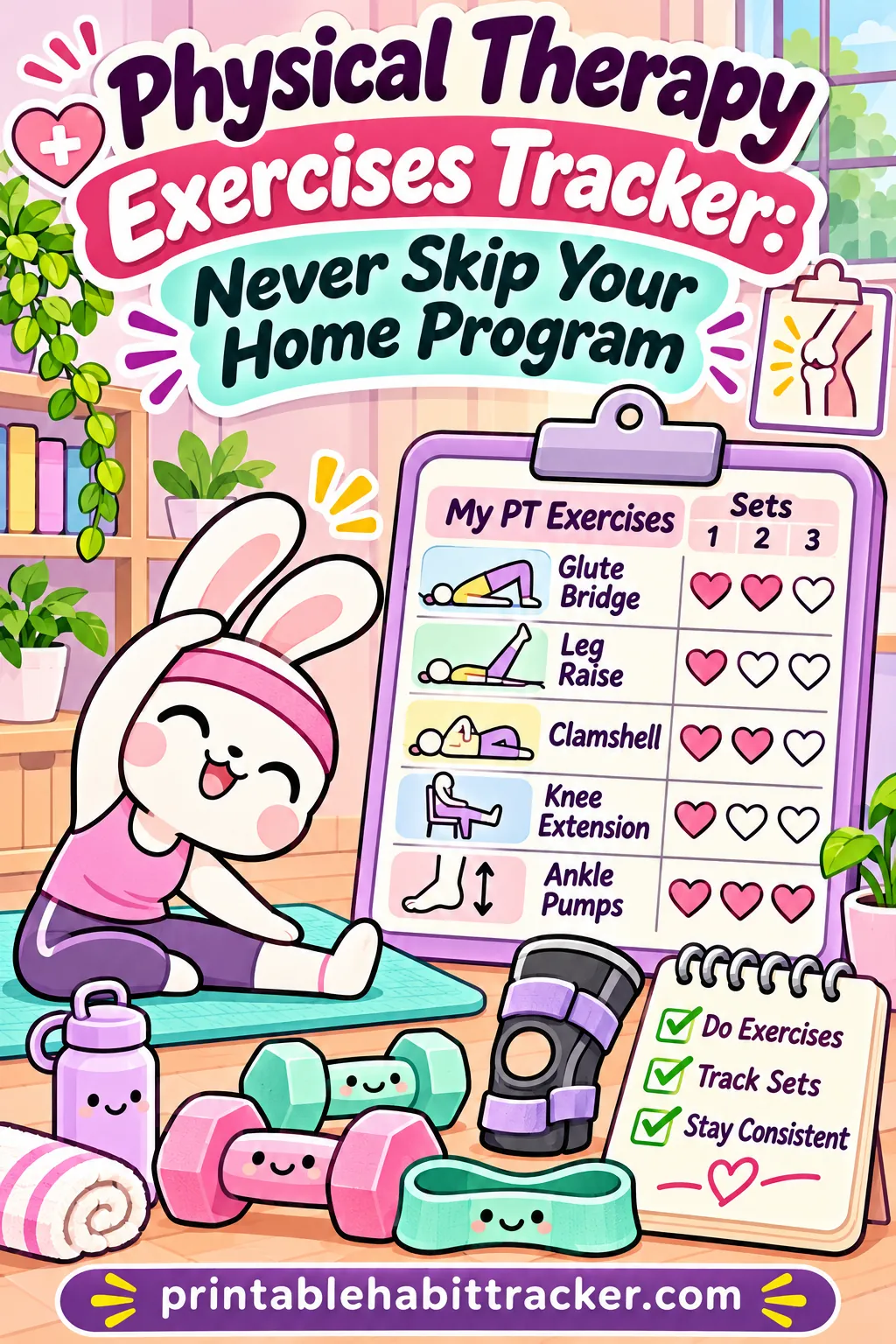
The simplest way to stop forgetting your physical therapy exercises is a one-page daily tracker that lists every exercise from your home program, with a small box for each set, kept right where you do the exercises. You check a box after each set, so you always know what's done and what's left. At your next appointment, you hand your therapist a clear record instead of a guess.
You can make this sheet in a few minutes with the free habit tracker maker on our homepage. Type your exercises, pick a daily layout, and print. To save time, build this exact tracker and it opens with a ready-made home program checklist you can edit.
One important note before we start: this guide is about remembering and recording the program your physical therapist gave you. It isn't medical advice, and it won't tell you which exercises to do. Always follow your therapist's or doctor's instructions for exercises, sets, reps, frequency and pain limits, and ask them if anything feels wrong.
✅ Try this tracker for one week
Tap a box each day you do the habit. Your ticks stay on this device.
Why Home Exercise Programs Get Skipped
Your appointments might be once or twice a week. Your home program is every day. That means most of your progress depends on what you do alone, at home, without anyone reminding you. And that's hard.
Most people don't skip PT exercises because they don't care. They skip them for ordinary reasons:
- The handout got lost. The sheet with stick-figure drawings ended up under a pile of mail.
- You can't remember if you did them. Was that this morning or yesterday? Did you do two sets or three?
- The exercises feel too small to matter. Ankle circles and gentle stretches don't feel like "real" exercise, so they're easy to push aside.
- They're boring. Repeating the same ten movements every day gets old fast.
- No set time. "Sometime today" quietly becomes "tomorrow."
- You feel better. Once the pain eases, it's tempting to stop, even when your therapist wants you to keep going.
- You feel worse. A sore day makes it hard to know whether to push, modify or rest.
A tracker can't fix every one of these, but it helps with most. It keeps the program visible. It answers "did I already do this?" in one glance. It gives tiny exercises a satisfying checkmark. And it gives you something concrete to bring to your therapist, so the sore days and the confusing exercises get talked about instead of quietly skipped.
What a Physical Therapy Tracker Should Include
A good PT tracker is simple enough to fill in with a pen in five seconds, but detailed enough to be useful at your appointment. Here's what to put on it.
| Part of the tracker | What goes in it | Why it helps |
|---|---|---|
| Exercise name | The name your therapist uses, like "heel slides" or "bridges" | Matches your handout so nothing gets mixed up |
| Sets and reps | Exactly what your therapist prescribed, like 2 sets of 10 | You don't have to look it up every time |
| Set boxes | One box per set, per session | Shows exactly what's done, even mid-session |
| Times per day | Morning, evening or both, if your program says so | Keeps twice-a-day programs on track |
| Pain or comfort note | A number or word your therapist asked you to track | Gives your therapist real information |
| Other instructions | Ice, heat, walking, brace use, posture reminders | Keeps the whole program in one place |
| Notes or questions | Anything that felt off, confusing or easier | Makes your next visit more useful |
Set boxes are the secret
The single most helpful thing on a PT tracker is one box per set. A habit tracker with just "Did my exercises: ✓" doesn't tell you much. If your program has three sets of ten bridges, three small boxes let you tick each set as you finish. Get interrupted halfway through and you'll know exactly where you left off.
In the habit tracker maker, you can do this by writing each set as its own line, or by writing the exercise once and adding the set count to the name. Both approaches are covered in the settings walkthrough below.
Keep the language your therapist uses
If your therapist calls it a "clamshell," write "clamshell." Don't rename it. When you show your tracker at your visit, matching names make it quick for both of you to see what's happening.
Track what your therapist wants tracked
Some therapists ask you to note pain on a 0 to 10 scale before and after exercise. Others ask you to note how far you can bend, how long you can stand or how many steps you walked. Some don't ask for any numbers at all. Ask yours what would be most helpful, and track that. Don't add measurements just because you can. A shorter, accurate log beats a long, messy one.
How to Make Your PT Tracker in the Free Tool
The habit tracker maker on the homepage builds your sheet and prints it. Here's exactly how to set it up for a home exercise program.
Step 1: Title. Type something clear, like "Home Exercise Program Tracker," "Knee Rehab Exercises," or "Shoulder PT: Weeks 1 to 4." Including the body area or week range helps if your program changes over time.
Step 2: Template chip (optional). Tap Fitness for a starting point, then replace the sample lines with your own exercises. If you also take medication on a schedule as part of your recovery, the Medication chip is another option. You can also skip the chips and type everything yourself.
Step 3: Your habits (one per line). Copy your exercises straight from your therapist's handout, one per line. Keep names short so they fit the row. There are two ways to handle sets:
- One line per exercise, sets in the name: "Bridges 2x10," "Heel slides 2x15," "Wall push-ups 3x8." You check once when all sets are done. This is quicker and works well for shorter programs.
- One line per set: "Bridges set 1," "Bridges set 2." You check after every set. This takes more lines but is great if you often get interrupted or tend to lose count.
Step 4: Layout. Choose Daily for a twice-a-day or very detailed program, since it gives each day plenty of room. Choose Weekly if your program is short and you want to see the whole week at a glance. Choose Monthly only for a simple maintenance routine with three or four lines.
Step 5: Style. Checkbox is the most practical for exercises because you can tick boxes quickly between sets.
Step 6: Color theme. Ocean or Sage look calm. Classic B&W prints cleanly and saves ink.
Step 7: Options. Turn on Notes/goals so you can write your therapist's instructions and questions at the bottom. Turn on Reflection if you want a line for how the session felt. Streak boxes can help motivation once you're in a steady routine. Skip the Mood row unless you find it helpful, since your therapist may want a pain or comfort note instead, which you can write in Notes.
Step 8: Paper and orientation. Letter or A4 to match your printer. Landscape gives longer rows, which helps when exercise names include sets and reps.
Step 9: Print. Hit 🖨️ Print / Save PDF. Print a week or two of pages at a time, because programs often change after appointments.
If you'd like to skip most of the setup, build this exact tracker. It opens with a home program checklist already filled in, and you can replace the lines with your own exercises before printing.
Example Tracker Setups (Use Your Own Program)
These examples show how different home programs might look once they're on a tracker. They are layout examples only. The exercises, sets and reps here are placeholders. Your therapist's handout is the only list you should follow, so swap in exactly what they gave you.
Example 1: A short daily program
A short program with four or five exercises fits easily on a weekly layout.
- Exercise A 2x10
- Exercise B 2x10
- Exercise C hold 30 sec x3
- Exercise D 2x15
- Ice as directed
- Pain level noted
Example 2: A twice-a-day program
If your therapist wants you to do the program morning and evening, give each session its own line so you can see both.
- AM: all exercises done
- PM: all exercises done
- AM: pain before and after
- PM: pain before and after
- Walk as my PT advised
- Brace on as directed
Example 3: A program with lots of sets
For a longer program, use one line per set for the exercises you tend to lose count on, and one line per exercise for the rest.
- Bridges set 1
- Bridges set 2
- Bridges set 3
- Heel slides 2x15
- Stretch hold 3x30 sec
- Questions for next visit
Example 4: Back pain stretches routine
Many people with back pain are given a short list of gentle stretches and movements to do daily. Again, use your own therapist's list, and never add stretches you found elsewhere without asking. A tracker for that kind of program might include:
- Stretch 1 as shown
- Stretch 2 as shown
- Core exercise as shown
- Walk as my PT advised
- Posture check at desk
- Pain level noted
A posture check line is a handy reminder for anyone who sits for long hours, but only if your therapist has given you posture guidance. Write their exact words in the Notes section.
A Sample Week on the Tracker
Here's what an honest, realistic week might look like for a twice-a-day program. A check means done, a dash means not done, and "M" means modified, which you'd note in the Notes section.
| Habit | Mon | Tue | Wed | Thu | Fri | Sat | Sun |
|---|---|---|---|---|---|---|---|
| Morning exercises done | ✓ | ✓ | ✓ | – | ✓ | ✓ | ✓ |
| Evening exercises done | ✓ | – | ✓ | ✓ | ✓ | M | ✓ |
| All sets completed | ✓ | – | ✓ | – | ✓ | M | ✓ |
| Ice or heat as directed | ✓ | ✓ | ✓ | ✓ | – | ✓ | ✓ |
| Walk as my PT advised | ✓ | ✓ | – | ✓ | ✓ | ✓ | – |
| Pain level noted | ✓ | ✓ | ✓ | ✓ | ✓ | ✓ | ✓ |
| Questions for next visit | – | ✓ | – | – | – | ✓ | – |
Notes at the bottom might say:
- Tue PM: skipped, worked late. Did morning set only.
- Thu AM: missed, early appointment. Did evening set.
- Sat PM: knee felt sore after walk, did half reps of exercise B. Ask PT about this.
- Question: Is it normal for exercise C to feel easier now? Can I progress?
This week isn't perfect, and it doesn't need to be. It shows a strong, consistent effort with a couple of real-life misses. More importantly, it shows your therapist exactly what happened, including the sore Saturday. That one note might lead to a small change in your program that makes the next week go better.
How to Build Your Home Exercise Routine
The tracker keeps score. These habits make it easier to put checks in the boxes.
Pick a fixed time
"Sometime today" is the easiest time to skip. Choose a specific moment and connect it to something you already do every day:
- Right after brushing your teeth in the morning
- Before your morning coffee
- During a lunch break
- After dinner, before you sit down for the evening
- Right before bed, if your program is gentle stretches
This is called habit stacking, where you link a new habit to an existing one so the old habit acts as the reminder. If your program is twice a day, pick two anchors. The guide on how to stay consistent with habits has more ways to make a routine automatic.
Pick a fixed place
Choose one spot in your home for your exercises and keep it ready. Leave the mat rolled out, the resistance band on a hook and the tracker on the wall nearby. When everything is already set up, starting takes seconds.
Keep the tracker and the handout together
Tape your tracker next to your therapist's handout, or clip them both to a clipboard. If you print the tracker, hang it at eye level where you'll do the exercises: on the bedroom wall, the back of a door or the fridge.
Use a pen you don't have to find
Tie a pen to the clipboard or keep one in a cup by the mat. It sounds tiny, but a missing pen is one more reason to skip the check, and the check is part of the habit.
Set up a small exercise kit
Gather everything your program uses into one basket or bag so you never have to hunt for it. Depending on what your therapist gave you, that might include:
- Your therapist's handout, in a clear sleeve
- Your printed tracker and a pen
- A mat or folded towel
- Any band, strap, small ball or light weight your therapist provided
- A sturdy chair, if your program uses one for support
- An ice pack or heat pack, if your program includes it
- A simple timer for holds
Only use equipment your therapist has shown you how to use. If you aren't sure whether you need something, ask at your next visit rather than buying gear on your own. Keeping the kit in the same spot also makes your exercise corner a cue on its own. Seeing the basket reminds you it's time.
Make it more pleasant
Repetitive exercises can be dull. A few ideas:
- Play a favorite song or podcast, and do your program while it plays.
- Do your exercises at the same time as a family member who has their own routine.
- Count out loud, or use a simple timer for holds.
- Give yourself a small treat for a full week of checks, like a new book or a long, quiet bath. Turn on the Reward box option in the tool and write it there.
Bringing Your Tracker to Physical Therapy
Your tracker isn't just for you. It's a great tool for your appointments.
Before each visit, take two minutes to look over the week's pages:
- Count how many sessions you completed.
- Circle any days you skipped, and write a word or two about why.
- Highlight any sessions where you modified an exercise or something felt off.
- Write your questions in the Notes section.
Then bring the pages with you. Your therapist can quickly see how your week actually went, which makes it easier for them to adjust your program. You don't need to explain or apologize for missed days. An honest record is more helpful than a perfect one.
Some questions you might want to ask, in your own words:
- Which exercise matters most if I'm short on time?
- Is it okay if this exercise feels different on some days?
- What kind of soreness is expected, and what should I tell you about right away?
- Am I doing this movement correctly? Can you watch me once?
- When will my program change, and what should I watch for?
Write the answers on the back of your tracker so you don't forget them by the time you're home.
If you have trouble remembering what was said during a visit, it's fine to ask your therapist to write key points directly on your tracker or handout. Some people also bring a family member along to listen. Either way, leave the clinic with your updated exercises, any new sets and reps, and a clear idea of what to call about. Then update your sheet that same evening while the details are still fresh, so tomorrow's session starts with the right list on the wall.
When Your Program Changes
Home programs usually change over time. Your therapist may add exercises, drop easy ones, raise the reps or switch to harder versions. Your tracker should change with it.
Here's a simple system that keeps things clear:
- Print one or two weeks at a time. That way you're never stuck with a stack of outdated pages.
- Update the tracker the same day as your appointment. Open the tool, edit the habit lines to match your new handout, and reprint. It takes a couple of minutes.
- Put the date range in the title. "Knee Rehab: Weeks 5 to 6" makes it easy to tell old and new sheets apart.
- Keep old pages in a folder. Looking back at week one when you're in week eight can be really encouraging. You'll see exercises you couldn't do at first that now feel easy.
- Cross out removed exercises instead of erasing them if a change happens mid-week. That keeps the record honest.
If you also keep a medication schedule as part of your recovery, a separate medication tracker keeps it distinct from your exercise sheet, so both stay simple and easy to read.
Celebrate the milestones
Recovery can feel slow, and it's easy to miss how far you've come. Use your tracker pages to notice progress. Mark the first full week of checks with a star. Write down the day an exercise felt easier, the first time you walked farther, or the day your therapist moved you to a harder version. These small wins are worth noticing, and they make it easier to keep going on the days when progress feels invisible.
Tracker Variations for Different Situations
Everyone's recovery looks different. These tweaks help the tracker fit your situation. As always, the exercises themselves come from your therapist.
After surgery
Programs after surgery are often very specific and change frequently. Keep the tracker short and focused, with lines for exactly what your surgeon and therapist asked for, such as exercises, ice, elevation, brace use or walking. Add a line for "Called the clinic if worried" in the notes as a reminder that questions are welcome. Print just one week at a time.
Ongoing back or neck pain
Programs for long-term back or neck pain often focus on daily movement, stretches and posture habits. A weekly or monthly layout can work well here, since the program may stay the same for longer. A notes-heavy layout helps you spot patterns, such as whether pain is better on days you walked. Our habit tracker with notes explains how to make the most of a notes column.
Older adults
Large print, fewer lines and a high-contrast theme make the sheet easier to read. Classic B&W or Bold prints with strong contrast. Use Landscape for bigger rows. If a family member or caregiver helps, they can fill in the tracker together with you and bring it to appointments.
Athletes returning to sport
Athletes often have a longer program with progressions. One line per set helps you stay accurate when you're tempted to rush. Keep your PT program on its own sheet, separate from your regular training log, so it's clear which exercises are for rehab. When your therapist clears you for more training, a workout tracker can take over for the gym side.
Kids and teens
Younger patients may do better with a color-in style tracker and a small reward. A parent can help set up the sheet and check in at the end of the day. Teens may prefer a minimalist sheet they manage on their own. Either way, follow the pediatric therapist's guidance for how much support to give.
Travel and busy weeks
Trips, visitors and hectic work weeks are classic times for home programs to slide. Before a busy stretch, ask your therapist which exercises matter most and whether a shorter version is okay for a few days. Then print a travel copy of your tracker with just those lines. Fold it into your bag along with the handout, and take a photo of both on your phone as a backup.
Pick a new anchor that fits the trip, like right after you wake up in the hotel or before you head out for the day. Many simple programs need little more than a floor and a towel. A shorter week with steady checks is far better than a week with none, and it makes it much easier to slip back into your normal routine when you get home.
Caregivers tracking for someone else
If you're helping a parent, partner or child with their program, put their name in the title and write the exercises exactly as the therapist gave them. Add a line like "Help given" if you assist with any movement, so the therapist knows how much support was needed.
Troubleshooting: When the Checks Stop Coming
If your tracker shows a pattern of missed boxes, it's not a sign you've failed. It's a sign something about the routine needs a small change. Look at the pattern, then try a fix.
| What your tracker shows | Possible reason | What to try |
|---|---|---|
| Evening sessions often blank | Too tired by evening | Ask your therapist if you can shift the time, or anchor it to dinner |
| "All sets completed" often blank | Running out of time or energy mid-session | Use one line per set, and ask your therapist which exercises matter most |
| Whole days missing | No fixed time or place | Pick one anchor habit and keep the mat set up |
| Misses after feeling better | It feels like you don't need it anymore | Ask your therapist how long to continue, and write the answer on the sheet |
| Misses after sore days | Unsure whether to push or rest | Note it and call or ask your therapist, rather than guessing |
| Tracker forgotten, but exercises done | Tracker isn't where you exercise | Move the sheet to your exercise spot and tie a pen to it |
| Weekends always blank | Routine is tied to weekday schedule | Choose a separate weekend anchor, like after breakfast |
| Feeling bored and skipping | Same routine every day | Add music or a podcast, and ask your therapist if any variation is okay |
Never push through pain your therapist told you to avoid just to fill a box. A note that says "stopped, felt sharp pain, will ask PT" is a good entry. It's exactly the kind of information your tracker is there to capture. And if you miss a few days in a row, simply restart at your next anchor time. The guide on what to do when you miss a day has ideas for getting back on track without guilt.
Daily Checklist: Your PT Session in Five Steps
Copy this short routine onto the Notes section of your tracker, or keep it on a sticky note by your exercise spot.
- Look at the handout. Check today's exercises, sets and reps.
- Note your starting point, if your therapist asked you to, like a pain or comfort number.
- Do each exercise as shown. Tick a box after each set or exercise.
- Note how it went. A word or two: "easier," "sore knee," "lost balance on C."
- Write any questions for your next appointment.
That's the whole routine. Most days, the tracking part takes less than a minute.
Start Your Home Program Tracker Today
Your physical therapist gives you the plan. The tracker helps you follow it on the days nobody's watching, and gives your therapist a clear picture of how it's really going. Print a week, put it where you exercise, and check your first box today.
Build this exact tracker to start with a ready-made home program checklist, then swap in your own exercises. Or open the free habit tracker maker to design a sheet from scratch with your own title, layout and colors.
Frequently Asked Questions
What should I write on a physical therapy tracker?
Write each exercise from your home program, using the same names as your handout, along with the sets and reps your therapist gave you. Add any other instructions, like ice or walking, and a space for notes and questions. Track a pain or comfort number only if your therapist asks for it.
How do I stop forgetting my PT exercises?
Link your exercises to something you already do every day, like brushing your teeth or eating dinner. Keep your mat and equipment set up in one spot, with the tracker hanging right there. Checking a box after each set makes it easy to see what's left.
Should I use a daily or weekly layout?
A daily layout gives you more room for detailed programs, twice-a-day sessions and one-line-per-set tracking. A weekly layout is better for short programs, since you can see the whole week at once. Either works, so pick the one you'll actually fill in.
Is it okay to skip a day of my home exercise program?
Ask your therapist how strict your program needs to be, since every program is different. If you miss a day, note why on the tracker and restart at your next session. Don't try to double up to make up for it unless your therapist says that's fine.
What if an exercise hurts?
Stop and follow the instructions your therapist gave you about pain. Write a short note on your tracker about what happened and contact your therapist or doctor if you're unsure. The tracker is there to record what happens, not to push you through pain.
Should I bring my tracker to appointments?
Yes. Your tracker gives your therapist a clear picture of how your week went, including missed sessions and anything that felt off. That makes it easier for them to adjust your program. Be honest on the sheet, because a real record is more useful than a perfect one.
How do I update my tracker when my program changes?
Edit your habit lines in the free tool on the same day your program changes, then reprint. Print only a week or two at a time so you don't end up with outdated sheets. Add a date range to the title to keep versions clear.
Can I track a family member's PT exercises?
Yes. Put their name in the title, list the exercises exactly as the therapist gave them, and fill it in together. A line like "Help given" lets the therapist know how much assistance was needed.
How long should I keep tracking?
Keep tracking as long as your therapist wants you doing the program, and ask them when it's okay to stop or switch to a maintenance routine. Many people find a simpler weekly tracker helps them keep up a few key exercises long after formal therapy ends.