Piano Practice Chart for Kids: Sessions, Stickers and a Payoff That Works
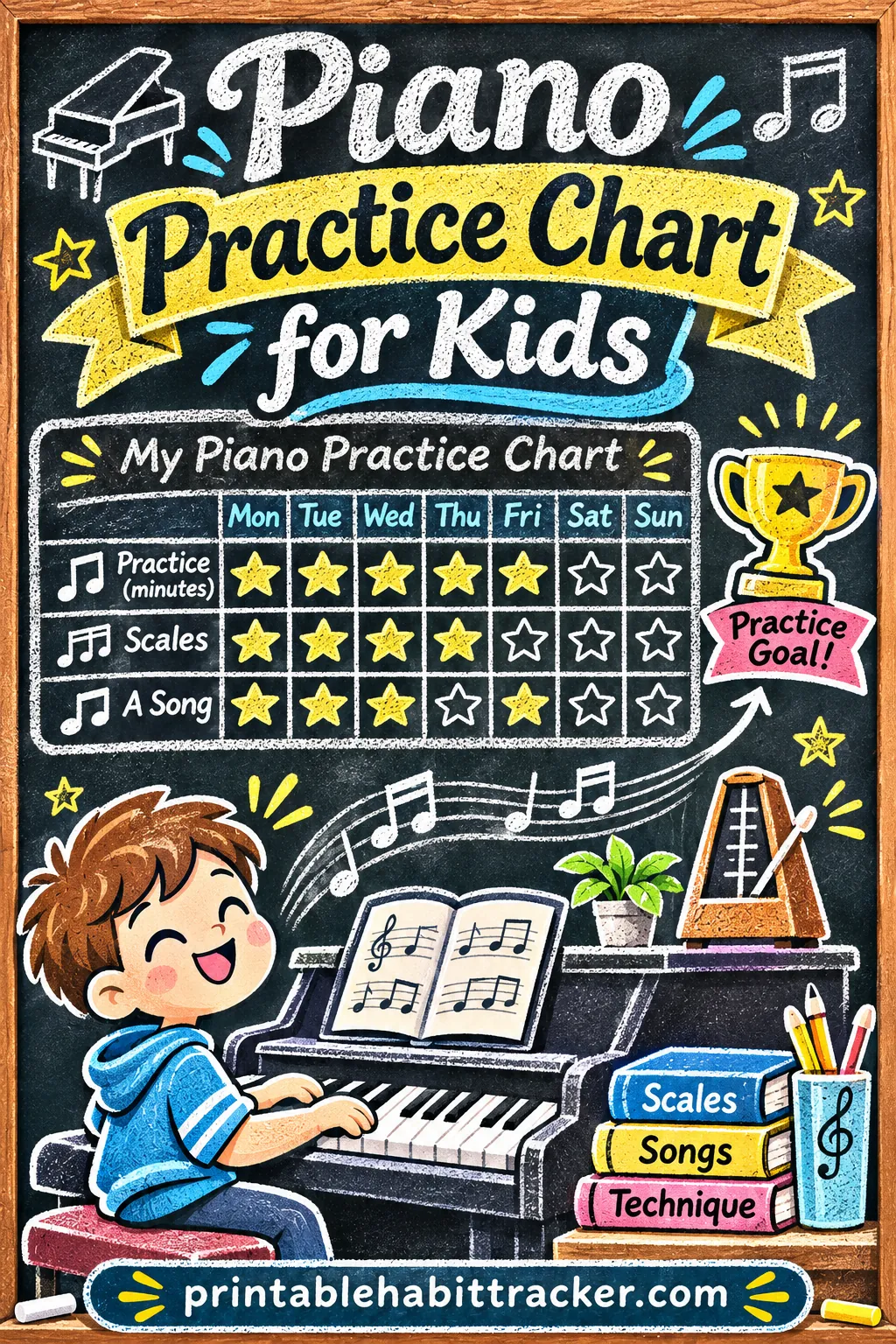
A piano practice chart works when it sets a small, fixed number of short sessions for the week, lets your child mark each one the moment it's done, and promises a reward they picked themselves when the chart fills. It moves the daily nagging off your shoulders and onto a page your child can see. Short sessions, a visible finish line and a payoff that actually arrives are what make it stick.
You can make one for free in a couple of minutes with the printable habit tracker maker on our homepage. To skip the setup, build this exact chart with five kid-friendly practice steps already filled in, then print it and tape it to the piano.
Below you'll find how to set the right number of sessions, what to put on the chart for each age, exact tool settings, reward ideas that don't backfire, scripts for the "I don't want to practice" moments, and versions for violin, guitar and other instruments.
Why Kids Resist Practice (and What a Chart Changes)
If your child fights practice, you're in good company. Most kids who take lessons go through stretches of not wanting to practice, even kids who love their lessons. It doesn't mean they're not musical or that lessons are a waste.
Practice is hard for kids for a few predictable reasons:
- It's open-ended. "Go practice" has no clear end. A child doesn't know if they're done after five minutes or forty, so the whole thing feels huge.
- It's repetitive. Playing the same tricky measure again and again is genuinely boring, especially for a young child who just wants to play songs they like.
- Progress is slow and invisible. A piece that takes three weeks to learn doesn't feel like it's getting better day to day.
- The reward is far away. "You'll be glad you can play someday" means very little to a seven-year-old.
- It becomes a power struggle. When practice turns into a daily argument, the argument becomes the habit, not the music.
A practice chart tackles each of these directly. It gives every session a clear, short list of steps with a visible end. It turns invisible progress into colored-in boxes your child can count. It brings the reward close enough to matter, at the end of the week instead of the end of the year. And it lets the chart be the "boss" instead of you, which takes a lot of heat out of the daily ask.
A chart isn't magic. It works best alongside a regular practice time, a teacher's clear assignment, and a parent who notices the effort. But it's one of the simplest tools you can add, and it works in the same way a behavior chart works for other skills: clear goal, quick mark, real payoff.
What to Put on a Piano Practice Chart
Every good piano practice chart answers three questions for your child:
- How many sessions this week?
- What do I do in each session?
- What happens when the chart is full?
Decide the number of sessions first
Pick a number your child can hit, not the number you wish they'd hit. If your child currently practices twice a week, a chart demanding seven sessions will feel like a punishment, and they'll give up by Wednesday. Start at a level that's a small stretch from where they are now.
| Where your child is now | Sessions per week to start | Next step after 2–3 full weeks |
|---|---|---|
| Rarely practices at all | 3 short sessions | 4 sessions |
| Practices 1–2 times a week | 4 sessions | 5 sessions |
| Practices most days with reminders | 5 sessions | 5 sessions, slightly longer |
| Practices daily but rushes | 5–6 sessions | Same number, add a "slow play" step |
Leave at least one day off a week. Kids, like adults, do better with a built-in rest day, and it gives a little wiggle room for busy days.
Then decide what a session is
A session isn't "sit at the piano for 20 minutes." It's a short list of specific steps. Each step is a row on the chart, and your child colors or stickers each box as they finish it. Here's a five-step session that works for most beginners and early intermediates:
| Row | What your child does | Why it helps |
|---|---|---|
| Warm-up scales | One or two scales or finger exercises from their book | Gets fingers moving and focus started |
| Play my new piece | Play the piece the teacher assigned this week | The main work of the session |
| Tricky spot 3 times | Find the hardest few measures and play them slowly three times | Fixes problems instead of repeating mistakes |
| Play an old favorite | A piece they already know and like | Ends the "work" part on something fun |
| Play for someone at home | Play one piece for a parent, sibling or pet | Builds confidence and gives a small audience |
Five steps take most young kids 10 to 20 minutes, depending on age and level. That's a real practice session with a clear finish line.
Finally, decide the payoff
Write the reward right on the chart before the week starts, in your child's words if possible. "When all five sessions are colored in, I get to pick Friday's movie." Seeing it on the page every day keeps the finish line in view. We'll go through reward ideas in detail below.
Time-based or task-based?
Some families count minutes ("20 minutes a day"). Others count tasks ("finish the five steps"). For most kids, task-based charts work better. A timer invites clock-watching and slow, aimless playing until it beeps. A task list has a clear end and rewards focus: if your child does the five steps carefully in 12 minutes, they're done.
If your teacher asks for a set number of minutes, combine them: use the task list, and add a row like "Practiced 15 minutes" that gets colored in only when both the time and the steps are done.
How to Make It in the Free Tool
Here's exactly how to set up a piano practice chart in the free maker. It takes about two minutes.
- Open the free habit tracker maker.
- Title: use your child's name. "Maya's Piano Chart" gets a lot more buy-in than "Practice Tracker." Let them help pick it.
- Template chip: tap Reward Chart. It's built for kids and pairs naturally with a payoff. (Behavior Chart also works if you'd like a simpler look.)
- Your habits (one per line): replace the template's rows with your practice steps:
- Warm-up scales
- Play my new piece
- Tricky spot 3 times
- Play an old favorite
- Play for someone at home
- Layout: choose Weekly. A week is the right length for kids: the finish line is close, and lessons usually happen weekly, so each new chart lines up with a new assignment.
- Style: choose Color-in. Kids can color the boxes with crayons, markers or a highlighter, or press a sticker into each square.
- Color theme: let your child choose. Bold and Sunset are bright and cheerful. Classic B&W is best if your child wants to color everything themselves.
- Options: turn on Reward box (write the payoff there) and Color-code habits so each step has its own color. Streak boxes are great for kids who like seeing a run of days. Add Notes/goals if the teacher gives weekly notes you want to copy onto the chart.
- Paper: Letter or A4, Landscape for the widest boxes (easier for little hands and stickers).
- Print: tap 🖨️ Print / Save PDF. Print four copies so you have a month ready to go.
Want to skip to the end? Open this chart pre-filled and just change the title to your child's name.
Settings by age
| Age | Rows | Layout | Style | Options to turn on |
|---|---|---|---|---|
| 4–6 | 2–3 very simple steps | Weekly | Color-in (stickers) | Reward box |
| 7–9 | 4–5 steps | Weekly | Color-in | Reward box, Color-code habits |
| 10–12 | 5–6 steps, one with a target | Weekly | Checkbox or Color-in | Reward box, Notes/goals, Streak boxes |
| 13+ | Their own steps, written by them | Weekly or Monthly | Checkbox | Notes/goals, Reflection |
If you like the idea of a sticker-heavy chart for a young child, the sticker chart page has more ideas for making stickers feel special.
Where to put the chart
Put it right on or next to the piano, at your child's eye level, with a pen, crayon or sticker sheet attached by a string or clip. If marking a box means walking to another room, it won't happen. The chart should be the first thing they see when they sit down and the last thing they touch when they finish.
Practice Session Plans by Age
The five-step session above is a good default, but the right session changes a lot with age. Here are ready-to-use plans. Always follow your child's teacher's assignment first. These plans just organize it into chart rows.
Ages 4–6: three tiny steps
Very young beginners can focus for only a few minutes at a time, so keep it short and playful. Five to ten minutes is plenty.
- Finger game: a quick warm-up like "walking" fingers up the keys or tapping each finger
- My song: play the current piece once or twice
- Free play: two minutes of playing anything they like, loud, soft, high or low
A parent usually sits with kids this age the whole time. Your job is mostly cheering and helping them find their place on the page. Color in the boxes together.
Ages 7–9: the five-step session
This is where the standard five rows shine. Kids this age can follow a list on their own, especially if the chart is clear. Plan on 10 to 20 minutes.
Tip: make "Tricky spot 3 times" fun by setting three small objects (coins from a game, buttons, little erasers) on the left side of the piano. Each time they play the spot correctly, one object slides to the right. When all three have moved, they color in the box.
Ages 10–12: add a target
Older kids can handle a bit more structure and like having a goal. Plan on 20 to 30 minutes, depending on level and the teacher's advice. Rows that work well:
- Scales or technique (from the teacher's list)
- New piece, section by section
- Slow practice on one hard spot
- Review piece (keeps old pieces from getting rusty)
- Sight-reading: one short new piece played once
- Performance run: play the new piece start to finish without stopping
Let them write the "hard spot" measure numbers in the Notes/goals box each week. It gives them ownership of the work.
Teens: they write the chart
By the teen years, a chart that you wrote can feel babyish. Hand over the pen. Sit down together once, ask them what their teacher wants and what they want to sound like, and let them pick the rows and the weekly session count. A simple Checkbox style with a Reflection area usually suits them better than stickers. Your role shifts from manager to interested listener.
Sample week for a 7-year-old
| Day | Session? | Notes |
|---|---|---|
| Monday | Yes, all five steps | Lesson was today, new piece assigned |
| Tuesday | Yes, all five steps | Tricky spot: right-hand jump in line 2 |
| Wednesday | Rest day | Soccer practice |
| Thursday | Yes, all five steps | Played new piece for Grandma on the phone |
| Friday | Yes, four steps | Skipped old favorite, still counts as a session |
| Saturday | Yes, all five steps | Chart full: pizza night and picks the movie |
| Sunday | Rest day | New chart goes up after next lesson |
Notice that Friday still counts. Decide ahead of time what makes a session "count." A good rule for most families: the new piece and the tricky spot must be done. The other steps are bonus boxes.
Rewards That Work (and Ones That Backfire)
The payoff is what makes a reward chart feel worth finishing. But not every reward helps. The best ones are small, quick to deliver, chosen by your child, and connected to time with you or to music itself.
How to set up the payoff
- Let your child pick from a short menu. Offer three or four options you're happy with. Choosing makes the reward theirs.
- Write it on the chart before the week starts. Use the Reward box. No changing the reward halfway through.
- Deliver it fast. If the chart fills on Saturday, the reward happens Saturday or Sunday. A reward that shows up two weeks late teaches that the chart doesn't matter.
- Keep it small. Weekly charts need weekly-sized rewards. Save bigger treats for longer milestones.
- Never take boxes away. A colored box is earned. Removing one for unrelated behavior turns the chart into a punishment tool, and kids stop trusting it.
Reward menu ideas
Time together - Pick the family movie - Choose a board game for game night - Extra 15 minutes of bedtime reading - A walk to the park, just the two of you - Bake something together
Music-related - Learn a song of their choice (ask the teacher to help pick one at their level) - A "concert" for the family, with tickets they make themselves - Pick the music in the car for a week - A new sticker sheet for the next chart - Record a video of them playing to send to a grandparent
Small privileges - Choose dinner one night - Stay up 15 minutes later on the weekend - Skip one small chore (agreed in advance) - Pick the weekend breakfast
Little things - A small toy or book from a short list you set - A special pencil or eraser for lesson notes - Fancy stickers or a new set of markers
A payoff ladder for longer streaks
Weekly rewards keep things moving. A longer ladder gives kids something bigger to work toward.
| Milestone | Example reward |
|---|---|
| 1 full chart | Small reward from the weekly menu |
| 4 full charts (about a month) | Bigger outing, like a trip to the library or a special lunch together |
| 8 full charts | Pick a "fun piece" to learn just for enjoyment |
| 12 full charts | A family concert with snacks and invitations |
| A full term or season | A celebration chosen together |
Keep old charts in a folder or tape them up in a row. A wall of full charts is a reward in itself, and it gives your child proof of how hard they've worked.
Rewards to avoid
- Rewards that are too big. If one week earns a major toy, there's nowhere to go from there.
- Food as the only reward. An occasional treat is fine, but varied rewards work better over time.
- Paying for practice. It can shift the focus from music to earning, and it gets hard to undo.
- "If you don't fill it, you lose..." Threats turn the chart into a source of stress. Missing the reward is consequence enough.
- Rewards that need you to be in a good mood. If the reward depends on you having time and energy that week, pick something easier to deliver.
What to Say When Your Child Won't Practice
Even with a great chart, there will be days your child digs in their heels. What you say in those moments matters. The goal is to keep practice from turning into a fight, while still holding the routine. Here are scripts you can use or adapt.
"I don't want to practice."
Try: "I hear you. Some days it's hard to get started. Let's just do the first box together, and then you can decide if you want to keep going."
Starting is usually the hardest part. Once your child has colored in the warm-up box, most of the time they'll finish the rest. If they truly stop after one box, that's still more than zero, and you can try again tomorrow.
"It's too hard."
Try: "That part is tricky. Let's make it smaller. Can you play just the first two notes? Now the first measure? Let's go really slow, like a turtle."
Frustration often means the chunk is too big. Shrinking it to a size your child can win builds confidence fast. This is exactly why "Tricky spot 3 times" is on the chart: it teaches kids to break hard parts down instead of avoiding them.
"I already practiced."
Try: "Great! Show me the chart. Which boxes are left?"
The chart settles it without an argument. If the boxes are colored, they're done. If they aren't, the chart, not you, is the one saying so.
"This is boring."
Try: "Want to play it as a robot? A mouse? A giant? Super loud or super soft?"
Playful variations keep the notes the same but change the feel. Young kids especially love playing a piece "like a tired dinosaur." It's still practice, and it's a lot more fun.
"I want to quit piano."
Try: "Thanks for telling me. That's a big feeling. Let's finish this month of charts, and then we'll sit down with your teacher and talk about it together."
This one deserves a real conversation, not a snap decision on a bad day. Many kids say it when practice feels stuck and then change their minds once a new piece clicks. If the feeling lasts, talk with the teacher about changes, like different music or a different practice routine, before deciding anything.
Phrases that help more than "Go practice"
- "It's piano time. Want to start with scales or your old favorite?"
- "I'd love to hear your new piece while I make dinner."
- "Can you teach me the first line?"
- "Two more boxes and the chart is full!"
- "I noticed you played that tricky part slowly. That's exactly how real musicians practice."
Notice the last one. Praise the effort and the method, like slowing down or trying again, rather than just saying "good job." It tells your child what to keep doing.
Troubleshooting Your Practice Chart
If the chart stops working after the first excitement fades, the page itself usually shows why. Here are common problems and quick fixes.
| What's happening | Likely cause | Try this |
|---|---|---|
| Chart never fills | Too many sessions to start | Drop to 3 or 4 sessions a week, then build up |
| Fills easily but playing doesn't improve | Steps are vague, kid rushes through | Add "slow play" or "tricky spot" with a clear target |
| Kid loves it for one week, then ignores it | Reward got old | Rotate the reward menu every couple of weeks |
| You forget to deliver the reward | Reward too complicated | Switch to simpler rewards you can give the same day |
| Every session turns into a fight | Practice time isn't fixed | Pick one daily time and stick to it, like right after snack |
| Siblings argue over whose chart is fuller | Charts feel like a contest | Give each child a different number of sessions based on their age, and celebrate each separately |
| Kid colors boxes without practicing | Chart is too far from the piano | Keep it on the piano, and have them play you one thing before coloring |
| Weekends always blank | Weekend schedule is different | Make weekends the rest days, or move the session to after breakfast |
| Your child cries at the piano | The music may be too hard right now | Talk with the teacher about an easier piece or shorter sessions |
Set a regular practice time
A chart works best with a fixed time. Kids do better when practice isn't up for negotiation every day. Good spots in the day include:
- Right after an after-school snack
- Before screen time (practice first, then screens)
- Right after breakfast on weekends
- Before dinner, while a parent is cooking nearby
- Right after homework
Write the practice time on the chart in the Notes/goals area. "Piano is after snack" is a small sentence that saves a lot of arguments. A family routine chart, like a habit tracker for kids, can hold piano alongside other daily jobs if you want everything on one page.
Work with the teacher
Show the chart to your child's teacher. Most teachers love seeing it, and many will suggest specific steps to put in the rows or stamp the chart at lessons. When the teacher praises a full chart, it means a lot to a child. You might ask:
- "What should a good practice session look like this week?"
- "Which part of the new piece should she slow down on?"
- "Is there a fun piece we could add as a reward?"
- "How long should practice be at his age and level?"
Variations: Violin, Guitar and Other Instruments
A piano practice chart is really a music practice log, and the same setup works for nearly any instrument. Swap the rows for ones that fit.
Violin, viola or cello
- Set up instrument and rosin the bow
- Open strings or bow exercise
- Scale
- New piece
- Tricky spot 3 times
- Review piece
Young string players often need a parent to help with setup and posture. Make "Set up" its own row so it counts as part of practice instead of a delay before it.
Guitar or ukulele
- Tune up
- Chord changes (two chords back and forth for one minute)
- Strumming pattern
- New song
- Play a song I already know
Recorder, flute or band instruments
- Long tones or breathing warm-up
- Scale
- Band music, section by section
- Tricky spot 3 times
- Play along with a recording
Drums or percussion
- Warm-up on a practice pad
- Today's rhythm exercise
- Play along with a song
- Tricky fill 3 times
Voice
- Breathing and gentle warm-up
- Scales or vowel exercises
- New song
- Sing for someone at home
Siblings with different instruments
Make one chart per child. Give each a different title, theme color and reward menu so they don't feel compared. If they're working toward a shared payoff, like a family outing, add it to both charts' Reward box: "When both charts are full, we go to the lake."
A weekly-piece chart
Some families prefer to track progress on a single piece instead of daily steps. Make each row a section of the piece: "Line 1," "Line 2," "Line 3," "Whole piece slowly," "Whole piece at speed." Your child colors one row each time they can play that section well. When every row is filled, the piece is ready for the teacher, and the chart is full.
When to stop using the chart
You don't need a chart forever. Signs your child is ready to move on:
- They practice at the usual time without being reminded
- They choose to play extra
- The reward has stopped mattering, but practice keeps happening
Don't remove it suddenly. Spread it out instead: move to a monthly chart with a bigger reward at the end, then to a simple checklist, then nothing. Some kids like keeping a chart just because they enjoy coloring in the boxes, and that's fine too.
Print Your Chart and Start This Week
Pick the number of sessions, sit down with your child to choose the reward, and put the chart on the piano before the next practice. A chart that starts on a Thursday still has a few boxes to fill and a reward to earn this weekend.
Build this exact chart with five practice steps ready to go, change the title to your child's name, and print a month's worth. Then hand them the crayons.
Frequently Asked Questions
How long should a child practice piano each day?
It depends on age, level and what the teacher recommends. Very young beginners often do well with 5 to 10 minutes, while older kids may practice longer. Ask your child's teacher for a target, and focus on focused steps rather than minutes on a clock.
How many days a week should kids practice?
Most families aim for four to six sessions a week, with at least one rest day. If your child practices rarely now, start with three sessions and add one more after a few full weeks. A chart that's easy to fill builds the habit faster than one that's out of reach.
What should I put on a piano practice chart?
List the steps of one practice session as rows, such as warm-up scales, the new piece, a tricky spot played slowly three times, an old favorite and playing for someone at home. Add a box for each session that week and a reward box at the bottom.
What are good rewards for practicing an instrument?
Small, quick rewards your child helped choose work best. Picking the family movie, a game night, extra reading time, learning a fun song or putting on a family concert are all good options. Save bigger rewards for longer milestones, like a full month of charts.
Should I pay my child to practice?
Many families prefer not to, because money can shift the focus from music to earning and it's hard to undo later. Time together, privileges and music-related rewards tend to work well without that downside. Every family is different, so choose what fits your values.
My child cries or melts down at the piano. What should I do?
Stop for the day and stay calm. Then talk with the teacher, since the music may be too hard right now or the sessions too long. Shorter sessions, easier pieces and smaller chunks often help a lot.
Does this chart work for violin or other instruments?
Yes. Swap the rows for steps that fit the instrument, like setting up and rosining the bow for violin or tuning for guitar. The session count and reward box work the same way for any instrument.
Should I sit with my child while they practice?
Younger kids usually need a parent nearby, both for help and for company. As they get older, you can move from sitting next to them, to being in the next room, to just checking the chart. Being an interested listener matters at every age.
When should my child stop using a practice chart?
When they practice at the usual time without reminders and the reward has stopped mattering, it's time to fade the chart. Switch to a monthly chart, then a simple checklist. Some kids like to keep a chart anyway, and there's no harm in that.