Holiday Habit Tracker: Keep a Floor Version of Two Habits Through December
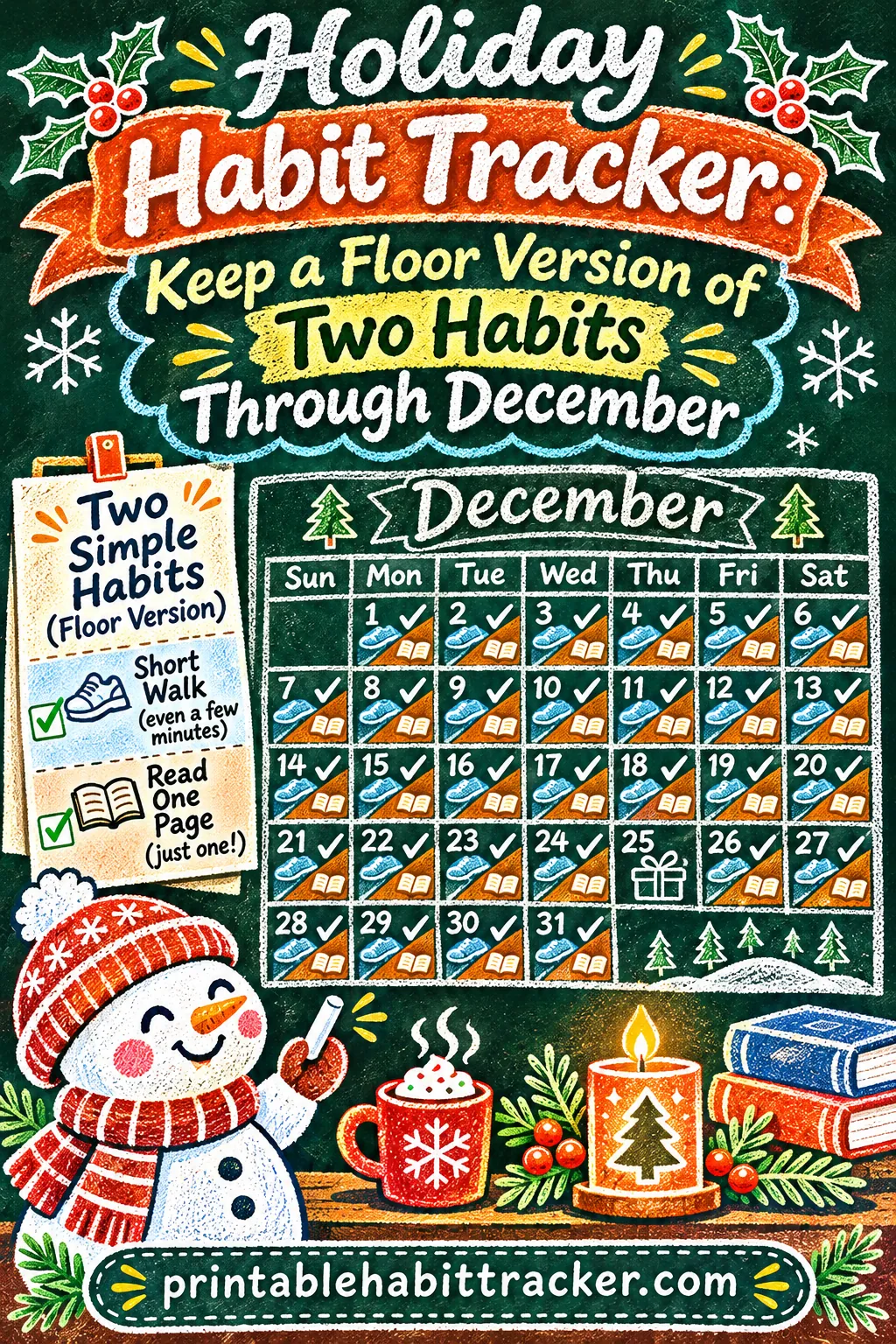
The way to keep habits during the holidays is to shrink them, not pause them: give two or three habits a "floor" version so small that a travel day or a party night still earns a check. Five minutes of movement counts. A glass of water with dinner counts. You stop asking "did I do my full routine?" and start asking "did I hit the floor?" That one change keeps December from turning into a month-long gap you have to climb out of in January.
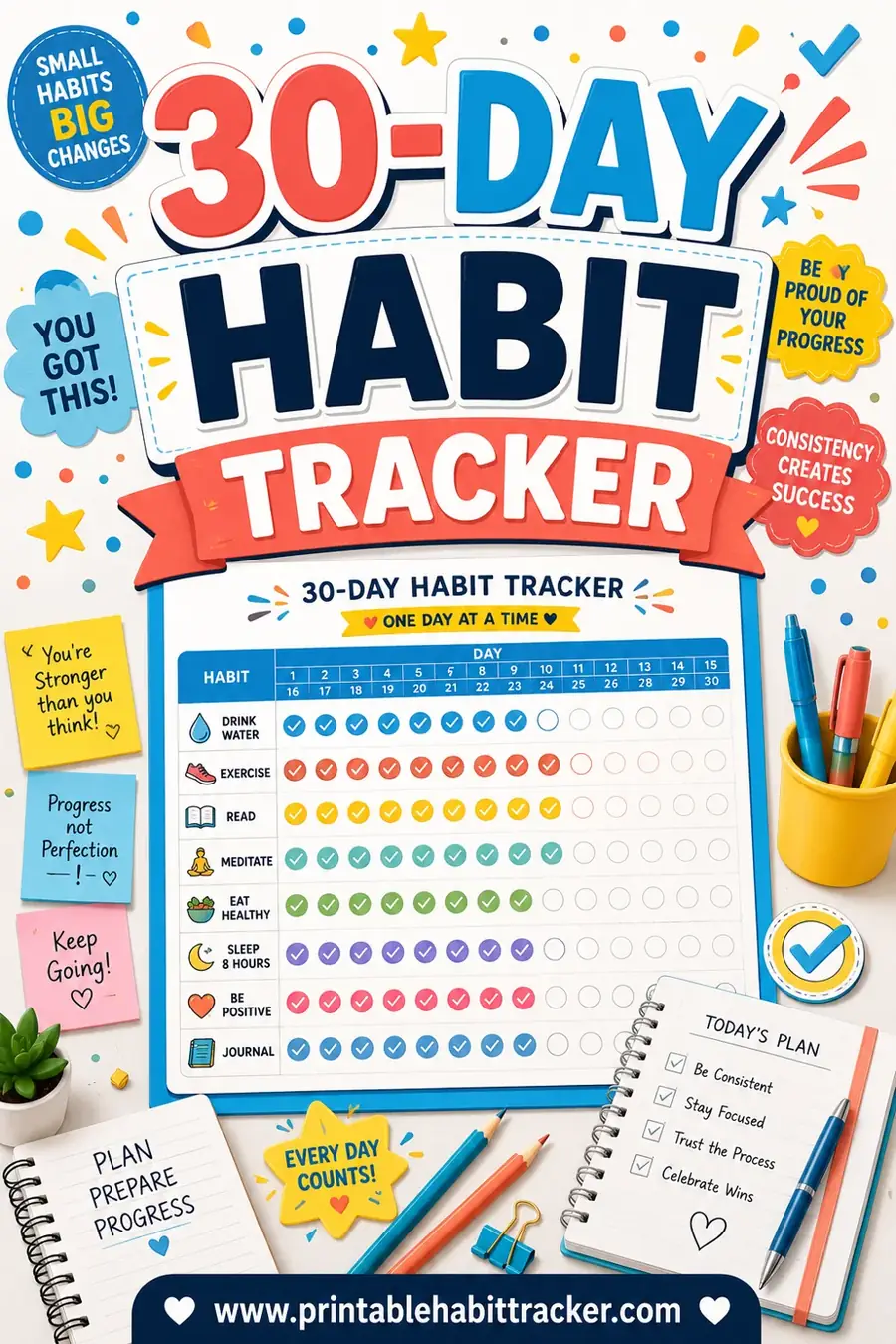
You can set this up in a couple of minutes with our free printable habit tracker maker. Build this exact tracker and it opens with four floor habits, a monthly layout and a checkbox style already filled in, ready to print for December.
Below you'll find how to pick your floor habits, how to write the floor and the "full" version side by side, the exact tool settings, a week-by-week plan for the whole month, a sample filled-in sheet, troubleshooting for the days that go sideways, and versions for parents, travelers, hosts and shift workers.
✅ Try this tracker for one week
Tap a box each day you do the habit. Your ticks stay on this device.
Why December Breaks Routines (and Why January Isn't the Fix)
Most routines don't fail because people stop caring. They fail because the conditions that held them up disappear. In December, those conditions disappear almost all at once.
What changes in the first busy week
Think about what usually keeps a habit going: the same wake time, the same commute, the same gym hour, the same quiet evening. Then the holidays arrive and you get:
- Evening events two or three nights a week, so bedtime slides.
- Travel days where your normal morning simply doesn't exist.
- Guests in the house, kids home from school or a work deadline before the break.
- Shopping, wrapping, cooking and cards squeezed into the hours your habits used to live in.
- Food that's out on the counter all day instead of at mealtimes.
None of these is a big deal alone. Stacked together in the same two weeks, they knock out the cues your habits depended on. And when the cue is gone, the habit usually goes with it.
The all-or-nothing trap
Here's the pattern a lot of people fall into. The first busy week of December, they miss their usual 45-minute workout twice. Then a party night wrecks their sleep. They look at the week and decide, "December's a write-off. I'll start fresh on January 1st."
That feels reasonable, but it costs more than it seems. You don't just lose four weeks of workouts. You lose the identity of being someone who moves every day, and you have to rebuild the whole habit from zero in the coldest, darkest month of the year. January resolutions are hard partly because people are restarting so many habits at once after a long break. If you want to see why that trap is so common, our guide on setting up a habit tracker for New Year resolutions covers the January side of it.
Why a tiny version keeps the habit alive
A habit isn't only the action. It's also the daily decision to show up. When you keep even a tiny version going, you keep the decision alive. Health organizations have long said that short bouts of activity still add up, and that getting back on track after a slip matters more than avoiding every slip. A floor habit is built on that same idea: something small, done most days, beats something big done never.
So instead of choosing between "full routine" and "nothing," you add a third option that's always within reach. That third option is the floor.
What a Floor Habit Is (and How to Set One)
A floor habit is the smallest version of a habit that still counts as doing it. It's the minimum you commit to on your worst day. Anything above it is a bonus.
Floor, normal and full
It helps to think of each habit at three levels:
| Level | What it means | Example: movement | Example: sleep |
|---|---|---|---|
| Floor | The minimum on your busiest day | Move 5 minutes | Lights out by 11 |
| Normal | What a regular December day allows | 20-minute walk | Lights out by 10:30 |
| Full | Your usual routine on a free day | 45-minute workout | Lights out by 10, phone outside the bedroom |
On the tracker, you only check against the floor. If you did the full version, great, you still get one check. That keeps the rule simple and makes the check honest. You're not grading yourself. You're just confirming the habit is still alive.
The four rules for a good floor
A floor that works in December has to pass four tests:
- It takes 5 minutes or less. If it needs a block of time, it won't survive a travel day.
- It needs no special place or gear. No gym, no yoga mat, no blender. You can do it in a relative's guest room or an airport.
- It's clear whether you did it. "Move 5 minutes" is clear. "Be healthier" isn't.
- You'd still do it on the worst day you can imagine. Picture December 23rd with a 6 a.m. flight and a late dinner. If the floor still feels doable, it's right.
If a floor fails one of these, shrink it again. Five minutes becomes two. "Read a chapter" becomes "read one page." You can always do more. The floor is a promise you can keep.
Pick two or three habits, not seven
December isn't the month to track everything. The more rows you have, the more boxes go empty on busy days, and empty rows feel like failure. Two or three floor habits is the sweet spot. Four is the most I'd suggest, and only if one of them is very easy.
Our article on how many habits to track at once goes into the reasoning, but for December the short version is: protect the habits that make everything else easier. Usually that's movement, sleep and something that keeps you steady.
Choosing your floor habits for December
Start with the habits you'd most hate to rebuild in January. Then write the smallest version of each.
Floor ideas by area
| Area | Full version | Floor version (row text) |
|---|---|---|
| Movement | 45-minute workout | Move 5 minutes |
| Walking | 8,000 steps | Walk around the block |
| Strength | Full strength session | 10 squats and 10 wall push-ups |
| Stretching | 20-minute stretch class | Stretch for 3 minutes |
| Water | 8 glasses a day | Water with every meal |
| Sleep | In bed by 10, up at 6 | Lights out by 11 |
| Reading | A chapter before bed | Read one page |
| Journaling | A full page | One line in the journal |
| Quiet time | 20-minute meditation | 3 slow breaths before bed |
| Tidying | Full kitchen reset | Clear one surface |
| Something for you | An hour on a hobby | One thing for me |
| Language study | 30-minute lesson | One review session |
Each row text is under 28 characters, so it fits cleanly on the printed sheet.
The starter set in the preset
The preset tracker uses these four rows:
- Move 5 minutes. Any movement counts: a short walk, a few stretches, dancing in the kitchen, carrying boxes up from the basement with intent.
- Water with every meal. A glass of water at breakfast, lunch and dinner. It's tied to meals, so it doesn't need its own reminder, even on a day when you're eating at someone else's table.
- Lights out by 11. Not "in bed by 10." A later, realistic line that you can hit most nights, even after an evening event.
- One thing for me. Five minutes of something that's just yours: a page of a book, a short call with a friend, a cup of tea in silence, a few minutes with a sketchbook.
If four feels like too many, drop "One thing for me" or fold it into movement. If you want to swap one, use the floor table above.
Write the full version in the Notes box
Here's a small trick. On the printed sheet, use the Notes / goals space to write your full version for each habit, like this:
"Move: floor 5 min, full = 45-min workout. Lights out: floor 11, full = 10 with phone outside the room."
That way the full version is visible, so it's still something you reach for on easy days. But the box only asks for the floor. You won't forget what your real routine looks like, and you won't punish yourself for not doing it on the 22nd.
How to Make Your Holiday Habit Tracker in the Free Tool
You can set this up in about two minutes. If you used the preset link at the top, the title, habits, layout and style are already in place. Otherwise, open the free printable habit tracker maker and follow the settings below.
Exact settings
| Setting | Choose | Why |
|---|---|---|
| Title | December Floor Habits | Reminds you every day that the floor is the goal |
| Your habits (one per line) | Move 5 minutes, Water with every meal, Lights out by 11, One thing for me | Two to four small, clear rows |
| Layout | Monthly | One page shows all 31 days of December |
| Month | December | The date grid lines up with your calendar |
| Tracking style | Checkbox | Quick to tick, even on a rushed night |
| Color theme | Classic (B&W) or Sage | B&W saves ink; Sage is calm on the fridge |
| Color-code habits | Optional | Helps you see each row at a glance |
| Extras | Notes / goals, Reflection | Space for your full versions and your end-of-month review |
| Paper | Letter or A4 | Whatever your printer uses |
| Orientation | Landscape | Wider boxes for 31 days |
When it looks right in the live preview, press 🖨️ Print / Save PDF. Save the PDF as well as printing it, so you can print a fresh copy if the paper gets lost during a trip.
Optional extras worth turning on
- Streak boxes. Nice if you want to count your longest run of floor days. With floors, streaks are realistic, which makes them motivating instead of stressful.
- Reward box. Write a small reward for hitting the floor on, say, 25 of 31 days. Keep it simple and non-food if you can: a new book, an afternoon off, a long bath.
- Mood row. Useful if you want to notice whether floor days feel different from no-floor days.
- Reflection. You'll use this at the end of December to decide which habits carry into January.
Checkbox, circle or color-in?
Checkbox is the fastest, which matters when you're marking the sheet at 11 p.m. after a party. Circle works the same way. Color-in is prettier and shows a visual pattern, but it takes a little longer. For December, I'd pick checkbox unless coloring the box is part of what you enjoy.
If you want to see more ways to lay out a one-month sheet, our monthly habit tracker page shows a few options.
Where to keep the sheet
Put it where you'll see it at night, because that's when you'll mark it. The bathroom mirror, the inside of a kitchen cabinet or the nightstand all work. If you're traveling for part of the month, fold it into your bag or take a photo of it and mark the boxes when you get home. A tracker that stays home on a closed fridge door won't help much from a relative's guest room.
The Daily Rule: How to Mark Your Sheet
The tracker works because the rule is so simple you can't argue with it at the end of a long day.
One check per habit, floor or better
Each night, look at each row and ask one question: did I hit the floor today? If yes, check the box. If you did the full version, you still check one box. There are no half-checks, no stars for extra credit and no penalty marks.
That might sound too easy. It's meant to be. The point of December isn't to make progress on fitness or sleep. It's to keep the habit alive so you don't have to restart it. Progress can come back in January, and it comes back much faster when the habit never fully stopped.
Mark it at the same time every night
Pick one moment to mark the sheet, ideally right before bed. Tie it to something you already do, like brushing your teeth or plugging in your phone. "After I plug in my phone, I mark my tracker" takes ten seconds and doesn't need any willpower.
If you're out late, mark it the next morning. Don't let a missing check sit for three days, because by then you won't remember what you did.
A tiny note when you do more
You don't need to, but some people like to write a small "F" in the corner of the box on days they did the full version. That turns the sheet into a quiet record of how much you did on the easy days, without changing the rule. If writing letters feels like work, skip it.
What to do when you miss the floor
You will miss some days. That's normal, not a sign the plan failed. The rule for misses is short:
- Never miss twice in a row. One empty box is a blip. Two in a row is how habits slip away. If you missed yesterday, make today's floor the first thing you do.
- Don't fill in boxes you didn't earn. An honest sheet is more useful than a perfect-looking one.
- Don't make up for it. You don't need to walk 10 minutes today because you missed 5 yesterday. Just hit today's floor.
Our article on what to do when you miss a day has more on bouncing back without guilt.
A Week-by-Week December Plan
December isn't one even month. The first week is usually normal-ish, the middle is packed and the last week is either chaos or total stillness. Here's how to use your floor habits through each stage.
Week 1 (December 1 to 7): Set it up and aim above the floor
Things are usually still calm. Print your sheet on November 30th or December 1st, put it somewhere visible and start marking.
Most days this week, you'll probably do your normal or full version. That's good. Check the box and, if you like, write a little F. The real goal this week is to build the nightly marking habit while life is still quiet.
This week's checklist:
- Print the sheet and save the PDF.
- Write your full versions in the Notes box.
- Choose your nightly marking moment.
- Look at your calendar and circle the dates of events, trips and hosting days.
Week 2 (December 8 to 14): Plan your floor days in advance
Now the calendar fills up. Look at the days you circled. For each one, decide ahead of time: "That's a floor day." Writing it down in advance takes the guilt out. You aren't failing on those days. You're doing exactly what you planned.
For each circled day, also decide when the floor will happen. For example:
- Office party night: 5-minute walk at lunch, water with dinner, lights out by 11 even if it's later than usual for you.
- Shopping Saturday: park farther away, which covers movement; water at each meal stop.
Week 3 (December 15 to 21): Protect the floor, let the rest go
This is often the busiest week. School events, the last work days before a break, deliveries, wrapping and cooking. Let your normal and full versions go if they need to. Just protect the floor.
Here's a helpful line to say to yourself: "The floor is the plan this week." You'll probably find you still do more than the floor on some days, because once you start moving or reading, you often keep going.
Week 4 (December 22 to 31): Travel, hosting and the quiet stretch
This is where most routines fully break. You might be traveling, hosting, or home with nothing scheduled at all. The floor carries you through each:
- Travel days: walk the airport or a rest stop for 5 minutes, drink water with each meal on the road, and aim for lights out by 11 local time.
- Hosting days: movement is easy because you're on your feet all day. The harder floor is usually sleep, so protect lights out.
- Quiet days after the holiday: these are the easiest to use for full versions. A long walk on December 26th or 27th can feel great.
December 31: Review before you plan January
Before you set any resolutions, look at your December sheet. Count the checks in each row and write the totals in the Reflection box. That number tells you which habits survived the hardest month of the year. Those are the ones you build on in January.
Examples: A Sample Sheet and a Real Routine
A sample filled-in December sheet
Here's how a realistic first two weeks might look for someone using the preset rows. A ✓ means the floor was hit. F means the full version was done. A blank means a miss.
| Day | Move 5 min | Water with meals | Lights out by 11 | One thing for me | Notes |
|---|---|---|---|---|---|
| Dec 1 | F | ✓ | ✓ | ✓ | Normal day |
| Dec 2 | F | ✓ | ✓ | ✓ | |
| Dec 3 | ✓ | ✓ | ✓ | Late meeting | |
| Dec 4 | F | ✓ | ✓ | ✓ | |
| Dec 5 | ✓ | ✓ | ✓ | Friend's party | |
| Dec 6 | F | ✓ | ✓ | ✓ | Long walk |
| Dec 7 | ✓ | ✓ | ✓ | ✓ | Shopping |
| Dec 8 | ✓ | ✓ | ✓ | ||
| Dec 9 | ✓ | ✓ | ✓ | Sick kid at home | |
| Dec 10 | ✓ | ✓ | ✓ | ✓ | Missed once, not twice |
| Dec 11 | ✓ | ✓ | ✓ | Work lunch | |
| Dec 12 | ✓ | ✓ | ✓ | Office party | |
| Dec 13 | F | ✓ | ✓ | ✓ | |
| Dec 14 | ✓ | ✓ | ✓ | ✓ | Wrapping day |
What this sheet tells you
Count the marks: movement got 13 of 14 days, water 13 of 14, lights out 12 of 14 and "one thing for me" 12 of 14. That's close to 90 percent across the board in two of the busiest weeks of the season.
Without floor habits, this same person might have looked at the nine days they didn't get a full workout and decided the month was lost. With floors, they can see the truth: the habits are fine. Workouts happened on five days, and on every other day except one, they still moved.
The misses also tell a story. Both "lights out" misses were party nights. That's useful for planning week 3: on the next party night, they might decide in advance to leave at a set time, or accept the miss and protect the next night.
Worked example: turning a real routine into floors
Let's take one person's regular routine and turn it into a December tracker step by step.
The starting routine
Maya is a teacher with two kids. Her normal routine looks like this:
- Run 3 miles four mornings a week.
- Drink about 8 glasses of water a day.
- In bed by 10, up at 5:45.
- Read for 30 minutes before sleep.
- A 15-minute stretch on run days.
Step 1: Pick the habits that matter most
She asks which habits she'd hate to rebuild in January. Running is the big one, since getting back to 3 miles after a month off would take weeks. Sleep matters because everything else falls apart without it. Reading is her "one thing for me." Water and stretching feel easier to restart, so she lets them go for December.
That leaves three habits: running, sleep and reading.
Step 2: Write the floor for each
- Running becomes Move 5 minutes. On busy days, it might be a walk around the school track at lunch. On free days, she still runs.
- Sleep becomes Lights out by 10:45. She knows she has at least four evening events, so 10 is unrealistic.
- Reading becomes Read one page. One page often turns into ten, but one page is the promise.
Step 3: Set up the tracker
She opens the preset with the build this exact tracker link, deletes "Water with every meal" and "One thing for me," changes "Lights out by 11" to "Lights out by 10:45" and adds "Read one page." She keeps the monthly layout and checkbox style and turns on Notes / goals and Reflection.
In the Notes box she writes: "Full: run 3 mi, in bed by 10, read 30 min. Floor = what's in the box."
Step 4: Mark her calendar
Before December starts, she circles her floor days: the school concert, two family dinners, a work party, the travel day to her parents' house and the travel day back. That's six days she knows will be floor days. She writes "floor" next to each in her planner.
Step 5: Review on December 31
At the end of the month, her sheet shows movement on 29 of 31 days, including runs on 14 of them. Lights out was hit on 25 days and reading on 30. In January, she doesn't need to restart anything. She just moves her floors back up toward her full routine.
That's the whole point. December didn't build her fitness. It protected it.
Variations for Different Kinds of Decembers
Not everyone's December looks the same. Here's how to adjust the floor habits for a few common situations.
Parents of young kids
Your evenings belong to school concerts, class parties and late wrapping sessions. Movement can come from the kids: a 5-minute dance break, a walk to look at neighborhood lights, a snowball fight. Make one row something the kids can see you do, like "Walk with the kids," so they help you hit it.
Sleep floors for parents should be realistic. If the kids are up at 6, "Lights out by 11" may still be too late. Try "Lights out by 10:30" and expect to miss it on wrapping nights.
If the whole family wants in, add one shared row such as "Family walk" and let the kids check it.
Travelers
If you'll be away for a week or more, the floor needs to work in someone else's home. Good travel floors:
- Move 5 minutes (a walk around the block, stairs in a hotel, stretching in the guest room).
- Water with every meal.
- One page of a book on your phone or a paperback in your bag.
Print two copies of the sheet. Keep one at home and fold one in your bag. Or save the PDF on your phone and mark checks on a sticky note, then copy them over when you get back.
Hosts
When you're hosting, you're on your feet for hours, so movement is rarely the problem. The habits that slip are sleep, quiet time and eating at regular times. Good host floors:
- Lights out by 11 (even if the dishes wait until morning).
- Sit down for one meal.
- Five quiet minutes alone.
Shift workers and people working through the holidays
If you work nights or holiday shifts, set floors by "my day" instead of the clock. Instead of "Lights out by 11," try "7 hours in bed after shift." Instead of "Water with every meal," try "Water bottle refilled once per shift." The monthly grid still works. You just read each column as one of your days, not one calendar date.
People who already have a long habit list
If you normally track eight or ten habits, December is the time to trim, not to quit. Copy your list onto paper and mark each one as "floor," "pause" or "drop." Keep two to four floor habits on the December sheet. Paused habits go in the Notes box with "back in January." That way nothing is forgotten, and you aren't looking at seven empty rows on a travel day.
Troubleshooting: When the Floor Isn't Working
Even floor habits run into trouble. Here are the most common snags and what to do.
| Problem | What's probably going on | What to try |
|---|---|---|
| I keep forgetting to mark the sheet | No fixed marking moment | Tie it to brushing your teeth or plugging in your phone |
| I hit the floor but feel like I'm cheating | Old all-or-nothing thinking | Remember the goal is keeping the habit alive, not progress |
| I missed three days in a row | A trip or illness broke the chain | Restart today with just one habit, then add the others back |
| My floor is still too hard | It needs time, a place or gear | Shrink it again, from 5 minutes to 2, or from one chapter to one page |
| Every day is a floor day | The floor became the ceiling | On free days, check the Notes box and try your normal version |
| The sheet got lost on a trip | Paper stayed home | Print a new copy from your saved PDF and fill in what you remember |
| I hate seeing empty boxes | Too many rows | Cut to two habits for the rest of the month |
| I feel worn out and low | Busy season, short days, too little rest | Make rest one of your floors, and talk to your doctor if low mood lasts |
A quick note on that last row: a habit tracker is a planning tool, not medical advice. If you're feeling low for more than a couple of weeks, or your sleep or energy changes in a way that worries you, please talk to your doctor.
When the floor turns into the ceiling
This is the most common worry, and it's fair. If you only ever do 5 minutes, won't you lose ground?
Maybe a little. But the comparison isn't "5 minutes versus 45 minutes." It's "5 minutes versus nothing for a month." And in practice, most people do more than the floor on a good number of days, because starting is the hard part. Once you're out walking, you often keep walking.
If you notice every single day has been floor-only for two weeks, pick one free day and plan a full version on purpose. Put it in your calendar like an appointment.
Carrying Your Floor Habits Into January
The best part of a December floor tracker is what it does for January. Instead of starting from zero, you start from a habit that's still running.
Step up gradually
In the first week of January, raise each floor one notch:
| Habit | December floor | January week 1 | January week 3 |
|---|---|---|---|
| Movement | Move 5 minutes | Move 15 minutes | Your normal routine |
| Sleep | Lights out by 11 | Lights out by 10:30 | Your usual bedtime |
| Reading | One page | Ten pages | A chapter |
| Water | With every meal | With meals plus one more | Your normal amount |
Small steps keep the habit easy while the rest of life gets back to normal.
Keep the floor as a backup
Even after December, keep the floor version written on your sheet. Busy weeks happen all year: a sick kid, a deadline, a move. When they do, you already know what your minimum looks like. The floor becomes a permanent safety net instead of a holiday trick.
Start your January sheet the same night
On December 31st, after you write your totals in the Reflection box, set up your January sheet in the same tool. Change the month, raise the floors and print it. Starting the new month the same night you review the old one keeps the momentum. If the idea of very small habits clicks for you, our article on the Tiny Habits method explains why starting tiny works so well.
Get your December sheet ready
You don't need a perfect December to come out of it with your habits intact. You need two or three tiny promises you can keep on your busiest day, a simple nightly check and permission to do more when life allows.
Pick your floors, write your full versions in the Notes box and circle your busy days before the month starts. Then build this exact tracker, print it and put it where you'll see it tonight. Come January 1st, you won't be starting over. You'll just be turning the dial back up.
Frequently Asked Questions
What is a floor habit?
A floor habit is the smallest version of a habit that still counts as doing it, like moving for 5 minutes instead of a full workout. It's your minimum on the busiest day. Anything you do above it is a bonus, but the tracker only asks for the floor.
How many habits should I track in December?
Two or three is best, and four at most. Fewer rows means fewer empty boxes on busy days and less guilt. Pick the habits you'd most hate to rebuild in January, usually movement, sleep and one thing that keeps you steady.
Does 5 minutes of exercise really count?
For keeping a habit alive, yes. Health sites have long said short bouts of activity still add up, and the bigger benefit here is that you keep the daily habit of showing up. On free days you can always do more. If you have health conditions, check with your doctor about what's right for you.
Should I use a monthly or weekly layout for the holidays?
Monthly works best for December because one page shows all 31 days, including the busy middle weeks and the quiet days after the holiday. Weekly works if you'd rather print a fresh sheet each Sunday and adjust your floors as you go. Both are free in the same tool.
What if I travel for most of December?
Choose floors that need no gym, kitchen or special gear, like a 5-minute walk, water with meals and one page of a book. Print an extra copy or save the PDF on your phone, then mark your checks when you get a moment. Set your sleep floor by local time.
Is it cheating to only do the floor?
No. The floor is the plan, not a shortcut. December's goal is to keep the habit alive so you don't have to restart in January. Most people find they do more than the floor on plenty of days anyway, because starting is the hardest part.
What do I do if I miss a few days in a row?
Start again today with the easiest habit on your sheet, then add the others back over the next day or two. Don't try to make up for missed days. Leave the empty boxes honest and focus on not missing the next one.
When should I start my holiday habit tracker?
Print it on November 30th or December 1st, while things are still calm. That gives you a quiet first week to build the nightly marking routine before the busy weeks arrive. Starting late is fine too. A tracker started on December 12th still beats waiting for January.
Can I use the same tracker after the holidays?
Yes. In January, keep the same rows but raise each floor one step, like 15 minutes of movement instead of 5. Keep the floor written in your Notes box as a backup for busy weeks the rest of the year.