How to Keep Your Habits Going While Traveling
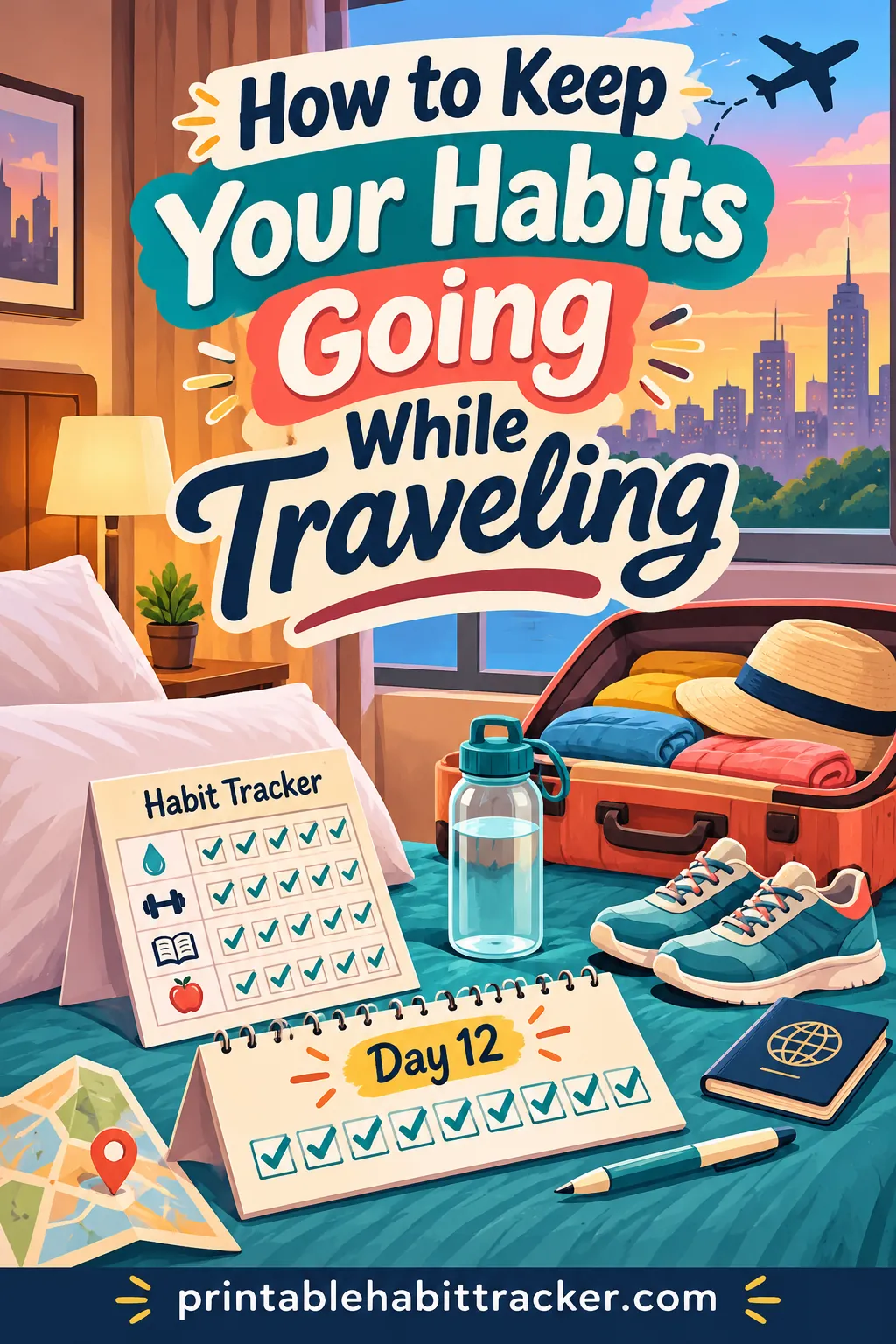
To keep habits while traveling, shrink each habit to a 2-minute travel version before you leave, track those small versions on a one-week trip tracker, and count every travel day you hit the small version as a full win. Your full routine doesn't fit in a hotel room, a relative's guest bed or an airport gate, and it doesn't have to. The goal on a trip is to keep the thread alive, not to keep the whole routine.
You can build this exact tracker in the free printable habit tracker maker in about a minute. It opens with six small travel habits already filled in on a weekly layout, so you can edit the list, print it and tuck it in your bag.
This guide walks you through why streaks die on trips, how to write a travel version of every common habit, what to put on the trip tracker, how to handle different kinds of trips, and how to restart cleanly when you get home.
Why Your Streaks Die on Every Trip
Most habits are tied to a place and a sequence. You drink water because the glass sits by the sink. You stretch because the mat is rolled out by the bed. You read because the book is on the nightstand and the lamp is already on. Take away the kitchen, the mat and the nightstand, and the cue disappears with them.
Trips also scramble your clock. Early flights, late dinners, time zone shifts, long drives and shared rooms all push the usual time slot around. A habit that lived at 6:30 a.m. has nowhere to land when you're boarding at 6:30 a.m.
Then there's the all-or-nothing trap. Your normal workout is 45 minutes with weights. The hotel gym has one treadmill and a stack of towels. So you skip it, because a "real" workout isn't possible. Do that for four days and the streak is gone, along with the feeling that you're someone who works out.
Here's the shift that fixes most of this: a trip is not a normal week, so it shouldn't be measured like one. You don't need a weaker version of yourself. You need a smaller version of the habit, written down before the trip starts, so you aren't deciding what counts while you're tired, jet-lagged or juggling family plans.
The three things a trip takes away
| What you lose | What it looks like | What to do instead |
|---|---|---|
| Your cues | No mat, no water glass, no book on the nightstand | Pack one visible cue per habit and put it out the first night |
| Your time slot | Flights, tours and dinners land on your usual habit time | Attach each habit to something that happens every day on any trip, like brushing teeth |
| Your full-size version | No gym, no kitchen, no quiet room | Write a 2-minute travel version that works anywhere |
When you fix all three, most habits survive the trip just fine. When you fix only one, they usually don't.
The 2-Minute Travel Version: Your Main Tool
A travel version is the smallest form of a habit that still keeps you in the habit. It takes about two minutes, needs no special equipment and works in any room. It isn't a punishment or a lowered standard. It's a placeholder that tells your brain "this is still something I do."
This idea comes straight from the tiny habits method, which shrinks a behavior until it's almost too easy to skip. On a trip, that's exactly what you want. If you have energy for more, you do more. If you don't, the small version still counts.
Write your travel versions before you pack. That's the most important step in this whole guide. If you try to decide on the spot, you'll either skip it or argue with yourself. Decide at home, write it on the tracker, and follow the paper.
A ready list of travel versions for common habits
Pick the habits you already track and copy the travel version that fits.
| Your normal habit | 2-minute travel version | What you need |
|---|---|---|
| 45-minute gym workout | 10 pushups, 10 squats, 30-second plank | Floor space |
| Morning run | 10-minute walk outside or in the hotel hallway | Shoes |
| Yoga session | Three stretches on the bed or floor | Nothing |
| Drink 8 glasses of water | One full bottle before lunch, water with every meal | Refillable bottle |
| Read 30 minutes | Read 2 pages | Book or e-reader |
| Journal one page | Write one line about the day | Small notebook |
| Meditate 20 minutes | Five slow breaths before getting out of bed | Nothing |
| Study a language 20 minutes | Five flashcards or one short lesson | Phone or cards |
| Cook healthy meals | One vegetable or fruit with every meal | Nothing |
| Practice an instrument | Tap or hum one piece, or watch one lesson | Nothing |
| Skincare routine | Cleanse and moisturize | Travel-size bottles |
| Take medication on time | Same home-time alarm, pills in a day-marked case | Pill case |
| Daily steps goal | Take the stairs or walk one errand | Shoes |
| Gratitude list of three | Name one good thing out loud or on paper | Nothing |
| Budget check | Snap a photo of every receipt | Phone |
| Bedtime by 10 p.m. | Lights out within an hour of your trip bedtime | Eye mask |
| No screens before bed | Phone face-down for the last 10 minutes | Nothing |
| Clean the kitchen nightly | Repack your bag and clear the nightstand | Nothing |
If medication is on your list, keep following your doctor's or pharmacist's instructions about timing, especially when you cross time zones. Ask them before the trip if you're unsure how to adjust. The travel version for medication isn't "smaller," it's just better organized.
The "floor and ceiling" rule
Give each travel habit a floor and a ceiling.
- Floor: the 2-minute version. This is what you must do for the day to count.
- Ceiling: your full normal habit. This is what you do if the day allows it.
On a quiet beach day, you might hit the ceiling for everything. On a travel day with two flights, you hit the floor and go to sleep. Both days get a check. Write the floor on your tracker, not the ceiling, so the paper always asks for something you can do.
How many habits to bring along
Bring fewer habits than you track at home. Three to six is plenty for most trips. If you normally track ten habits, choose the ones that matter most to how you feel, like movement, water, sleep and one mind habit such as reading or journaling. Leave the rest at home and pick them back up when you return.
If you're not sure which ones to keep, ask yourself which habit you'd miss most by day three of the trip. Start there.
Count Travel Days as Wins (and Change What You Measure)
A trip tracker works differently from a home tracker in one key way: a travel day where you hit the small version is a win, full stop. Not half a win, not a "sort of" check. A full check.
This matters because of how streaks feel. If you treat the trip as a pause and leave the boxes blank, you come home to a gap that looks like failure. If you treat the trip as part of the streak and check the small versions, you come home to an unbroken row. The second one is much easier to keep going.
Count days per month, not just streaks
Streaks are motivating, but they're fragile. One missed day on a red-eye flight can wipe out 40 days of effort if the streak is the only number you watch. A sturdier way to measure is to count how many days per month you did the habit at all.
For example, "I walked 26 out of 30 days this month" is still a great month, even if the streak broke twice. Many people find this takes the sting out of travel and makes it easier to keep going. Our article on streaks vs flexibility goes deeper on why a days-per-month count often holds up better than a pure streak.
Try tracking both:
| Measure | What it tells you | Best use |
|---|---|---|
| Current streak | How many days in a row | Motivation on normal weeks |
| Days per month | How often you showed up overall | The real picture, especially in travel months |
| Travel-version days | How many days you hit the floor | Shows the trip didn't erase the habit |
Write one line when a streak breaks
Sometimes the floor still doesn't happen. You land at 2 a.m., or you're sick, or a family event runs from dawn to midnight. That's fine. When a box stays empty, write one short line on the tracker about why. Keep it plain and specific.
- "Missed walk, 14-hour travel day."
- "No reading, shared room, lights out early."
- "Skipped water bottle, left it in the rental car."
That one line does two things. It stops you from turning a single miss into a story about failing, and it gives you something to fix next trip. If "left the bottle in the car" shows up twice, you know to clip it to your bag. For more on handling misses in general, see what to do when you miss a day.
How to Make a Trip Tracker in the Free Tool
A trip tracker is a one-week sheet with your travel versions written in, and it takes about two minutes to set up. You can build this exact tracker to start from the sample, or open the free habit tracker maker and set it up from scratch with these settings.
- Title: type something short like "Trip Week Habit Tracker" or the name of the trip, such as "Beach Week" or "Work Trip, Denver."
- Template chips: skip them, or tap Morning Routine or Self-Care if you want ideas to start from, then edit.
- Your habits (one per line): type your travel versions, not your full habits. One per line, three to six lines. Keep each one short so it fits the row, for example "10 pushups or a walk" or "Read 2 pages."
- Layout: choose Weekly for a trip of a week or less. For a longer trip, choose Monthly and set the month the trip falls in.
- Style: choose Checkbox if you'll carry a pen. Choose Color-in if you're bringing colored pencils or traveling with kids who like coloring the boxes.
- Color theme: Classic B&W prints cleanly on any printer and photocopies well if you need extra copies on the road.
- Options: turn on Streak boxes so you can see the streak continue, and Notes/goals so you have room for the one-line "why it broke" notes. Reflection is handy for longer trips.
- Paper: Letter or A4 to match your printer. Portrait folds neatly into a passport wallet or book; Landscape gives longer rows if your habit names are wordy.
- Click 🖨️ Print / Save PDF. Print one copy, or save the PDF to your phone so you can print a spare at a hotel business center if the first one gets lost.
Where to keep the sheet on the road
Paper works on trips because you can see it. A tracker buried at the bottom of a suitcase does nothing. Try one of these spots.
- Folded inside the book you're reading. It doubles as a bookmark and you'll see it every night.
- Tucked in your passport wallet or travel folder. Good for work trips where you're opening the folder daily anyway.
- Taped to the bathroom mirror with a small piece of tape from the front desk. You'll see it every morning and every night.
- Photographed on your phone as a backup, and checked off on paper when you're back in the room.
If you'd rather not print at all on a trip, take a photo of the blank sheet and mark it with a photo-editing pen tool each night, then copy the checks to paper when you're home. A pencil and a folded sheet are all the system you need.
Pre-trip checklist
Run through this the night before you leave.
- Travel versions written on the tracker, one per habit.
- Tracker printed and packed somewhere you'll open daily.
- One pen packed with it (hotel pens disappear).
- One physical cue per habit packed on top: water bottle, book, resistance band, journal, pill case.
- Trip bedtime decided and written at the top of the sheet.
- Your "anchor" for each habit chosen (more on that below).
Plans for Different Kinds of Trips
Before you pick a plan for your trip type, set up anchors. They work on every kind of trip.
Anchor habits to things that happen on every trip
At home, your habits hang on your routine. On a trip, the routine changes daily, so you need anchors that show up no matter where you are. A few things happen on almost every trip, every day.
- You wake up.
- You brush your teeth.
- You eat meals.
- You get dressed.
- You go back to your room or bed at night.
- You charge your phone.
Tie each travel habit to one of these. This is habit stacking adapted for travel: "After I [anchor], I will [travel version]."
| Anchor | Travel habit attached to it |
|---|---|
| After I brush my teeth in the morning | I do 10 pushups and 10 squats |
| After I sit down to any meal | I drink one full glass of water |
| After I get dressed | I fill my water bottle |
| After I plug in my phone at night | I read 2 pages |
| Right before I turn off the lamp | I write one line in my journal |
| Before I leave the room each morning | I take my medication from the day-marked case |
Anchors beat clock times on trips because clock times move. Your teeth get brushed at 5 a.m. on a travel day and 9 a.m. on a beach day, and the habit moves along with them.
Match the plan to the trip
Not every trip looks the same. A weekend at your in-laws' house asks for something different than a two-week tour with daily early starts. Use the trip type to decide how strict to be and which habits to bring.
Weekend getaway (2 to 3 nights)
Keep it to three habits. Pick the ones that most affect your mood, like a walk, water and sleep. Use the floor version every day and don't worry about the ceiling. A short trip is where people most often throw out the whole routine, and it's also the easiest one to protect with just a few small checks.
Work trip
Work trips usually come with a hotel, a schedule and long sitting days. That's actually helpful, because the structure is predictable.
- Use the hotel gym or a hallway walk before the first meeting.
- Bring your own water bottle into every session.
- Read 2 pages on the plane or in the room at night.
- Protect sleep. Work trips tend to run late with dinners, so set a firm trip bedtime and write it at the top of the tracker.
Family visit or holiday at a relative's house
Staying with family often means shared rooms, set meal times and less privacy. Choose travel versions you can do quietly or in short bursts.
- Stretch in the bathroom or before others wake up.
- Walk after a meal and invite a relative, which counts as both movement and family time.
- Read on the couch while others nap.
- Keep journaling to one line so it doesn't need a private desk.
If you're traveling for the holidays, it helps to expect at least one day that's packed from morning to night. Decide in advance that day only needs the water habit, and you'll still come home with a full row.
Road trip
Long drives make movement harder and snacking easier. Build habits around stops.
- At every gas stop, walk one lap of the lot.
- Refill your water bottle at every stop.
- Pack fruit or vegetables in the car so the "one vegetable with every meal" habit has a fallback.
- Swap reading for an audiobook chapter, which counts.
Long trip or extended stay (two weeks or more)
On a longer trip, you can rebuild more of your home routine after the first few days. Start with floor versions for the first three to four days while you settle in. Once you find a park, a pool or a quiet corner, raise one or two habits back toward the ceiling. A monthly layout works better here than a weekly one.
Trips with kids
When kids come along, your own habits compete with naps, meals and meltdowns. Keep your list tiny and look for ways to do habits together. A walk with a stroller counts as movement. Reading a picture book aloud counts for some reading goals. Many families bring a simple kids' sheet, too; a printed kids' chart with two or three easy boxes like "brush teeth" and "drink water" can make the trip feel like a game.
Camping or off-grid trip
No outlets, no hotel gym, no screen. Paper wins here. Pick habits that need nothing: a morning stretch, water, a walk, one journal line by flashlight. Keep the tracker in a zip bag with a pencil, since pens can skip in the cold.
A 15-minute hotel workout (and 2-minute backup)
Movement is the habit people lose most often on trips, so it gets its own section. You don't need a gym. You need a patch of floor about the size of a bath towel. As always, if you have a health condition or injury, follow your doctor's or physical therapist's advice about what's right for you.
The 2-minute floor version.
Do this when the day is packed. It counts.
- 10 squats
- 10 pushups (on the floor, the bed edge or the desk)
- 30-second plank
- 10 slow arm circles each way
The 15-minute ceiling version.
Do this when you have a little time. Repeat the circuit three times, resting as long as you need between rounds.
| Move | Amount | Room-friendly tip |
|---|---|---|
| Squats | 15 | Hold the desk chair for balance if needed |
| Pushups | 10 | Hands on the bed edge to make them easier |
| Reverse lunges | 8 per leg | Quieter than jumping moves for thin walls |
| Chair dips | 10 | Use a sturdy chair without wheels |
| Glute bridges | 15 | On a towel on the floor |
| Plank | 30 seconds | Forearms on the towel |
| Hallway or stair walk | 3 minutes | Only if the stairwell is open to guests |
Avoid jumping moves if someone is staying below you, and skip anything that needs furniture you aren't sure is stable. When the trip ends, pick your home workout back up using the ramp below.
A Sample Trip Week, Filled In
Here's how a real-looking trip week might go for someone on a six-day family trip with two travel days. Each check means the floor version or more. Each X has a one-line note.
| Habit | Sat (fly) | Sun | Mon | Tue | Wed | Thu (fly) |
|---|---|---|---|---|---|---|
| 10 pushups or a walk | ✓ | ✓ | ✓ | ✓ | ✓ | ✓ |
| Water with every meal | ✓ | ✓ | ✓ | X | ✓ | ✓ |
| Read 2 pages | ✓ | ✓ | ✓ | ✓ | X | ✓ |
| Stretch 2 min | X | ✓ | ✓ | ✓ | ✓ | ✓ |
| One line in journal | ✓ | ✓ | ✓ | ✓ | ✓ | ✓ |
| In bed by trip bedtime | X | ✓ | ✓ | X | ✓ | ✓ |
Notes column:
- Sat: no stretch, landed late; asleep right away.
- Sat: bedtime missed, flight delay.
- Tue: water missed, all-day outing, bottle left in car. Fix: clip bottle to bag.
- Tue: bedtime missed, family dinner ran late. Expected.
- Wed: reading missed, shared room with cousins. Fix: read on the couch after lunch.
That's 31 checks out of 36 boxes, on a trip with two flights and a packed family schedule. The habits didn't vanish. They got smaller for a week, and the notes give two easy fixes for next time.
Coming Home: How to Restart Without the Slump
The first few days back can be harder than the trip itself. You're tired, the laundry is piled up, and the full routine suddenly feels huge. Many people keep the trip going by accident, staying on the small versions for weeks. Here's a simple re-entry plan.
The three-day ramp back
| Day back | What to do | Why |
|---|---|---|
| Day 1 (arrival day) | Floor versions only, same as the trip | Travel days are tiring; don't raise the bar yet |
| Day 2 | Half of your normal habit for each | Rebuilds the full routine without a shock |
| Day 3 | Full normal routine | You're back to the ceiling |
Print a fresh home sheet before you leave
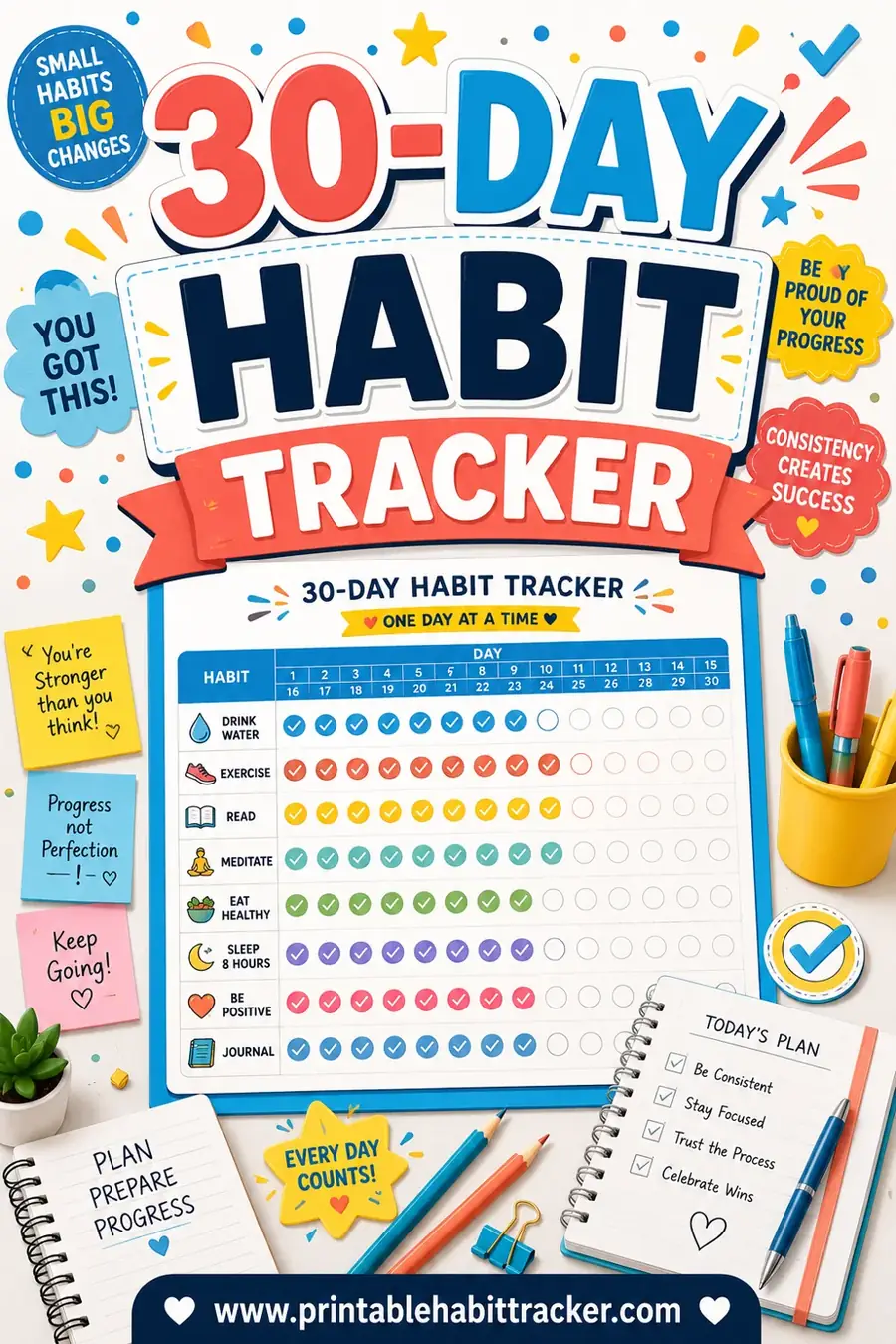
One small trick helps a lot: print your regular home tracker before the trip and leave it on the counter or the fridge. When you walk in the door, the next sheet is already waiting. You don't have to rebuild anything while you're unpacking. A 30-day habit tracker is a good choice here, since a fresh 30-day sheet that starts the day after you get home feels like a clean start without throwing away the trip's progress.
Do a quick trip review
Sit down for five minutes on day two or three and look at the trip sheet.
- Which habit held up best? It's probably your strongest habit, and a good anchor for others.
- Which one broke most? Look at the notes for the pattern.
- What one change would help next trip? Write it on the back of the sheet and keep it with your travel things.
Keep a small folder of old trip sheets. After two or three trips, you'll know exactly which travel versions work for you, and packing the tracker becomes as automatic as packing a toothbrush.
Troubleshooting: When Travel Habits Still Slip
| Problem | Likely cause | Fix |
|---|---|---|
| You forget the tracker exists | It's buried in the suitcase | Keep it in your book, passport wallet or taped to the mirror |
| You skip because the small version feels pointless | You're comparing it to the home version | Remind yourself the goal on a trip is to keep the thread, not build fitness |
| Every evening plan falls apart | Trips get busier as the day goes on | Move habits to the morning anchor: right after brushing teeth |
| Time zones scramble everything | Clock-based habits drift | Use anchors, not clock times; for medication, ask your doctor or pharmacist how to adjust |
| Shared room makes habits awkward | No privacy | Choose quiet versions: breathing, reading, bathroom stretches |
| You drop everything on travel days | Travel days are exhausting | Plan travel days as "one habit only" days in advance |
| You keep the small versions for weeks after | No re-entry plan | Use the three-day ramp and a fresh home sheet waiting on the counter |
| One miss makes you quit the whole trip | All-or-nothing thinking | Write one line about why, then check the next box tomorrow |
If you notice a pattern of quitting after any miss, not just on trips, that's worth working on at home too, because the same fix applies: shrink the habit and keep the row going.
Ready to pack your tracker?
You don't need willpower on a trip so much as a plan made before you leave. Pick three to six habits, write the 2-minute version of each, tie them to anchors that happen on every trip, and print a one-week sheet that counts small days as full wins. When you get home, ramp back over three days with a fresh sheet already waiting.
Ready to try it? Build this exact tracker, swap in your own travel versions, and print it before your next trip.
Frequently Asked Questions
How do I keep habits while traveling if I have no time?
Shrink each habit to a 2-minute version you can do anywhere, and attach it to something you do every day on any trip, like brushing your teeth. On packed days, those small versions are all you need. A check for the small version still counts as a full win.
Should I pause my habit tracker during vacation?
You can, but it often makes restarting harder because you come home to a blank gap. Many people find it easier to keep tracking with smaller travel versions so the row stays unbroken. If you truly want a rest, plan the pause in advance and write "vacation" across the days so it doesn't feel like a miss.
Does a travel version really count toward my streak?
Yes, if you decide in advance that it does. The point of a streak is to keep showing up, and the travel version keeps you showing up. Write the travel version on the tracker so there's no debate in the moment.
What's the best tracker layout for a trip?
A weekly layout works well for trips of a week or less, since it fits on one page and folds small. For longer trips, a monthly layout lets you see the whole stay. Keep the habit list shorter than at home, around three to six items.
How do I handle habits across time zones?
Tie habits to daily anchors, like waking up, meals and bedtime, instead of clock times, so they move with your day. For medication, follow your doctor's or pharmacist's advice about timing and ask them before the trip if you're unsure.
What if I miss a day on my trip?
Write one short line on the tracker about why, then pick up the next day. One empty box doesn't erase the trip or the habit. Counting how many days you did the habit across the month gives a fairer picture than a single streak.
How do I get back into my routine after a trip?
Use a three-day ramp: small versions on arrival day, half your normal habit on day two, and your full routine on day three. Having a fresh home tracker printed and waiting on the counter makes the restart much easier.
Can kids use a travel habit tracker too?
Yes. Give them two or three very simple boxes, like brushing teeth and drinking water, and let them color in each one. It keeps a bit of home routine on the trip and gives them something to look forward to each night.