Postpartum Tiny Habits: A One-Line Tracker for New Moms
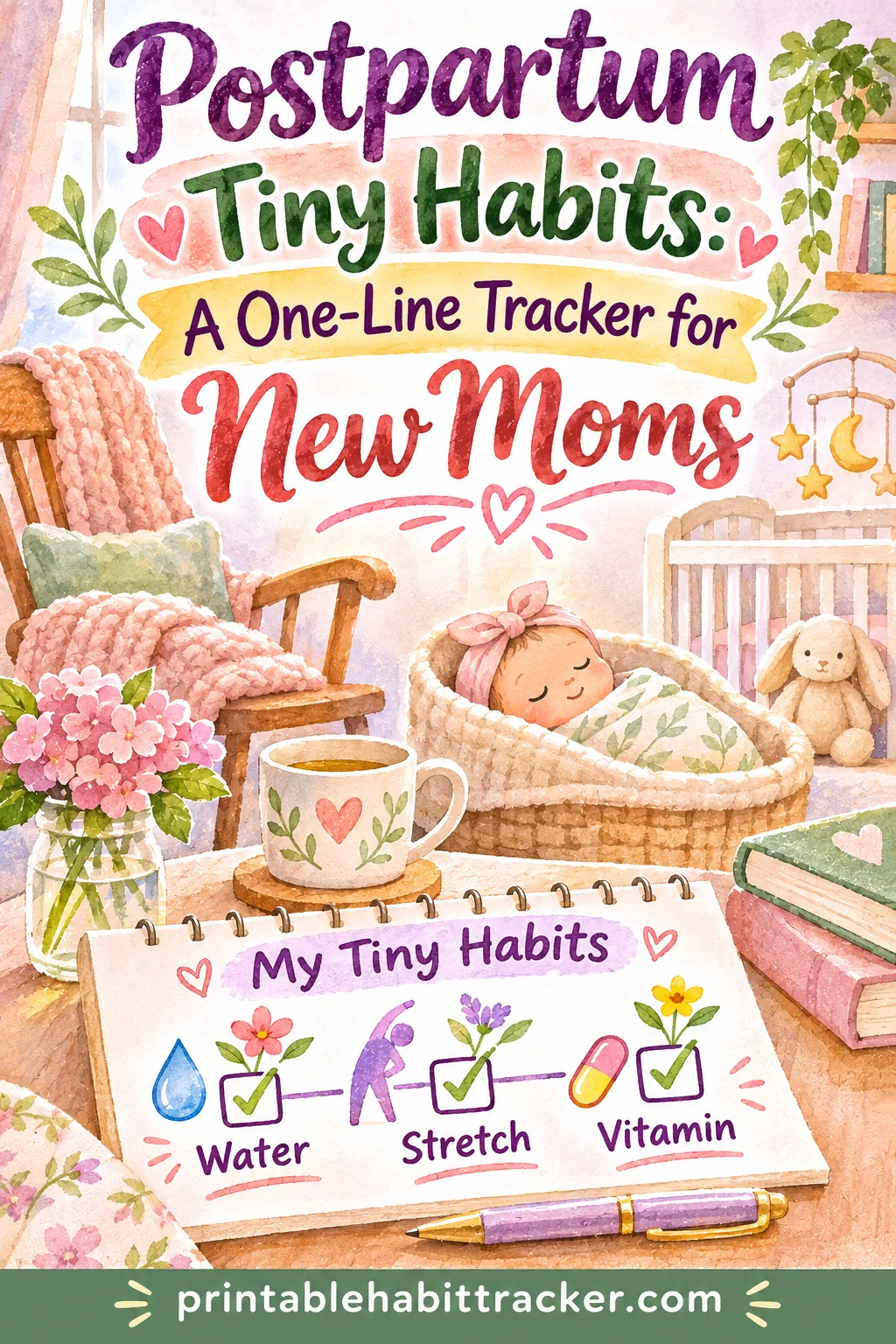
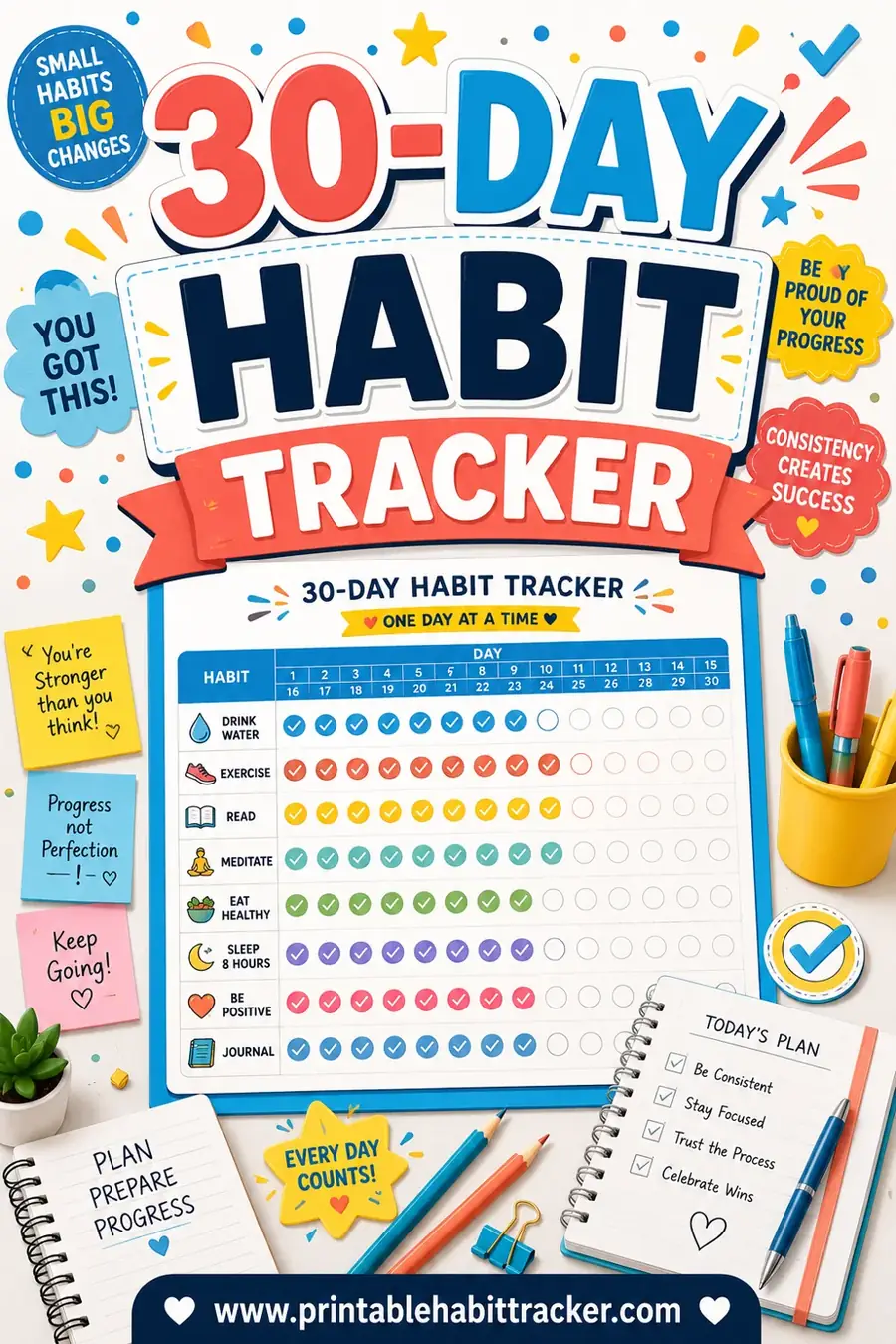
A postpartum habit tracker that actually works with a newborn has three tiny habits, each tied to something that already happens every day (a feed, a nap, bedtime), and a grid you can tick in under ten seconds. Water at a feed, one line in a journal at the first nap, five minutes of fresh air or daylight when you can. That's it. You aren't building a new life right now; you're collecting small proof that you're still looking after yourself while you look after someone tiny.
You can make this exact tracker in our free printable habit tracker maker. Build this exact tracker and it opens with the title, habits and a daily layout already filled in, so all you do is print it and stick it on the fridge or next to the spot where you feed the baby.
This guide walks you through why tiny habits fit the newborn season, which habits to pick (with lists for different weeks and situations), how to set up the sheet, how to use a one-line journal, and what to do on the days when nothing gets ticked at all. It's written for new moms, but partners, adoptive parents and anyone caring for a newborn can use every part of it.
One important note before we start: a habit tracker is a support for your day, not a substitute for care. If you're struggling with your mood, your recovery, sleep, feeding or anything that worries you, please talk to your doctor, midwife or another health provider. The tracker can sit alongside that care. It can't replace it.
Why Tiny Habits Fit the Newborn Season
Most habit advice assumes you control your schedule. You wake at a set time, you exercise before work, you read before bed. With a newborn, almost none of that is true. The day breaks into small pieces between feeds, changes and naps, and the pieces move around.
That's why big goals tend to fall apart in the early weeks. "Exercise 30 minutes a day" or "journal every evening" depend on a predictable block of time you simply may not have. When you miss them, it can feel like one more thing you're failing at, and that's the last feeling you need.
Tiny habits work differently. They're so small that they fit inside the gaps you already have. A glass of water takes the same few seconds whether the baby slept two hours or twenty minutes. One sentence in a notebook takes less time than reading a text message. Standing by an open window with the baby for five minutes counts.
There's a second reason tiny habits help. In the newborn weeks, a lot of what you do is invisible. Nobody sees the 3 a.m. feed, the fifth outfit change or the hour of rocking. A tracker turns a little slice of that day into something you can see. A column of small ticks at the end of the week is a quiet reminder: you were here, you showed up, you took care of yourself in small ways too.
If you want the background on why small actions anchored to existing routines tend to stick, our guide to the tiny habits method explains the idea in more detail. The short version: make the habit tiny, attach it to something that already happens, and notice when you do it.
What "survival wins" means
Some new moms find it helpful to think of their ticks as "survival wins." These aren't achievements in the usual sense. They're the basics that keep you going: you drank water, you ate something, you rested your eyes, you got a breath of fresh air. On hard days, those are real wins, and they deserve a tick just as much as anything bigger.
Counting survival wins changes the question you ask yourself at night. Instead of "What did I get done?" (often a painful question with a newborn), you ask "Did I look after myself at all today?" The answer is usually yes, even if it's only one box.
The Three-Habit Rule for New Moms
Pick three habits. Not five, not eight. Three.
Three is small enough that you can remember them without looking at the sheet, and big enough that you'll usually tick at least one, even on a rough day. You can always add a habit later. Starting with too many is the most common reason trackers end up in a drawer.
For the postpartum weeks, three is plenty.
The starter set
If you don't want to think about it, use this starter set. It covers the three basics that are easy to forget when your attention is on the baby: drinking, reflecting and getting a little light or air.
| Habit | Tied to | What counts as a tick |
|---|---|---|
| Water at a feed | Any feed, day or night | You drank a glass or a good few sips from a bottle you keep nearby |
| One line in my journal | The first nap of the day, or bedtime | One sentence, even three words |
| Five minutes of air or daylight | Any time the baby is settled or in a carrier or stroller | Stepping outside, opening a window or sitting by a bright window |
Notice how forgiving the "what counts" column is. That's on purpose. A tracker for this season should make ticking easy. If the bar is too high, you'll stop using it.
Why anchoring to naps and feeds matters
Every tiny habit on your tracker should have an anchor: something that already happens, which reminds you to do the habit. The most reliable anchors in the newborn weeks are the things that happen over and over, whatever the clock says.
- Feeds. They happen many times a day, so a habit tied to a feed gets lots of chances. Water is the classic pairing. Keep a filled bottle wherever you usually feed.
- The first nap of the day. Whenever it happens, it's a natural pause. A good moment for one line in a journal or a snack.
- Bedtime (yours or the baby's). Even if nights are broken, there's usually a moment when you lie down. That's a good anchor for a quick reflection or the night's tick.
- Diaper changes. Frequent and predictable. Some moms use them as a cue for a few slow breaths or a quick stretch.
- Putting the baby in the carrier or stroller. A natural lead-in to five minutes outside.
You don't need a fixed nap schedule for this to work. The anchor is the event, not the time. If the first nap comes at 7 a.m. one day and 10 a.m. the next, the habit just moves with it.
Choosing Your Tiny Habits: Ready-to-Use Lists
The starter set suits most people, but you know your own needs. Below are lists you can choose from. Pick three in total, ideally from at least two different groups. Each one is written short enough to fit straight onto the tracker.
Body basics
- Water at a feed
- Water bottle refilled
- Ate a real snack
- Ate breakfast (any time counts)
- Took my vitamins, if my doctor suggested them
- Lay down once, eyes closed
- Shower or quick wash
- Brushed my teeth
- Changed into clean clothes
- Did my recovery exercises, if my provider gave me some
A note on the last two: only track things your doctor, midwife or physical therapist has actually suggested for you. Don't add exercises or supplements just because you saw them somewhere else. Recovery after birth is different for everyone, and your care team knows your situation.
Mind and mood
- One line in my journal
- Three slow breaths
- Named one feeling
- Noticed one good moment
- Listened to one song I like
- Put the phone down for one feed
- Read one page of something
- Said one kind thing to myself
Air and movement
- Five minutes outside
- Sat by a bright window
- Opened a window for fresh air
- Short walk with the stroller
- Gentle stretch while baby plays
- Stood up and moved between feeds
Again, follow your provider's guidance on when and how to get moving. "Five minutes outside" can be sitting on a step. It doesn't need to be a walk.
Connection and support
- Texted or called one person
- Asked for help with one thing
- Accepted help when offered
- Had a real conversation with an adult
- Talked to my partner about my day
- Joined a parent group or chat
Home (only if it helps)
- Cleared one surface
- Started one load of laundry
- Put dinner in the slow cooker
- Ten-minute tidy
Be careful with this group. Home tasks can quickly turn your tracker into a to-do list, and that's not what it's for. If you add one home habit, keep it tiny and keep it optional.
Habits to leave off for now
Some things are better left off a newborn-season tracker, at least in the early weeks:
- Anything tied to a strict clock time ("Up at 6 a.m.")
- Weight, calorie or diet goals, unless your doctor has asked you to track something specific
- Long workouts or step goals
- Big projects ("Finish the baby book")
- Habits that need a long, uninterrupted block of time
None of these are bad goals. They're just for later. A tracker that fits your real life now is worth more than an ambitious one you abandon.
How to Make It in the Free Tool
You can set up this postpartum tracker in a couple of minutes. Open the free printable habit tracker maker and follow these steps.
- Title. Type something gentle and personal, like "Postpartum Tiny Wins," "Small Wins With Baby" or "My Fourth Trimester." Avoid titles that sound like a test, such as "Daily Goals" or "Discipline."
- Template chips. You don't need a template for this one, but if you'd like a head start, tap Self-Care or Water Intake and then edit the habit list. The Medication chip can be useful later if your provider has given you something to take on a schedule.
- Your habits (one per line). Type your three habits, each on its own line. For example: Water at every feed, One line in my journal, 5 min outside or by a window.
- Layout. Choose Daily. A daily layout gives you a simple grid with one box per day, so you can tick and walk away. If you'd rather see just seven days at a time on the fridge, choose Weekly instead.
- Month. Pick the current month. If your baby is due soon, you can print next month as well so it's ready.
- Style. Choose Checkbox for a quick tick, or Color-in if coloring a square with a highlighter feels nicer. Many tired parents prefer checkboxes because they take less effort.
- Color theme. Sage and Blush are soft and calm. Classic B&W saves ink if your printer is running low.
- Options. Turn on Reflection or Notes/goals to get a little space for your one-line journal. Turn on Mood row if you'd like to note how you feel each day. Leave Streak boxes off for now; streaks can add pressure you don't need. A Reward box is a nice extra if you'd like to plan a small treat.
- Paper. Choose Letter or A4, and Portrait or Landscape. Portrait fits better on a fridge; Landscape gives the journal space more room.
- Print. Tap 🖨️ Print / Save PDF. Save a PDF copy too, so you can print a fresh sheet next month without setting it up again.
If you'd rather skip the typing, open this tracker already filled in and adjust anything you like before you print.
Where to put the sheet
Where the tracker lives matters as much as what's on it. Put it somewhere you pass many times a day, with a pen attached.
- Next to your feeding spot. The chair, the couch corner or the bedside table where most feeds happen. Tape the sheet to the wall or keep it on a clipboard.
- On the fridge. Good if you pass the kitchen often. Hang a pen on a string.
- Inside the diaper caddy lid. A small folded sheet goes wherever the caddy goes.
- On the bathroom mirror. Handy for a water or teeth habit.
Keep a second pen nearby. Hunting for a pen with a baby in one arm is one of those small obstacles that quietly stops a habit.
The One-Line Journal: Small Words, Big Record
The one-line journal is the heart of this tracker. It's exactly what it sounds like: one sentence a day, written in the Notes or Reflection space on your tracker or in a small notebook kept beside it.
Why one line? Because one line is always possible. You can write it during a feed, while the kettle boils or as you lie down at night. A full journal page can feel like homework when you're short on sleep. One line never does.
Over a few weeks, those single lines add up to something precious: a small record of the newborn days in your own words. Plenty of parents find the early weeks blur together later. A column of one-liners gives you a little of that time back.
One-line prompts
If you're stuck for what to write, pick a prompt. You don't have to use the same one every day.
- One thing the baby did today:
- One thing I did for myself:
- Today was hard because…
- Today was easier because…
- I'm proud that I…
- Someone who helped today:
- Something I want to remember:
- How I'm feeling, in three words:
- What I need more of:
- One small thing that went right:
- What I'd tell a friend in my shoes:
- Tomorrow I'll try:
Example lines
Here's what a real week of one-liners might look like. None of them are long, and some are just a few words.
- "Baby held my finger for the whole feed."
- "Hard day. Ate toast. That's it, and that's okay."
- "Walked to the corner and back. Sun felt good."
- "Mom came over and I slept two hours."
- "Cried in the shower. Felt better after."
- "First real smile? Maybe. I'm counting it."
- "Tired, grateful, a bit lost. All at once."
There's no right or wrong line. Honest lines are often more useful than cheerful ones. If you notice your lines are low or worried most days, that's important information to share with your doctor or midwife.
Gratitude is optional
Some trackers push daily gratitude. You're welcome to include it, but please don't feel you have to. Gratitude is not a substitute for care, rest or support, and feeling grateful for your baby doesn't mean you can't also feel exhausted, sad or overwhelmed. Both can be true on the same day. Your one line can hold whatever is real.
A Sample Week on the Tracker
Here's what a realistic first week might look like with the starter set. The point isn't to fill every box. It's to see that even a hard week has some ticks in it.
| Day | Water at a feed | One line in my journal | 5 min air or daylight | The line |
|---|---|---|---|---|
| Mon | ✓ | ✓ | – | "Long night. Tea and a cuddle." |
| Tue | ✓ | – | ✓ | (skipped, too tired) |
| Wed | ✓ | ✓ | ✓ | "Short walk. Baby slept in the stroller." |
| Thu | – | ✓ | – | "Fussy day. We got through it." |
| Fri | ✓ | ✓ | ✓ | "Friend brought soup." |
| Sat | ✓ | – | – | (skipped) |
| Sun | ✓ | ✓ | ✓ | "Partner did the morning. I napped." |
That's 15 ticks out of 21 boxes. Some weeks will look like this; some will have far fewer ticks. Both are fine. On the Saturday above, one tick still counts. On a day with no ticks at all, the habit simply wasn't the priority, and that's allowed.
How to look back at the week
At the end of the week, or whenever you get a quiet moment, glance at the sheet. Don't grade it. Just notice:
- Which habit was easiest to tick? Keep that one.
- Which habit kept getting missed? Is the anchor wrong, or is the habit too big?
- Were some days harder than others? Is there a pattern, like after a rough night?
- Did any of your one-liners surprise you?
If one habit is constantly blank, shrink it or swap it. "Five minutes outside" might become "Sat by a bright window." "Water at every feed" might become "Water at one feed." Making a habit smaller isn't giving up. It's adjusting the tool to fit your life.
Tiny Habits by Stage: Early Weeks to Back to Work
Your needs change fast in the first months. Here's how you might adjust the tracker as time goes on. These are loose stages, not rules; every recovery and every baby is different, and your provider's advice comes first.
| Stage | What the days often feel like | Suggested habits | Tracker tips |
|---|---|---|---|
| First two weeks | Recovery, frequent feeds, visitors, very broken sleep | Water at a feed, ate something, lay down once | Keep it to two or three body basics. Skip the journal if it feels like too much. |
| Weeks three to six | Still tired, a slightly more familiar rhythm | Water, one-line journal, sat by a window or stepped outside | Add the one-line journal. Turn on the Mood row if it helps. |
| Two to three months | Some days feel more predictable | Short walk, one line, texted a friend | Swap one body habit for a connection habit. |
| Three months and on | More awake time, maybe longer naps | Recovery exercises if your provider suggests them, one page of reading, a simple meal habit | Consider a Weekly layout, or add a fourth habit if you want. |
| Going back to work | New routine, pumping or new childcare | Water at work, one line on the commute, lights out earlier | Re-anchor habits to the new day, like arriving at work or the trip home. |
The first two weeks
In the very early days, many new moms find any tracker is too much, and that's completely okay. If you'd like something, keep it to the bare basics: water, food and lying down. You might ask your partner or a support person to tick the boxes for you, or to remind you about water during feeds.
Weeks three to six
As things settle a little, the one-line journal often becomes possible. This is also when many people start to notice how they're really feeling, so the Mood row can be useful. Keep the habits gentle and the anchors flexible.
Two to three months and beyond
Some families find a little more rhythm around this time, though not all. If naps become more regular, you can tie habits to a specific nap, such as the first morning nap. If they don't, keep using events like feeds and bedtime as anchors.
This is also a good time to look at our broader habit tracker for moms if you're ready to track a few more everyday habits as your baby grows.
Going back to work
The return to work or a new routine often scrambles habits that were finally working. Rather than starting from scratch, keep the same three habits and give each one a new anchor. Water at a feed might become water when you sit down at your desk or after each pumping session. The one-line journal might move to your commute (if you're a passenger) or the first few minutes after the baby falls asleep.
When Days Go Sideways: Troubleshooting Your Tracker
Some days the baby won't settle, you're up all night, or everything just feels too heavy. The tracker should bend around those days, not add to them. Here are the most common snags and simple fixes.
| Problem | What's probably going on | Try this |
|---|---|---|
| I forget the tracker exists | It's out of sight or away from your usual spots | Move it to your feeding spot and tie a pen to it |
| I tick nothing for days | Habits are too big, or life is simply too full right now | Cut to one habit, or pause the tracker for a week |
| Blank boxes make me feel guilty | The sheet feels like a report card | Switch to Color-in and only color the wins; ignore the blanks |
| Naps are completely unpredictable | Anchors are tied to a nap schedule that doesn't exist yet | Anchor to feeds or diaper changes instead |
| I can't find time to journal | One line still feels like too much | Write three words, or draw a quick face for your mood |
| My partner wants to help | Support is available but unclear | Give them one habit to remind you about, or let them tick boxes for you |
| I lost the sheet | Life with a newborn | Print a fresh copy from your saved PDF; start mid-month without catching up |
| I feel worse when I look at it | The tracker isn't helping right now | Put it away. You can come back to it any time |
Missing a day (or a week) is normal
You'll miss days. Everyone does, and with a newborn it's guaranteed. A blank box doesn't erase the ticks before it. Just tick the next box when you can.
Don't try to fill in missed days from memory, and don't "catch up" by doing extra. Start again from today. Our guide on what to do when you miss a day has more ideas for getting back on track without the guilt.
When a tracker isn't the right tool
If you notice you're feeling persistently low, anxious, numb, unable to sleep even when you have the chance, or having thoughts that frighten you, please reach out to your doctor, midwife or another health provider as soon as you can. If you ever feel you might harm yourself or your baby, contact emergency services right away. These feelings are more common than many people realize, and support is available. A tracker can't spot these things for you, and it's never a reason to wait.
Some moms find it helpful to bring their tracker or a few of their one-liners to a checkup. It can make it easier to describe how the past weeks have really felt.
Variations and Small Rewards
Every newborn season looks different. Here are a few ways to shape the tracker around yours.
For breastfeeding or pumping moms
Water at a feed is a natural fit, and a snack at a feed is another. Some moms like a separate feeding log; if yours is from your provider or lactation consultant, follow their format. Keep the habit tracker for your own wellbeing so it doesn't become another feeding chart.
For bottle-feeding parents
Feeds still make good anchors. Water while the bottle warms is an easy pairing. If your partner shares feeds, you can each keep a copy of the tracker with your own three habits.
After a C-section or a difficult birth
Follow your care team's guidance on movement, lifting and rest. Your tracker might focus entirely on rest, water and food at first, with "five minutes by a window" instead of a walk. If your provider gives you specific recovery steps, those can become habits, but only the ones they've suggested.
For twins or multiples
Time is even tighter, so drop to one or two habits. Anchor them to the moment both babies are finally settled, whenever that happens. Count a tick for any small act of self-care, even ones a support person reminded you about.
For partners and non-birthing parents
Partners have a newborn season too. A partner tracker might include habits like "Took one night feed," "Gave mom a full nap," "Ate a real meal," "Walked with the stroller" and "Checked in with a friend." Our habit tracker for couples has ideas for keeping a shared tracker if you'd like to tick habits side by side.
For adoptive and foster parents
Recovery may look different, but sleep deprivation, a new routine and big feelings are just as real. The same tiny-habit approach works: three small habits, anchored to the baby's feeds and sleep, and a one-line journal to remember the early days together.
Small rewards and gentle motivation
Rewards in the newborn season don't need to be big. They need to feel like a small kindness to yourself. If you turned on the Reward box in the tool, write something simple there:
- A favorite drink in a quiet moment
- A long shower while someone else watches the baby
- A new podcast or audiobook for night feeds
- Fresh flowers or a plant for the window
- A short outing alone, even just to the corner store
- An early night while your partner covers the evening
Tie rewards to showing up, not to perfection. "Ticked at least one box on five days this week" is a fair target. "Every box, every day" isn't. Keep the rewards small, too; a newborn week has no room for anything that needs planning.
Moving From Tiny Habits to Your Next Season
At some point you may notice the three habits have become automatic. Water happens without thinking; the one line has turned into a few lines. That's a lovely sign, and it's a good moment to decide what's next.
- Keep going as you are. If the tracker feels good, there's no need to change it.
- Swap one habit. Retire the one that's now automatic and add something new from the lists above.
- Grow one habit. "Five minutes outside" might become "A short walk with the stroller," if your provider is happy with that.
- Change the layout. Move from Daily to Weekly, or print a Monthly sheet with a little more room for notes.
There's no deadline for any of this. Some moms stay with three tiny habits for the whole first year, and that's a real achievement. When you're ready for more, our daily habit tracker page has more layout ideas for everyday habits.
Whenever you're ready, build this exact tracker in a few seconds, print it, and put it next to the spot where you feed the baby. Or start from a blank sheet in the free habit tracker maker and choose your own three habits. Either way, the first tick is the one that matters.
Frequently Asked Questions
What is a postpartum habit tracker?
A postpartum habit tracker is a simple printable grid where you tick off a few small self-care habits each day during the months after having a baby. It's meant to help you notice small wins, not to set big goals. Most new moms do best with three tiny habits tied to feeds, naps or bedtime.
How many habits should a new mom track?
Three is a good number for most new moms, and one or two is fine in the first couple of weeks. Fewer habits mean you'll tick at least one box on most days, which keeps the tracker encouraging. You can add more as your days become more predictable.
When should I start a postpartum habit tracker?
Whenever it feels helpful, not before. Some moms like a very simple tracker from the first week, while others wait until things settle a little. There's no right time, and it's fine to skip a tracker entirely during recovery.
What if my baby doesn't have a nap schedule yet?
That's normal, especially in the early weeks. Tie your habits to events instead of times, such as a feed, a diaper change or putting the baby down to sleep. The habit happens whenever the event does, so there's no schedule to keep.
What should I write in a one-line journal?
Write one honest sentence about your day: something the baby did, something you did for yourself, or how you're feeling. Prompts like "Something I want to remember" or "Today was hard because" can help. Three words count too.
Is a habit tracker good for postpartum mental health?
A habit tracker can help you notice small acts of self-care, but it isn't a treatment and it can't replace professional support. If you're feeling persistently low, anxious or not like yourself, please talk to your doctor, midwife or another health provider. You can bring your tracker along if it helps you describe how things have been.
Should I track exercise after giving birth?
Only track movement your doctor, midwife or physical therapist has said is right for you, and only when you feel ready. Gentle options like "five minutes outside" or "sat by a bright window" are a good place to start. Recovery is different for everyone, so follow your care team's advice.
Can my partner use the same tracker?
Yes. Partners can keep their own copy with three habits of their own, or you can share one sheet with a row for each person. Some couples also agree that the partner will remind the new mom about one habit, like water at feeds.
What if I miss a whole week?
Just start again with the next box. Don't fill in the gaps or try to catch up. A week off is part of life with a newborn, and the ticks you made before still count.