Why Isn't My Child's Routine Chart Working? 7 Fixes
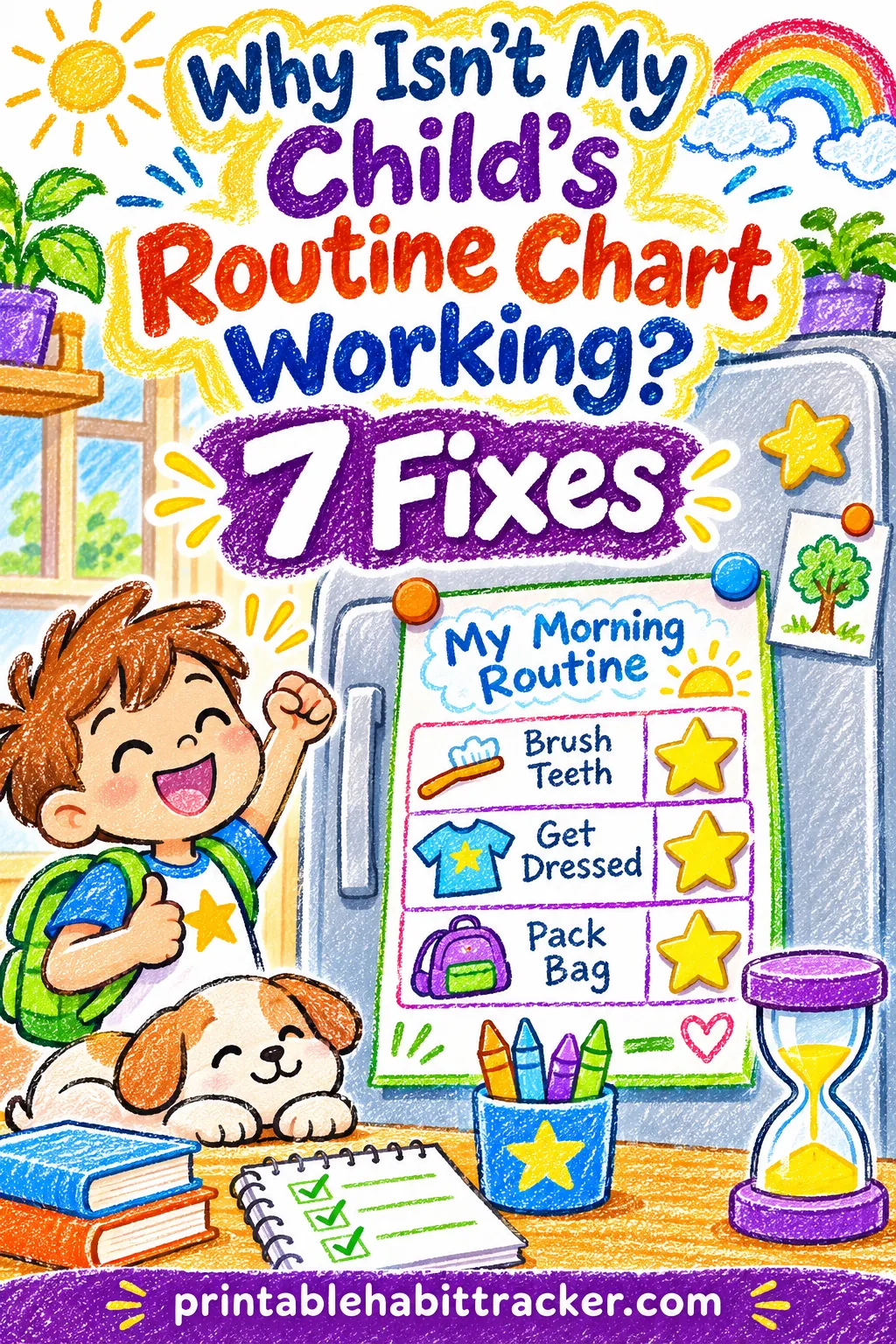
When a routine chart isn't working, it's usually because the chart is too long, hangs in the wrong spot, or was handed over before your child had practiced using it, so cut it to about five steps, add photos of your child doing each one, hang it right where the routine happens, and walk through it together for two full weeks before you step back. A chart is a tool you teach, not a sign you tape to the wall. Most charts that "fail" were never actually taught.
You can build this exact tracker in the free printable habit tracker maker. It opens with a five-step morning routine on a weekly color-in layout, ready to edit and print.
This guide is for parents and caregivers of kids with ADHD, or kids who just struggle with routines. It covers the signs that a chart isn't working, seven fixes in the order to try them, exact tool settings, ready-made step lists for mornings, after school and bedtime, and a two-week plan for slowly handing the routine over to your child. It's practical support, not medical advice. If your child has a care team, such as a pediatrician, therapist or school counselor, follow their guidance and feel free to bring the chart to your next appointment.
Signs Your Routine Chart Isn't Working
It's easy to tell when a chart has failed: mornings are still loud and late. But it helps to look a little closer, because the type of failure points to the fix.
| What you see | What it usually means | Fix to try first |
|---|---|---|
| Your child never looks at the chart | It's out of sight or out of the path of the routine | Fix 3: hang it where the routine happens |
| Your child starts, then stalls halfway | Too many steps, or steps that are really several tasks | Fix 1 and Fix 5 |
| Your child can't tell what a step means | Words only, or vague steps like "get ready" | Fix 2: photos of your child |
| The chart worked for three days, then stopped | The novelty wore off before the habit set in | Fix 4: two weeks of prompting |
| Every morning turns into an argument about the chart | The chart has become a nagging tool | Fix 6: connection and a finish line |
| Your child says the chart is "babyish" or rips it down | They had no say in it | Fix 7: make it together |
| It works on calm days but not hard days | The routine has no backup plan | The troubleshooting table below |
You'll notice that "my child just doesn't care" isn't on the list. When a chart stops working, it's almost always the setup, not your child. Kids with ADHD often want mornings to go well just as much as you do. They may simply need the steps to be fewer, clearer, closer and more practiced.
Why Charts Are Harder for Kids With ADHD
Routine charts are often suggested for kids with ADHD, and for good reason. A chart moves the list of steps out of your child's head and onto the wall, so they don't have to remember everything at once. It also cuts down on the number of times you have to say "Did you brush your teeth?"
But a chart only helps if your child can use it in the moment. Many kids with ADHD find it hard to hold several steps in mind, to notice how much time has passed, or to switch from something fun to something boring. A chart that ignores those struggles, like a 12-step list across the room, asks for exactly the skills your child is still building.
So the goal of these fixes is simple: make the chart easier to use than to ignore. Shorter, clearer, closer and practiced together. If you want broader background on using trackers with kids who have attention struggles, the habit tracker for ADHD page and the ADHD routine charts collection are good places to browse layouts.
The 7 Fixes for a Routine Chart That Isn't Working
Try these in order. You don't need all seven at once. Many families see a big change from the first four alone.
Fix 1: Cut the chart to about five steps
Long charts are the most common problem. A morning chart with 10 or 12 steps looks thorough, but for a child with ADHD it can feel like a wall of text. They lose their place, skip to the fun steps, or give up.
Aim for three to seven steps, with five as a good target for most school-age kids. Younger kids often do best with three or four.
How to cut a long chart:
- Write out every step you currently expect.
- Cross off anything your child already does reliably without a reminder. It doesn't need to be on the chart.
- Combine tiny steps that always happen together, like "pajamas off, clothes on" into "Get dressed."
- Move anything that isn't truly needed every morning to a different time or chart.
- Keep the hardest or most-forgotten steps. Those are why the chart exists.
| Before (too long) | After (5 steps) |
|---|---|
| Wake up, turn off alarm, use bathroom, wash hands, take off pajamas, put on clothes, put pajamas in hamper, eat breakfast, put bowl in sink, brush teeth, brush hair, put on shoes, put on jacket, grab lunch, grab backpack | Get dressed, Eat breakfast, Brush teeth and hair, Shoes and jacket on, Backpack by the door |
Notice that "Wake up" isn't on the chart. Your child is already awake if they're reading it. Every step on the chart should be something they actively need to do and are likely to forget.
Fix 2: Use photos of your child doing each step
Words alone ask your child to read, understand and picture the task. A photo does all three in one glance. And a photo of your child, in your bathroom, holding their toothbrush, is easier to connect with than clip art or a cartoon.
Here's a simple way to add photos:
- On a calm weekend morning, take a photo of your child doing each step. Let them pose and be silly; that's part of the fun.
- Print the photos small, about the size of a sticky note, or print several on one page and cut them out.
- Print your chart, then glue or tape each photo next to its step.
- For extra durability, slip the finished chart into a plastic sheet protector.
If photos aren't practical, simple drawings work too. Let your child draw each step. Their drawing of "brush teeth" may be a smiling blob with a stick, and that's fine; they'll know exactly what it means.
Photos help most for younger kids and kids who are still learning to read, but many older kids like them too, especially if they get to choose the pose.
Fix 3: Hang the chart where the routine actually happens
A chart on the fridge doesn't help much if getting dressed happens upstairs. If your child has to walk away from the task to check the chart, they often won't.
Put each chart, or each part of a chart, right where the steps happen:
- Getting dressed: on the bedroom door or inside the closet door.
- Brushing teeth and hair: on the bathroom mirror at your child's eye level.
- Breakfast: on the wall by their seat at the table.
- Shoes, jacket and backpack: by the front door or wherever bags live.
You can print one chart and cut it into strips, or print a separate mini chart for each room. Hang it at your child's eye height, not yours. Kneel down and check that they can see it and reach it to check off a box.
If your child moves through the house in a set path, follow that path. The chart should be in their line of sight at exactly the moment they need the next step.
One more check: look at what else is on that wall or door. A chart surrounded by artwork, school notices and magnets is easy to tune out. Give it a clear space of its own, with nothing else at your child's eye level, so it stands out as the one thing to look at during the routine.
Fix 4: Prompt with the chart for two full weeks
This is the fix most families skip, and it's often the one that matters most. Handing your child a chart and saying "Follow this" is like handing someone a map of a city they've never visited. They need a guide for the first few trips.
For the first two weeks, plan to walk through the routine with your child every single day. That doesn't mean doing the steps for them. It means being nearby and using the chart as the reminder instead of your voice.
The key move is the tap-the-chart prompt:
- Instead of saying "Go brush your teeth," walk to the chart and tap the next step.
- Say as little as possible. "What's next?" or just a tap and a smile.
- When they finish a step, let them check or color the box themselves.
Why does this help? Because it shifts the reminder from you to the chart. Over time, your child learns to look at the chart instead of waiting for you to tell them. And it cuts down on nagging, which often turns mornings into a power struggle.
Expect to prompt a lot at first, maybe every step. That's normal. You're teaching a skill, not testing one. The two-week plan later in this article shows how to slowly fade your prompts.
Fix 5: Make every step one clear action
Some steps that look simple are actually several tasks bundled together. "Get ready for school" might mean six things. "Clean up" could mean anything. If your child stalls on a step, check whether it's really one action.
Good steps are:
- Concrete: "Shoes on" instead of "Get ready."
- Visible: you and your child can both tell when it's done.
- Short: one or two minutes for most steps.
- Starting with a verb: Put, Brush, Eat, Pack, Hang.
| Vague step | Clear step |
|---|---|
| Get ready | Get dressed |
| Clean up breakfast | Bowl in the sink |
| Hygiene | Brush teeth |
| Be ready to go | Shoes and jacket on |
| Pack your stuff | Backpack by the door |
| Calm down for bed | Lights down, one book |
| Do homework | Homework folder open on the table |
If one step is still too big after you rewrite it, it may need its own mini chart. For example, "Get dressed" might become a small four-picture strip inside the closet: underwear, pants, shirt, socks.
Fix 6: Add a finish line and a bit of connection
A chart that only lists chores can feel like a list of demands. A chart with a clear finish line feels like a game with an ending.
Add one thing at the bottom of the chart that your child looks forward to once the steps are done. Keep it small and available every day:
- Five minutes of a favorite show or game before leaving.
- Choosing the music for the car.
- A special handshake or high five at the door.
- Ten minutes of reading together before school.
- Feeding the pet or another "grown-up" job they enjoy.
Some families add a reward box or sticker system for completed days. That can help, especially at the start, but keep it simple and positive. Avoid taking away rewards for missed steps during the first two weeks; you're still teaching. A sticker chart can sit next to the routine chart if your child loves stickers.
Connection matters too. A morning chart works better when it isn't the only thing you talk about in the morning. A few seconds of warmth, like a hug or a joke, before the first step can make the whole routine go more smoothly.
Fix 7: Make the chart with your child
Kids are more likely to use something they helped build. This is especially true for older kids and tweens, who may push back on a chart that feels like it was made for them instead of with them.
Sit down together on a calm day, not right after a hard morning. Then:
- Ask, "What are the steps you need to do before school?" Let them list them first. You can fill in gaps.
- Let them choose the order where it doesn't matter.
- Let them pick the color theme and the title.
- Let them pose for the photos or draw the pictures.
- Let them choose the finish-line reward from two or three options you're okay with.
- Ask where they think the chart should hang.
Making the chart together also gives you a chance to practice. Do a "pretend morning" on a weekend afternoon, walking through each step with the chart. It's low pressure, and it often turns into a silly, fun moment that makes the real morning easier.
How to Make a Routine Chart in the Free Tool
You can build this exact tracker to start with the five-step morning chart above, or open the free habit tracker maker and set up your own using these settings.
- Title: use your child's name or a title they choose, like "Maya's Morning" or "Ready for School."
- Template chips: tap ADHD Routine for a starting list, or Morning Routine or Bedtime Routine for those times of day. Then edit the steps.
- Your habits (one per line): type your three to seven steps, one per line. Keep each step short, starting with a verb: "Get dressed," "Eat breakfast," "Brush teeth," "Shoes on," "Backpack by the door."
- Layout: choose Weekly so each step has a box for every day of the week. This is the best layout for a routine chart. Choose Daily if you want a single-day sheet you print fresh each morning.
- Style: choose Color-in for most kids. Coloring a box feels more rewarding than a small check, and it's easier for young hands. Choose Checkbox for older kids who prefer a cleaner look.
- Color theme: let your child pick. Ocean and Sunset are bright without being busy. Classic B&W is best if you'll color it in yourselves or photocopy it.
- Options: turn on Reward box for the finish line. Turn on Streak boxes if your child likes counting days in a row. Notes/goals gives you room to jot what helped or what got stuck that day.
- Paper: Letter or A4 to match your printer. Landscape gives the step names more room and works well on a wall or door.
- Click 🖨️ Print / Save PDF. Print a few weeks at once so you always have the next sheet ready.
After printing, add the photos or drawings next to each step, then put the sheet in a plastic sleeve if your child will use a dry-erase marker instead of coloring.
Should you make one chart or several?
| Situation | Best setup |
|---|---|
| Your child does the whole routine in one room | One chart with all steps |
| The routine moves through two or three rooms | One chart cut into room strips, or a mini chart per room |
| Mornings and evenings are both hard | Separate morning and bedtime charts, each with its own steps |
| Two or more kids share a routine | One chart per child, each with their own photos and colors |
| Shared custody or two homes | Identical charts for each home, same steps and same order |
Separate charts for morning and bedtime usually work better than one chart covering the whole day. Each one stays short, and each one hangs in the right place. For the evening, our bedtime routine chart page has layouts that fit a nightstand or bathroom door.
Ready-to-Use Routine Steps by Time of Day and Age
Copy these straight into the tool and adjust. Each list stays within the three-to-seven step range.
Morning routines
| Age | Steps |
|---|---|
| Ages 3 to 5 | Potty and wash hands, Get dressed, Eat breakfast, Brush teeth |
| Ages 6 to 8 | Get dressed, Eat breakfast, Brush teeth and hair, Shoes and jacket on, Backpack by the door |
| Ages 9 to 12 | Get dressed, Eat breakfast, Bowl in the sink, Brush teeth, Check backpack list, Shoes on by the door |
| Teens | Up with alarm, Shower or wash face, Dressed, Breakfast, Bag packed, Out the door by set time |
After-school routines
| Age | Steps |
|---|---|
| Ages 3 to 5 | Shoes off, Wash hands, Snack, Play |
| Ages 6 to 8 | Shoes and bag away, Wash hands, Snack, Homework folder open, Play time |
| Ages 9 to 12 | Bag on hook, Snack, Homework first task, Movement break, Finish homework, Free time |
| Teens | Bag away, Snack, Check planner, Homework block one, Break, Homework block two |
Bedtime routines
| Age | Steps |
|---|---|
| Ages 3 to 5 | Bath, Pajamas on, Brush teeth, Two books, Lights out |
| Ages 6 to 8 | Pajamas on, Brush teeth, Clothes out for tomorrow, One book, Lights out |
| Ages 9 to 12 | Shower, Pajamas, Brush teeth, Backpack packed for tomorrow, Read 15 minutes, Lights out |
| Teens | Devices on charger, Shower or wash face, Tomorrow's bag ready, Read or wind down, Lights out by set time |
A helpful trick for many kids with ADHD: put tomorrow's prep (clothes out, backpack packed) on the bedtime chart. Doing it at night, when there's less time pressure, takes a lot of weight off the morning chart.
The Two-Week Prompting Plan (and How to Step Back)
Most routine charts are abandoned too early, usually just before they would have started working. This plan gives the chart time to become part of your child's day, and then gradually hands the routine over to them.
| Days | What you do | What your child does |
|---|---|---|
| Days 1 to 3 | Stay with your child for the whole routine. Tap the chart for every step. Praise each finished step. | Follows your taps, colors each box. |
| Days 4 to 7 | Stay nearby. Tap only when they stall. Ask "What's next?" instead of naming the step. | Starts checking the chart before you tap. |
| Days 8 to 10 | Move to the next room. Check in after every two steps. | Does two or three steps on their own between check-ins. |
| Days 11 to 14 | Check in at the start and the end. Help with the hardest step only. | Does most steps alone, colors boxes, comes to show you. |
| Week 3 and on | Check the chart at the end of the routine. Step back in for a day or two whenever things slip. | Runs the routine with the chart as the reminder. |
A few things to keep in mind as you go:
- Step back slowly. If a stage isn't working, stay at the earlier stage for a few more days. There's no deadline.
- Expect a dip. Many kids do great in the first few days, then have a rough patch. That's normal and doesn't mean the chart failed.
- Restart after breaks. Weekends, school holidays and sick days can knock a routine off track. Plan a day or two of extra prompting when school starts again.
- Notice effort out loud. "You got all the way to shoes without me!" is more motivating than a reward for many kids.
- Keep your tone calm. If you're feeling frustrated, tap the chart and say nothing. The chart can be the "bad guy" so you don't have to be.
What a real first week can look like
Here's an example of how week one might go for a seven-year-old using the five-step morning chart, with notes a parent jotted in the Notes box.
| Day | Steps colored | Parent note |
|---|---|---|
| Monday | 5 of 5 | Tapped every step. Loved coloring. |
| Tuesday | 5 of 5 | Tapped every step. Stalled at shoes. |
| Wednesday | 4 of 5 | Skipped teeth; came back after a tap. |
| Thursday | 5 of 5 | Started looking at the chart before I tapped. |
| Friday | 3 of 5 | Tired, rough morning. Did the rest together. |
| Saturday | 2 of 2 | Short weekend version only. |
| Sunday | 2 of 2 | Short weekend version only. |
A week like this can feel messy while you're living it, but look at what it shows. By Thursday, your child was reaching for the chart on their own. Friday's rough morning was one day, not a pattern. And the notes point to one clear fix for next week: shoes keep causing a stall, so put the shoes by the door the night before and add that to the bedtime chart.
Keep each week's sheet. After a month, line them up and you'll usually see the boxes filling in more on their own, even if no single morning felt like a breakthrough.
Troubleshooting: Common Problems and Fixes
Even with a good setup, mornings won't be perfect every day. Here are the issues that come up most often and what to try.
| Problem | What to try |
|---|---|
| Your child gets stuck on one step every day | Break that step into a mini chart, or move it to bedtime prep |
| They rush through and color every box without doing the steps | Check each step together before coloring for a few days; praise the doing, not the coloring |
| They lose track of time and run late | Add a simple visual timer near the chart, or mark one step as "by the time the big hand is on the 6" |
| They do well at home but not at the other parent's house | Make identical charts for both homes with the same steps and order |
| Siblings distract each other | Stagger routines by a few minutes, or set up separate stations |
| The chart worked, then stopped after a month | Refresh it: new photos, new colors, a new finish-line reward, and two days of extra prompting |
| Your child says the chart is for babies | Let them redesign it with a cleaner checkbox style, smaller pictures and a title they choose |
| Weekends wreck Monday mornings | Keep a short weekend version of the morning chart with two or three steps |
| You find yourself nagging again | Go back to tap-the-chart prompts and fewer words |
| Nothing seems to help | Talk with your child's doctor, therapist or school counselor; bring the chart and notes on what you've tried |
If mornings are very hard most days, or your child seems distressed rather than just distracted, that's worth raising with their care team. A chart can be part of a plan, but it isn't meant to carry the whole load on its own.
Variations by Age
Preschoolers (ages 3 to 5)
Keep charts to three or four steps with large photos and very few words. Use color-in boxes with crayons or stickers. Expect to do most steps alongside your child for weeks, not days. At this age, the chart is mostly a picture schedule that helps them know what comes next, which can reduce meltdowns at transitions.
Early elementary (ages 6 to 8)
This is often the sweet spot for routine charts. Five steps, photos plus short words, color-in style and a small daily finish-line reward. Kids this age usually love coloring their own boxes and showing off a full row at the end of the week.
Upper elementary (ages 9 to 12)
Kids this age may want more say and a more grown-up look. Try checkbox style, small icons or no pictures, and a title they choose. They may be ready to help plan the steps and set their own reward. Some prefer a checklist on the back of the bedroom door rather than a chart in a shared space.
Teens
Many teens won't want a "chart" at all, but they may use a simple checklist or habit tracker, especially one that looks like something an adult would use. Keep it in their room, let them write the steps, and focus on one or two sticking points instead of the whole routine. The free tool's Classic B&W theme and checkbox style work well here.
Bringing It All Together
When a routine chart isn't working, it rarely means routine charts don't work for your child. It usually means the chart needs to be shorter, clearer, closer and taught. Start with five steps. Add photos of your child. Hang it where the routine happens. Walk through it together for two weeks, using taps instead of words. Then step back slowly and refresh it whenever it gets stale.
Ready to give it another try? Build this exact tracker, swap in your child's steps and photos, and print a few weeks at once so the next sheet is always ready.
Frequently Asked Questions
Why isn't my child's routine chart working?
The most common reasons are too many steps, the chart hanging away from where the routine happens, and expecting your child to use it on their own from day one. Cutting to about five steps, adding photos, moving the chart and prompting for two weeks fixes many charts that seemed to fail.
How many steps should an ADHD routine chart have?
Three to seven steps is a good range, and five works well for many school-age kids. Younger children often do better with three or four. If your list is longer, combine steps that always happen together or move some to a different time of day.
Should I use photos or pictures on a routine chart?
Photos of your child doing each step are often the easiest to understand at a glance, especially for younger kids or kids still learning to read. Simple drawings your child makes are a good alternative. Glue or tape them next to each step after you print the chart.
Where should I put my child's routine chart?
Hang it right where the routine happens, at your child's eye level. If the routine moves through several rooms, cut the chart into strips or use a mini chart in each room so your child sees the next step without walking away from the task.
How long should I help my child with the chart?
Plan on about two weeks of daily support, starting with prompting every step and gradually stepping back. Some kids need longer, and that's okay. Step back in for a few days whenever the routine slips, such as after a school break.
Should routine charts have rewards?
A small, positive finish line, like choosing the car music or a few minutes of a favorite activity, can help. Keep rewards simple and avoid taking them away during the first two weeks while your child is still learning. Many kids are motivated just as much by praise and coloring in a full row.
What if my child refuses to use the chart?
Make it together. Let your child choose the steps' order, the colors, the title and the photos, and ask where it should hang. Older kids often accept a cleaner checklist style more easily than a picture chart.
Is a routine chart a replacement for ADHD treatment?
No. A routine chart is a practical home tool that can support your child, but it isn't a treatment. Follow the advice of your child's doctor, therapist or school team, and feel free to share the chart with them so everyone uses the same steps.