Nail Biting and Skin Picking: A Habit Reversal Tracker
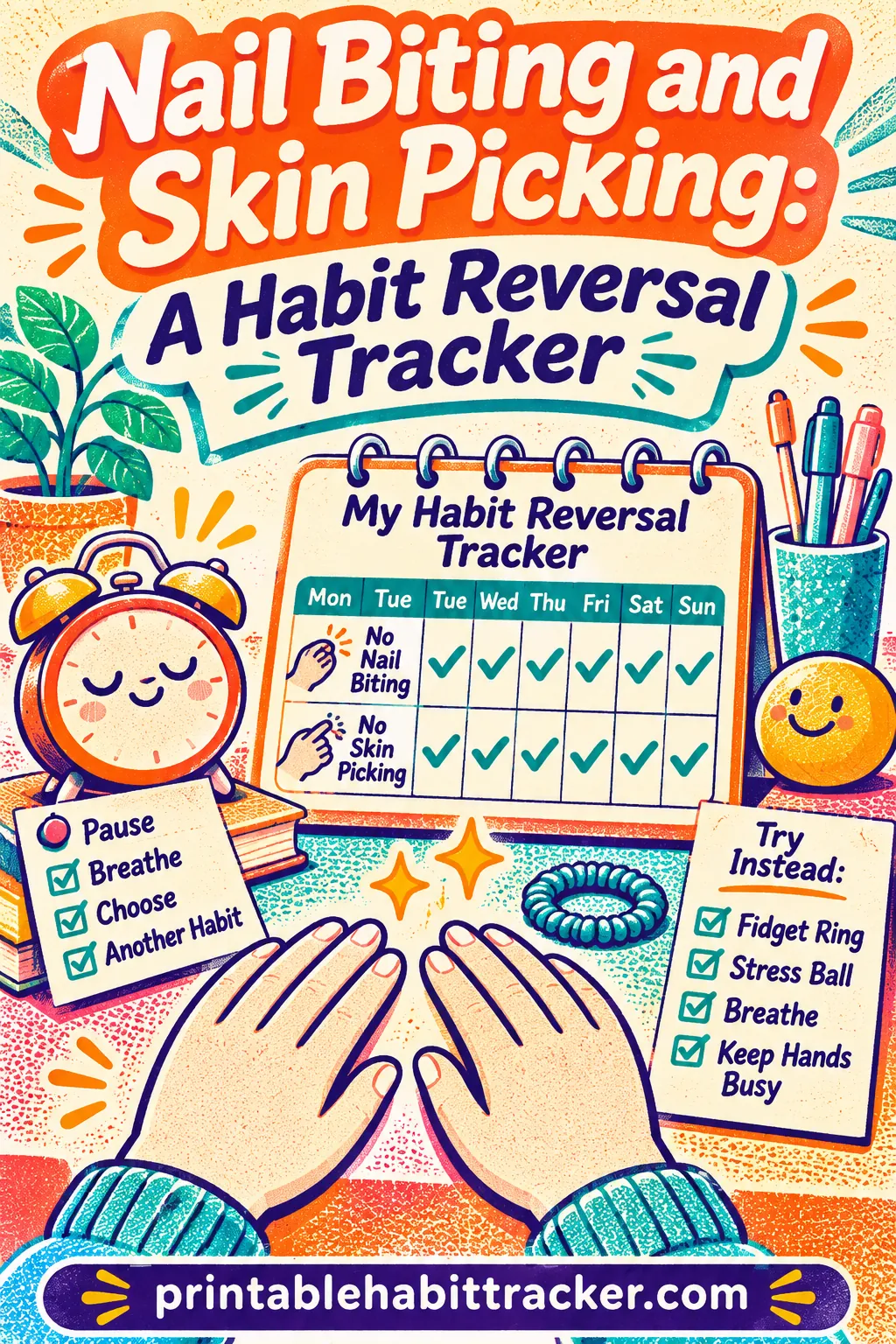
To stop nail biting or skin picking, track two things every day instead of one: the moment you noticed the urge, and the replacement action you did with your hands instead. That small shift turns an automatic, half-conscious habit into something you see, name and redirect. Counting "days without biting" alone tends to fail on the first slip; counting catches and swaps builds the skill that actually breaks the loop.
You can make this tracker in our free printable habit tracker maker. Build this exact tracker and it opens with a title, six habit reversal rows and a daily layout already filled in. Print it, put it where your hands usually wander (desk, couch, nightstand), and start ticking tonight.
This guide covers how habit reversal works in plain language, how to find your triggers, a big list of replacement behaviors, the exact tool settings, a two-week starter plan, variations for kids and teens, and a troubleshooting table for the days it feels like nothing's working.
A quick note on care: nail biting and skin picking range from a mild nervous habit to something that causes wounds, infections or real distress. If your picking leaves open sores, bleeds often, gets infected, or feels completely out of your control, please talk to your doctor or a licensed therapist. A paper tracker can support that care and give you useful notes to bring along. It isn't a treatment by itself.
Why "Just Stop" Doesn't Work for Nervous Habits
If willpower alone fixed nail biting, you'd have stopped years ago. The trouble is that most biting and picking happens on autopilot. Your hand drifts to your mouth while you read an email. Your fingers find a rough patch of skin while you watch a show. By the time you notice, you've already been at it for a minute.
That's why a goal like "Don't bite my nails" is so slippery. You can't decide not to do something you don't notice yourself starting. And when you do catch yourself halfway through, the usual reaction is frustration, which often feeds the urge even more.
Nervous habits like these are usually doing a job for you. They can ease boredom, release tension, give your hands something to do while your brain concentrates, or smooth out a rough edge you can feel. The habit isn't random. It's a response to a feeling or a situation. Remove it without giving that need somewhere else to go, and the urge just keeps knocking.
So the approach in this article has three parts:
- Notice. Get faster at catching the urge, ideally before your fingers reach your mouth or skin.
- Swap. Do a specific replacement behavior with your hands for a minute or two until the urge passes.
- Make it harder. Change your environment so the old habit takes more effort, such as short filed nails, a fidget on the desk, or gloves at night.
The tracker supports all three. Each day you tick whether you noticed, whether you swapped, and whether you set up your barriers. Over a few weeks, those ticks show you a skill getting stronger, even before your nails visibly change.
If you want the bigger picture on breaking any unwanted habit, our guide on how to break a bad habit walks through the general cue, routine and reward loop. This article zooms in on body-focused habits specifically.
What Habit Reversal Means in Plain Language
Habit reversal is a structured approach that therapists often use for repetitive behaviors like nail biting, skin picking, hair pulling and similar habits. You don't need a clinical background to use the core ideas at home. In everyday terms, it comes down to a few steps.
Awareness: learning your own warning signs
The first step is getting to know the habit in detail. When does it happen? Which hand? Which finger or patch of skin? What are you feeling just before? Many people find their hand has a "pre-move," like touching the face, running a thumb along a nail edge or scanning the skin with a fingertip. Spotting that pre-move gives you a head start.
A competing response: something your hands can do instead
Next, you choose a replacement action that makes the habit physically awkward to do at the same moment. Clenching your fists gently, pressing your palms together, sitting on your hands or holding an object all keep your fingers busy and away from your mouth or skin. You hold it until the urge fades, which is often a minute or two.
Support and motivation: making it easier to keep going
Finally, you build support around the habit change. That can be a person who knows what you're working on, reminders in your space, rewards for streaks of good days, and a way to see progress. A printed tracker fits neatly here, because it's visible and it gives you a simple daily "yes" to aim for.
A therapist trained in habit reversal can tailor these steps to you, and that's worth exploring if your habit is severe or long-standing. The tracker below borrows the everyday parts so you can practice them between appointments or on your own if your habit is mild.
Find Your Triggers First
Before you set up your tracker, spend three or four days just watching. Don't try to stop yet. Simply jot down each time you catch yourself biting or picking, along with where you were and what was happening. A sticky note or the notes section of your printed sheet works fine.
Most people find their habit clusters around a small number of situations. Once you know yours, you can aim your replacement behaviors at exactly those moments instead of trying to be vigilant all day.
Common trigger situations
| Trigger type | Examples | What the habit may be doing |
|---|---|---|
| Screens | Reading emails, scrolling, watching shows, gaming | Filling idle hands while your mind is busy |
| Waiting | Traffic, lines, waiting rooms, loading screens | Easing boredom or impatience |
| Concentration | Studying, writing, working on a hard task | Releasing tension while thinking |
| Stress | Before a meeting, during an argument, reading the news | Calming a jittery, anxious feeling |
| Tiredness | Late evening, in bed, lying on the couch | Soothing on autopilot as you wind down |
| Texture | A hangnail, rough cuticle, dry patch, bump on the skin | "Fixing" something that feels uneven |
| Mirrors | Bathroom mirror, phone camera, bright light | Examining and then picking at skin |
Look for your top two or three. Those become the places you'll put fidgets, barriers and reminders.
Questions to ask in your trigger log
When you catch yourself, try answering a few quick questions:
- Where am I right now?
- What am I doing with the rest of my body?
- What was I feeling a minute ago (bored, tense, tired, frustrated, focused)?
- Which hand, and which finger or spot?
- Did I notice before I started, partway through, or only afterward?
That last question matters most. Over time, you want more "before" and fewer "afterward" answers. That shift is real progress, even if you still bite now and then.
Pre-moves to watch for
These small movements often come right before biting or picking. If you spot one, that's your cue to swap:
- Bringing a hand up to your chin or lips
- Running a thumb along the edge of a nail
- Feeling for rough cuticles with another finger
- Scanning your arms, face or scalp with your fingertips
- Leaning closer to a mirror
- Resting your elbow on the desk with your hand near your face
Write your own pre-move at the top of your printed tracker. Seeing it every day helps you recognize it faster.
Replacement Behaviors: A Ready-to-Use List
A good replacement behavior keeps your hands busy, feels okay to do in public (or at least in the place where your trigger happens), and can last a minute or two. Pick one or two for each of your top triggers. You don't need to use them all.
Quiet swaps you can do anywhere
- Make gentle fists for 60 seconds
- Press your palms together in your lap
- Interlace your fingers and rest them on your knee
- Sit on your hands for a slow count of 60
- Hold the edge of the desk or chair
- Tap each fingertip to your thumb, one hand at a time
- Put your hands flat on your thighs and press down lightly
- Hold your phone or pen with both hands
Fidget swaps for your desk or couch
- Smooth stone or worry stone
- Stress ball or soft squeeze toy
- Spinner ring
- Putty or modeling clay
- A clicky pen (if it won't bother anyone nearby)
- Textured fidget with bumps or ridges
- Hair tie around the wrist to roll between your fingers
- Small beaded bracelet to slide bead by bead
Hand-busy swaps for screen time
- Knitting, crochet or a simple craft
- Doodling on a notepad
- Folding paper
- Holding a warm or cold drink with both hands
- Sorting buttons or beads
- Turning a puzzle cube
- Applying hand cream and massaging it in slowly
Swaps for texture triggers
If a rough edge sets you off, the fix is often to deal with the texture in a gentler way:
- File a snagged nail smooth right away (keep a file in every bag)
- Use cuticle cream or plain hand cream on rough cuticles
- Clip hangnails with clean clippers instead of tearing them
- Cover a picked spot with a small bandage so you can't feel it
- Moisturize dry patches before bed
Swaps for stress triggers
- Three slow breaths with your hands pressed together
- Squeeze a stress ball in time with your breathing
- Stand up and shake out your hands
- Walk to get a glass of water
- Write one line about what's bothering you
Pick your swaps based on what you can actually reach in the moment. A worry stone in your coat pocket does nothing if your trigger is the couch at 10 p.m.
Set Up Your Habit Reversal Tracker
Here's the core tracker. Each row is one daily habit you tick. Together they cover noticing, swapping and setting up barriers.
| Habit row | What counts as a tick | Why it's on the sheet |
|---|---|---|
| Noticed the urge | You caught at least one urge or pre-move today | Builds awareness, the first step of habit reversal |
| Used my replacement | You did your swap at least once when the urge came | Practices the competing response |
| Hands busy at screen time | Fidget, craft or swap during your main screen session | Targets one of the most common triggers |
| Nails filed smooth | You checked and filed any rough edges | Removes texture triggers |
| Gloves or tape at night | Barrier on before sleep, if night picking is an issue | Makes the habit harder when you're least aware |
| Logged my trigger | You wrote down where and when at least once | Keeps your trigger list accurate |
Notice that none of these rows says "Didn't bite at all." That's deliberate. A tracker that only rewards perfect days makes one slip feel like failure, and many people quit after the first bad afternoon. These rows reward the skill. You can tick "Noticed the urge" and "Used my replacement" on a day you still bit a nail once, because you still practiced.
Optional rows to swap in
Your trigger list may call for different rows. Swap in any of these (each fits within the tracker's row length):
- Fidget in my pocket
- Hand cream after washing
- Bandage on picked spots
- No phone in the bathroom
- Mirror check under 2 min
- Kept a file in my bag
- Told my buddy how it went
- Hands busy while driving
- Gloves on for TV time
- Cuticle cream at bedtime
- Short nails, clean edges
- Breaths before meetings
For skin picking in particular, "Mirror check under 2 min" and "No phone in the bathroom" are worth trying. Long sessions in front of a mirror, especially under bright light, are a common setting for picking. Setting a short limit and keeping your phone elsewhere can make those sessions shorter.
A "clean day" row, if you want one
Some people do like a single outcome row, such as "Nail-biting-free day" or "Pick-free day." If that motivates you, add it as the last row. Just keep the skill rows above it, so a missed outcome box never leaves your whole column empty. The streaks versus flexibility guide explains why a mix of strict and forgiving rows often lasts longer than strict rows alone.
How to Make It in the Free Tool
The tracker maker on our homepage builds this sheet in about a minute. If you used the preset link earlier, everything below is already filled in, and you only need to adjust it to your triggers. If you'd rather start from scratch, open the free habit tracker maker and follow these settings.
Exact settings
| Setting | Choose | Why |
|---|---|---|
| Title | Hands-Free Habit Reversal Tracker (or your own) | A neutral name you won't mind others seeing |
| Template chips | Skip, or start from Goal Tracker and replace the habits | No chip matches this topic exactly |
| Your habits (one per line) | The six rows from the table above, or your swaps | One habit per line keeps the grid clean |
| Layout | Daily | You need a box for every day, since triggers happen daily |
| Month | The month you're starting | The grid matches real dates |
| Style | Checkbox | Fast to tick, even with a pen in a hurry |
| Color theme | Sage or Classic B&W | Calm and easy to read |
| Options | Streak boxes, Reward box, Reflection, Notes/goals | Tracks progress and gives room for trigger notes |
| Paper | Letter or A4 | Whatever your printer uses |
| Orientation | Portrait | Six rows fit comfortably |
Then press 🖨️ Print / Save PDF. Print two copies: one for the spot where your main trigger happens, and one spare in case the first gets lost or covered in coffee.
Using the options well
- Streak boxes. Count your longest run of days with "Used my replacement" ticked. That's a better streak to chase than "never bit," because it keeps growing even on imperfect days.
- Reward box. Write one small reward you'll give yourself at 7 and 14 days of practice. Our guide on how to reward yourself for streaks has ideas. A manicure, a nice hand cream or a new fidget are fitting rewards for this habit.
- Reflection. Use it once a week. Which trigger came up most? Which swap worked best? What will you change next week?
- Notes/goals. Write your pre-move at the top and your top three triggers. This keeps them in front of you every day.
Color-in style for kids or visual thinkers
If you're making a tracker for a child or you just prefer color, switch Style to Color-in and turn on Color-code habits. Each row gets its own color, which helps younger kids find their row quickly. It also makes a full week look rewarding, and that matters for motivation.
One month or the whole year
Most people only need one month at a time while they're building the skill. If you want a longer view, switch the layout to Yearly to see a whole year of practice days at a glance, or keep Daily and print all 12 months at once so next month's sheet is ready when you need it.
Your First Two Weeks: A Day-by-Day Plan
You don't have to do everything at once. This plan adds one piece at a time, which keeps the first two weeks manageable.
Days 1 to 3: watch only
Don't try to stop. Just tick "Noticed the urge" and "Logged my trigger" whenever you catch yourself. Write each trigger in the notes area. By the end of day three, circle the two places or situations that showed up most.
Days 4 to 5: pick your swaps
Choose one replacement behavior for each of your top two triggers. Put the needed object (fidget, file, hand cream) right where that trigger happens. Practice the swap a few times on purpose, even without an urge, so it feels familiar when you need it.
Days 6 to 7: start swapping
Now when you notice an urge or pre-move, do your swap for 60 seconds or until the urge fades. Tick "Used my replacement" every day you do it at least once. Don't worry about how many times you still bite. You're practicing.
Days 8 to 10: add barriers
File your nails short and smooth and tick that row. If you bite or pick at night or while watching TV, try thin cotton gloves, bandages on your favorite fingertips or a fidget in your hand during that time. Tick the barrier row each day you set it up.
Days 11 to 14: review and adjust
Look at your sheet. Which rows are full? Which are empty? If "Noticed the urge" is full but "Used my replacement" is empty, your swap may not be convenient enough. Move the fidget closer, or try a different swap. If both are empty, you may need a stronger reminder, like a sticky note on your screen or a bracelet you only wear while practicing.
At the end of two weeks, write one sentence in the Reflection box: what changed? Even "I catch it faster now" is a real win.
Variations for Kids, Teens, Skin Picking and Work
The same notice-swap-barrier idea works at any age, but the details change. Here's how to adapt the tracker.
For young kids
Young children often bite their nails without any idea they're doing it. Nagging tends to backfire, because it adds attention and tension to the habit. A tracker can turn the whole thing into a calm, positive game instead.
- Keep it to three rows, written in kid language: "Hands busy at TV time," "Used my squishy," "Nails trimmed this week."
- Use Color-in style so they color a box instead of ticking it.
- Agree on a quiet signal you can give, such as a gentle tap on the shoulder, instead of saying "Stop biting!" out loud.
- Praise the swap, not the nails. "I saw you grab your squishy. Nice catch!" works better than comments about how their fingers look.
- Add a small reward in the Reward box for a week of colored-in swap boxes, like choosing the weekend movie.
If your child's biting leads to sore, bleeding or infected fingers, or comes with a lot of worry or other repetitive behaviors, check in with your pediatrician.
For teens
Teens usually want privacy. Use a neutral title, such as "Daily Focus Tracker," and rows that don't spell out the habit, such as "Caught it early," "Used my swap" and "Hands busy while studying." Let them keep the sheet in a folder or notebook instead of on the fridge. Offer support, but let them own the tracking. A teen who chooses their own swaps is much more likely to use them.
Exam season and late-night studying are big triggers for many teens. A fidget kept in the pencil case and a "Hands busy while studying" row can target that directly.
For skin picking
Skin picking often has a stronger "search and fix" quality than nail biting: you feel or see a bump, then you want to smooth it out. A few changes help:
- Add a "Mirror check under 2 min" row and set a timer for mirror time.
- Dim harsh bathroom lighting, or leave the bathroom once you're done washing.
- Keep small bandages handy to cover spots you're tempted to pick.
- Add "Hands busy in bed" if you tend to pick while lying down.
- Track the location (face, arms, scalp, cuticles) in your notes to see patterns.
Skin picking that causes scarring, frequent infections or a lot of distress is worth talking to a doctor or therapist about. Some people find it eases with professional support, and you don't have to figure it out alone.
For adults at work
Meetings, calls and long stretches at a computer are prime biting time. A few work-friendly tweaks:
- Keep a quiet fidget, like a smooth stone or spinner ring, at your desk.
- Hold a pen or mug in video calls so your hands stay down.
- Add a "Hands busy in meetings" row.
- Place your printed tracker inside a desk drawer or planner if you'd rather keep it private.
If you want a simpler sheet that lives on your desk all month, our daily habit tracker page shows more ways to lay out a one-month grid.
Troubleshooting: When It Feels Like Nothing's Working
Progress with nervous habits is rarely a straight line. Expect good weeks and messy ones. This table covers the most common snags.
| Problem | Likely reason | What to try |
|---|---|---|
| I only notice after I've already bitten | Awareness is still building | Keep logging. Add a visual cue, like a bracelet or a dot of tape on your favorite finger |
| My swap feels silly or awkward | It's new, not natural yet | Practice it on purpose a few times a day without an urge |
| I forget to tick the tracker | The sheet is out of sight | Move it to your main trigger spot, or tick at the same time every evening |
| I bite more when I'm stressed | The habit is calming you | Pair your swap with slow breathing. Add a stress-break row |
| I pick at night without noticing | Low awareness when tired | Gloves, bandages or a fidget in bed. Tick the barrier row |
| I had a bad day and feel like giving up | One slip feels like failure | Look at the skill rows. Did you notice or swap at all? Restart tomorrow |
| My nails grew, then I bit them all again | A big trigger hit at once | Write down what happened. Plan a swap for that exact situation next time |
| The tracker feels like pressure | Too many rows | Cut back to two or three rows for a week |
After a slip
A slip doesn't erase your progress. You still noticed more often this week than last. You still built a habit of reaching for a fidget. A slip is just information about a trigger you haven't planned for yet.
When it happens, write one line in the notes: what was going on, and what you'll try next time. Then tick tomorrow's boxes as normal. Our guide on what to do when you miss a day has more on getting back on track without guilt.
When to get extra help
Please reach out to a doctor or licensed therapist if any of these apply:
- Your biting or picking causes bleeding, open wounds or infections
- You have scarring or skin damage you're worried about
- You spend a lot of time each day biting or picking
- The habit causes you real distress, shame or avoidance
- You've tried for a while on your own and nothing has shifted
Bring your printed tracker to the appointment. Your trigger notes and the pattern of ticked days give a clear picture of what's happening, and that can make the conversation easier.
Ready to start?
Pick your top two triggers, choose a swap for each, and print your sheet. Build this exact tracker to start with the six rows from this guide, then edit them to fit your own hands, habits and day.
Frequently Asked Questions
Can a habit tracker really help me stop nail biting?
A tracker can help by making an automatic habit visible and giving you a daily reason to practice noticing and swapping. It works best when you track the skills, like catching the urge and using a replacement, rather than only counting perfect days. It isn't a cure on its own, but many people find the daily check-in keeps them focused.
What is the best replacement behavior for nail biting?
The best replacement is one you can do right where your trigger happens and that keeps your fingers away from your mouth for a minute or two. Gentle fists, pressing your palms together, a smooth stone or a stress ball are common choices. Try a few and keep the one you actually reach for.
How long does it take to stop biting your nails?
It varies a lot from person to person, so there's no set timeline. Many people notice they catch the urge faster within a couple of weeks of consistent tracking, even before their nails look different. Focus on the skill rows and give yourself at least a few months before judging how it's going.
Should I track nail biting and skin picking on the same sheet?
You can, if both habits share triggers. Use shared rows like "Noticed the urge" and "Used my replacement," then add one row for each habit's specific barrier, such as "Nails filed smooth" and "Bandage on picked spots." If one habit is much bigger, give it its own sheet.
What if I keep forgetting to fill in the tracker?
Put the sheet where your main trigger happens, such as your desk or the arm of the couch, and keep a pen clipped to it. Or tie ticking to something you already do every evening, like brushing your teeth. If it still feels like too much, cut back to two rows for a week.
Is it okay to wear gloves or use bitter nail polish?
Barriers like thin cotton gloves, bandages on fingertips or bitter-tasting polish can make the habit harder and give you a moment to notice. They work best alongside a replacement behavior, not instead of one. Check product labels and ask a doctor first for young children or if you have sensitive skin.
How do I help my child stop biting their nails without nagging?
Agree on a quiet signal instead of calling it out, give them a fidget for TV or homework time, and praise them when they use it. A color-in tracker with two or three kid-friendly rows and a small weekly reward keeps it positive. Talk to your pediatrician if their fingers are sore, bleeding or infected.
When should I talk to a professional about skin picking?
Reach out to a doctor or licensed therapist if picking causes wounds, infections or scarring, takes up a lot of your day, or causes you real distress. Some therapists use habit reversal and related approaches, and they can tailor a plan to you. Your tracker notes make a useful starting point for that conversation.