10-Minute-a-Day Christmas Prep Tracker: Cards, Wrapping and One Small Task
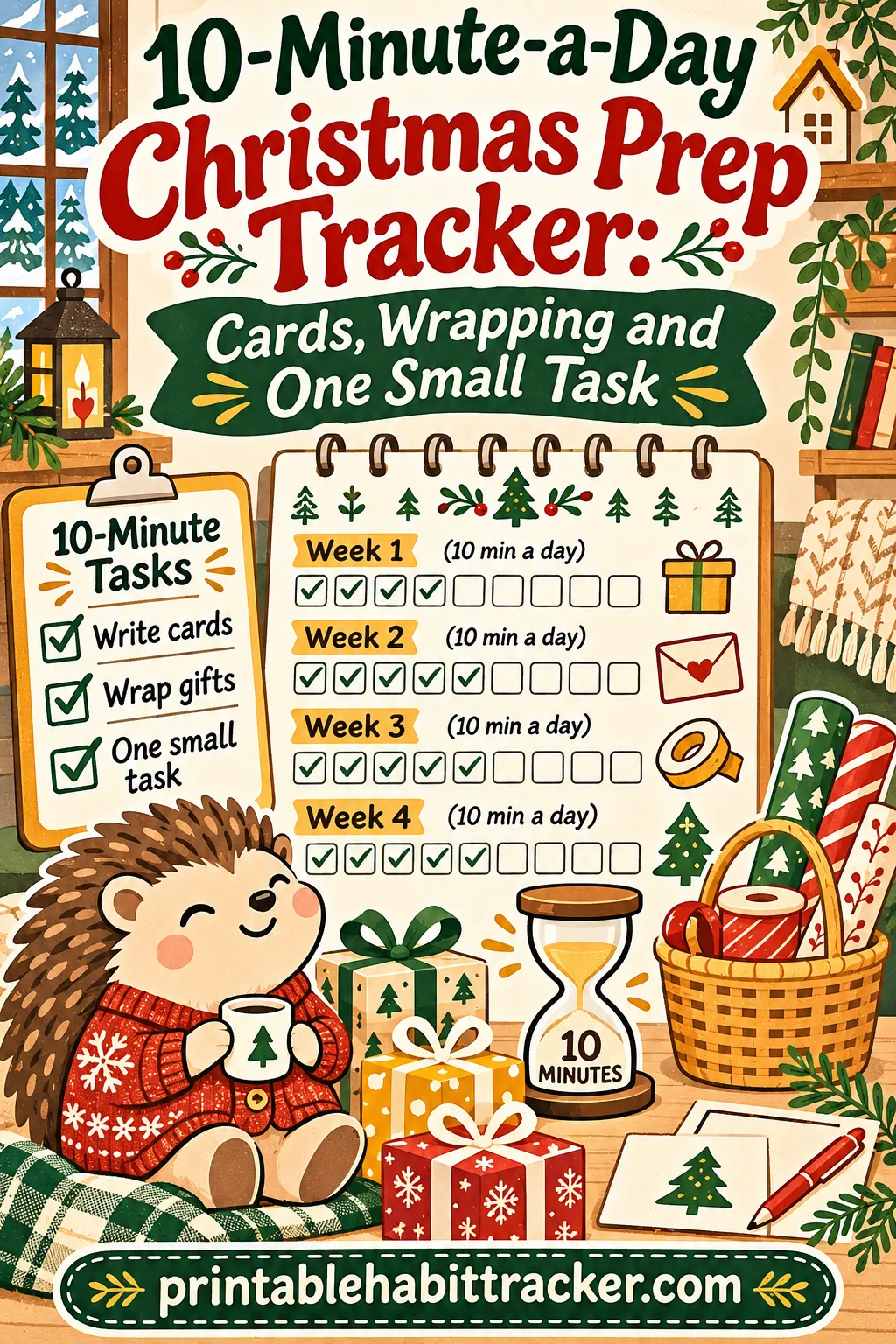
The fix for an endless December to-do list is to stop treating it as a list and turn it into a few tiny daily habits: wrap 3 gifts, address 3 cards and do one small task, about 10 minutes a day, checked off on a printed sheet. Thirty gifts wrapped three at a time are done in ten days. Forty-five cards addressed three at a time are done in fifteen. No marathon wrapping night on the 23rd, no pile of blank envelopes in January.
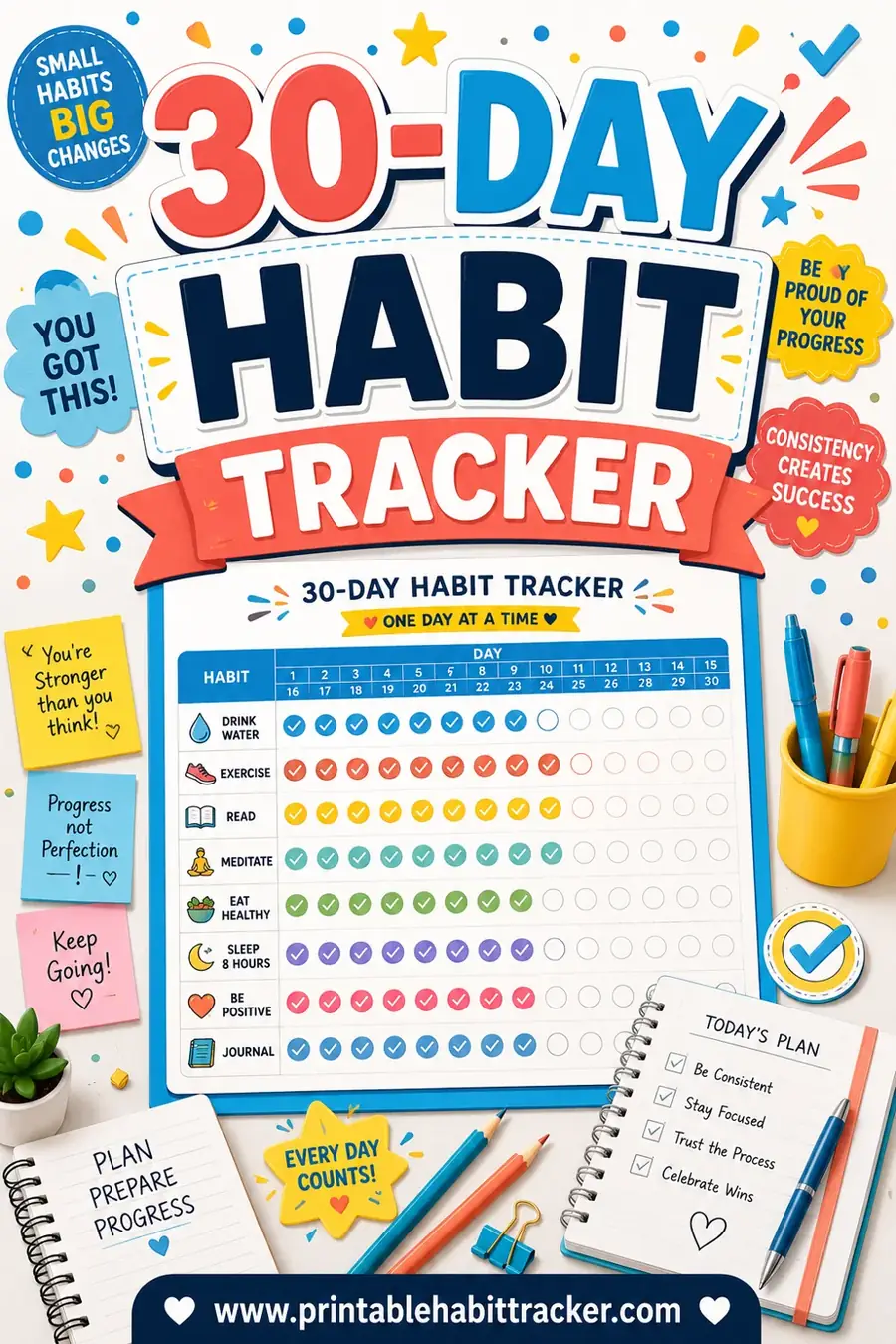
You can set this up in a couple of minutes with our free printable habit tracker maker. Build this exact tracker and it opens with five daily prep habits, a monthly layout and a color-in style already filled in, ready to print for December.
Below you'll find how to turn your list into daily habits, the exact tool settings, the simple math for how many days each job needs, a week-by-week timeline from Thanksgiving weekend to Christmas Eve, the "done at 80%" rule, versions for different households, and a troubleshooting table for the days that go sideways.
✅ Try this tracker for one week
Tap a box each day you do the habit. Your ticks stay on this device.
Why the December List Feels Endless
Most holiday to-do lists aren't hard. Wrapping a gift takes a few minutes. Addressing a card takes less than one. The trouble is the size of the list and the way it sits there, all at once, every time you look at it.
The panic-wrap pattern
Here's how it usually goes. Right after Thanksgiving, you write a long list: gifts, cards, decorations, the cookie exchange, teacher gifts, the guest room, the grocery run, the school party sign-up. It's two pages long. You look at it on a Tuesday night and think, "I'll do a big chunk this weekend."
The weekend fills up. So does the next one. Then it's December 20th, and you're up until 1 a.m. wrapping 26 gifts on the living room floor, cards still unwritten, tape running out. You promise yourself next year will be different.
It isn't a time problem. Spread across December, most families' prep adds up to a few hours. It's a starting problem. A two-page list doesn't tell you what to do tonight, so you do nothing tonight.
Why a big weekend block rarely works
Saving everything for one big block feels efficient. In practice, it fails for three reasons:
- Weekends in December aren't free. They're when parties, school events, travel and shopping happen.
- Big blocks are easy to push back. "I'll do it Saturday" turns into "I'll do it next Saturday" without any decision being made.
- Some jobs can't wait. Cards that travel need mailing time. Gifts that ship need wrapping and packing before your carrier's holiday cutoff. A single late block puts all of that at risk.
Why ten minutes a day works better
Ten minutes is short enough that you'll start even on a tired night. It fits after dinner, while the kettle boils or during a show. And because the same small jobs repeat every day, you stop having to decide what to do. The decision is already printed on the sheet.
That's the shift this article is about. You're not managing a to-do list anymore. You're keeping a few small habits for one month. If you've ever wondered what the difference really is, our guide on habit trackers versus to-do lists explains why repeated tasks do better on a tracker than on a list.
Turn Your List Into Five Daily Ten-Minute Habits
The trick is to find the jobs on your list that can be split into small, equal pieces and done a little every day. Those become rows on your tracker. Everything else goes on a short "one-time" list in the Notes box.
Split the list into repeat jobs and one-time jobs
Take your holiday list and sort each item into one of two piles.
Repeat jobs are big jobs made of many small, identical pieces:
- Wrapping gifts (one gift at a time)
- Addressing and writing cards (one card at a time)
- Tidying and decorating the house (one zone at a time)
- Baking ahead (one batch at a time)
- Writing thank-you notes after the holiday (one note at a time)
One-time jobs happen once and are done:
- Buy wrapping paper and tape
- Order the family photo prints
- Book the grocery pickup for Christmas week
- Pull the decoration bins out of the attic
- Sign up for the class party
Repeat jobs go on the tracker as daily rows. One-time jobs go in the Notes / goals box, where you can tick them off as they happen. That keeps the tracker short and the one-time jobs visible.
The five rows in the preset
The preset uses five rows. Each is a tiny, repeatable action you can finish in a few minutes.
Wrap 3 gifts. Three is the sweet spot. It takes about ten minutes once your supplies are set up, and it moves fast: three a day covers 21 gifts in a week. If you have only a few gifts, drop it to "Wrap 1 gift." If you have a big family, keep it at three and start earlier.
Address 3 cards. Address, sign, stamp and seal three cards. That's it. Three cards takes a few minutes, and it's small enough that you'll do it even on a night when you're tired. A list of 45 cards is done in 15 days.
One tidy zone. Pick one small area: the entry table, one kitchen counter, the coat closet floor, the guest bathroom sink. Tidy just that zone. By the time guests arrive, the house has been reset one corner at a time. Our family chore habit tracker has more ideas for splitting the house into zones.
Check the shared list. Take two minutes to look at your master list (on the fridge, in a notes app, wherever it lives) and cross off what's done. Add anything new. This is the row that stops surprises, like realizing on December 22nd that nobody ordered the teacher gifts.
Say no to one extra. This one surprises people. December fills with "extras": an extra cookie batch for the office, a second gift for a neighbor you barely know, a new decoration project you saw somewhere. Each one is small. Together they're what makes the month feel endless. Once a day, notice one extra you can skip, and skip it. Check the box.
Swap rows to fit your own list
The preset is a starting point. Swap rows for the repeat jobs on your own list. Each of these fits under 28 characters, so it prints cleanly:
| Your repeat job | Row text for the tracker | About how long |
|---|---|---|
| Wrapping gifts | Wrap 3 gifts | 10 minutes |
| Holiday cards | Address 3 cards | 5 minutes |
| House prep | One tidy zone | 10 minutes |
| Master list | Check the shared list | 2 minutes |
| Saying no | Say no to one extra | 1 minute |
| Baking ahead | Bake or freeze one batch | 20 to 40 minutes |
| Decorating | Decorate one spot | 10 minutes |
| Gift shopping | Buy or order one gift | 10 minutes |
| Packing gifts to mail | Pack one box to ship | 15 minutes |
| Teacher and staff gifts | Finish one small gift | 10 minutes |
| Meal planning | Plan one holiday meal | 10 minutes |
| Kids' jobs | Kids do one helper job | 10 minutes |
| After Christmas | Write 2 thank-you notes | 10 minutes |
Keep it to four to six rows. If you add a baking row, consider dropping it to every other day by writing "Bake: Mon, Wed, Sat" in the Notes box and only coloring the box on those days.
Why three and not ten
People often ask why the numbers are so small. Why not wrap ten gifts a night and finish faster?
Because ten feels like a project, and projects get postponed. Three feels like nothing, so you start. And once you've started, you'll often keep going. On a quiet night, "Wrap 3 gifts" turns into eight. The box still gets one color. The low number is just there to make sure you begin.
This works the same way as "habit stacking," where you attach a new small habit to something you already do. "After I clear the dinner table, I wrap 3 gifts." Our guide on habit stacking shows how to pick a good anchor.
How to Make Your Christmas Prep Tracker in the Free Tool
If you used the preset link above, the title, habits, layout and style are already in place. Otherwise, open the free printable habit tracker maker and use the settings below. It takes about two minutes.
Exact settings
| Setting | Choose | Why |
|---|---|---|
| Title | December Ten-Minute Prep | A daily reminder that ten minutes is the whole job |
| Your habits (one per line) | Wrap 3 gifts, Address 3 cards, One tidy zone, Check the shared list, Say no to one extra | Five small, repeatable jobs |
| Layout | Monthly | One page shows every day of December |
| Month | December | The date grid matches your calendar |
| Tracking style | Color-in | Coloring a box is quick and fun, and the page fills with color as you go |
| Color theme | Sunset or Blush | Warm and festive on the fridge; Classic (B&W) saves ink |
| Color-code habits | On | Each row gets its own color, so you can scan the sheet fast |
| Extras | Streak boxes, Reward box, Reflection | A streak count, a family reward and space for your wins |
| Notes / goals | Your one-time jobs and your 80% target | Keeps the short one-time list on the same page |
| Paper | Letter or A4 | Whatever your printer uses |
| Orientation | Landscape | Wider boxes for 31 days |
When it looks right in the live preview, press 🖨️ Print / Save PDF. Save a PDF copy too, so you can print a fresh sheet if this one gets coffee on it or disappears under a pile of wrapping paper.
What to put in the Notes / goals box
The Notes box is where your one-time jobs live. Keep it short. A good Notes box might read:
"Goal: 80% of boxes by Dec 23. One-time: buy tape and tags, order photo prints, book grocery pickup, check carrier's holiday shipping dates, pull decoration bins."
That's it. When a one-time job is done, cross it off in pen.
The extras worth turning on
Streak boxes. These print a row of numbered boxes, 1 to 30, under the heading "Longest streak." Circle the number of your longest run of days in a row. It's a small, satisfying count, and it keeps you from skipping two days in a row.
Reward box. This prints "My reward when I hit my goal" with space to write. Pick a reward that's about rest, not more prep: a movie night at home, a long bath, a morning off, a slow breakfast on the 24th. If the family helps, make it a family reward.
Reflection. This prints a "This month's wins" box. Use it on Christmas Eve or after the holiday to jot down what went well, so next year's sheet starts smarter.
Where to put the sheet
Put it where the prep happens. If wrapping happens in the bedroom closet, tape the sheet to the inside of the closet door. If cards are written at the kitchen table, put it on the fridge. If you set up a small wrapping station (more on that below), tape the sheet right above it.
The settings you choose stay in your browser on that device, so if you come back to the tool later in the month to tweak a row or print a second copy, your tracker will usually still be there.
Do the Math First: How Many Days Each Job Needs
Before you print, spend five minutes counting. The numbers tell you when to start and whether three a day is enough. This is where the plan stops feeling vague.
Count your gifts, cards and zones
Grab your list and count:
- Gifts to wrap. Count every one, including stocking stuffers you plan to wrap, teacher gifts and gifts that ship.
- Cards to send. Count your address list, plus a few spares for the people you'll remember late.
- Zones to tidy. Walk through the rooms guests will see and list small areas. A typical home has 15 to 25 zones if you keep them small.
Then divide each total by your daily number.
Worked examples
| Job | Total | Per day | Days needed | Add a buffer | Start by |
|---|---|---|---|---|---|
| Gifts to wrap | 30 | 3 | 10 | +4 days | 14 days before you need them |
| Cards to send | 45 | 3 | 15 | +3 days | 18 days before mailing day |
| Zones to tidy | 20 | 1 | 20 | +3 days | 23 days before guests arrive |
| Gifts to ship | 6 | 1 box | 6 | +3 days | 9 days before your carrier's cutoff |
| Thank-you notes | 14 | 2 | 7 | +2 days | Right after the holiday |
The buffer covers sick days, travel days and nights when nothing happens. A buffer of three or four days is usually enough for December.
Example 1: A family of four with a big gift list
Jenna has 30 gifts to wrap, including stocking stuffers, and 45 cards. She wants cards mailed by December 10th and gifts wrapped by December 20th.
- Cards: 45 cards at 3 a day takes 15 days. With a 3-day buffer, that's 18 days. Counting back from December 10th, she starts around November 22nd, which means picking up her cards and stamps the week before Thanksgiving.
- Gifts: 30 gifts at 3 a day takes 10 days. With a 4-day buffer, that's 14 days. Counting back from December 20th, she starts wrapping around December 6th.
So her tracker has "Address 3 cards" running in early December and "Wrap 3 gifts" running from the first week on, with gifts wrapped as soon as they arrive.
Example 2: A couple with a short list
Sam and Ari have 12 gifts and 20 cards. Three a day feels like too much work for a list this size.
- Cards: 20 cards at 2 a day takes 10 days.
- Gifts: 12 gifts at 2 a day takes 6 days.
They change the rows to "Address 2 cards" and "Wrap 2 gifts," and start December 1st. Everything is finished by December 12th, with weeks to spare.
Example 3: Gifts that need to ship
Lena has six gifts going to relatives out of state. Before she does anything else, she looks up her carrier's official holiday shipping dates for the service she plans to use. She doesn't guess, because those dates change from year to year and differ by service. She writes the cutoff in her Notes box and counts back: one box packed per day, six days, plus a three-day buffer. Her "Pack one box to ship" row starts nine days before that cutoff.
What if the math says you're already late?
If your count says you needed to start a week ago, don't panic. You have three options, and you can use more than one:
- Raise the number for a few days. "Wrap 5 gifts" for one week, then drop back to three.
- Cut the list. Fewer cards, gift bags instead of wrapping for some gifts, store-bought cookies instead of a third batch. This is what "Say no to one extra" is for.
- Share the job. A teenager can address cards. A partner can take tidy zones. A younger child can put on gift tags.
Late is fine. Ten minutes a day starting December 12th still beats one panicked night on the 23rd.
A Week-by-Week Christmas Prep Timeline
December isn't even. Some jobs have hard deadlines, some can float, and the last few days before Christmas are rarely good for anything but cooking and being together. Here's how to spread the work out.
Thanksgiving weekend: count, buy supplies, print
Thanksgiving weekend is a natural starting point. Many busy-mom checklists suggest getting cards ready right after Thanksgiving, and it's a good moment to count everything.
Checklist:
- Count gifts, cards and zones (see the math above).
- Buy tape, tags, paper, gift bags, cards and stamps in one trip.
- Set up a small wrapping station (see below).
- Look up your carrier's official holiday shipping dates and write them in the Notes box.
- Print your tracker and tape it up.
Set up a ten-minute wrapping station
Wrapping only fits in ten minutes when the supplies are already out. Pick a spot you can leave set up for the month: a folding table in a spare room, a shelf in a closet, a large bin under the bed. Stock it with paper, tape, scissors, tags, a pen and a small trash bag. Each night you open it, wrap three, close it. No hunting for the tape.
Week 1 (December 1 to 7): cards first
Cards are the job with a mailing deadline, so they go first. Keep "Address 3 cards" as your top row. Wrap gifts as they arrive, three a day, so they don't pile up. Do one tidy zone a day, starting with the zones guests will see first: the entry, the guest bathroom, the living room.
By the end of week 1, you might have 21 cards done, a dozen gifts wrapped and seven zones reset.
Week 2 (December 8 to 14): mail cards, ship gifts
Finish cards and mail them. If you have gifts that ship, this is the week to pack and send them, well ahead of your carrier's cutoff. Swap the cards row for "Pack one box to ship" once cards are done, or for "Decorate one spot" if nothing ships.
This is also a good week to check the master list carefully. Teacher gifts, the class party, the cookie exchange and work events tend to show up in the middle of the month.
Week 3 (December 15 to 21): finish wrapping, start food
Most gifts should be wrapped by the end of this week. If the "Wrap 3 gifts" row runs out of gifts, swap it for "Bake or freeze one batch" or "Plan one holiday meal."
Tidy zones should be wrapping up too. Leave the kitchen and the main bathroom for last, since they get messy again quickly.
Week 4 (December 22 to 24): stop prepping, start enjoying
By now, most of your rows should be done. Keep only the rows that still matter: maybe "Check the shared list" and a final tidy zone. Anything still on the list on December 22nd gets one honest question: does this really need to happen? If the answer is no, cross it off and check "Say no to one extra."
After Christmas: thank-you notes and next year's notes
On the 26th or 27th, change one row to "Write 2 thank-you notes" and keep the sheet up for another week. Then use the Reflection box ("This month's wins") to write down what worked, how many gifts and cards you had and when you wish you'd started. Next November, that box is your starting point.
The timeline at a glance
| When | Main job | Supporting rows |
|---|---|---|
| Thanksgiving weekend | Count, buy supplies, print | Set up wrapping station |
| December 1 to 7 | Address 3 cards | Wrap 3 gifts, one tidy zone |
| December 8 to 14 | Mail cards, ship gifts | Wrap 3 gifts, one tidy zone |
| December 15 to 21 | Finish wrapping | Bake or plan meals, last zones |
| December 22 to 24 | Check the list, say no | One final tidy zone |
| December 26 to 31 | Thank-you notes | Reflection box |
The "Done at 80%" Rule
The most useful rule on the whole sheet isn't a habit. It's a target. You aim to color in about 80% of your boxes, not all of them.
Why 80% and not 100%
A goal of 100% means one bad day ruins the month. A sick kid, a late night at work or a snow day leaves empty boxes, and suddenly the sheet feels like a failure. When the sheet feels like a failure, people stop using it, and then the whole plan falls apart.
At 80%, a few empty boxes are already built into the plan. A missed night isn't a problem. It's part of the math. Several holiday planning guides for busy parents use the same idea: aim for "done at 80%" and let the last 20% go.
How to count your 80%
Count the days you plan to use the tracker and multiply by the number of rows.
| Rows | Days (Dec 1 to 23) | Total boxes | 80% target |
|---|---|---|---|
| 3 | 23 | 69 | 55 |
| 4 | 23 | 92 | 74 |
| 5 | 23 | 115 | 92 |
| 6 | 23 | 138 | 110 |
With the five preset rows over 23 days, your target is 92 colored boxes. Write it in your Notes box: "Goal: 92 boxes by Dec 23."
Every Sunday, count your colored boxes and jot the running total in the margin. After week 1 you might have 30. After week 2, 60. You'll know early whether you're on track.
The 80% rule applies to the list too
It isn't only about boxes. Apply the same thinking to the whole season. If the cards go out but three of them are a few days late, that's fine. If the house is 80% tidy when guests arrive, nobody will notice the junk drawer. If two of the five planned cookie types get made, everyone will still eat cookies.
Write this somewhere you'll see it: "Done at 80% is done."
Never miss twice
Pair 80% with one more rule: try not to leave the same row empty two days in a row. One empty box is just a busy day. Two in a row is how a row quietly stops. If you missed wrapping yesterday, make it the first thing you do tonight. Our article on what to do when you miss a day has more on bouncing back without guilt.
A sample week on the sheet
Here's what a realistic first week looks like for someone using the five preset rows. A ■ means the box was colored in. A blank means it wasn't.
| Day | Wrap 3 gifts | Address 3 cards | One tidy zone | Check the shared list | Say no to one extra | Notes |
|---|---|---|---|---|---|---|
| Dec 1 | ■ | ■ | ■ | ■ | ■ | Entry table |
| Dec 2 | ■ | ■ | ■ | ■ | Guest bath sink | |
| Dec 3 | ■ | ■ | ■ | ■ | No gifts arrived yet | |
| Dec 4 | ■ | ■ | ■ | ■ | School concert | |
| Dec 5 | ■ | ■ | ■ | ■ | ■ | Wrapped 7 |
| Dec 6 | ■ | ■ | ■ | Family visit | ||
| Dec 7 | ■ | ■ | ■ | ■ | ■ | Coat closet |
What this week tells you
That's 30 of 35 boxes, or about 86%. Comfortably above target.
Look at what got done: at least 18 gifts wrapped (more on Dec 5), 18 cards addressed, six zones tidied and a list that got checked every day. And not one evening went past ten or fifteen minutes of prep.
The empty boxes tell a story too. Half of them landed on the concert night and the family visit, and both were planned events. That's useful. Next week, on the night of the class party, this person might decide in advance to do only "Check the shared list" and call it a win.
Versions for Different Households
Not every December looks the same. Adjust the rows and numbers to fit your home.
Busy moms and main planners
If you're the one carrying the whole list in your head, the "Check the shared list" row matters most. It moves the list out of your head and onto paper, where everyone can see it. Keep the list on the fridge right next to the tracker and invite anyone in the house to add or cross things off. Our page on a habit tracker for moms covers more ways to lighten the mental load.
A helpful row for main planners: "Hand off one job." Once a day, give one task to someone else and check the box.
Families with young kids
Kids under eight love to help, and they like having their own row. Add "Kids do one helper job" and keep a short list of jobs they can do:
| Age | Jobs a child can own |
|---|---|
| 3 to 5 | Stick on gift tags, put stamps on envelopes, set out stockings |
| 6 to 8 | Seal cards, sort ornaments, tidy one shelf, help tape gifts |
| 9 to 12 | Address cards from a list, wrap simple box-shaped gifts, decorate one spot |
| 13 and up | Wrap gifts, write cards for their own friends, take a whole tidy zone |
Let the child color in their own box. That small moment of coloring often does more for their motivation than any reward.
Hosts
If you're hosting Christmas, food and space take over. Swap "Address 3 cards" (or send fewer cards) for "Plan one holiday meal" in early December and "Bake or freeze one batch" in mid-December. Keep "One tidy zone" all month and add "Ready one guest space" in the final week: clear a closet shelf, put out towels, make up a bed.
Two-household or long-distance families
If gifts have to travel, the shipping row comes first. Look up your carrier's official holiday dates, write the cutoff in the Notes box and work backward. If you're driving or flying instead, add "Pack one bag of gifts" in the last week and keep the wrapping station near your luggage.
Shift workers and people working retail in December
If your schedule is unpredictable, set the rows by your days instead of calendar dates. On a work day, you might do only "Check the shared list." On a day off, do two rounds of everything. You can still aim for 80% by counting total boxes over the month rather than day by day.
Troubleshooting: When the Plan Wobbles
Even a ten-minute plan hits snags. Here are the common ones and what to try.
| Problem | What's probably going on | What to try |
|---|---|---|
| I keep skipping the wrapping row | Supplies aren't set up | Set up a wrapping station you never have to pack away |
| Ten minutes turns into an hour | You're tackling too much at once | Stop after the number on the row; leave the rest for tomorrow |
| I don't have three gifts to wrap yet | Gifts haven't arrived | Color the box if you wrapped what you have, or swap the row for a week |
| The tracker is up but nobody else helps | The list lives only in your head | Put the shared list next to the tracker and hand off one job a day |
| I missed four days in a row | A trip or illness | Restart tonight with the easiest row, then add the others back |
| I forgot the shipping cutoff | It wasn't written down | Check your carrier's official holiday dates now and write them in Notes |
| Cards feel like a chore | Too many on the list | Cut the list, or send a short note to some people after the holiday |
| The sheet is too crowded | Too many rows | Cut to three or four rows; move the rest to the Notes box |
| Every day still feels rushed | Extras keep sneaking in | Take "Say no to one extra" seriously for a week |
| The kids lose interest | The job is too big or vague | Give one specific job per day and let them color their own box |
When the list itself is the problem
Sometimes no tracker can fix the list, because the list is simply too long for one person in one month. If you look at your counts and the total is more than about 20 minutes a day, it's time to cut, not to work harder. Fewer cards, simpler wrapping, store-bought instead of homemade for some things. Nobody will remember whether the cookies were homemade. They'll remember whether you were relaxed.
Get Your Christmas Prep Tracker Ready
You don't need a perfect December. You need a few small jobs done most days, a target of 80% and a sheet that tells you exactly what to do tonight.
Count your gifts, cards and zones. Write your one-time jobs and your 80% target in the Notes box. Set up a wrapping station. Then build this exact tracker, print it, tape it up and do your first ten minutes tonight. Want to change the rows, theme or extras first? Open the habit tracker maker and adjust anything before you print. By the time December 24th arrives, the wrapping will be done, the cards will be out and the only thing left to do is enjoy it.
Frequently Asked Questions
What should I put on a Christmas prep tracker?
Put the jobs that repeat and can be split into small pieces: wrapping gifts, addressing cards, tidying one zone of the house and checking your master list. One-time jobs, like buying tape or ordering photo prints, go in the Notes box instead. Four to six rows is plenty.
When should I start my Christmas prep?
Count your gifts, cards and zones first, then divide by your daily number and add a few buffer days. For many families, Thanksgiving weekend or December 1st is a good starting point. Cards usually come first because they need mailing time.
Is ten minutes a day really enough?
For most households, yes, because the jobs add up fast. Wrapping three gifts a day covers 21 gifts in a week, and addressing three cards a day covers 45 cards in about two weeks. If your counts show you need more than about 20 minutes a day, it's a sign to trim the list.
What does "done at 80%" mean?
It means you aim to color in about 80% of the boxes on your tracker, not all of them. With five rows from December 1st to 23rd, that's 92 of 115 boxes. It builds busy days into the plan, so one missed night doesn't make the whole sheet feel like a failure.
Should I use a monthly or weekly layout?
Monthly works best for Christmas prep because you see all of December on one page and can count toward your 80% target. A weekly layout is handy if your rows change a lot, for example cards in week 1 and baking in week 3, since you can print a fresh sheet each Sunday.
How do I handle gifts that need to ship?
Look up your carrier's official holiday shipping dates for the service you'll use, write the cutoff in your Notes box and count backward. Add a row like "Pack one box to ship" and start it several days before the cutoff. Don't guess the dates, because they change from year to year.
Can my kids help with the tracker?
Yes, and they usually enjoy it. Give them a row of their own, like "Kids do one helper job," and pick age-appropriate tasks such as sticking on gift tags, putting stamps on envelopes or setting out stockings. Let them color in their own box when they're done.
What if I start late?
Start anyway. Raise your daily number for a week, cut what you can from the list and share jobs with the people at home. A tracker started on December 12th still keeps you out of the late-night wrapping rush.