Why Do I Quit Resolutions by February? A 6-Week Tracker That Works
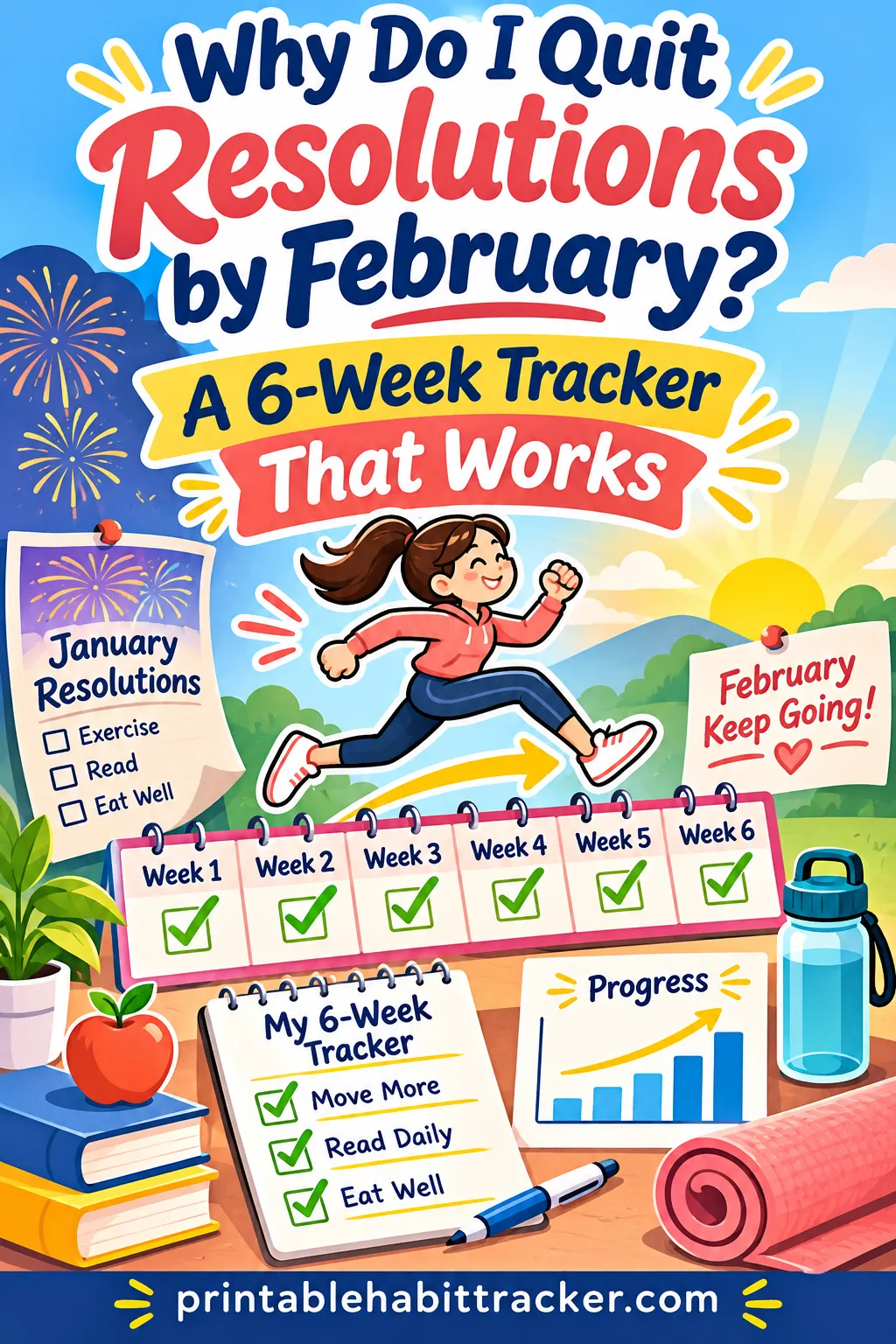
Resolutions usually fail by February because they start too big, run on all-or-nothing rules, and never get reviewed, so the first missed week feels like proof you've failed and you quietly stop. The fix isn't more willpower. It's a smaller plan: track only three habits, aim for 80 percent of the boxes each week instead of a perfect streak, and check in every Sunday for six weeks.
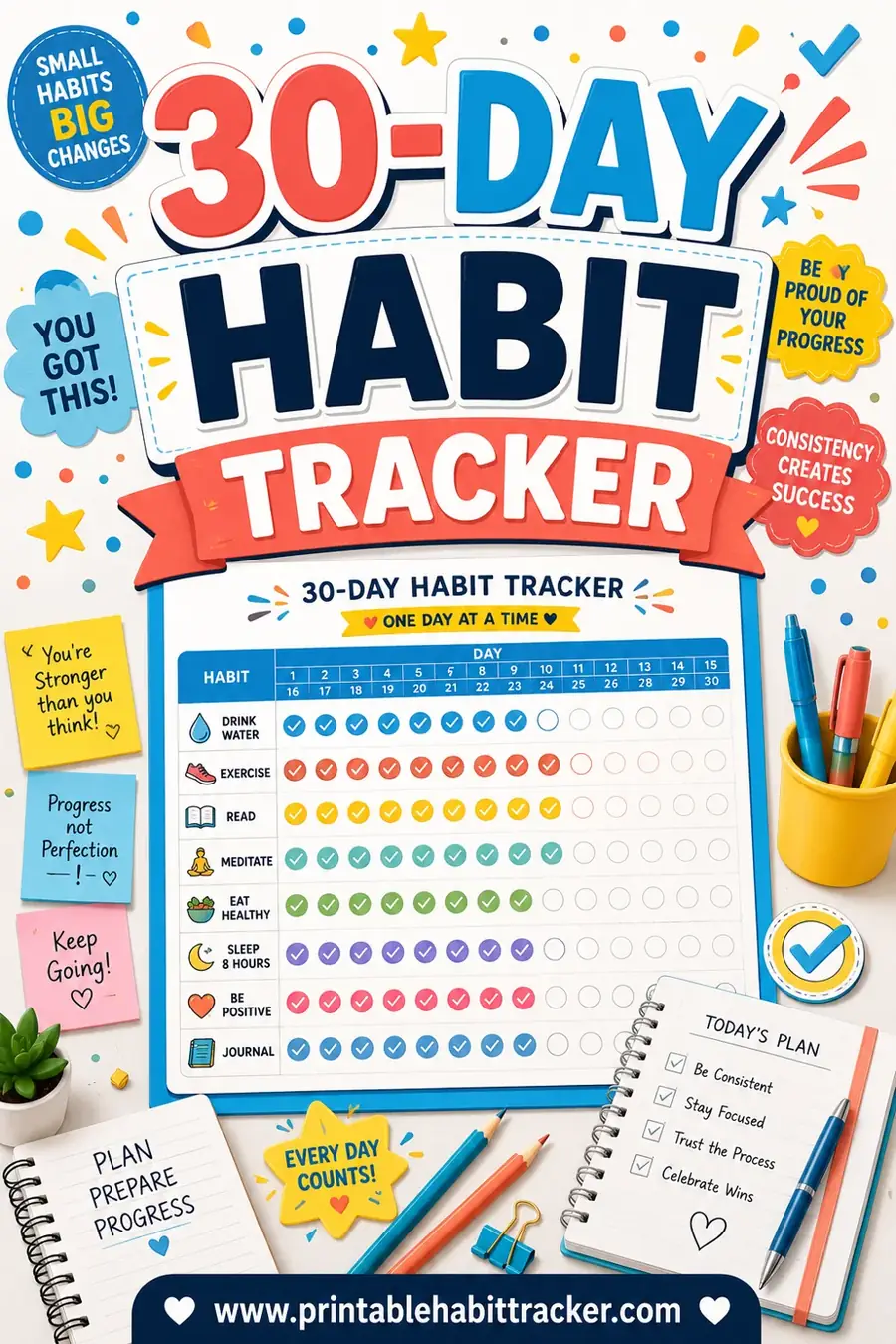
You can print that six-week plan in a couple of minutes with our free printable habit tracker maker. Build this exact tracker and it opens with a title, three starter habits and a monthly grid already filled in. Swap in your own habits, print, and you're set for the six weeks that decide whether a resolution lasts.
This guide covers why the February drop-off happens, the six-week plan week by week, how to shrink a big resolution into three trackable habits, how the 80 percent rule works, a Sunday review script, and what to do when you've already slipped. If you've quit a resolution before, you're in good company, and this time you'll have a plan for the exact weeks where it usually goes wrong.
Why Resolutions Fail by February
Most resolutions don't end with a big decision to quit. They fade. You miss a day, then two, then a week, and by the middle of February you realize you haven't thought about the goal in a while. Understanding why that happens is the first step to stopping it.
Here are the patterns that show up again and again, along with the fix for each.
| Why it fails | What it looks like | The fix in this plan |
|---|---|---|
| Too many goals at once | Five or six resolutions starting January 1 | Track only three habits |
| Goals instead of habits | "Get fit," "save more," "be less stressed" | Turn each goal into one small daily action |
| All-or-nothing rules | "Every day, no exceptions" | Aim for 80 percent of boxes each week |
| The novelty wears off | Exciting in week one, a chore by week three | Plan for the dip and shrink habits when it hits |
| No check-ins | Nobody notices the slide until it's too late | A 10-minute Sunday review every week |
| No end point | "Forever" feels too long to commit to | A six-week finish line, then decide what's next |
| Starting at full size | Hour-long workouts from day one | Start small and grow only after a good week |
| Real life shows up | A cold, a work deadline, a trip | A "minimum version" of each habit for hard days |
Too many goals at once
January invites a fresh-start mindset, and it's tempting to fix everything at once: exercise, diet, savings, sleep, reading, screen time. Each one on its own might be doable. Together, they compete for the same limited time and energy. When one slips, the others often go with it.
Three habits is a good limit for the first six weeks. It's enough to feel real progress and few enough that you can keep all of them in your head. Our habit tracker for New Year's resolutions covers setup in more detail; this guide focuses on the part after setup, when the quitting usually happens.
Goals instead of habits
"Get healthier" is a direction, not something you can do on a Tuesday. A resolution only becomes trackable when you turn it into a specific action you can tick off: "Walk 15 minutes after lunch," "Drink a glass of water before coffee," "Cook dinner at home four nights."
If you can't answer "Did I do it today, yes or no?" the habit is still too vague to track.
All-or-nothing thinking
This is the big one. Many resolutions come with an unspoken rule: every day, no exceptions. That rule works beautifully until the first exception, and there's always an exception. Then the whole thing feels broken, and a broken streak is easy to abandon.
A tracker built around 80 percent changes that. A missed day becomes part of the plan, not a failure of it. We'll get to how the 80 percent rule works in a moment.
The week-two dip
Many people notice that the excitement of a new habit fades somewhere around the second or third week. The novelty is gone, the results aren't visible yet, and the habit starts to feel like a chore. This is completely normal. It doesn't mean the habit is wrong for you or that you lack discipline. It means you've reached the part of habit-building where most of the work happens.
The trouble is that most people don't expect the dip, so when it arrives it feels like a sign to stop. If you know it's coming, you can plan for it: shrink the habit for a week, lean on your tracker, and keep going until it starts to feel automatic.
No review, no adjustment
Resolutions are usually set once and never looked at again. But almost no plan survives the first few weeks unchanged. Maybe the morning walk doesn't work because of school drop-off. Maybe ten pages a night is too much after a long workday. Without a regular check-in, these small problems pile up until quitting feels easier than fixing them.
A weekly review is the habit that protects all the other habits. Ten minutes on Sunday, looking at your tracker, is often the difference between a resolution that adjusts and one that disappears.
No finish line
"Forever" is a long time to commit to anything. A six-week window gives you a clear, reachable finish line. At the end of six weeks, you look back and decide: keep going, change something, or add a new habit. That decision point makes it easier to keep going through the hard middle weeks, because you know a review is coming.
The 6-Week Resolution Plan at a Glance
Six weeks is long enough to get past the early-February dip and short enough to stay focused. Here's the whole plan on one page. You can start it on January 1 or on any Monday; there's nothing magic about the date.
| Week | Focus | Weekly target | Sunday review question |
|---|---|---|---|
| Week 1 | Start small: three habits at their easiest size | 80 percent of boxes | Which habit felt easiest? Which was hardest? |
| Week 2 | Find the right time and anchor for each habit | 80 percent of boxes | Is each habit tied to something that already happens? |
| Week 3 | Get through the dip; use minimum versions if needed | 80 percent, minimums count | Did a minimum version save a day? |
| Week 4 | Protect your best habit; fix your weakest | 80 percent of boxes | What's one change that would make next week easier? |
| Week 5 | Hold steady, no new habits | 80 percent of boxes | Which habit now feels almost automatic? |
| Week 6 | Finish line and decision | 80 percent of boxes | Keep, change, grow or add? |
Notice what isn't on the plan: no new habits until week six, no punishing catch-up days, and no "start over" rule. If week three goes badly, week four is still week four. You keep moving forward.
Why six weeks instead of 21 or 30 days
You may have heard that a habit takes 21 days, or 30, or 66. The honest answer is that it varies a lot from person to person and habit to habit. Our guide on how long it takes to build a habit looks at this in more depth.
Six weeks is a practical choice, not a scientific promise. It covers the stretch from early January into mid-February, which is exactly where many resolutions stall. And it's long enough to have five Sunday reviews before the finish line, so you get plenty of chances to adjust.
Shrink Your Resolution Into Three Trackable Habits
This is where most of the real work happens, and it only takes about fifteen minutes. You start with whatever you resolved and end up with three small, daily or near-daily actions that fit on a tracker.
Step 1: Write down every resolution
Get them all out of your head. It's fine if the list is long. For example:
- Get in shape
- Save more money
- Read more
- Sleep better
- Spend less time on my phone
- Eat healthier
- Be more organized
Step 2: Pick the three that matter most right now
Not forever, just for the next six weeks. Ask yourself which three would make the biggest difference to how your days feel. If you're torn, pick the ones that would make the others easier. Better sleep, for instance, often makes exercise and healthy eating feel more doable.
The rest of the list isn't gone. Write it on the back of your tracker under "Later." You'll come back to it at the six-week review.
Step 3: Turn each one into a small daily action
Now translate each resolution into something you can do, today, in a few minutes. Here are common resolutions and some trackable versions of each.
| Resolution | Trackable habit (start here) | Minimum version for hard days |
|---|---|---|
| Get in shape | Walk 15 minutes | Walk 5 minutes or 10 squats |
| Exercise more | Workout 3x a week | Put on workout clothes and stretch |
| Eat healthier | Vegetables at dinner | One piece of fruit |
| Drink more water | Water before coffee | One glass at any point |
| Save money | Log every purchase | Check my balance |
| Spend less | No-spend weekday | Wait 24 hours before buying |
| Read more | Read 10 pages | Read 1 page |
| Sleep better | Phone away by 10 pm | Lights out 15 minutes earlier |
| Less screen time | No phone for first 30 min | Phone out of the bedroom |
| Be more organized | 10-minute evening reset | Clear one surface |
| Learn something new | Practice 15 minutes | Practice 2 minutes |
| Stress less | 5 minutes of quiet | Three slow breaths |
| Write more | Write 200 words | Write one sentence |
| Call family more | One call or message a day | Send one text |
The middle column is your real habit. The right column is your safety net: the smallest version that still counts as a tick on a bad day. We'll come back to minimum versions in week three, when they matter most.
Step 4: Give each habit an anchor
An anchor is something that already happens every day, which reminds you to do the habit. "Walk 15 minutes" becomes "Walk 15 minutes after lunch." "Read 10 pages" becomes "Read 10 pages once I'm in bed." Anchoring is one of the simplest ways to stop relying on memory and motivation. Pairing a new habit with an old one is often called habit stacking, and it works because the old habit does the remembering for you.
Good anchors include:
- Morning coffee or tea
- Brushing your teeth
- Arriving at work or sitting at your desk
- Lunch
- Getting home
- Dinner
- Kids' bedtime
- Getting into bed
Step 5: Check the size
Ask: "Could I do this on my worst day this month?" If the honest answer is no, shrink it. The habits that survive February are the ones that are a little too easy in January.
Sample sets of three
If you'd like a ready-made set, pick one of these and adjust it.
- Health reset: Walk 15 minutes; Water before coffee; Vegetables at dinner.
- Money reset: Log every purchase; No-spend weekday; Pack lunch.
- Calm and sleep: Phone away by 10 pm; 5 minutes of quiet; Lights out by 11.
- Reading year: Read 10 pages; Phone out of the bedroom; Library or bookstore visit once a week.
- Busy parent: Walk 10 minutes with the kids; Water at lunch; One page before sleep.
- Student: Study 25 minutes; Bed by midnight; Plan tomorrow in 2 minutes.
- Work-from-home: Get outside before noon; Stand-up break each hour; Close laptop by 6.
The 80 Percent Rule: Why "Most Days" Beats "Every Day"
Instead of aiming for a perfect streak, you aim to tick about 80 percent of your boxes each week. That's the core idea that keeps this plan alive through February.
The simple math
With three habits tracked every day, you have 21 boxes a week. Eighty percent of 21 is about 17. So a successful week is 17 or more ticks.
| Habits tracked | Days per week | Total boxes | 80 percent target |
|---|---|---|---|
| 3 habits, daily | 7 | 21 | 17 ticks |
| 3 habits, weekdays only | 5 | 15 | 12 ticks |
| 2 daily + 1 three times a week | varies | 17 | 14 ticks |
| 2 habits, daily | 7 | 14 | 11 ticks |
| 1 habit, daily | 7 | 7 | 6 ticks |
For a habit you only plan to do a few times a week, such as workouts, count only the days you planned. Three planned workouts with two done is close to 70 percent; three of three is 100. Don't count rest days as misses.
Why 80 percent works
An 80 percent target gives you about one or two misses per habit each week, built right in. A sick day, a late night at work or a busy weekend doesn't break anything. You don't need to "start over," because there was nothing to break.
It also takes the drama out of a missed day. Instead of "I failed," the thought becomes "I've used one of my misses this week." That's a much easier place to bounce back from.
And it's honest. Very few people do anything every single day for six weeks. A plan that expects perfection is a plan that expects you to quit. If you'd like the full case for flexible targets over streaks, our guide to streaks versus flexibility walks through both approaches.
The one rule that goes with it: never miss twice
The 80 percent rule has one companion: try not to miss the same habit two days in a row. One miss is life. Two in a row is the start of a new pattern. On the day after a miss, do at least the minimum version, even if it's tiny. That single tick keeps the habit alive.
When 80 percent is too high
If you're consistently landing well below 80 percent, the habits are probably too big, not you too weak. Shrink each habit to its minimum version for a week and see what happens. Hitting 80 percent with small habits is far better than hitting 40 percent with big ones, because the small ones are the ones that last.
How to Make It in the Free Tool
You can set up your six-week tracker in a few minutes. Open the free printable habit tracker maker and use these settings.
- Title. Something short and specific, like "6-Week Resolution Tracker," "January Reset" or "Six Weeks to Spring." A time-limited title reminds you there's a finish line.
- Template chips. Optional. If one of your habits fits a chip, such as Fitness, Reading, Sleep, No-Spend or Goal Tracker, tap it to see suggestions, then edit the list down to your three.
- Your habits (one per line). Type your three habits, one on each line. Include the anchor if it fits, such as "Walk 15 min after lunch."
- Layout. Choose Monthly. A monthly grid shows every day in a single view, which makes it easy to count your weekly ticks and spot patterns. Prefer one sheet per week? Choose Weekly and print six.
- Month. Set it to the month you're starting in. Six weeks crosses into a second month, so print that month too. If you're starting January 1, print January and February.
- Style. Checkbox is quick. Color-in is satisfying if you like a visual record; a full row of colored squares is very motivating by week four.
- Color theme. Pick one you'll enjoy seeing every day. Bold and Ocean are bright; Classic B&W saves ink.
- Options. Turn on Reflection or Notes/goals for your Sunday review notes. Color-code habits helps if you want each habit in its own color. Turn on Reward box and write your six-week reward in it. Leave Streak boxes off for this plan, since you're aiming for 80 percent, not unbroken streaks.
- Paper. Letter or A4, Portrait or Landscape. Landscape gives longer habit names more room.
- Print. Tap 🖨️ Print / Save PDF and save a PDF copy, so you can reprint if a sheet gets lost or coffee-stained.
Short on time? Open the tracker already filled in, swap in your three habits, and print.
Mark the six weeks on the sheet
Once it's printed, take a pen and do three quick things:
- Draw a line after every seventh day so each week stands out.
- Write "Review" next to each Sunday.
- Circle the last day of week six and write your reward next to it.
Now the plan is visible every time you look at the tracker. For more on reading a full month at a glance, our monthly habit tracker page has layout ideas.
Where to keep it
Put the tracker somewhere you'll see it at the moment you'd tick a box: on the fridge, by the bed, beside the desk or inside the front cover of your planner. Keep a pen with it. A tracker you have to go looking for is a tracker you'll forget.
The Sunday Review: 10 Minutes That Save the Plan
The weekly review is the habit that holds everything else together. Every Sunday, sit down with your tracker and a pen for about ten minutes. That's all it takes.
The Sunday review script
Work through these questions in order. Write short answers in the Reflection or Notes space on your tracker.
- Count. How many boxes did I tick this week, out of how many? Did I reach 80 percent?
- Celebrate. What went well? Name one thing, even a small one.
- Spot the pattern. Which days did I miss? Is there a common reason (weekends, late meetings, tired evenings)?
- Find the friction. What got in the way of my weakest habit?
- Make one change. What's one small adjustment for next week? Change the time, change the anchor, or shrink the habit.
- Look ahead. Is anything unusual coming up next week, like travel, guests or a deadline? Plan the minimum versions now.
- Reset. Draw the line for the new week and write next week's change at the top.
Keep it to one change per week. Changing everything at once makes it hard to tell what helped.
Sample review notes
Here's what a few weeks of review notes might look like for someone tracking "Walk 15 min," "Read 10 pages" and "Phone away by 10 pm."
| Week | Ticks | What went well | One change for next week |
|---|---|---|---|
| Week 1 | 19 of 21 | Reading every night | None, keep going |
| Week 2 | 15 of 21 | Walked every weekday | Weekends are hard; walk Saturday mornings instead |
| Week 3 | 13 of 21 | Phone habit held up | Shrink reading to 5 pages this week |
| Week 4 | 17 of 21 | Back to 80 percent | Charge phone in the kitchen |
| Week 5 | 18 of 21 | Walking feels automatic | Nothing, hold steady |
| Week 6 | 18 of 21 | Finished the six weeks | Keep all three; add one new habit |
Notice week three. That's the dip. Ticks dropped, the reading habit shrank, and the plan kept going anyway. By week four the numbers were back. That's what the plan is built for.
If you want a deeper version of this check-in for the end of each month, our guide on how to review your habits monthly has a longer set of questions.
What to do with a bad week
A bad week isn't a failed plan. If you land well under 80 percent, the review simply asks: what was different this week, and what's the smallest change that would help? Often the answer is to shrink one habit to its minimum version for a week. Sometimes it's to accept that the week was unusual and carry on as planned.
The one thing not to do is "start over." There's no week one again. You keep the weeks you've done and move to the next one.
Getting Through the February Wall
Somewhere between week two and week four, most people hit a wall. Motivation drops, results aren't obvious yet, and the habit feels like work. Here's how to handle the most common problems.
| Problem | Why it happens | What to try |
|---|---|---|
| I've lost motivation | The novelty has faded, which is normal around week two or three | Do the minimum version for a week; motivation often returns once the pressure drops |
| I keep forgetting | The habit has no anchor, or the anchor isn't reliable | Tie it to something that happens every day, and move the tracker to where you'll see it |
| I missed several days in a row | Life happened, or the habit got too big | Do the minimum version today; don't fill in old boxes |
| I'm not seeing results | Many results take longer than a few weeks to show | Track the habit, not the result; the ticks are the progress for now |
| Weekends always break the plan | Different routine, different anchors | Give weekends their own anchor or a smaller weekend version |
| One habit is always blank | Too big, wrong time, or not truly important to you right now | Shrink it, move it, or swap it at the next review |
| I want to add more habits | Things are going well and you feel ready | Wait until the six-week review, then add one |
| I got sick or traveled | A genuine break in routine | Pause the tracker, write "sick" or "away" across those days, and pick up where you left off |
| I feel guilty looking at blanks | The tracker feels like a report card | Switch to Color-in and focus on colored squares, not empty ones |
| I'm bored of the habit | Same thing every day gets dull | Vary the habit a little: a new walking route, a different book, a new playlist |
Minimum versions: your week-three lifeline
When the dip hits, don't drop the habit. Drop to its minimum version. Walk five minutes instead of fifteen. Read one page instead of ten. Put the phone in another room fifteen minutes earlier instead of a full hour.
Minimum versions count as a full tick. That's the deal. They keep the habit alive through the hard weeks so it's still there when your energy comes back. Many people find that once they start the minimum version, they keep going a bit longer anyway. But even if you stop right at the minimum, you've done what you set out to do.
If you've already quit
Maybe you're reading this in mid-February, or March, or later, and your resolution already faded. That's fine. Nothing about this plan depends on January 1.
Start a fresh six weeks on the next Monday. Use what you learned from the last attempt: if you set five goals, pick three; if your habits were too big, shrink them; if you never reviewed, put "Sunday review" on the tracker. A second attempt with a smaller plan often goes better than the first, because now you know where you got stuck.
Any Monday, the first of any month, a birthday or the start of spring can all be your fresh start.
Variations by Goal and Situation
The six-week plan works for almost any resolution, but a few tweaks help for specific goals.
Fitness resolutions
Plan workouts on specific days rather than "three times a week," and count only planned days toward your 80 percent. Add a short daily walk as a second habit so you have something to tick on rest days. Start lighter than you think you need to; it's easier to add than to recover from doing too much in week one.
Money resolutions
Pick habits you control daily, like logging every purchase or a no-spend weekday, rather than a big savings total. Watching the total is useful, but it moves slowly and can feel discouraging in February. The daily habit is what moves the total over time.
Reading resolutions
A page target is easier to track than a book target. "Read 10 pages" gives you a clear yes-or-no every night. Keep the minimum version tiny (one page) so a tired evening still counts.
Health and wellbeing resolutions
Choose simple actions like a glass of water, a walk outside or a set bedtime. If your resolution relates to a medical condition, diet change or medication, follow your doctor's guidance on what to track and how.
Students
Anchor habits to the class schedule instead of the clock, and plan a lighter version for exam weeks. Study in short, trackable blocks, such as "Study 25 minutes," rather than "Study more."
Parents
Anchor habits to the family routine: school drop-off, nap time, the kids' bedtime. Expect more misses during school breaks and sick weeks, and lean on minimum versions. Doing habits alongside the kids, like a family walk after dinner, can turn one tick into a shared win.
Shift workers and irregular schedules
Anchor to events, like waking up or getting home from a shift, rather than clock times. Your "morning" habit happens whenever your morning is.
If your shifts rotate, consider the 80 percent target per stretch of shifts rather than per calendar week. Mark each block of shifts on the tracker with a bracket, count ticks inside it, and review on your first full day off instead of Sunday. The point of the review is the pause, not the day of the week, so put it wherever a pause naturally falls in your schedule.
After Week Six: Keep, Change, Grow or Add
At the end of week six, sit down for a slightly longer review. Look back at all six weeks on your tracker and decide what happens next for each habit.
- Keep. The habit is working and you want it to continue as it is.
- Change. The habit matters but needs a different time, anchor or form.
- Grow. The habit feels easy now. Make it a little bigger, such as walking 20 minutes instead of 15.
- Add. If you hit 80 percent for most of the six weeks, you've earned a new habit. Pick one from your "Later" list and add it.
- Drop. If a habit never fit, it's okay to let it go. Not every resolution needs to last.
Then print a fresh tracker for the next six weeks. Many people find that a second round feels noticeably easier than the first, because the first set of habits has started to run on its own.
Give yourself the reward
If you wrote a reward in the Reward box, now's the time. Make it something that supports the habits rather than undoing them: new walking shoes, a book you've been wanting, a day trip, a quiet morning to yourself. You showed up for six weeks, including the hard ones. That deserves a celebration.
Ready to start? Build this exact tracker, swap in your three habits, and print the next six weeks. Or open the free habit tracker maker and set it up from scratch. The plan is small on purpose, and that's exactly why it lasts past February.
Frequently Asked Questions
Why do resolutions fail so often?
Resolutions often fail because they start too big, include too many goals at once, and rely on all-or-nothing rules. When the first missed days arrive, the plan feels broken and it's easier to stop than to adjust. Smaller habits, a flexible weekly target and a regular review make a resolution much more likely to last.
Why do people quit resolutions in February?
For many people, the excitement of a fresh start fades after the first few weeks, while the results aren't visible yet. Add a busy work or school schedule, and the habit starts to feel like a chore. Knowing that this dip is normal, and planning smaller versions of your habits for it, helps you get through it.
How many resolutions should I track?
Three is a good limit for the first six weeks. That's enough to feel real progress and few enough to keep in your head every day. You can add another habit once you've hit about 80 percent for most of those weeks.
What is the 80 percent rule for habits?
It means aiming to complete about 80 percent of your habit boxes each week instead of every single one. With three daily habits, that's about 17 of 21 boxes. It builds in room for real life, so a missed day doesn't feel like a failure.
What if I miss a day of my resolution?
Just tick the next box. One missed day doesn't undo your progress, and the 80 percent target already allows for it. Try not to miss the same habit two days in a row; on the day after a miss, do at least the minimum version.
Is it too late to start a resolution in February or March?
Not at all. Any Monday works as a starting point, and a six-week plan doesn't depend on the calendar year. If you've tried before, use what you learned to make the habits smaller and add a weekly review.
Should I use a monthly or weekly tracker for resolutions?
A monthly tracker lets you see the whole picture at once and makes weekly counting easy, so it's a good default for a six-week plan. A weekly tracker gives you a fresh page every Monday, which some people find motivating. Either works; choose the one you're most likely to look at every day.
How long does it take for a resolution to become a habit?
It varies a lot depending on the person and the habit. Some simple habits start to feel automatic within a few weeks, while others take months. A six-week plan won't make every habit automatic, but it gets you past the point where most resolutions fade.
What should I do after the six weeks?
Do a longer review and decide, for each habit, whether to keep it, change it, grow it, add a new one or drop it. Then print a fresh tracker for the next six weeks. Many people find the second round easier than the first.