Winter Blues Habit Tracker: Morning Daylight, a Walk and a Steady Bedtime
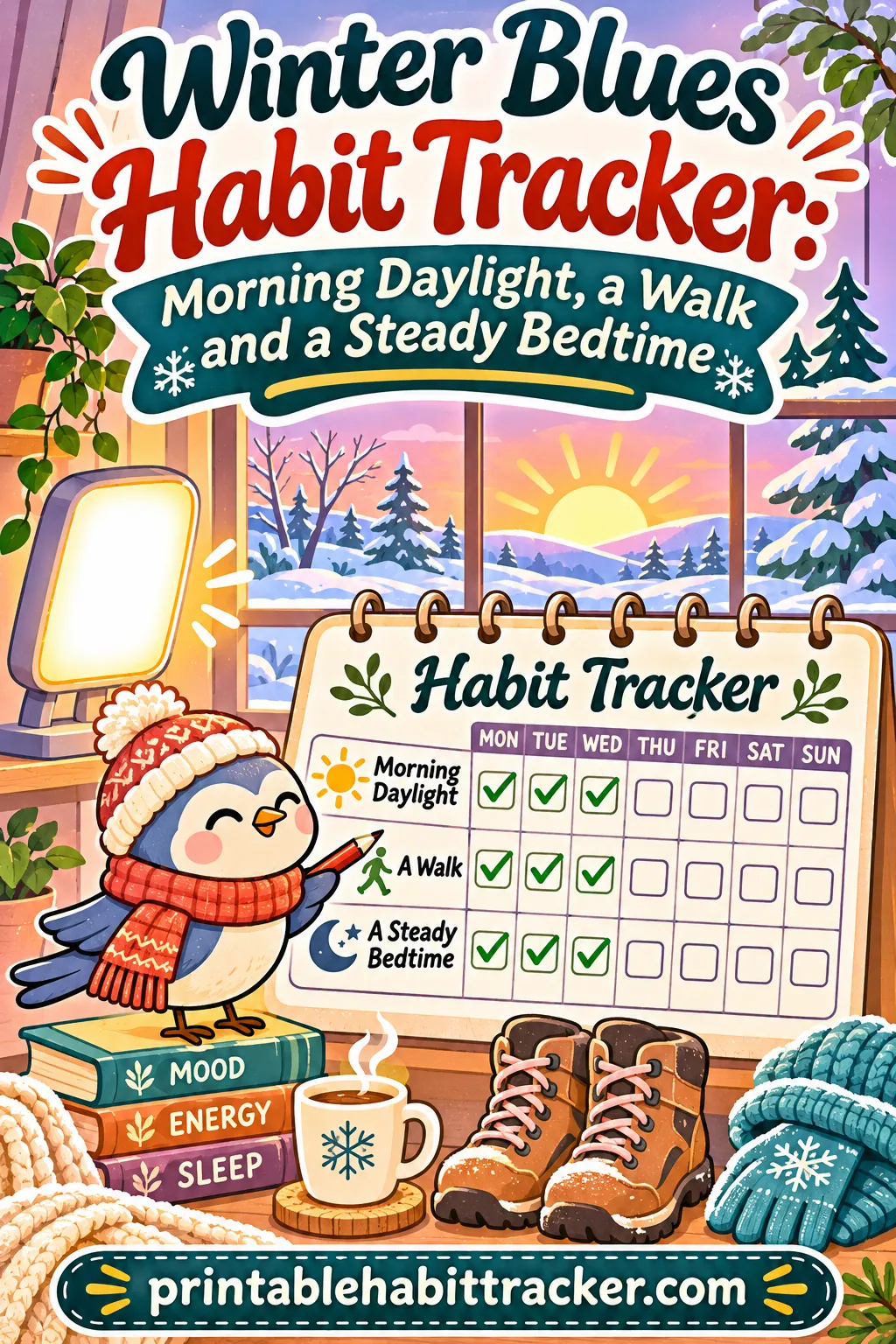
When short days and a packed December leave you tired and flat, a small daily routine usually helps more than a big plan: get about 10 minutes of daylight in the morning, take a 10-minute walk, keep a steady bedtime, reach out to one person and rate your energy from 1 to 5. Check those off on one printed page, and after two or three weeks you can see which habits line up with your better days.
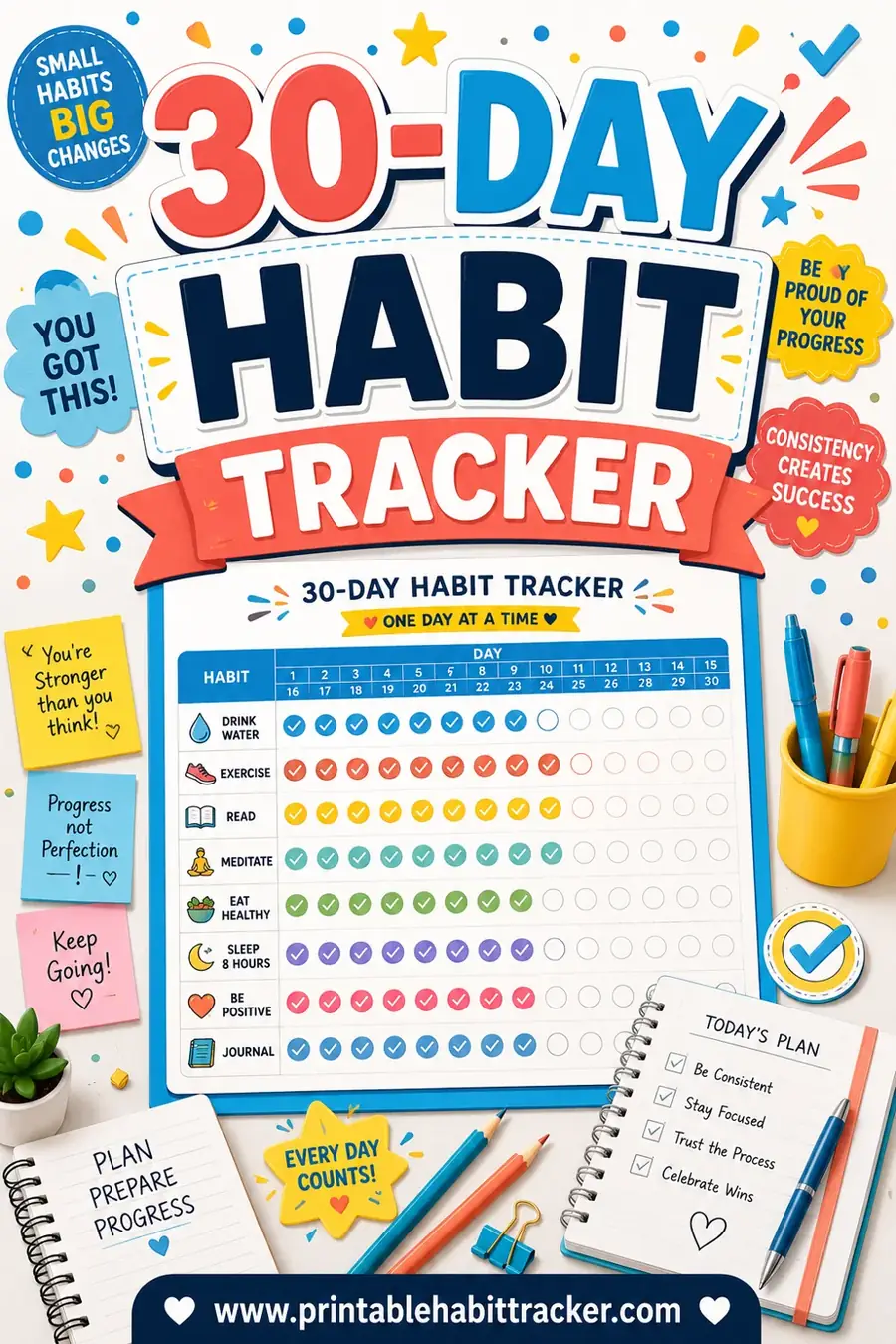
You can set it up in a couple of minutes with our free printable habit tracker maker. Build this exact tracker and it opens with all five rows, a monthly layout and a simple checkbox style, ready to print.
Please read this first: this article is not medical advice. A habit tracker is a planning tool. If your low mood lasts more than a couple of weeks, keeps getting worse, gets in the way of work, school or family life, or feels severe in any way, please talk to your doctor. If you ever have thoughts of harming yourself, call or text 988 in the US to reach the Suicide and Crisis Lifeline right away, or call 911 in an emergency.
Below you'll find why winter can drag your energy down, the five rows and how to do each one on a dark December day, the exact tool settings, a four-week plan, a worked example of reading your sheet, versions for different schedules, a troubleshooting table and clear signs it's time to call your doctor.
✅ Try this tracker for one week
Tap a box each day you do the habit. Your ticks stay on this device.
Why Short Days Leave You Tired and Low
A lot of people notice the same thing every year. Sometime in late fall, mornings get harder, afternoons feel heavy and evenings vanish into the couch. Then December adds parties, shopping, travel and late nights on top. By mid-month, many people feel worn down and a bit gray without being able to say exactly why.
What changes in winter
Several things shift at once:
- Less daylight. In much of the US, the sun rises later and sets in the late afternoon. Many people commute in the dark both ways and spend the bright part of the day indoors.
- Less movement. Cold, wet or icy weather makes walks less appealing, so daily steps quietly drop.
- Messier sleep. Dark mornings make it hard to get up, and holiday evenings push bedtime later. Weekends drift even further.
- Less real connection. It sounds odd in the busiest social month, but crowded events aren't the same as a real talk with someone you trust. Many people feel lonelier in December, not less.
- More pressure. Money, family, hosting and year-end deadlines pile up.
None of these is dramatic alone. Together, they can leave you running on low for weeks.
Why a small routine, not a program
When people feel low, big plans tend to backfire. A new hour-long workout, an early-rising schedule and a strict diet all at once is a lot to ask from someone who's already tired. When the plan falls apart on day four, it adds guilt to the tiredness.
Health and sleep organizations tend to suggest the same handful of simple steps for the winter slump: get some morning light, move a little each day, keep a regular sleep and wake time and stay in touch with people. Those are small enough to fit into a December day, and they work together. A morning walk outside covers both light and movement. A steady bedtime makes the morning light easier to get.
That's what this tracker does. It gives those few steps one row each and adds an energy score, so you can see what's helping instead of guessing.
Winter blues or something more?
Lots of people feel a bit flatter in winter. For some, though, the change is bigger: low mood most days, loss of interest in things they usually enjoy, sleeping or eating much more or less than usual, trouble functioning or feeling hopeless. Doctors take this seriously, and seasonal depression is a real, treatable condition.
A tracker can't tell the difference between ordinary winter tiredness and depression. Only a doctor or mental health professional can do that. If any of that list sounds like you, skip ahead to the section on when to talk to your doctor, and make that call first. The tracker can still help alongside real care, and your sheet can be a useful thing to show your doctor.
The Five Rows on Your Winter Blues Habit Tracker
Each row is short enough to fit on the printed sheet and simple enough that you know whether you did it. Here's what each one means and how to do it when the days are short.
Row 1: Morning daylight 10 min
Get outside, or sit right by a bright window, for about 10 minutes in the first part of your day. Guides from sleep organizations commonly suggest 10 to 20 minutes of early light. Outdoor light is much brighter than indoor lighting, even on a cloudy day, so outside is better than inside when you can manage it.
What counts:
- Drinking your morning coffee or tea on the porch or steps
- Walking the dog or the kids to the bus
- Walking part of your commute or parking farther away
- Standing outside for a few minutes at a midmorning break
- Sitting right next to the brightest window in the house with the blinds fully open, on days you truly can't go out
If it's still dark when you leave for work, count the first daylight you can get, even if it's a midmorning break. The goal is light early in your day, not at a set clock time.
Some people ask about light therapy lamps. They're something to discuss with your doctor first, especially if you have eye conditions, take medicines that make you sensitive to light or have a history of bipolar disorder. The tracker row is about plain daylight.
Row 2: 10-minute walk
A 10-minute walk at any point in the day. Lunchtime is a great slot in winter, because it's often the brightest part of the day. If you can walk in the morning, you can check rows 1 and 2 together.
Ten minutes is the floor, not the goal. If you walk 30, great, it's still one check. The low bar is there so that a cold, busy day still gets a walk. If walking outdoors isn't safe because of ice or darkness, walk laps in a mall, a big store, a school gym or up and down your stairs, and still check the box.
If you have a health condition that affects how much you can move, check with your doctor about what kind of activity is right for you.
Row 3: Same bedtime
Pick a bedtime you can hit most nights, including weekends, and check the box when you're in bed with the lights out within about 30 minutes of it. Sleep guides commonly recommend keeping both bedtime and wake time steady, because a regular schedule helps your body know when to feel sleepy and when to feel alert.
Choose a realistic time. If your nights have been sliding to midnight, don't set 9:30. Try 11 for the first two weeks, then move it earlier by 15 minutes if you want to. And aim to keep your wake time within an hour of your weekday time on weekends, too, since a long weekend lie-in can make Monday morning feel even darker.
For holiday party nights, decide in advance: either leave in time to hit the bedtime, or accept one empty box and protect the next night. Our guide on a habit tracker for better sleep has more ideas for winding down.
Row 4: Reach out to one person
Send a message, make a call or have a real face-to-face conversation with one person you care about. It doesn't need to be long. "Thinking of you, how's your week?" counts. So does a 10-minute phone call on your walk, which checks two boxes at once.
This row matters because December can be crowded and lonely at the same time. Small daily contact keeps people close. And if you're having a hard stretch, the people you're already in touch with are the ones it's easiest to tell.
Row 5: Energy 1-5
At the end of the day, rate your energy from 1 to 5 and write the number small inside the box for that day. This is the row that turns your sheet from a checklist into something you can learn from.
Use the same scale every day:
| Score | What it means |
|---|---|
| 5 | Good energy, got through the day easily, felt like myself |
| 4 | Mostly fine, a slow patch or two |
| 3 | Got by, tired in the afternoon, nothing extra left |
| 2 | Dragging most of the day, hard to start things |
| 1 | Very low, could barely get through the day |
Don't overthink it. Pick the number that first comes to mind. One score means little. The pattern across two or three weeks is what tells you something.
If you see a lot of 1s and 2s in a row, that's a signal to talk to your doctor, not to try harder with the habits.
Fitting daylight and a walk into a dark day
The hardest part of this tracker in December is finding light. Here's how it can fit different schedules. Check your local sunrise and sunset times in your phone's weather app, since they vary a lot by where you live.
| Your schedule | Morning daylight | 10-minute walk | Tip |
|---|---|---|---|
| Office job, dark commute | Midmorning step outside or a window seat | Lunchtime walk | Put a 10-minute walk on your work calendar |
| Work from home | Coffee outside right after sunrise | Walk before your first meeting | Do rows 1 and 2 together |
| School drop-off parent | Walk to the bus or school | Walk after drop-off | Take the long way home |
| Retired or home in the day | Breakfast by the brightest window, then outside | Late-morning walk | Brightest hours are usually late morning to early afternoon |
| Student | Walk between morning classes | Walk to lunch | Study by a window when you can |
| Night shift | Daylight after you wake, whatever the hour | Walk before your shift | See the shift worker section below |
How to Make Your Winter Blues Habit Tracker in the Free Tool
If you used the preset link above, the title, rows, layout and style are already in place. Otherwise, open the free printable habit tracker maker and use these settings. It takes about two minutes.
Exact settings
| Setting | Choose | Why |
|---|---|---|
| Title | Winter Energy Tracker | Keeps the focus on energy, not perfection |
| Your habits (one per line) | Morning daylight 10 min, 10-minute walk, Same bedtime, Reach out to one person, Energy 1-5 | Four habits plus a daily score |
| Layout | Monthly | One page shows the whole month, so patterns are easy to spot |
| Month | December (or the month you start) | The date grid lines up with your calendar |
| Tracking style | Checkbox | Quick to tick, with room to write a small number in the energy row |
| Color theme | Sage or Ocean | Calm colors; Classic (B&W) if you want to save ink |
| Color-code habits | Optional | Makes each row easy to find at a glance |
| Extras | Reflection | A "This month's wins" box for your end-of-month notes |
| Notes / goals | Your bedtime, wake time and walk slot | Your plan, written where you'll see it |
| Paper | Letter or A4 | Whatever your printer uses |
| Orientation | Landscape | Wider boxes, easier to write energy numbers |
When the live preview looks right, press 🖨️ Print / Save PDF. Save the PDF too, so January's sheet is one click away.
What to write in the Notes / goals box
Use the Notes box to make your plan concrete. For example:
"Bedtime 11:00, up 7:00 every day. Daylight: coffee on the porch. Walk: lunch, around the block twice. Reach out: text one person on my walk."
When you write the exact slot for each habit, you don't have to decide each day. You just follow the note.
Optional extras
Mood row. This adds a small strip of faces, from smiling to sad, below the grid. It isn't one face per day, so the Energy row stays your daily score. Some people like to circle a face at the end of each week as a quick weekly check-in.
Streak boxes. These print a numbered row from 1 to 30 under "Longest streak." They can be motivating for the walk row. If streaks make you anxious, leave them off. For a winter routine, a steady pattern matters more than an unbroken chain.
Reward box. Prints "My reward when I hit my goal." If you use it, pick a gentle reward: a new book, a favorite breakfast, a slow Saturday morning.
Where to put it
Put the sheet where you'll see it at night, because that's when you'll mark it and score your energy. The bathroom mirror or the nightstand works well. Keep a pen right next to it. If you want a page built more around mood itself, our mood + habit tracker page shows other ways to lay it out.
How to mark it each night
Before bed, take 30 seconds:
- Check each habit you did today.
- Write today's energy number, 1 to 5, in the Energy box.
- If something stood out, write a word or two in the margin: "party," "sick," "sunny," "bad night."
That's all. No journaling, no long notes. The short margin words are surprisingly useful later, because they explain the odd days.
A Four-Week Plan for December
You don't need to start all five rows at full strength on day one. Ease in, so the routine still feels small when the busy weeks arrive.
Week 1: Start with sleep and the score
For the first week, focus on just two rows: "Same bedtime" and "Energy 1-5." Check the other rows if you happen to do them, but don't push. Sleep is the habit that makes everything else easier, and the energy score needs a few days of practice before it feels natural.
Week 1 checklist:
- Print the sheet and tape it up.
- Pick a realistic bedtime and wake time and write them in Notes.
- Score your energy every night, even on days you did nothing else.
- Look up your local sunrise and sunset times.
Week 2: Add daylight and the walk
Now add "Morning daylight 10 min" and "10-minute walk." Tie each to something you already do. "After I pour my coffee, I take it outside." "After I eat lunch, I walk around the block twice." Pairing a new habit with an old one is the easiest way to remember it.
Expect a few misses this week. December weather and calendars aren't kind. Aim for most days, not every day.
Week 3: Add the reach-out row and protect the basics
Add "Reach out to one person." This week is often the busiest of the season, so treat the other habits as protected time. On a jam-packed day, the minimum is: daylight for a few minutes, a short walk, lights out on time.
Week 4: The holiday stretch
The days around Christmas change everything: travel, guests, time off, late nights. Keep the sheet going anyway, even if it's just the energy score. If you're traveling, take a photo of the sheet and keep a quick note on your phone, then fill in the boxes when you're home.
Days off are a great chance for longer walks in the middle of the day, when the light is best. And if you've been running short on sleep, the quiet days after the holiday are a good time to settle back into your bedtime.
The plan at a glance
| Week | Rows to focus on | Main goal |
|---|---|---|
| Week 1 | Same bedtime, Energy 1-5 | Steady sleep and a nightly score |
| Week 2 | Add morning daylight and the walk | Tie each to a daily anchor |
| Week 3 | Add reach out to one person | Protect the basics on busy days |
| Week 4 | Keep all rows, even if lightly | Use days off for midday light and longer walks |
A sample two weeks, filled in
Here's how a realistic stretch might look. A ✓ means the habit was done. The last column is the energy score.
| Day | Daylight | Walk | Bedtime | Reach out | Energy | Margin note |
|---|---|---|---|---|---|---|
| Dec 8 | ✓ | ✓ | ✓ | 4 | Sunny | |
| Dec 9 | ✓ | ✓ | ✓ | 3 | ||
| Dec 10 | ✓ | 2 | Party, late | |||
| Dec 11 | ✓ | 2 | Rain all day | |||
| Dec 12 | ✓ | ✓ | ✓ | ✓ | 4 | Long walk |
| Dec 13 | ✓ | ✓ | ✓ | 3 | ||
| Dec 14 | ✓ | ✓ | ✓ | 4 | ||
| Dec 15 | ✓ | ✓ | 3 | Dark commute | ||
| Dec 16 | ✓ | ✓ | ✓ | ✓ | 4 | |
| Dec 17 | 2 | Work deadline | ||||
| Dec 18 | ✓ | ✓ | ✓ | ✓ | 4 | |
| Dec 19 | ✓ | ✓ | ✓ | 3 | Family dinner | |
| Dec 20 | ✓ | ✓ | ✓ | 5 | Walk in the snow | |
| Dec 21 | ✓ | ✓ | ✓ | 3 |
Reading Your Sheet: Which Habit Actually Helps?
After two or three weeks, sit down with your sheet for ten minutes. You're looking for pairings: which habits tend to show up on your higher-energy days?
A simple way to compare
For each habit, split the days into two groups: days you did it and days you didn't. Then average the energy scores in each group. You don't need a calculator for a two-week sheet. Just add the numbers and divide.
Worked example from the sample sheet
Using the 14 days above:
Morning daylight. Done on 10 days. Energy on those days: 4, 3, 4, 3, 4, 4, 4, 3, 5, 3. That adds to 37, so the average is 3.7. Not done on 4 days: 2, 2, 3, 2. That adds to 9, an average of about 2.3.
10-minute walk. Done on 9 days: 4, 4, 3, 4, 3, 4, 4, 3, 5, adding to 34, an average of about 3.8. Not done on 5 days: 3, 2, 2, 2, 3, adding to 12, an average of 2.4.
Same bedtime. Done on 10 days: 4, 3, 2, 4, 4, 3, 4, 4, 5, 3, adding to 36, an average of 3.6. Missed on 4 days: 2, 3, 2, 3, adding to 10, an average of 2.5.
Reach out to one person. Done on 8 days: 3, 2, 4, 3, 4, 4, 3, 3, adding to 26, an average of about 3.3. Not done on 6 days: 4, 2, 4, 3, 2, 5, adding to 20, also about 3.3.
What this person learns
| Habit | Avg energy when done | Avg energy when not done | Gap |
|---|---|---|---|
| Morning daylight | 3.7 | 2.3 | 1.4 |
| 10-minute walk | 3.8 | 2.4 | 1.4 |
| Same bedtime | 3.6 | 2.5 | 1.1 |
| Reach out | 3.3 | 3.3 | 0 |
For this person, daylight and the walk line up most clearly with better days, and the bedtime isn't far behind. Reaching out doesn't show a difference in energy, which makes sense: it may help in ways an energy score doesn't catch, like feeling less alone. That's not a reason to drop it.
Be careful with what the numbers mean
A two-week sheet is a hint, not proof. Some of the low days had other causes, like a deadline or a party, and those days also happened to be days without a walk. Maybe the walk helped. Maybe a busy day just pushed out both the walk and the energy. Look at your margin notes, too.
The useful takeaway is practical: "On days I get outside in the morning and walk, I usually feel better. Let me protect those two on busy days." You don't need more certainty than that to decide where to put your effort.
What to do with what you learn
- Protect the habit with the biggest gap. Make it the one you do even on the worst day.
- Make the hardest habit easier. If bedtime keeps slipping, set an alarm 30 minutes before it as a wind-down cue.
- Don't drop a habit just because it shows no gap. Keep it if it matters to you for other reasons.
- Bring the sheet to your doctor if your scores stay low. A month of real data is far more useful than "I've been tired lately."
Our guide on how to stay consistent with habits has more on keeping the routine going once you know what helps.
Versions for Different Schedules
The five rows work for most people, but a few situations need small changes.
Night shift and early shift workers
If you sleep during the day, "morning" means the start of your day, whatever the clock says. Change row 1 to "Daylight after I wake" and row 3 to "Same sleep time" based on your shift pattern. Write your sleep window in the Notes box. If your shifts rotate, aim for a steady routine within each run of shifts rather than one fixed bedtime. Talk to your doctor if shift work is wrecking your sleep, since there are specific approaches for that.
Parents of young kids
Your bedtime may depend on a toddler's night, so set a realistic target and count it as done if you were in bed on time, even if you were up later with a child. Daylight and walks are easier with kids: stroller walks, the walk to school, ten minutes in the yard after breakfast. Count them. If the kids are old enough, invite them to check the walk box with you.
Working from home
Remote workers can go days without stepping outside. Make row 1 non-negotiable: coffee outside or a walk around the block before you open your laptop. Put the 10-minute walk on your calendar as a meeting with yourself.
Living alone
Row 4 matters even more. Spread your reach-outs across different people, and try for at least one voice or face-to-face contact a week, not only texts. A standing call with a friend or relative, same day every week, takes the planning out of it.
Older adults
Daylight walks are often easiest late in the morning, when it's brightest and ice may have melted. If falls are a concern, walk indoors in a large building or a hallway and still check the box. Ask your doctor what level of activity is right for you.
Students
Exam season and holiday break both scramble sleep. Keep the wake time steady over break, within an hour of your school schedule, so January isn't a shock. Studying by a window counts toward daylight on days you can't get outside. The sleep tracker page has more layouts if sleep is the main thing you want to fix.
Troubleshooting: When the Routine Isn't Sticking
| Problem | What's probably going on | What to try |
|---|---|---|
| It's still dark when I leave for work | Sunrise is after your commute | Count your first daylight, like a midmorning step outside or lunch |
| I keep skipping the walk | No fixed slot | Tie it to lunch or to the end of your work day |
| My bedtime keeps sliding | No wind-down cue | Set an alarm 30 minutes before bed to start winding down |
| Weekends wreck my schedule | Late nights and long lie-ins | Keep your wake time within an hour of weekdays |
| I forget to score my energy | No marking moment | Mark the sheet right after brushing your teeth |
| The weather is too bad to go out | Ice, storms or deep cold | Walk indoors and sit by your brightest window |
| I feel guilty about empty boxes | All-or-nothing thinking | Aim for most days, and never miss the same row twice in a row |
| My energy is low no matter what I do | It may be more than winter tiredness | Talk to your doctor |
If you keep missing days and feel bad about it, our article on using a habit tracker for mental health covers how to keep the sheet kind rather than harsh.
When to Talk to Your Doctor
This tracker is a self-help planning tool. It is not medical advice, and it is not a treatment for depression or any other condition. Please talk to your doctor if:
- Your low mood lasts more than about two weeks.
- You've lost interest in things you usually enjoy.
- Your sleep, appetite or weight has changed a lot.
- You're struggling to get through work, school or caring for your family.
- Your energy scores stay at 1 or 2 for most of a week or more, even when you're doing the habits.
- You feel hopeless, worthless or numb.
- This happens every winter and seems to be getting worse.
Seasonal depression and other forms of depression are real, common and treatable. A doctor can talk with you about options and rule out other causes of tiredness. Bring your sheet along. A few weeks of energy scores and habit checks gives your doctor a clear picture.
If you're in crisis or have thoughts of harming yourself, call or text 988 in the US to reach the Suicide and Crisis Lifeline, or call 911. You don't have to wait until things get worse to reach out.
Start Your Winter Sheet Tonight
You don't need a big plan to get through the darkest weeks of the year. You need a little morning light, a short walk, a steady bedtime, one real connection and a quick score each night to see what helps.
Pick your bedtime, write your walk slot in the Notes box, then build this exact tracker and print it. Score tonight's energy before bed, even if you did nothing else today. Want to tweak a row or the theme first? Open the habit tracker maker and change anything before you print. And if the low days start to outnumber the good ones, please call your doctor.
Frequently Asked Questions
What habits help with the winter blues?
The habits most often suggested by health and sleep organizations are simple: get some daylight early in the day, move a little every day, keep a steady bedtime and wake time and stay in touch with people. This tracker gives each one a row. It isn't medical advice, so talk to your doctor if low mood lasts or feels severe.
How much morning light should I get?
Sleep guides commonly suggest about 10 to 20 minutes of outdoor light early in the day. Outdoor light is much brighter than indoor light, even on a cloudy day. If it's dark when you leave home, use your first chance at daylight, like a midmorning step outside or a walk at lunch.
Is a habit tracker a treatment for seasonal depression?
No. A tracker is a planning tool that can help you build supportive routines and notice patterns. It doesn't diagnose or treat any condition. If you think you might have seasonal depression or any kind of depression, please talk to your doctor.
How do I rate my energy from 1 to 5?
Use 5 for a day when you felt like yourself with good energy, 3 for a day you got through but felt tired, and 1 for a very low day. Write the number small inside that day's box before bed. Pick the first number that comes to mind; the pattern over weeks matters more than any single score.
How long before I see a pattern?
Most people can spot something after two to three weeks of steady marking. Compare your average energy on days you did a habit with days you didn't. Treat it as a useful hint, not proof, and look at your margin notes for days with other causes.
What if I can't get outside in the morning?
Count the first daylight you can get, even midmorning or at lunch. On days you truly can't go out, sit right by your brightest window with the blinds open. If you're curious about light therapy lamps, ask your doctor first.
Should I track my mood or my energy?
Energy is often easier to rate honestly in winter, which is why this tracker uses it. If you'd rather track mood, rename the row "Mood 1-5" and use the same scale. Either way, if your scores stay very low, talk to your doctor.
Can I keep using this tracker after December?
Yes. Winter days stay short and cold well into January and February, so it can help to print a new sheet each month. Keep the rows that showed the biggest difference in your energy and drop or swap the rest.