Cleaning Schedule for an Overwhelmed, Messy House: 10 Minutes a Day
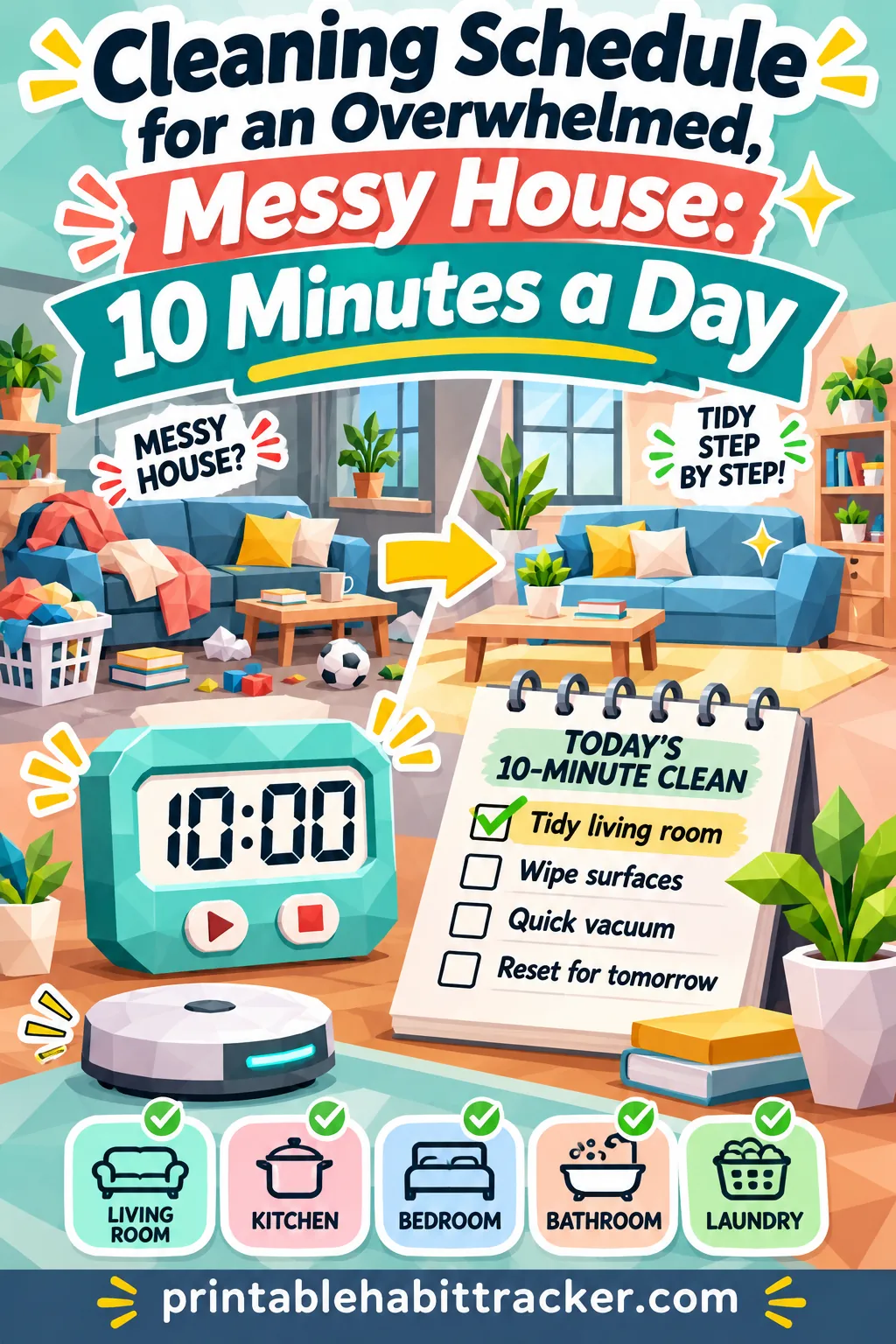
When your house feels too far gone to fix, the cleaning schedule that works is tiny: a 10-minute reset in the morning, a 10-minute reset in the evening, and one 10-minute "zone" job per weekday, ticked off on a weekly grid. That's about half an hour a day, split into pieces small enough to start even on a bad day. You don't catch up all at once. You stop the pile from growing, then shrink it one zone at a time.
You can print the grid for free with the habit tracker maker on our homepage. Use this link to build this exact tracker: it opens the tool with a weekly layout and the six habits from this article already filled in, so you can print it in about a minute.
Below you'll find the full weekday zone plan, word-for-word reset checklists, a rescue plan for the first day, the exact tool settings, versions for ADHD brains, parents, roommates and long work weeks, and a troubleshooting table for when the plan wobbles.
✅ Try this tracker for one week
Tap a box each day you do the habit. Your ticks stay on this device.
Why a Messy House Feels Impossible (and Why 10 Minutes Works)
A messy house isn't really one big problem. It's dozens of small unfinished tasks sitting in the same space: a sink of dishes, a chair of clothes, a counter of mail, a floor of toys or shoes. Your brain sees all of them at once and tries to plan the whole thing. That's where the frozen, "I don't know where to start" feeling comes from.
Big cleaning days make it worse. You wait for a free Saturday, spend six hours on it, feel wrecked, and then life fills the house back up within a week. The next big cleaning day feels even harder to face, so you put it off longer. The gap between "clean" and "now" keeps widening.
Short, fixed sessions break that loop for a few plain reasons:
- Starting is the hard part. Ten minutes is short enough that you can talk yourself into it when you're tired, stressed or unmotivated.
- A timer gives you a finish line. You're not agreeing to "clean the kitchen." You're agreeing to work until the timer rings, then stop without guilt.
- Daily beats heroic. Thirty minutes a day is about three and a half hours a week, which is more than most people manage on a single weekend clean, and it's spread out so the mess never gets a full week's head start.
- One zone per day narrows the view. On Tuesday, you're not looking at the whole house. You're only looking at the bathroom.
- Ticking a box closes the loop. A cleaning job never feels "done" because the house keeps getting used. The checkbox is the done.
That last point is why a printed tracker helps. Cleaning has no natural finish, and a sheet on the fridge gives each day a small, visible ending. Over a week, a row of ticks also shows you something your eyes can't see yet: that you've been showing up, even while the house still looks messy.
Set your expectations kindly. For the first two weeks, the house may look only a little better. That's normal. The first job of this schedule is to stop the mess from growing. Shrinking it comes second, and it happens faster once the daily resets are steady.
The 10-Minute-a-Day Cleaning Schedule
Here's the whole plan on one page. Each weekday has the same two resets plus one zone. Weekends are lighter on purpose.
| Day | Morning reset (10 min) | Zone job (10 min) | Evening reset (10 min) |
|---|---|---|---|
| Monday | Quick reset | Kitchen: counters, sink, stovetop, one fridge shelf | Quick reset |
| Tuesday | Quick reset | Bathroom: toilet, sink, mirror, swap towels | Quick reset |
| Wednesday | Quick reset | Living room: clear surfaces, cushions, floor pick-up | Quick reset |
| Thursday | Quick reset | Bedrooms: clear floor, change one set of sheets | Quick reset |
| Friday | Quick reset | Entry and "drop zones": shoes, bags, mail pile, car trash | Quick reset |
| Saturday | Quick reset | Floors: vacuum or sweep the main walkway rooms | Optional |
| Sunday | Optional | Catch-up: redo the zone you missed, or rest | Quick reset and look at next week |
A few notes on why the plan is built this way.
The kitchen comes first. Monday gets the room that affects every other day. A working kitchen means meals happen, dishes have somewhere to go and the rest of the house stops collecting cups and plates.
The bathroom is short but frequent. Ten minutes a week keeps a bathroom from ever needing a scary deep clean. Toilet, sink and mirror are the jobs people notice most.
Friday is for drop zones. The spots where things land when you walk in the door, like the entry table, the bottom of the stairs or a kitchen chair, fill up fastest. Clearing them before the weekend gives you a calmer two days.
Saturday is floors. Floors are easier once the week's surfaces and pick-ups have happened, so they go last.
Sunday is a buffer. Every plan needs a slot for the day you skipped. If you didn't miss anything, Sunday is rest plus a quick look at the coming week.
You can move the zones around to fit your home. If you have two bathrooms, alternate them by week. If you don't have a separate entry, give Friday to the room that gets messiest in your house, whatever that is. The rule that matters is one zone per weekday, ten minutes, then stop.
What "10 minutes on a zone" actually looks like
Ten minutes feels short, so it helps to know what's realistic. In a kitchen, you can usually clear and wipe the counters, scrub the sink, wipe the stovetop and toss old food from one fridge shelf. In a bathroom, you can clean the toilet, wipe the sink and mirror and put out fresh towels. In a living room, you can clear every flat surface into a basket and fluff the couch.
You will not finish every zone in ten minutes, especially in the first few weeks. That's fine. Stop when the timer rings anyway. The zone comes back around next week, and each lap takes less time than the last. Stopping on time is what makes tomorrow's ten minutes feel safe to start.
Pick the order inside a zone ahead of time. Decision-making eats time when you're overwhelmed. If you always do a zone in the same order, like trash first, then dishes, then surfaces, then floor, you never have to think about where to begin.
The Two Daily Resets: Morning and Evening Checklists
The resets are the backbone of the schedule. Zones make progress; resets protect it. If you only manage one thing on a hard day, do the evening reset.
A reset isn't deep cleaning. It's putting the house back to "usable." Keep the lists short and identical every day so they become automatic.
Morning reset (10 minutes)
- Make the bed, even roughly. Pull up the covers and toss the pillows on.
- Open the blinds or curtains.
- Start a load of laundry if the hamper is half full or more.
- Empty the dish rack or dishwasher if it's full of clean dishes.
- Wipe the bathroom sink after you use it.
- Carry anything out of the bedroom that doesn't belong there.
- Put on shoes. (This one sounds odd, but many people find they move around the house more once their shoes are on.)
Evening reset (10 minutes)
- Set a timer and put on music or a podcast.
- Load or wash every dish in sight. Run the dishwasher if it's full.
- Wipe the kitchen counters and stovetop.
- Do a "return box" lap: walk once through the main rooms with a basket and collect anything out of place (more on this below).
- Move the laundry along one step: washer to dryer, or dryer to basket.
- Take out any overflowing trash.
- Set out one thing for tomorrow, like a lunch bag, keys or a clean outfit.
That's it. When the timer rings, you're done, even if step six didn't happen.
Why the evening one matters most: waking up to a clear sink and counter changes how the next day starts. The morning reset gets easier, the zone job starts from a cleaner base and you're less likely to skip the whole day out of discouragement.
If seven steps feel like too many, cut the list to three: dishes, counters, return box lap. Those three alone keep most homes from sliding back into chaos.
Writing your own reset list
Your house is unique, so your lists can be too. Here's how to build one:
- Look at what makes tomorrow harder. Is it the sink? A pile of shoes by the door? An overflowing hamper? Those are your reset tasks.
- Keep each item under two minutes. A reset list is a series of quick wins, not projects.
- Cap it at seven items. More than that and it won't fit in ten minutes.
- Write it on the sheet itself. Use the Notes/goals box on your printed tracker so the list is right where you tick it off.
Day Zero: The First Rescue Session When It's Really Bad
If your house is past the point where ten minutes makes a dent, start with one rescue session before the daily schedule begins. It isn't a deep clean. It's a fast pass that gets the house back to a baseline where the resets can work.
Plan for an hour, broken into four 15-minute rounds, with a short break between each. Work in this order, because each step makes the next one easier:
- Trash first (15 minutes). Grab a big bag and walk through every room collecting only obvious garbage: wrappers, packaging, empty bottles, old receipts, junk mail. Don't sort, don't decide, don't put anything away. Just trash. This round usually shrinks the visual mess more than any other.
- Dishes second (15 minutes). Collect every dish, cup and utensil from around the house into the kitchen. Fill the dishwasher or start a sink of hot soapy water. If there are too many to finish, stack the rest neatly by the sink to finish tomorrow.
- Laundry third (15 minutes). Gather all clothes, towels and linens into baskets. Clean and dirty go in separate piles if you can tell; if you can't, it all goes in the wash. Start one load.
- Surfaces and paths last (15 minutes). Clear the kitchen counter, the table and a walking path through the main rooms. Anything left goes into a box or basket to sort later.
Stop after four rounds. You'll want to keep going if it's going well, or quit if it isn't. Do neither. Stop, take a breath and look at what's changed. Then start the regular schedule the next morning.
If an hour is too much in one go, split the rescue over two or four days. One 15-minute round a day still works. The order matters more than the speed.
The "leftover box" for things you can't decide on
During the rescue, you'll pick up items you don't know what to do with: a gadget you might fix, papers you might need, a gift you don't love. Don't stop to decide. Put them all in one box, write the date on it and set it aside. Making decisions is what slows overwhelmed cleaning to a crawl, and this box lets you skip them for now.
Later, once the daily schedule is steady, go through the box in ten-minute bites. Many people find that a month later, the right call on most items is obvious.
When the mess is more than a messy house
Sometimes a home gets hard to manage because of something bigger: a new baby, an illness, grief, a low mood that won't lift, a long work stretch, a move or a busy season with kids. If you've been feeling down, exhausted or stuck for a long time, please be gentle with yourself and talk to a doctor or someone you trust. A cleaning schedule is a practical tool, not a fix for how you feel, and there's no shame in needing support.
It's also fine to ask for help with the rescue session itself. A friend, relative or partner working beside you for an hour can make day zero far less heavy.
The Return Box and Other Micro-Task Tricks
The return box is the single most useful habit on this schedule. It solves the problem of "stuff that belongs somewhere else," which is most of what makes a room look messy.
How it works: keep one basket or box in a central spot, like the living room or the bottom of the stairs. During the evening reset, walk through the main rooms and drop every out-of-place item into the box. Don't walk each item to its home. Just collect.
Then, once a day (or a few times a week), empty the box by carrying its contents back to their rooms. That's the "Empty the return box" habit on the tracker. Because everything is already gathered in one place, putting it away takes a few minutes instead of dozens of trips.
Ground rules for the return box:
- One box, not one per room. More boxes means more places for things to get stuck.
- Empty it at least every other day. A return box that never gets emptied is just a pile with handles.
- Family members carry their own items. If someone's things are in the box, they take them back.
- If the box overflows, that's information. It means certain items don't have a home yet. Give them one.
Other micro-tasks that help a lot
When you're overwhelmed, small tasks you can finish in under two minutes give your brain quick wins. Use them to warm up before a zone job or to fill odd moments in the day.
| Micro-task | Time | Why it helps |
|---|---|---|
| Wipe the bathroom sink after brushing your teeth | 30 seconds | Keeps the bathroom zone short |
| Put one item away every time you leave a room | 10 seconds | Slowly drains the return box |
| Rinse a dish right after using it | 30 seconds | Stops the sink pile before it starts |
| Hang up your coat and bag when you walk in | 20 seconds | Keeps the entry drop zone clear |
| Sort mail over the recycling bin | 1 minute | Junk never touches the counter |
| Spray and wipe the stovetop after cooking | 1 minute | Prevents baked-on mess later |
| Close one drawer or cabinet you left open | 5 seconds | Visual calm in seconds |
| Fold one basket of laundry during a show | 5 to 10 minutes | Laundry stops piling up on chairs |
You don't need to track micro-tasks on the sheet. They're there to make the tracked habits easier. Over time, they cut how long the resets and zones take.
The body double trick
Many people, especially those with ADHD, find cleaning easier with someone else nearby, even if that person isn't cleaning. This is often called body doubling. A partner reading on the couch, a friend on a video call or a live "clean with me" stream can make the ten minutes easier to start and finish. It's worth a try if you often stall before starting.
How to Make It in the Free Tool
Here's how to print this exact cleaning schedule in the free habit tracker maker. The fastest route is to build this exact tracker, which fills in the title, habits, layout and style for you. If you'd rather set it up by hand, or tweak it, go to the habit tracker maker on our homepage and use these settings.
| Setting | What to choose | Why |
|---|---|---|
| Title | 10-Minute Reset Tracker | Short, clear, fits the header |
| Template chip | Chore Chart, then edit the habits | Starts you close to a cleaning list |
| Your habits (one per line) | The six habits listed below | One line per daily task |
| Layout | Weekly | One week per page, matches the zone plan |
| Style | Checkbox | Fast to tick when you're tired |
| Color theme | Classic B&W or Sage | Saves ink and looks calm on the fridge |
| Options | Streak boxes, Reward box, Notes/goals | Explained below |
| Paper | Letter (or A4 if that's your paper size) | Matches your printer |
| Orientation | Landscape | Room for seven wide day columns |
Your habits, one per line:
- Morning 10-min reset
- Today's zone, 10 min
- Empty the return box
- Dishes done before bed
- Evening 10-min reset
- One load of laundry
How to use the options:
- Streak boxes let you count days in a row for the evening reset. Watching that number climb is motivating, but don't let a broken streak end the plan.
- Reward box is where you write a small treat for a good week, like a favorite takeout meal, a long bath or an hour of guilt-free reading.
- Notes/goals is where your zone list goes. Write "Mon kitchen, Tue bathroom, Wed living room, Thu bedrooms, Fri drop zones, Sat floors" so you never have to look it up.
If you want each habit in its own color so the resets stand out from the zones, turn on Color-code habits. If you'd like a space to note how the week went, add Reflection. Then press Print / Save PDF.
Print four copies. That's one sheet per week for a month. Keep the spares in a folder by the fridge so a new week never stalls because you didn't print.
Want a different layout?
The weekly grid suits most people because the zone plan repeats every seven days. A few alternatives:
- Monthly layout works if you'd rather see a whole month of evening resets on one page. Track only the two resets and dishes; skip the zone line, since the zone changes daily. The monthly layout prints a full calendar grid with one row per habit.
- Chain layout turns the evening reset into a "don't break the chain" row, which some people find extra motivating.
- Color-in style is handy if ticking boxes feels dull; you shade each square instead.
If you share chores with other adults at home, the chore charts for adults page has setups for splitting jobs by person.
Schedule Variations for Different Homes and Brains
The core plan works for most people, but real life rarely looks like the textbook version. Here's how to adjust it.
| Your situation | What to change | Habits to track |
|---|---|---|
| ADHD or easily distracted | Use a visible timer, one zone written on the sheet each day, a body double, music | Evening reset, today's zone, return box |
| Parents of babies or toddlers | Split each reset into two 5-minute bursts around naps; skip Saturday floors if needed | Dishes before bed, evening reset, laundry |
| Kids old enough to help | Give each child one job in the evening reset; use a separate kids' chart | Evening reset, return box emptied by kids |
| Roommates or shared house | Assign zones by person, rotate weekly, keep resets for shared spaces only | Shared kitchen reset, your zone, trash day |
| Long work hours or shift work | Drop the morning reset; do the zone and evening reset together | Today's zone, evening reset, dishes |
| Low energy days or chronic illness | Shrink each block to 5 minutes; sit-down tasks on rough days | Dishes, one surface cleared, rest |
| Small apartment | Fewer zones; repeat the kitchen and bathroom twice a week | Morning reset, zone, evening reset |
| Big house with many rooms | Two-week rotation: each zone gets one 10-minute slot every other week | Today's zone, return box, floors |
The ADHD-friendly version
If you have ADHD, or just find it hard to get going, the schedule above can still feel like too many moving parts. Simplify it:
- Track only three habits. Evening reset, today's zone and the return box. Add more later if you want.
- Write the zone on the sheet in big letters. Don't rely on remembering that Tuesday is the bathroom.
- Use a timer you can see. A visual countdown helps you trust that ten minutes really will end.
- Pick a launch cue. For example, "after I put the kettle on" or "when the first show ends." Linking cleaning to something you already do is the idea behind habit stacking.
- Make it more interesting. A favorite playlist, a podcast that you only allow during cleaning, or a race against the timer can help.
- Lower the bar for "done." Five minutes counts. One counter counts. A tick for showing up beats a blank box for waiting until you can do it all.
For more ideas on routines that work with an ADHD brain, see the habit tracker for ADHD page. If you've been told by a doctor or therapist to approach routines a particular way, follow their advice first and use this tracker to support it.
Parents: cleaning around little ones
With babies and toddlers, any routine longer than a few minutes gets interrupted. Split each 10-minute block into two 5-minute bursts. Do one after breakfast and one during a nap or right after bedtime.
Let small kids "help" with simple jobs like putting toys in a bin or matching socks. It slows you down, but it's a step toward them owning their own mess later. Older kids can take one evening reset job each, like clearing the table or taking out recycling. A separate chart for them works better than adding them to yours; a simple kids chore chart with pictures or stickers keeps it fun.
Roommates and shared houses
In a shared home, the biggest source of stress is usually "who does what." Avoid it by giving each person their own zone each week and rotating on Sunday. Keep the shared kitchen evening reset as a group rule, like "dishes washed before bed." Post the schedule where everyone sees it.
Troubleshooting: When the Schedule Slips
Every cleaning plan wobbles. The point of a tracker is to help you notice early and adjust, not to grade yourself. Here are the most common problems and what to try.
| Problem | Likely cause | What to try |
|---|---|---|
| You skip the morning reset most days | Mornings are too rushed | Drop it; move two of its tasks to the evening reset |
| The zone takes much longer than 10 minutes | It's the first lap, or the zone is too big | Stop on time anyway; split big zones into halves |
| You keep missing whole days | The plan is still too big for this season of life | Track only the evening reset for two weeks |
| The return box overflows | Items don't have a home | Spend one zone slot giving homes to the repeat offenders |
| The house looks the same after a week | The resets are holding, but zones haven't caught up | Keep going; progress shows by week three or four |
| Family undoes your work | Nobody else knows the plan | Post the sheet; give everyone one reset job |
| You feel guilty looking at blank boxes | All-or-nothing thinking | Count what you did, not what you missed |
| Weekends fall apart | No structure on Saturday and Sunday | Keep only the evening reset on weekends |
| Laundry piles up on chairs | Washing happens, folding doesn't | Fold one basket during a show every evening |
| You lose the sheet | No fixed spot for it | Tape it inside a cabinet door or on the fridge |
If you miss a day (or a week)
Missing days is part of every routine. The plan isn't to never miss; it's to restart quickly. If you miss a day, do the evening reset that night and nothing else. If you miss a week, print a fresh sheet and start on whatever day it is. Don't try to make up every missed zone. Sunday's catch-up slot exists for exactly one missed zone, not five.
The what to do when you miss a day guide covers this in more depth, including the "never miss twice" approach that works well with a cleaning schedule.
Signs the schedule is working
Sometimes progress is hard to see in a home that still looks messy. Watch for these quieter signs:
- The sink is empty more mornings than not.
- You can find your keys, wallet and shoes without searching.
- Guests popping by feels less scary.
- The rescue session doesn't need repeating.
- Zones take less than ten minutes some weeks.
- You start the evening reset without thinking about it.
When three or more are true, you've built a routine, not just a cleaning burst.
Making the Habit Last Past the First Month
The first month is about getting the resets to feel automatic. After that, a few small upgrades can keep the plan fresh and the house in better shape.
Add one deeper task per zone, monthly. Once a month, use a zone slot for something you usually skip: wiping cabinet fronts in the kitchen, scrubbing the shower in the bathroom, dusting shelves in the living room, flipping the mattress in the bedroom. Write the month's deeper task in the Notes/goals box.
Review on Sunday evening. Take two minutes to look at the week's sheet. Which habit had the most ticks? Which had the fewest? Adjust one thing for the coming week. The how to review your habits monthly page has a simple review method that works weekly too.
Celebrate in small ways. Use the reward box. A good week deserves a small treat, even if the house isn't perfect. You're rewarding the showing up.
Expect seasons. Holidays, illness, travel and busy work weeks will throw the plan off. That's normal. When life calms down, go back to the evening reset first and build up from there.
Keep the sheet simple. It's tempting to add more habits once things are going well. Resist adding more than one at a time. A full but manageable sheet beats an ambitious one you abandon.
When you're ready to print next month's sheets, you can build this exact tracker again in a few seconds, or start fresh on the weekly habit tracker page and add your own zones and habits.
Frequently Asked Questions
What's the best cleaning schedule when you feel overwhelmed?
A short daily schedule works best: a 10-minute reset in the morning, a 10-minute reset in the evening and one 10-minute zone per weekday. It's small enough to start on a bad day, and it keeps the mess from growing while you slowly catch up. Tick each part off on a weekly tracker so you can see your progress.
Where should I start cleaning a really messy house?
Start with trash, then dishes, then laundry, then surfaces and walking paths. That order clears the most visible mess first and makes each next step easier. If it's very bad, do a one-hour rescue session in four 15-minute rounds before starting the daily schedule.
Is 10 minutes a day really enough to keep a house clean?
For daily upkeep, it often is, especially once the house is back to a baseline. Two 10-minute resets plus one 10-minute zone add up to about half an hour a day. The key is doing it daily, so the mess never gets a week to build up.
What is zone cleaning?
Zone cleaning means giving each area of your home its own day, such as kitchen on Monday and bathroom on Tuesday. You only focus on that one zone, which makes the job smaller and easier to start. Every zone gets attention once a week without you having to clean the whole house at once.
What is a return box?
A return box is a single basket where you collect items that are out of place during your evening reset. Instead of walking each item back to its room, you gather them all, then put them away in one trip later. It saves time and makes rooms look tidy fast.
How do I stick to a cleaning schedule with ADHD?
Keep it simple: track just three habits, write the day's zone on the sheet, use a visible timer and try body doubling or a favorite playlist. Link cleaning to something you already do, like after dinner. Count five minutes as a win; a ticked box beats waiting until you can do everything. Follow any advice from your doctor or therapist first.
What should I do if I fall behind on my cleaning schedule?
Do the evening reset that night and skip trying to make up everything you missed. Use Sunday's catch-up slot for one missed zone. If you've fallen off for a week or more, print a fresh sheet and restart on whatever day it is.
How do I get my family to help?
Post the printed schedule where everyone sees it and give each person one small job in the evening reset, like clearing the table or taking out trash. Kids can empty their own items from the return box. A separate kids' chore chart often works better than sharing yours.
Should I use a weekly or monthly tracker for cleaning?
A weekly tracker fits best because the zone plan repeats every seven days. A monthly tracker works if you only want to track the daily resets and dishes. Either one prints free in the habit tracker maker.