Practice a Language Every Day: A Streak Tracker That Actually Sticks
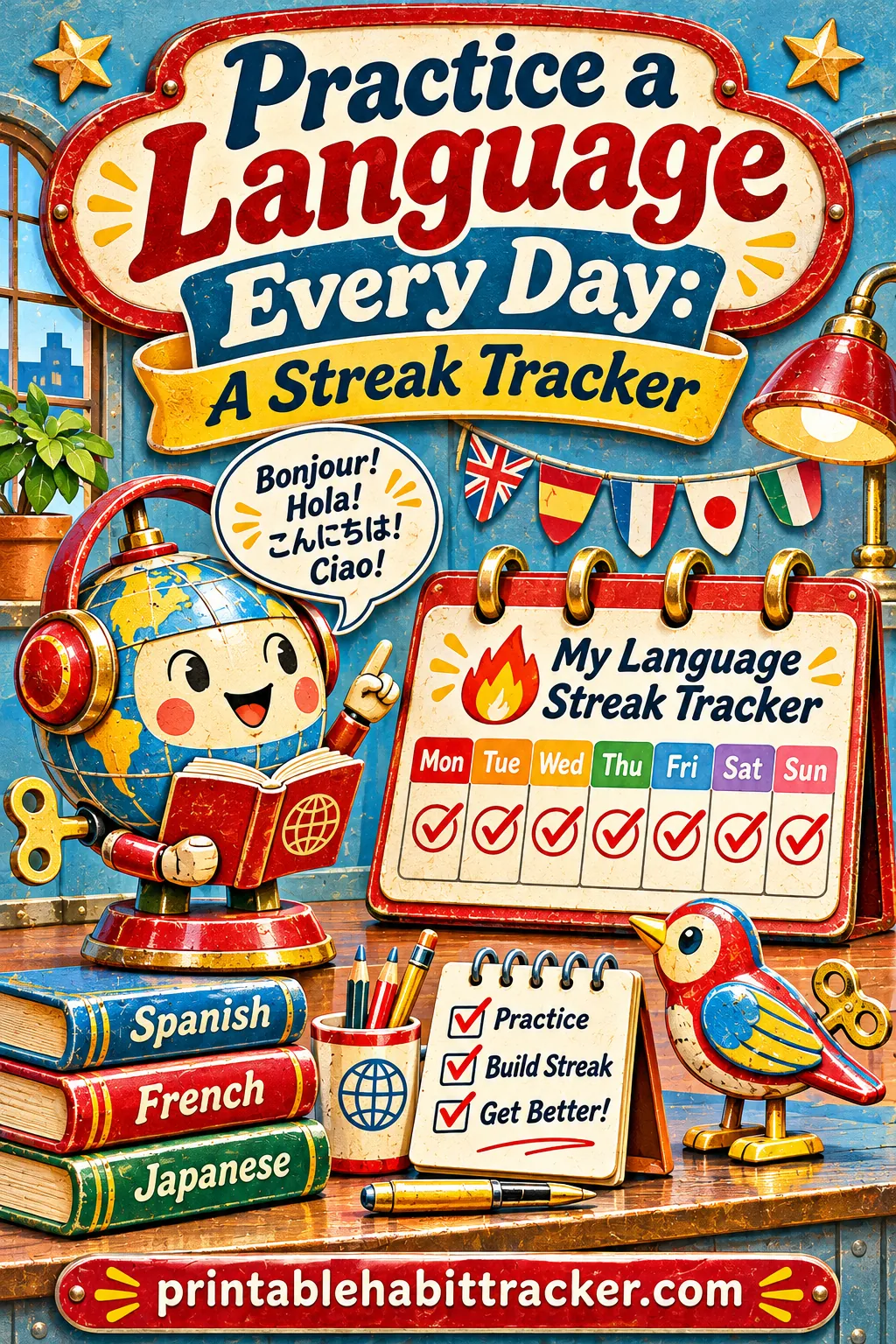
The easiest way to build a language learning habit is to shrink the daily goal to 10 minutes, tie it to something you already do, and color in one box on a paper streak tracker for the skill you practiced that day. Small sessions done daily beat long sessions done "when you have time." A tracker you can see on the fridge or your desk keeps the streak honest.
You can make that tracker in a couple of minutes with the free printable habit tracker maker on our homepage. If you'd rather skip the setup, you can build this exact tracker with six skill rows already filled in, then print it and start tonight.
This guide covers why daily practice falls apart, a 10-minute session plan by level, how to set up a skill-based streak tracker, what to do when you miss a day, and how to read your page at the end of the month.
✅ Try this tracker for one week
Tap a box each day you do the habit. Your ticks stay on this device.
Why Daily Language Practice Falls Apart
Most people don't quit a language because they lost interest. They quit because the habit was never built in the first place. The goal was "get fluent," the plan was "study a lot," and the schedule was "whenever."
Here are the patterns that show up again and again:
- The goal is too big to start. "Study Spanish for an hour" feels heavy at 9 p.m. after a long day, so it gets pushed to tomorrow, then the weekend, then next month.
- There's no fixed time. Without a cue, practice competes with every other thing you could be doing, and it usually loses.
- Only one skill gets practiced. Many learners do the same app lesson every day for months. The streak counter climbs, but they still can't hold a simple conversation, and that gap is discouraging.
- Progress is invisible. Languages improve slowly. You don't feel yourself getting better day to day, so it's easy to believe nothing is working.
- One missed day becomes a missed month. Once a streak breaks, a lot of people feel like they've failed and stop entirely.
A paper streak tracker helps with every one of these. It makes the daily goal small and concrete, it gives you a visible record of effort when progress feels slow, and it shows you at a glance which skills you're neglecting. And because it's on paper, a missed day is just one empty square, not a reset counter flashing zero at you.
What a Language Learning Habit Tracker Looks Like
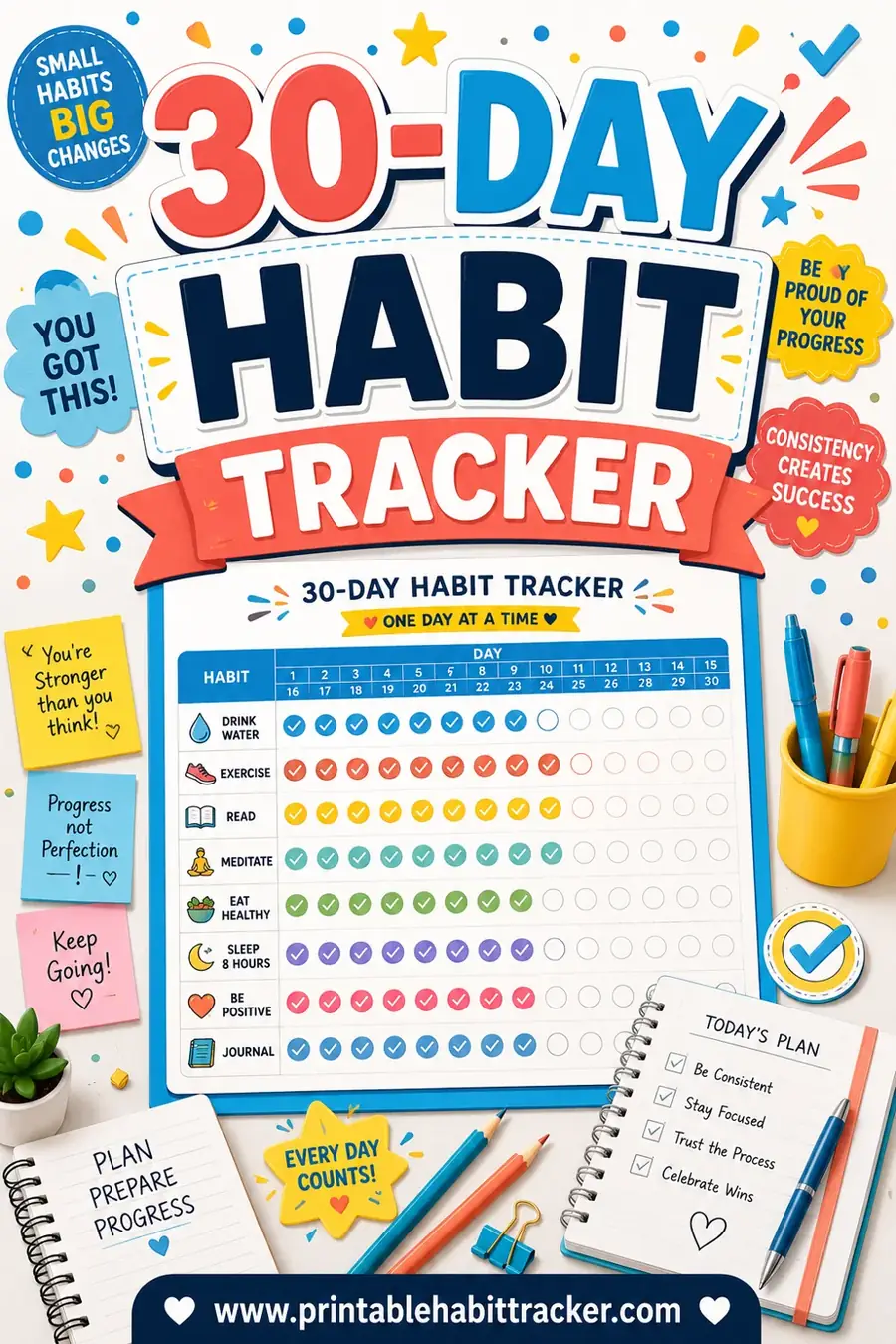
A general daily habit tracker has one row per habit and one column per day. A language tracker uses the same grid, but instead of separate habits, each row is a language skill. Every day you color in the box for the skill (or skills) you actually practiced.
That small change does a lot. Your page stops being a simple "did I study?" record and becomes a map of how balanced your practice is.
Here's the row setup that works for most learners:
| Row (skill) | What counts | Minimum to color it in |
|---|---|---|
| Listen 10 min | Podcast, show, music with lyrics, audio lessons | 10 minutes of focused listening |
| Say 5 sentences out loud | Shadowing, talking to yourself, reading aloud, a call | Five full sentences spoken |
| Review vocab cards | Flashcards, spaced review, a word notebook | One review session, any length |
| Read one short page | Graded reader, news for learners, a kids' book | One page or one short article |
| Write 3 lines | Journal, text message, notes about your day | Three sentences in the language |
| Learn 5 new words | New words from anything you met today | Five words written down |
At the bottom of the page, a streak row gets one box per day. You color it in on any day you practiced at least one skill. That's the line you're protecting.
Why color-in beats checkmarks for this
You can print the tracker with checkboxes, but color-in squares work especially well for language practice. Pick one color per skill (blue for listening, green for speaking, and so on) and after two weeks the page tells a story. A sheet that's almost all blue with no green tells you you've been listening but never speaking. You don't need to count anything to spot it.
The habit tracker color-coding ideas guide has more ways to use color on a tracker if you like this approach.
The 10-Minute Daily Session, by Level
Ten minutes is the sweet spot for building the habit. It's short enough that you can almost always find it, and long enough to feel like real practice. On good days you'll often keep going past 10 minutes, and that's great, but the commitment stays at 10.
Here's how to spend those 10 minutes depending on where you are.
| Level | Minutes 1–3 | Minutes 4–7 | Minutes 8–10 | Rows you'll usually color |
|---|---|---|---|---|
| Absolute beginner | Review yesterday's words | Listen to a slow beginner audio | Say 5 sentences out loud | Vocab, Listen, Speak |
| Beginner (a few months in) | Flashcard review | Read a short graded text | Write 3 lines about your day | Vocab, Read, Write |
| Lower intermediate | Listen to a short clip twice | Shadow the clip out loud | Note 5 new words | Listen, Speak, New words |
| Intermediate | Read a short news item for learners | Summarize it out loud | Write 3 lines with new words | Read, Speak, Write |
| Upper intermediate | Listen to native-speed audio | Talk to yourself about it for 3 minutes | Review tricky words | Listen, Speak, Vocab |
Notice that every plan includes some output, either speaking or writing. Input (listening and reading) feels easier and more comfortable, so it naturally takes over if you let it. Building one output skill into every session keeps your practice balanced without needing extra time.
The "two-minute floor" for hard days
Some days 10 minutes won't happen. A sick kid, a late shift, a travel day. For those days, set a two-minute floor: review five flashcards, or say three sentences out loud about what you did today. Color in that one row and the streak box.
This sounds almost too easy, and that's the point. The floor protects the habit on the days it's most likely to break. You'll come back to full sessions the next day without having to "restart."
How to Make It in the Free Tool
You can set this tracker up in the free tool on our homepage in about two minutes. Here are the exact settings.
- Open the free habit tracker maker.
- Title: type something specific, like "Daily Spanish Streak" or "Japanese, 10 Minutes a Day." Putting the language in the title makes the page feel like yours.
- Template chip: tap Study as a starting point. It's the closest built-in template. You'll replace its habits in the next step.
- Your habits (one per line): delete what's there and type your skill rows, one per line:
- Listen 10 min
- Say 5 sentences out loud
- Review vocab cards
- Read one short page
- Write 3 lines
- Learn 5 new words
- Layout: choose Monthly so you can see a full month of streak boxes on one page. If you like a fresh start every Sunday, choose Weekly instead. Advanced learners tracking a long goal can try Chain for a simple "don't break it" row.
- Month: pick the month you're starting. If you want to commit for longer, tick print all 12 months and keep the stack on a clipboard.
- Style: choose Color-in.
- Color theme: Ocean or Sage are easy on the eyes for a page you'll look at daily. Classic B&W prints cleanly if you plan to color with your own pens.
- Options: turn on Color-code habits (one color per skill), Streak boxes, and Notes/goals. Add Reward box if you like a small treat at the end of the month, and Reflection if you want a space for your monthly review.
- Paper: Letter or A4, then Landscape for monthly (more room for 31 columns) or Portrait for weekly.
- Print: tap 🖨️ Print / Save PDF.
Want to skip steps 2 through 9? Open this tracker pre-filled and just adjust the title and month.
Settings by goal
| Your goal | Layout | Style | Options to turn on |
|---|---|---|---|
| Just start and stay consistent | Monthly | Color-in | Streak boxes, Color-code habits |
| Prepare for a trip in 3 months | Monthly, print all 12 months (use 3) | Checkbox | Notes/goals, Reward box |
| Pass a class or exam | Weekly | Checkbox | Notes/goals, Reflection |
| Long-term, one year | Yearly | Color-in | Color-code habits, Reflection |
| Keep it ultra simple | Chain | Color-in | Streak boxes |
If you're learning alongside school, a broader study habit tracker can hold your language rows plus homework, reading and review for other classes.
Pick a cue: where your 10 minutes lives
The tracker shows if you practiced. A cue decides whether you practice at all. The most reliable way to make a habit automatic is to attach it to something you already do every day, a method often called habit stacking. The habit stacking explained guide covers it in depth, but here's how it looks for language learning.
Write your cue right on the tracker, in the Notes/goals box, as a short sentence: "After I pour my coffee, I listen for 10 minutes."
Cue ideas that work well for language practice:
- After pouring morning coffee or tea: flashcard review while it cools.
- During your commute: listening (audio only if you're driving).
- After brushing your teeth at night: say five sentences out loud about your day.
- During lunch: read one short page.
- While cooking dinner: listen to a podcast in your target language.
- After you put the kids to bed: write three lines in a notebook you keep by the couch.
- On a walk: shadow audio quietly or narrate what you see under your breath.
- Right after you open your laptop for work: five minutes of vocab before email.
Pick one main cue and one backup. If your morning coffee cue fails because you overslept, the backup (say, the evening teeth-brushing cue) catches the habit before the day ends.
Activity Ideas for Every Skill Row
One reason people get bored is doing the exact same thing every day. Your tracker has six rows, and each one has dozens of ways to fill it. Here's a ready-to-use list. Pick two or three favorites per row and rotate.
Listen
- A podcast made for learners at your level
- A short video with subtitles in the target language (not your native language)
- A song you like, listening for words you know
- The same 2-minute clip three times in a row, catching more each time
- Audio from your textbook or course
- A kids' show in the target language, which uses simple, clear speech
- Radio or news read slowly for learners
Speak
- Shadowing: play a short clip and repeat it right after the speaker, matching the rhythm
- Narrate what you're doing: "I'm washing the dishes. The water is hot."
- Read a page aloud
- Record yourself for one minute and listen back
- Describe a photo on your phone out loud
- Practice five phrases you'd need on a trip (ordering food, asking directions)
- A conversation with a tutor, exchange partner or friend
Vocab review
- A flashcard deck using spaced review
- A paper word notebook, covering one side and testing yourself
- Sticky notes on household objects
- Reviewing the words you wrote in yesterday's "Learn 5 new words" row
- Grouping words by theme (kitchen, weather, feelings) and quizzing the group
Read
- A graded reader, one page or one short chapter
- A children's picture book
- Learner news sites with simplified articles
- The back of a product package or a menu
- Your phone or one app set to the target language for the day
- Public-domain classics in the original language, once you're advanced (a single paragraph counts)
Write
- Three sentences about your day in a small journal
- A text message to a language partner
- A shopping list in the target language
- Rewrite a short paragraph you read, in your own words
- Three sentences using three new words from today
- A short note to your future self about why you're learning
Learn 5 new words
- Five words from whatever you listened to or read today
- Five words you needed but didn't know ("How do I say mailbox?")
- Five words on one theme
- Five verbs you use every day in your own language
Sample week using the list
| Day | Main activity | Rows colored |
|---|---|---|
| Monday | Flashcards + shadow a 2-minute clip | Vocab, Speak, Listen |
| Tuesday | Graded reader page + 5 new words | Read, New words |
| Wednesday | Podcast on the commute + narrate dinner prep | Listen, Speak |
| Thursday | Journal 3 lines + review Tuesday's words | Write, Vocab |
| Friday | Tutor or exchange call | Speak, Listen |
| Saturday | Kids' show with target-language subtitles | Listen, Read |
| Sunday | Two-minute floor: 5 flashcards, then weekly review | Vocab |
Every day gets a streak box. No single day covers everything, and that's fine. Over a week, every skill gets touched at least twice.
When You Miss a Day (and You Will)
Every learner misses days. The difference between people who keep going and people who quit isn't a perfect streak. It's what happens the day after a miss.
Use these three rules, and write them in small letters at the bottom of your tracker:
- Never miss twice. One empty box is a normal week. Two in a row is the start of drifting away. After a miss, the next day's session becomes your top priority, even if it's just the two-minute floor.
- Don't make up for it. You don't owe 20 minutes because you skipped yesterday. Doubling up makes the next session feel heavy, which makes another miss more likely. Just do today's 10.
- Don't start a new sheet. Leave the empty box where it is. A month with 26 colored boxes is a great month. Tearing up the page and "starting fresh" throws away the proof of all that work.
For more on bouncing back, the guide on what to do when you miss a day has a simple recovery plan that works for any habit.
Plan for the predictable misses
Some misses aren't random. Travel days, holidays, exam weeks at work and sick days come around every year. When you see one coming, decide ahead of time what the floor looks like that day and write it in the box lightly in pencil: "5 cards on the plane" or "1 song before bed." It turns a likely miss into a small, planned win.
Troubleshooting: common problems and fixes
If your tracker isn't working the way you hoped, look at the pattern on the page. It usually points straight to the fix.
| What your page shows | What's probably happening | Try this |
|---|---|---|
| Lots of empty days early in the week | Weekday mornings are too rushed | Move your cue to lunch or evening |
| Weekends are empty | Your cue only exists on workdays | Add a weekend cue, like after breakfast |
| Only the Listen row is colored | Input feels comfortable, output feels awkward | Make "Say 5 sentences" the first thing every session |
| Vocab row is full, everything else is thin | Flashcards became the whole habit | Cap vocab at 3 minutes, then switch skills |
| Streak is strong but you feel stuck | Same activity every day | Rotate activities from the idea list each week |
| You fill in boxes days later from memory | Tracker is out of sight | Move it next to where you practice, with a pen clipped on |
| You stopped after a bad week | Expectations were too high | Drop to the two-minute floor for a week, then rebuild |
| You dread opening the page | Too many rows or too long a session | Cut to three rows and a 5-minute session |
The tracker isn't a report card. It's information. Every pattern on it is a clue about how to make tomorrow easier.
Reading Your Page at the End of the Month
At the end of each month, set aside 10 minutes with your filled-in page. If you turned on the Reflection option, you've got space to write your answers right on the sheet.
Ask yourself:
- How many streak boxes did I color? Write the number. Next month, aim to match it or beat it by one or two, not by ten.
- Which skill row is fullest? Which is emptiest? The emptiest row is next month's focus.
- Which days of the week are most often blank? That's where your cue needs work.
- What did I do that I actually enjoyed? Do more of it. Enjoyment is what keeps a habit alive for years.
- What can I do now that I couldn't do a month ago? Maybe you understood a whole song, ordered food in your head, or wrote a paragraph without looking anything up. Write it down. This is the progress you can't feel day to day.
That last question matters most. Language progress is slow and quiet. A written note each month like "understood most of a kids' episode without subtitles" builds a record you can look back on when motivation dips.
A simple monthly score line
Some learners like one line to compare months. Try this at the bottom of the Reflection box:
Streak days / 30 — Fullest row — Emptiest row — One new thing I can do
For example: "24 / 30 — Listen — Write — Can introduce myself and my job without notes."
Variations: Kids, Families, Multiple Languages
The same tracker adapts to a lot of situations. Here's how to adjust it.
For kids learning a second language
Kids do better with fewer rows and a visible reward. Use three rows, keep sessions to 5 to 10 minutes, and turn on the Reward box option. Rows that work well for kids:
- Listen to a song
- Say 3 words out loud
- Read or look at a picture book
- Play a word game
Choose the Color-in style and let them pick the color theme. A sticker in the box works just as well as coloring.
For families learning together
If the whole family is learning the same language, print one copy per person, or make one shared page where each row is a person instead of a skill (Mom, Dad, Sam, Ava). Color a box when that person practiced. A family dinner where everyone uses five words in the target language can count for the whole table.
For heritage speakers reconnecting with a language
If you grew up hearing a language but don't speak it with confidence, your rows will look different. You may already understand a lot, so lean on output:
- Talk to a relative for 5 minutes
- Say 5 sentences out loud
- Write 3 lines
- Read one short page
- Learn 5 new words
For learning two languages at once
Keep it simple: one tracker per language, each with only three rows. Or use one page with alternating rows, like "Spanish: listen" and "Italian: listen." Color-coding each language helps a lot here. If your streak keeps breaking, it's usually a sign to put one language on a lighter maintenance plan (two short sessions a week) while you focus on the other.
For exam or class learners
Add rows that match what you're graded on: "Grammar exercise," "Practice test section," "Listening comprehension." Use the Weekly layout so each week lines up with your class schedule, and use the Notes/goals box for upcoming test dates.
Using an app and a paper tracker together
Plenty of learners use a language app every day. That's a great habit. The trouble is that app lessons usually cover only part of what you need, and an app's own streak counter only tells you if you opened the app.
A paper tracker sits alongside your app and fills the gaps. You can do it two ways:
- Count the app as one row. Add "App lesson" as a row, and keep the other rows for skills the app covers less, like speaking freely or writing your own sentences.
- Use the app as your "floor." On busy days, one app lesson counts as your two-minute minimum. On normal days, it's the warm-up before your real 10 minutes.
Either way, the paper page shows you the full picture of your practice, not just one tool's slice of it.
Your Next Step
Pick your cue, print your page, and do the first 10 minutes today. Don't wait for Monday or the first of the month. A tracker started on the 17th still has two weeks of boxes to fill.
Build this exact tracker with the six skill rows ready to go, change the title to your language, and tap Print. Then put it somewhere you'll see it every day, with a pen right next to it.
Frequently Asked Questions
How many minutes a day do I need to learn a language?
There isn't a magic number, and it depends on your goals and the language. For building a language learning habit, 10 minutes a day is a strong, sustainable start. Many learners do more on good days, but keeping the commitment small is what makes it last.
Is it better to study once a week for an hour or every day for 10 minutes?
For building the habit, daily short sessions usually work better. Frequent contact keeps words and sounds fresh, and a small daily goal is much harder to skip than a long weekly one. If you have both options, do both: 10 minutes daily plus a longer weekly session.
What should I track on a language practice tracker?
Track which skill you practiced each day: listening, speaking, vocab review, reading, writing and new words. Add a streak row that you color in on any day you practiced at all. That combination shows both consistency and balance.
Does an app lesson count toward my streak?
Yes. If you did an app lesson, color in the streak box and the row it covered. Just watch your page over a few weeks. If the app is the only thing you're doing, add one speaking or writing activity to round out your practice.
What if I miss a day of my language streak?
Leave the box empty and practice the next day. Try not to miss two days in a row, and don't double up to make up for it. A month with a few gaps is still a very good month of practice.
How do I practice speaking if I don't have anyone to talk to?
Talk to yourself. Narrate what you're doing, shadow short audio clips, read a page aloud, or record a one-minute voice memo and listen back. These all count for your speaking row and build confidence before real conversations.
Should I use a monthly or weekly layout?
Monthly works well for most people because you can see the whole streak on one page. Weekly is a good choice if you like a fresh start each Sunday or you're learning for a class with a weekly schedule. You can switch anytime in the free tool.
Can I use this tracker for any language?
Yes. The skill rows work the same for Spanish, French, Japanese, Korean, Arabic, sign languages or anything else. For a sign language, change "Say 5 sentences out loud" to "Sign 5 sentences" and "Listen" to "Watch a signed video."
How long before daily language practice feels automatic?
It varies from person to person and depends on how consistent your cue is. Many people notice it starts feeling more natural after a few weeks of steady practice. Keep the session small and the cue fixed, and let the tracker carry you through the weeks when it still takes effort.