Perimenopause Energy and Symptom Habit Tracker
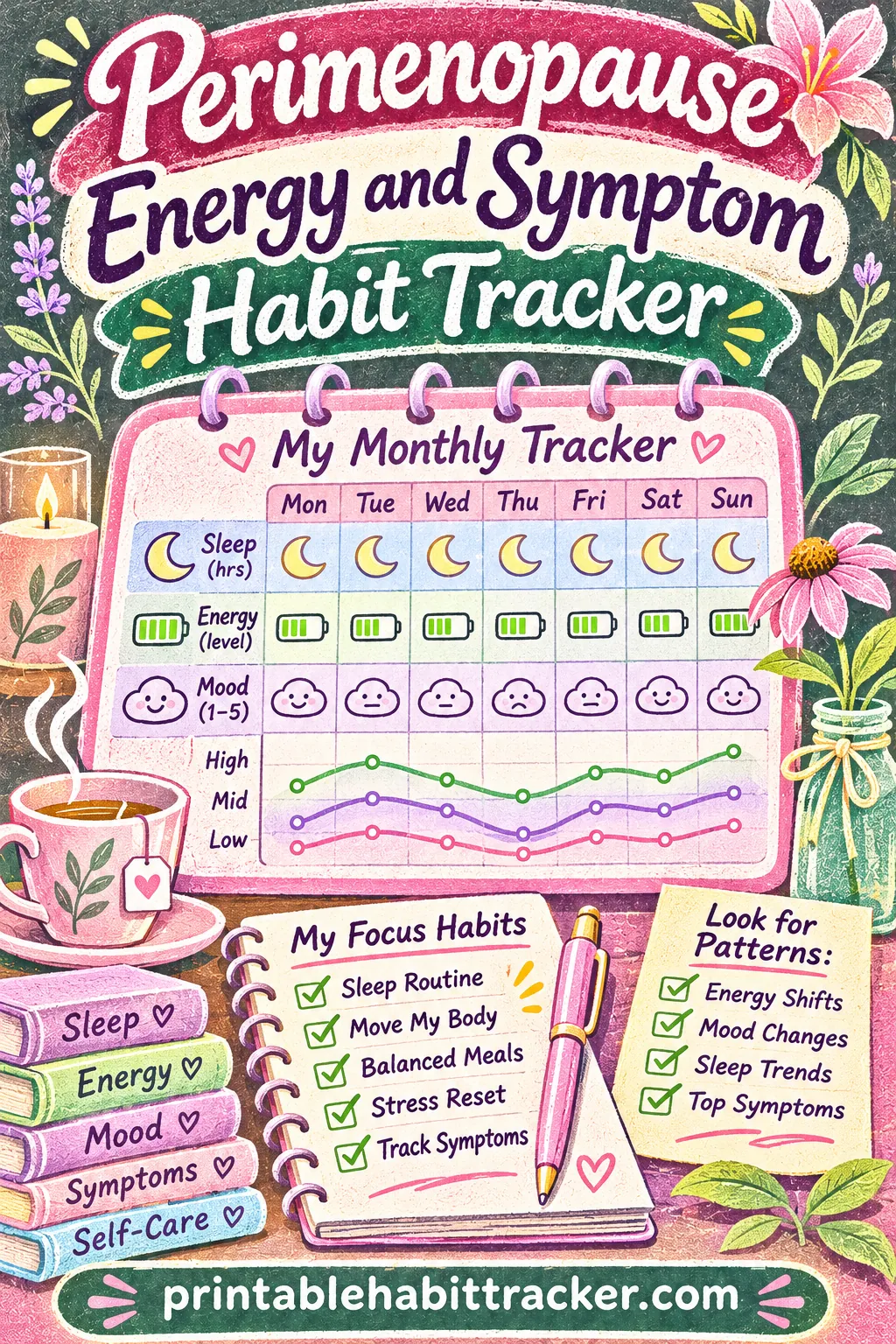
The simplest perimenopause tracker is one monthly page where your sleep, energy, mood and symptoms sit in rows right next to the daily habits you suspect affect them. When everything shares the same date columns, patterns jump out: the rough-sleep nights before a low-energy day, or the week your hot flashes eased after you moved caffeine earlier. You don't need an app or a spreadsheet, just a grid and a pen.
You can make this tracker in our free printable habit tracker maker. Build this exact tracker and it opens with seven rows, a monthly layout and a color-in style already set, so you can print it and start tonight.
Below you'll find which rows to track (with ready-to-use lists), a simple scoring system for energy and mood, the exact tool settings, how to read your month for patterns, a sample filled-in week, and how to turn your sheet into clear notes for your next doctor's visit.
An important note: this tracker is for noticing patterns in your own day. It doesn't diagnose anything and it isn't medical advice. Perimenopause symptoms overlap with many other conditions, so please talk to your doctor about any symptom that worries you, and follow their guidance on sleep, exercise, supplements, medication or treatment. Your tracker can make that conversation easier, but it doesn't replace it.
Why Track Perimenopause Symptoms Next to Your Habits
Perimenopause is the transition time before menopause, and for many people it brings changes that come and go: sleep that's lighter or more broken, energy that dips without warning, moods that feel less predictable, hot flashes or night sweats, and cycles that change in length. Every person's experience is different, and it can last for a while.
The tricky part is that these changes often feel random. One week you sleep fine and have plenty of energy. The next you're waking at 3 a.m. and dragging through the afternoon. When you're just trying to get through the day, it's hard to remember what was different.
A tracker helps because it holds the memory for you. When you write down a few simple things each day, you build a record you can look back at. After a month, you may start to see links that weren't obvious before. Maybe your energy is lowest the day after a poor night's sleep. Maybe your night sweats seem worse after late evening screen time or a warm bedroom. Maybe your mood is steadier in weeks when you walk most days.
These are personal patterns, not rules. What you find on your sheet applies to you, and it may change over time. But personal patterns are exactly what's useful. They help you decide which habits are worth keeping, and they give you concrete examples to share with your doctor.
Why one page beats separate logs
Many people try to track symptoms in one place, sleep in an app, and habits somewhere else. Then, when they want to compare, the information is scattered. A single monthly grid puts everything on the same day column. You can run your finger down Tuesday and see: slept 5 hours, energy 2, two hot flashes, no walk, coffee at 3 p.m. That's the whole picture in one glance.
If you're new to monthly grids, our monthly habit tracker page shows different ways to set up a one-month sheet.
What to Track: Symptoms, Signals and Habits
A useful perimenopause tracker has two kinds of rows. Signal rows record how you are: sleep, energy, mood and symptoms. Habit rows record what you did: movement, caffeine timing, wind-down routine and so on. Keep both kinds short. Seven or eight rows in total is plenty for a monthly page.
Signal rows (how you are)
Pick three to five of these:
- Slept 7+ hours (or your own sleep goal)
- Slept through the night
- Energy 1-5 in the box
- Mood noted
- Hot flashes or night sweats
- Headache today
- Brain fog today
- Joint aches today
- Felt anxious or on edge
- Period or spotting
Choose the ones that matter most to you right now. If hot flashes aren't an issue, leave that row off. If brain fog is your main frustration, put it near the top.
Habit rows (what you did)
Pick two to four of these:
- Moved my body
- Walked 20 minutes
- Strength or stretch session
- Caffeine before noon only
- Wind-down by 10 pm
- Screens off before bed
- Water with every meal
- Ate breakfast
- Time outside in daylight
- Cool bedroom at night
- Took my meds as prescribed
- Five minutes of quiet breathing
A gentle reminder: only add habits that fit your life and your doctor's guidance. If your doctor has suggested specific changes, those are the ones to track. Don't add supplements or diets just because you read about them online.
The starter set
If you'd like a ready-made sheet, these seven rows are a balanced place to start. They're the same rows that open with the preset link.
| Row | Type | What to write or color |
|---|---|---|
| Slept 7+ hours | Signal | Color the box if you got your sleep goal, leave blank if not |
| Energy 1-5 in the box | Signal | Write a number from 1 (empty) to 5 (great) |
| Mood noted | Signal | Write a quick letter or symbol (see the scoring section) |
| Hot flashes or night sweats | Signal | Write the number of episodes, or color if any happened |
| Moved my body | Habit | Color if you walked, stretched or exercised at all |
| Caffeine before noon only | Habit | Color if your last caffeine was before noon |
| Wind-down by 10 pm | Habit | Color if you started winding down by your target time |
You can change the sleep goal, the caffeine cutoff and the wind-down time to fit you. The point is to choose a clear "yes or no" line so the box is easy to fill in.
A Simple Scoring System for Energy, Mood and Symptoms
Checkboxes are great for habits, but energy and mood aren't yes-or-no. A tiny scoring system lets you capture more detail without turning your tracker into a diary. Keep it simple enough that you can fill it in half-asleep.
Energy: a 1 to 5 scale
Write one number in the box each evening, based on how your energy felt for most of the day:
| Score | What it means | Example |
|---|---|---|
| 1 | Running on empty | Hard to get through basic tasks, needed to lie down |
| 2 | Low | Got through the day, but everything felt like effort |
| 3 | Okay | Steady enough, a dip or two |
| 4 | Good | Energy for the day plus a little extra |
| 5 | Great | Felt strong and clear most of the day |
Don't overthink it. The first number that comes to mind is usually right. What matters is using the same scale every day so the numbers can be compared.
Mood: letters or simple symbols
For mood, a letter or symbol works well in a small box:
- C for calm or content
- L for low or flat
- I for irritable or short-tempered
- A for anxious or on edge
- M for mixed, up and down
If you prefer, turn on the Mood row option in the tool, which adds a dedicated row for this. Some people like to draw a tiny face instead: a smile, a straight line or a frown. Use whatever you'll actually keep doing.
Symptoms: count, color or skip
For symptoms like hot flashes, night sweats, headaches or brain fog, you have three choices:
- Count. Write the number of episodes in the box (for example, "3" for three hot flashes). This is the most detailed option.
- Color. Color the box if the symptom showed up at all that day. This is quickest.
- Shade. Color lightly for mild days and fully for strong days. This sits in between.
Pick one method per row and stick with it for the whole month. Mixing methods makes your sheet harder to read later.
Color-in tips for a quick visual
The preset uses the Color-in style, which turns your month into a picture. A few ideas:
- Use one color for signal rows and another for habit rows, so you can see at a glance which is which. The Color-code habits option does this for you.
- For energy, try lightly shading the box behind your number: dark for 4 and 5, light for 3, blank for 1 and 2. Low-energy stretches then stand out as pale gaps.
- Keep a single pen color for symptoms, so they're easy to spot when you scan across the month.
Our guide to habit tracker color-coding ideas has more systems you can borrow.
How to Make It in the Free Tool
Setting this up takes a couple of minutes. If you used the preset link above, the title, rows, layout and style are already filled in. Otherwise, open the free printable habit tracker maker and use these settings.
Exact settings
| Setting | Choose | Why |
|---|---|---|
| Title | Perimenopause Energy Tracker (or your own name for it) | Clear, private-sounding title |
| Template chips | Optional: start from Mood Tracker or Sleep, then replace the rows | Gives you a head start, but you'll edit the habits |
| Your habits (one per line) | Your 6 to 8 rows, signals first, then habits | Keeping signals on top makes patterns easier to read |
| Layout | Monthly | One page holds the whole month in date columns |
| Month | The month you're starting | Dates line up with your calendar |
| Style | Color-in | Turns the month into a visual pattern |
| Color theme | Sage, Ocean or Classic B&W | Calm colors; B&W saves ink |
| Options | Color-code habits, Mood row, Notes/goals, Reflection | Separates row types, adds mood and space for notes |
| Paper | Letter or A4 | Whatever your printer uses |
| Orientation | Landscape | Gives each day's box more width for numbers |
Press 🖨️ Print / Save PDF when it looks right. If you want to plan ahead, choose to print all 12 months at once and keep them in a folder or binder.
Which options to turn on, and why
- Color-code habits. Gives each row its own color. Handy for telling signal rows apart from habit rows.
- Mood row. Adds a dedicated row for mood, so you don't have to type it in as a habit.
- Notes/goals. Space at the top or bottom for your scoring key (energy 1 to 5, mood letters) and your current goals.
- Reflection. A box for your end-of-month review. You'll use this in the pattern-reading step below.
- Streak boxes and Reward box. Optional. Useful if you want to build a habit like daily walks, but they don't add much for symptom rows.
Landscape or portrait?
Landscape gives you wider day boxes, which helps if you're writing numbers or letters. Portrait works if you only color boxes in and want the sheet to fit a binder or clipboard. Try one month of each if you're not sure.
Write your key on the page
Before you start, write your scoring key in the Notes area: "Energy 1 = empty, 5 = great. Mood: C calm, L low, I irritable, A anxious, M mixed. Hot flashes: write count." When you look back in three months, you'll know exactly what each mark meant.
Your Two-Minute Daily Check-In
The tracker only works if filling it in is easy. Aim for two minutes, once a day, at the same time.
When to fill it in
Most people do best with an evening check-in, just before or after they start winding down. By then you know how your energy and mood were for the day, and you can still remember whether you had caffeine after noon. Sleep from the night before can be filled in first thing in the morning, or added in the evening for the previous night.
If evenings are hectic, try two quick moments instead: sleep in the morning with your first drink, everything else at bedtime.
What to fill in, in order
- Sleep. Did you hit your sleep goal last night? Color or leave blank. Note night sweats if they woke you.
- Energy. Write your 1 to 5 number for today.
- Mood. Write your letter or draw your face.
- Symptoms. Count, color or shade each symptom row.
- Habits. Color each habit you did.
- One-line note (optional). Anything unusual: a stressful day, travel, a late dinner, illness, a big event.
That one-line note is surprisingly useful. When you look back and see a run of low-energy days, a note like "work deadline" or "had a cold" can explain it.
Keep the sheet where you'll see it
Put the tracker somewhere you pass every evening: on the nightstand, inside the bathroom cabinet door, on the fridge or in a planner you already use. Clip a pen to it. If it's tucked away, it's easy to forget for a week.
Missed a few days?
Leave those boxes blank and carry on. Don't try to fill in a week from memory, because guesses can blur the patterns you're looking for. A blank stretch is honest data, too.
A Sample Filled-In Week
Here's what one made-up week might look like on the sheet. It's only an example to show how the rows work together, not a typical or "normal" week. Your numbers will look different.
| Row | Mon | Tue | Wed | Thu | Fri | Sat | Sun |
|---|---|---|---|---|---|---|---|
| Slept 7+ hours | yes | no | no | yes | yes | no | yes |
| Energy 1-5 | 4 | 2 | 2 | 3 | 4 | 2 | 4 |
| Mood | C | I | L | C | C | A | C |
| Hot flashes or night sweats | 1 | 3 | 4 | 1 | 1 | 3 | 0 |
| Moved my body | yes | no | no | yes | yes | no | yes |
| Caffeine before noon only | yes | no | no | yes | yes | no | yes |
| Wind-down by 10 pm | yes | no | yes | yes | yes | no | yes |
| Note | late meeting | party, late night |
What this example week might suggest
Looking down the columns, a few things stand out:
- The low-energy days (Tuesday, Wednesday, Saturday) follow nights that missed the sleep goal.
- Those same days also had afternoon caffeine and, on two of them, no wind-down routine.
- Mood was calm on the days with better sleep and lower energy dips.
- The hot flash count was higher on the days with poor sleep and late caffeine.
One week isn't enough to draw conclusions. These rows could be connected, or something else could be going on, such as a stressful meeting. That's why you track for at least a full month, and ideally two or three, before you look for real patterns. But even one week shows how the grid makes links easy to spot.
How to Read Your Month for Patterns
At the end of each month, set aside fifteen minutes with your sheet and a pen. You're not judging yourself. You're looking for clues.
Step 1: Find your best and worst days
Circle every day with an energy score of 4 or 5. Then underline every day with a 1 or 2. Now look at the other rows on those days. What do the good days have in common? What about the hard ones?
Step 2: Look at the day before
Many links show up with a one-day delay. A poor night's sleep may show up as low energy the next afternoon. A late caffeine day may show up as broken sleep that night. Compare each low-energy day with the row values from the previous day.
Step 3: Compare habit days with no-habit days
Count your energy scores on days you colored "Moved my body" and on days you didn't. Do the same for "Wind-down by 10 pm" and "Caffeine before noon only." You don't need fancy math. Just notice whether one group tends to have higher numbers.
Step 4: Check your notes
Read your one-line notes. Stressful events, travel, illness and big social nights can explain a rough stretch that otherwise looks random.
Step 5: Write two sentences in the Reflection box
Sum up what you saw and what you'll try next month. For example: "Energy was usually better on walking days. Next month I'll try a short walk on four days a week and see if it holds." Then make one small change and keep tracking.
Our guide on how to review your habits monthly has a longer checklist if you'd like more structure.
Questions to ask yourself at month's end
- Which row has the most colored boxes? Which has the fewest?
- Did my sleep goal days line up with better energy or mood?
- Do my symptoms cluster in certain weeks?
- Is there a habit I'm doing that doesn't seem to change anything?
- Is there a symptom I want to ask my doctor about?
- What one change will I try next month?
Patterns to look for (and what to do with them)
| What you notice | What it might mean for you | A gentle next step |
|---|---|---|
| Low energy after short-sleep nights | Sleep is a big driver of your day | Focus on one wind-down habit; track it for a month |
| More night sweats after warm evenings or late meals | Evening habits may play a part | Try a cooler bedroom or earlier dinner, and ask your doctor about it |
| Steadier mood on movement days | Movement may help your mood | Keep the habit; choose a type of movement you enjoy |
| Symptoms cluster in certain weeks | They may follow your cycle | Add a period row and compare over several months |
| No clear pattern at all | You need more data, or other factors are involved | Keep tracking another month; bring the sheet to your doctor |
| A symptom is getting worse or new | It needs attention | Contact your doctor, and bring your tracker |
Treat these as ideas to explore, not conclusions. Your body is the expert, and your doctor helps you interpret it.
Turning Your Tracker Into Notes for Your Doctor
One of the most practical uses for a perimenopause tracker is preparing for an appointment. Doctor visits are often short, and it's easy to forget details or say "I just feel tired" when you actually have a month of useful information.
What to bring
- Your last two or three monthly sheets
- A short summary written on a separate card or in the Notes area
- A list of any medications or supplements you take
- Your questions, written down
A simple summary template
Write a few lines like these, filling in from your sheets:
- Sleep: "Met my sleep goal on about half the nights. Woke from night sweats on most poor-sleep nights."
- Energy: "Scores of 1 or 2 on several days each month, usually after poor sleep."
- Mood: "Irritable or anxious more often than I'm used to, especially in the week before my period."
- Symptoms: "Hot flashes most days, more on hot days and after late meals."
- Cycle: "Period dates over the last three months were..." (copy from your sheet or a separate log)
- What I've tried: "Earlier caffeine cutoff and a wind-down routine for two months."
Keep your summary factual. Don't worry about using medical terms. Describing what happened in your own words is exactly what's helpful.
Questions you might ask
- Could these symptoms be related to perimenopause, or should we check for anything else?
- Which of these changes should I be most concerned about?
- Are there habits you'd suggest I try or track?
- Is there anything I should stop tracking because it isn't useful?
- When should I come back, and what should I watch for in the meantime?
Tracking your cycle alongside symptoms
Cycle changes are often part of perimenopause, and many people find it helpful to see their cycle next to their symptoms. You can add a "Period or spotting" row to your monthly sheet, or keep a dedicated cycle log. Our printable period tracker gives you a separate page for cycle dates if you'd rather keep this tracker focused on energy and habits.
Variations: Sleep-First, Minimal and Yearly Trackers
The starter set fits most people, but you can reshape it to match what bothers you most.
Sleep-first version
If broken sleep is your biggest issue, give it more rows:
- Slept 7+ hours
- Slept through the night
- Woke from night sweats
- Wind-down by 10 pm
- Screens off before bed
- Cool bedroom at night
- Energy 1-5 in the box
Use the Daily layout instead of Monthly if you want bigger boxes, or keep Monthly for the overview. Our sleep tracker page has more layouts built just for sleep.
Minimal version
On busy months, three rows can be enough:
- Energy 1-5 in the box
- Slept 7+ hours
- One symptom (your main one)
A short tracker you keep up is far more useful than a long one you abandon after a week.
Yearly overview
Once you've tracked for a few months, try a Yearly layout with just one or two rows, such as energy and your main symptom. Each day becomes a single small box, and a full year shows long-term trends: better and harder seasons, and how things change across the transition. Keep your monthly sheets for detail and the yearly page for the big picture.
Troubleshooting common snags
| Snag | Fix |
|---|---|
| I forget to fill it in | Tie it to something you do every night, like brushing your teeth, and keep the sheet next to it |
| My boxes are too small for numbers | Switch to Landscape, cut rows to six or fewer, or use the Daily layout |
| Tracking symptoms makes me focus on them too much | Trim to two signal rows and add more habit rows you enjoy |
| My energy score feels the same every day | Use half points (2.5), or add a short note for context |
| I feel discouraged by a rough month | Look at the habits you kept, not just the symptoms, and talk to someone you trust |
| I'm not sure a symptom is related | Don't guess; write it down and ask your doctor |
Ready to start?
Choose your rows, write your scoring key in the Notes area and print your first month. Build this exact tracker to open the seven-row starter set, then edit it to match your own sleep, energy and symptoms.
Frequently Asked Questions
What should I track in a perimenopause tracker?
Start with a few signal rows, like sleep, energy, mood and your main symptom, plus two or three habit rows you suspect affect them, such as movement, caffeine timing or a wind-down routine. Seven or eight rows on a monthly page is usually plenty. Add or drop rows as you learn what matters to you.
How long should I track before I look for patterns?
Give it at least a full month before drawing any conclusions, and two or three months if you can. Some patterns, like symptoms that follow your cycle, only show up over several months. One week can hint at links, but it's too short to rely on.
Can a habit tracker tell me if I'm in perimenopause?
No. A tracker records what you notice, but it can't diagnose anything. Many perimenopause symptoms overlap with other conditions, so talk to your doctor about what you're experiencing. Your tracker gives them clear, day-by-day information to work with.
Is a paper tracker better than an app for symptoms?
It depends on what you'll keep using. Paper puts sleep, energy, symptoms and habits on one page where you can see the whole month at once, and it's easy to bring to an appointment. If you already use an app you like, you can use this layout as a monthly summary sheet alongside it.
How do I track hot flashes on a printable sheet?
Write the number of hot flashes or night sweats in each day's box, or simply color the box if any happened. If you want more detail, shade lightly for mild days and fully for strong ones. Use the same method all month so your sheet is easy to compare.
Should I track my period on the same sheet?
You can add a "Period or spotting" row so you see your cycle next to your energy and symptoms. That's helpful for spotting symptoms that cluster in certain weeks. If your sheet is getting crowded, keep a separate period log and compare the two at month's end.
What if tracking my symptoms makes me feel worse?
Some people find that focusing on symptoms every day adds stress. If that's you, cut back to two signal rows and add habit rows that feel good to color, like time outside or something you enjoy. If your mood is low or anxious most days, please talk to your doctor.
Can I share my tracker with my doctor?
Yes. Bring your last two or three monthly sheets along with a short written summary and your questions. Doctors often find specific dates and patterns more useful than a general description, and it helps you remember everything you wanted to mention.