Pet Care Chart: Who Fed the Dog?
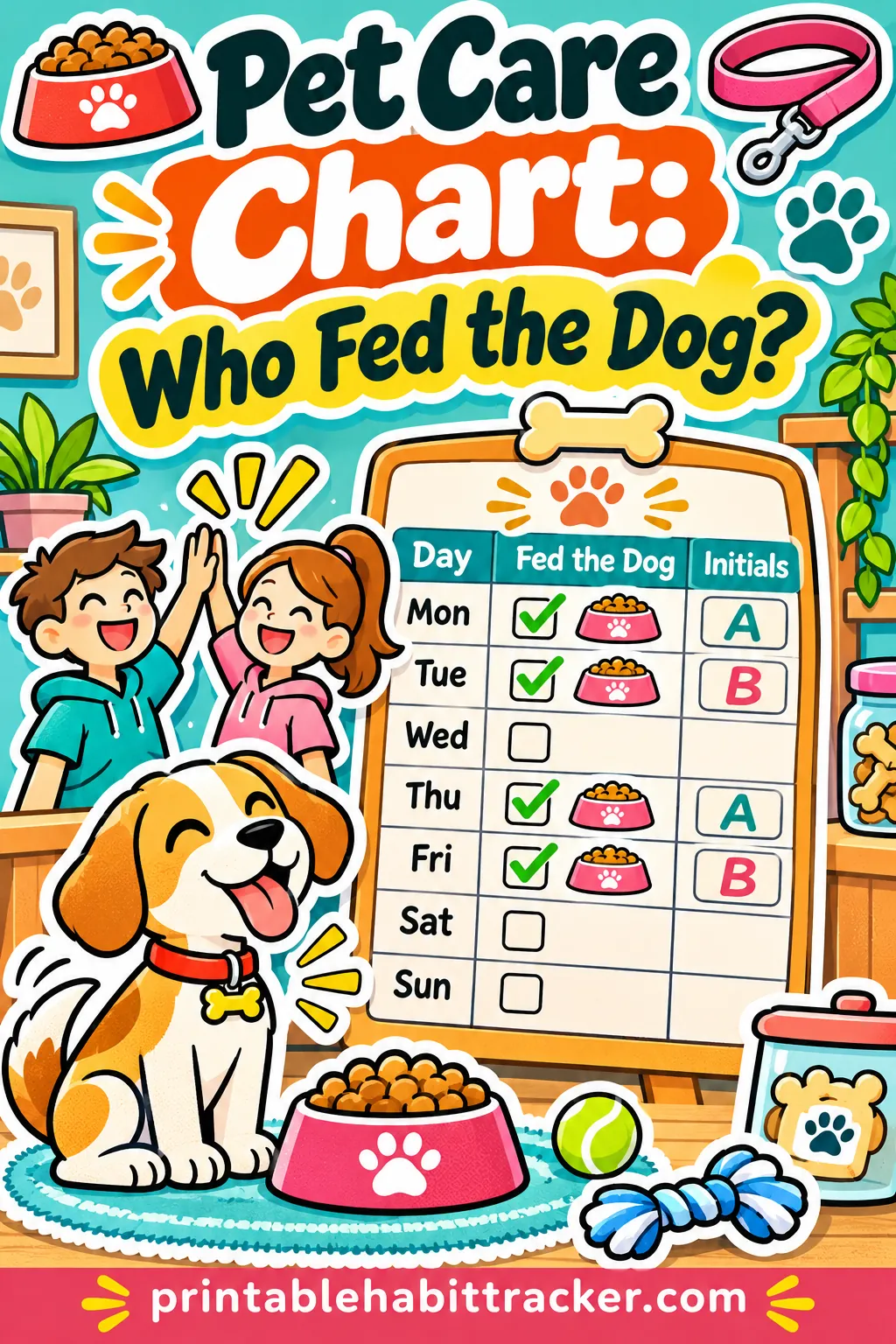
The fix for "Did anyone feed the dog?" is a pet care chart posted next to the food bin, with one box per feeding, walk and dose, where whoever does the job writes their initials the moment it's done. Nobody has to remember or guess. One glance shows what's done, who did it and what's still waiting.
You can print one free in about two minutes with the printable habit tracker maker on this site. Below you'll find ready-to-use task lists for dogs, cats and small pets, exact tool settings, a fair way to split jobs among family members, sample weeks and fixes for the usual hiccups.
✅ Try this tracker for one week
Tap a box each day you do the habit. Your ticks stay on this device.
Why "Who Fed the Dog?" Keeps Happening
In most busy homes, pet care slips through the cracks in one of two ways.
The double feeding. You fill the bowl at 7 a.m. Your partner gets up at 7:30, sees the dog sitting by the bowl looking hopeful (dogs are excellent actors), and fills it again. By lunchtime, your dog has eaten twice its breakfast, and you only find out when someone mentions it on Thursday.
The nobody feeding. Everybody assumes someone else did it. The kids think a parent fed the cat. The parent thinks the kid who promised to do it this week did it. The cat, who has strong opinions, eventually lets you know at full volume.
The same thing happens with walks, fresh water, litter boxes and especially medications, where a missed or doubled dose matters more than an extra scoop of kibble.
The root problem isn't laziness. It's that pet care is made of small, repeated jobs done by different people at different times, and memory is a terrible shared record. A chart solves that by moving the record out of anyone's head and onto a piece of paper that everyone can see.
Why initials work better than checkmarks
A plain checkmark tells you a job is done. Initials tell you who did it. That small difference fixes a lot:
- No more guessing. If the box has "MJ" in it, you know Maya fed the dog and you can ask her if anything seemed off.
- Built-in fairness. At the end of the week, you can count who did what. If one person's initials fill half the chart, it's time to rebalance.
- Gentle accountability. Kids especially like seeing their initials pile up. It's a visible record of being responsible.
- A useful history for the vet. If your pet gets sick, the chart shows when they last ate, when they went out and when meds were given.
What to Put on a Pet Care Chart
Every pet is different, so start with the jobs your animal actually needs. Here are complete lists you can copy, trimmed to fit a printable row.
Dog care chart: daily tasks
| Task | How often | Notes |
|---|---|---|
| Breakfast fed | Daily, morning | Write the amount on the chart if your vet gave you a portion |
| Dinner fed | Daily, evening | Same portion each time unless the vet says otherwise |
| Fresh water | Daily, plus refills | Wash the bowl every day or two |
| Morning walk or potty break | Daily | Note if anything seemed unusual |
| Midday potty break | As needed | Helpful for puppies and older dogs |
| Evening walk | Daily | Include a poop check |
| Meds or supplements | As prescribed | Follow your vet's exact instructions |
| Yard poop scoop | Daily or every few days | Easy to forget, so give it a box |
| Brushing | A few times a week | More for long-haired dogs |
| Play or training time | Daily | Ten minutes counts |
Dog care chart: weekly and monthly tasks
- Wash food and water bowls thoroughly
- Wash bedding
- Check and trim nails (or note when the groomer does it)
- Brush teeth with a pet toothbrush
- Check ears and paws
- Give monthly preventive treatments as your vet recommends
- Restock food and treats before they run out
- Clean the car seat cover or crate
Cat care checklist
Cats are quieter about their needs, which makes a chart even more useful. A cat care checklist might include:
| Task | How often |
|---|---|
| Breakfast | Daily |
| Dinner | Daily |
| Fresh water or fountain check | Daily |
| Scoop litter box | Daily, or as often as your vet suggests |
| Full litter change | Weekly or every couple of weeks |
| Brush | A few times a week |
| Play session | Daily |
| Meds | As prescribed |
| Wipe up food area | Daily |
Many households with cats find the litter box is the job that slides first. Give it its own row so everyone can see when it was last scooped.
Small pets, fish and birds
Smaller animals have their own routines. Pick the ones that apply:
- Rabbits and guinea pigs: fresh hay, pellets, fresh greens, water bottle check, spot-clean the cage, full cage clean, floor time.
- Hamsters and gerbils: food, water, spot-clean, bedding change, handling time.
- Fish: feed (small amounts), check the filter and temperature, partial water change on the schedule your tank needs.
- Birds: fresh food and water, cage paper change, out-of-cage time, cover the cage at night.
- Reptiles: feeding on their specific schedule, water, temperature and lighting check, spot-clean.
With small pets, overfeeding is a real risk when several people "help." Fish are the classic example: three kids each sprinkle in food, and the tank suffers. A chart with one feeding box per day stops that.
Keep the list short enough to use
A chart with fifteen rows looks thorough and then gets ignored. For the daily chart, stick to the five to eight jobs that happen every day. Put weekly jobs on a separate list at the bottom, or on a second page you check on weekends.
How to Make It in the Free Tool
The habit tracker maker on the homepage turns your task list into a printable grid. Use the checkbox style and have people write initials in the boxes instead of checkmarks. If you want to skip typing, build this exact tracker and the tool opens with a seven-row dog care chart already filled in.
To set it up yourself:
- Open the free printable habit tracker maker.
- In Title, type something clear and a little fun, like "Who Fed Biscuit?" or "Luna's Care Chart." Using the pet's name makes kids more likely to pay attention to it.
- Tap the Chore Chart template chip, then replace the sample chores with your pet tasks.
- In Your habits (one per line), type one task per line. For a dog:
- Breakfast fed
- Dinner fed
- Fresh water
- Morning walk
- Evening walk
- Meds given
- Yard poop scoop
- Set the layout to Weekly. This gives every task a box for each day, which is the best size for writing initials.
- Choose the Checkbox style. The boxes are where initials go.
- Pick a color theme. Classic B&W prints cleanly and saves ink; Sage or Ocean look nice taped to a cupboard.
- Under options, turn on Notes/goals. Use that space for the portion size, the vet's phone number and the medication schedule.
- Turn on Color-code habits if you want feeding, walks and meds to stand out from each other at a glance.
- Pick Letter or A4, Landscape if you have long task names, then tap 🖨️ Print / Save PDF.
Settings for other pets and setups
| Setup | Layout | Style | Options to turn on |
|---|---|---|---|
| Dog with two people sharing | Weekly | Checkbox | Notes/goals, Color-code habits |
| Cat household | Weekly | Checkbox | Notes/goals |
| Pet on daily medication | Weekly | Checkbox | Notes/goals, Streak boxes |
| Kids learning pet responsibility | Weekly | Color-in | Reward box, Streak boxes |
| Fish tank or small pet | Monthly | Checkbox | Notes/goals |
| Long-term record for the vet | Monthly | Checkbox | Notes/goals, print all 12 months |
The monthly layout is handy for jobs that happen once a day or less, like feeding fish or giving a monthly preventive. For a dog with two feedings and two walks, the weekly layout gives you more room to write.
Setting Up a Dog Feeding Schedule Everyone Follows
Before you print, agree on the schedule itself. A chart can only prevent double feedings if everyone knows when feedings are supposed to happen.
Pick fixed times, then add a window
Write feeding times on the chart, but give each one a window rather than a single minute. "Breakfast between 6:30 and 8" works better than "Breakfast at 7," because it covers the person who wakes up early and the person who sleeps in on Saturday. The rule becomes simple: if the breakfast box is empty and you're in the window, feed the dog and initial the box. If the box has initials, the dog has eaten, no matter how sad those eyes look.
Write the portion on the chart
How much your pet eats is between you and your vet, and it can change with age, weight and activity. Once you know the right amount, write it in the notes area: "1 scoop breakfast, 1 scoop dinner, use the red scoop." Keep the same scoop in the food bin so the amount doesn't drift depending on who's pouring.
Count treats, too
Treats are where a lot of extra food sneaks in, especially with kids. If treats matter for your pet's diet, add a row called "Treats given" and have people write a tally mark instead of initials. You'll quickly see if the dog is getting a treat from every family member every time they walk through the kitchen.
A sample daily rhythm
| Time | Job | Who usually does it |
|---|---|---|
| 6:30 to 8:00 | Breakfast, fresh water, morning walk | Early riser |
| Noon | Potty break (if someone's home) | Whoever is home |
| 3:30 to 4:30 | Afternoon play or yard time | Kid home from school |
| 5:30 to 7:00 | Dinner, evening walk | Rotating person of the week |
| Before bed | Last potty break, water top-up | Last one up |
Adjust the times to your household. What matters is that every job has a time window and a box.
Splitting Pet Chores Fairly Among Family Members
A chart with initials shows who's doing the work, which makes it the perfect tool for splitting it fairly. Here are three ways families divide family pet chores.
By job
Each person owns certain tasks every day. One person always does breakfast, another always does the evening walk.
Good for: households with steady schedules. People get into a rhythm and stop thinking about it.
Watch out for: the person with the unpopular job (litter box, poop scooping) feeling stuck. Rotate the least-liked job monthly.
By day
Each person is "pet captain" on certain days and handles everything that day.
Good for: families with shifting schedules, shared custody weeks or roommates.
Watch out for: long days where the captain isn't home at dinner time. Agree on a backup person.
By week
One person handles the main jobs for a full week, then hands off. Write the week's captain at the top of the chart.
Good for: older kids and teens who can handle a full week of responsibility, and couples who like a simple rotation.
Watch out for: handoff gaps. Do the handoff at the same time every week, such as Sunday after dinner, and have the outgoing captain mention anything the next person should know.
What kids can handle at each age
Kids love helping with pets, and pet care is one of the best ways to teach responsibility. Give jobs that match their age, and always keep an adult in charge of the pet's health and safety.
| Age | Jobs they can usually do | Adult still handles |
|---|---|---|
| 3 to 5 | Help pour premeasured food, fill the water bowl with help, put toys away, gentle brushing | Measuring food, walks, cleanup, meds |
| 6 to 8 | Feed with a marked scoop, refresh water, help on walks, play time, put away the leash | Walks near traffic, litter, meds |
| 9 to 12 | Feed independently, walk a calm dog in a safe area, scoop the yard, scoop litter, brush | Meds, vet visits, big cleanups |
| 13 and up | Most daily care, walks, cage or tank cleaning, restocking supplies | Meds unless you've agreed otherwise, vet decisions |
Every child and every pet is different. A large, strong dog might not be safe for a nine-year-old to walk alone, and a timid cat might do better with only calm, older handlers. You know your kids and your animal best.
If your kids already have a chore system, add the pet jobs to it so everything lives in one place. The kids chore chart and responsibility chart pages show layouts that hold both household jobs and pet jobs on a single page.
A simple sign-off routine
Teach everyone the same three steps, every time:
- Check the box first. Before feeding or giving meds, look at the chart.
- Do the job.
- Initial right away. Not later, not after breakfast. Right away, with the pen that lives next to the chart.
Step one is the one that stops double feedings. Make it a household rule that the scoop doesn't go into the bin until someone has looked at the chart.
Where to post the chart (and why it matters)
Location makes or breaks a pet care chart. The best spot is where the job actually happens.
- On the cupboard or wall right above the food bin. This is the number one spot. You literally can't feed the pet without seeing it.
- By the leash hook. If walks are the main issue, post a second copy by the door.
- Near the litter box. For cats, a small copy taped near the litter area is a strong reminder.
- Inside the cabinet with the meds. For any pet on medication, the dose record should be right where the medicine lives.
Hang a pen on a string or put a small cup of pens next to every chart. A chart without a pen nearby is a chart that gets filled in "later," which usually means never.
Some families also snap a quick photo of the chart each evening and drop it in a family group chat. That's handy if someone's away and wants to know the dog was walked, but the paper chart stays the main record.
Medications and Health Notes
If your pet takes medicine, the chart becomes much more than a convenience. A missed dose or a double dose can matter, so this is the part to set up with the most care.
Follow your vet's instructions exactly. The chart is a record, not a guide to dosing. Write the medicine name, dose and timing the way your vet or the label gives it, in the notes area.
Give each dose its own row. If a medicine is given twice a day, make two rows: "Meds AM" and "Meds PM." One box per dose means you'll never wonder if the evening dose happened.
Have one person in charge of meds. Even if everyone shares feeding and walks, it's often safest to have one adult (or two who coordinate closely) handle medication. Other people can still check the chart to see that it was done.
Write down anything unusual. If your pet skipped a meal, threw up, seemed tired or had trouble on a walk, note it with the date. If you need to call the vet, you'll have the details ready.
Keep old charts for a while. For a pet with an ongoing condition, a stack of past charts is a clear history to bring to the next appointment.
If you also track medications for people in the house, keep those on a separate sheet, such as the medication tracker, so human and pet doses never get mixed up.
Sample Weeks You Can Copy
Here's what a filled-in chart can look like.
A couple sharing a dog
Two adults, one dog. They split by job, with weekends shared.
| Task | Mon | Tue | Wed | Thu | Fri | Sat | Sun |
|---|---|---|---|---|---|---|---|
| Breakfast fed | AB | AB | AB | AB | AB | JR | AB |
| Dinner fed | JR | JR | JR | JR | JR | AB | JR |
| Fresh water | AB | AB | JR | AB | AB | JR | AB |
| Morning walk | AB | AB | AB | AB | AB | JR | JR |
| Evening walk | JR | JR | JR | JR | AB | AB | |
| Yard poop scoop | JR | JR | AB |
Thursday's empty evening walk box tells a story: someone worked late, and nobody picked it up. That's a good conversation for the weekend, such as agreeing that whoever is home first takes the walk on late nights.
A family of four with a cat and a dog
Two parents and two kids, ages eight and twelve. The kids handle feeding and play; parents handle walks, litter and meds.
| Task | Mon | Tue | Wed | Thu | Fri | Sat | Sun |
|---|---|---|---|---|---|---|---|
| Dog breakfast | Z | Z | Z | Z | Z | Mom | Z |
| Dog dinner | L | L | L | L | L | L | L |
| Cat breakfast | L | L | L | L | L | Z | L |
| Cat dinner | Z | Z | Z | Z | Z | Z | Z |
| Water bowls | Z | L | Z | L | Z | L | Z |
| Dog walk | Dad | Mom | Dad | Mom | Dad | All | Dad |
| Litter scoop | Mom | Mom | Dad | Mom | Mom | Dad | Mom |
| Dog meds | Dad | Dad | Dad | Dad | Dad | Dad | Dad |
Notice the single meds owner. Even in a busy household, one name in every medication box keeps things clear.
Special Situations: Puppies, Sitters, Roommates and Trips
A basic weekly chart covers most homes. These situations need a small tweak.
A new puppy
Puppies need far more frequent care than adult dogs: more meals, more potty trips and lots of short training sessions. In the first weeks, the chart is your best friend, because it shows exactly when the puppy last went outside.
Add rows for each potty break, or switch to a simple hourly log on the back of the chart with columns for time, what happened outside and initials. Many families find that when everyone writes down potty breaks, accidents in the house become easier to predict and prevent. Ask your vet how often your puppy should eat, and write those meal times on the chart.
A puppy chart might include:
- Breakfast, lunch and dinner (or the meal plan your vet suggests)
- Potty break after waking, eating and playing
- Short training session
- Crate nap
- Chew toy rotation
- Last potty trip before bed
A pet sitter or neighbor helping out
When someone outside the family helps, the chart becomes their instruction sheet. Before you leave:
- Fill in the notes area with the portion size, feeding times, walk route, vet phone number and an emergency contact.
- Ask the sitter to initial each box just like the family does.
- Leave enough pages for the whole trip, plus one spare.
When you get home, the chart tells you exactly how the days went. It's also a friendly way to thank a sitter, because you can see every walk they did.
Roommates sharing a pet
Shared pets in shared homes can be a source of quiet resentment. One roommate ends up doing most of the work and doesn't want to make it awkward. An initialed chart makes the split visible without anyone having to keep score out loud. Agree on a split by day or by week, and do a quick check-in at the end of each month. The habit tracker for roommates page has more ideas for shared household systems.
Shared custody or split households
If a pet travels between homes along with the kids, send the chart along with them. A single page in the pet's bag means both households know when the last meal, walk and dose happened. This is especially helpful for pets on medication.
Older pets
Senior pets often need more attention: extra potty breaks, special diets, joint supplements or more frequent vet checks. Add those rows, and use the notes area to record changes in appetite, energy or mobility. Over a few weeks, a pattern you'd never notice day to day can become obvious on paper, which is useful information to bring to your vet.
Troubleshooting: Fixing a Chart That Isn't Working
Most pet care charts hit a snag within the first month. Here's what usually goes wrong and how to fix it.
| Problem | Likely cause | What to try |
|---|---|---|
| Boxes are empty but the job was done | People forget to initial | Move the chart right above the food bin and keep a pen attached |
| Pet still getting fed twice | Someone skips checking first | Make "check the chart before the scoop" a house rule, and keep the scoop in the bin |
| Kids lose interest after a week | No payoff for consistency | Switch to Color-in style, turn on Streak boxes and add a small weekly reward |
| One person does almost everything | No assigned split | Write names next to each job, or assign a pet captain for each day |
| Walks get skipped on busy days | No backup plan | Name a backup walker for each day, and agree that whoever is home first does it |
| Litter box gets ignored | It's nobody's favorite job | Rotate it weekly and give it a row of its own |
| Chart gets wet or torn | Posted near the water bowl | Use a page protector and a dry-erase marker, or tape it higher |
| Nobody prints a new chart | No reset routine | Print a month of weekly pages at once and keep them in a folder nearby |
Keeping it going past the first month
The first two weeks are easy, because the chart is new. The trick is making it part of the house instead of a project.
- Same reset day each week. Swap the old page for a fresh one every Sunday and take a quick look at who did what.
- Thank people out loud. "I saw your initials on every dog walk this week. Thank you." Kids especially light up when someone notices.
- Rebalance when you need to. If schedules change (a new sport, a new work shift), shift jobs before resentment builds.
- Make it about the pet. Kids are more motivated by "Biscuit needs us" than by "Do your chore." Use the pet's name on the chart and talk about how happy and healthy they are.
- Fold it into the bigger chore system. If your family already uses a weekly chore chart, add the pet rows there so there's only one page to check.
Adding a reward for kids
For kids who are learning to care for a pet, a little motivation helps. Turn on Reward box in the tool and write a weekly goal, such as "Fed the dog every day this week = pick a new toy for him at the store" or "choose a fun outing with the dog." Rewards that involve the pet tend to work especially well, because they connect the effort to the animal.
When you're ready, build this exact tracker, tape it above the food bin and hang a pen next to it. By the end of the first week, "Did anyone feed the dog?" will have a written answer, and your dog will have to find a new way to talk you into a second breakfast.
Frequently Asked Questions
What is a pet care chart?
It's a printed grid that lists your pet's daily jobs, such as feeding, water, walks, litter and meds, with a box for each day. Whoever does a job writes their initials in the box, so everyone can see what's done and who did it.
How do I stop my dog from being fed twice?
Post the chart right above the food bin and make it a house rule to check the box before scooping. If the breakfast box already has initials, the dog has eaten. Writing the portion size on the chart and keeping one scoop in the bin also keeps amounts steady.
Should I use checkmarks or initials?
Initials work better in homes with more than one person. They show who did each job, which helps you ask questions if something seems off and makes it easy to see whether the work is split fairly. In a one-person home, checkmarks are fine.
How do I track who walked the dog?
Give each walk its own row (morning walk, evening walk) and have the walker initial the box when they get back. Add a quick note if anything was unusual, like a skipped potty break or a limp. Posting a copy by the leash hook makes it hard to forget.
What should be on a cat care checklist?
Most cat checklists include breakfast, dinner, fresh water, daily litter scooping, play time and brushing, plus weekly jobs like a full litter change and bowl washing. Add medications if your vet has prescribed any, with one row per dose.
At what age can kids help with pet care?
Even preschoolers can help pour premeasured food or fill a water bowl with a grown-up. School-age kids can usually feed independently and help with walks, and older kids and teens can handle most daily care. An adult should still oversee the pet's health, medications and any task that isn't safe for your child's age or your pet's size.
Can I use the chart for a pet sitter?
Yes. Fill in the notes area with feeding amounts, times, the vet's number and an emergency contact, and leave enough pages for the whole trip. Ask the sitter to initial each box, and you'll have a clear record of every meal and walk while you were away.
How do I make a pet care chart for free?
Use the habit tracker maker on the homepage. Type your pet's jobs one per line, choose the weekly layout and checkbox style, turn on notes for portion sizes and vet info, then print or save it as a PDF.