How to Track Habits You Only Do 3 Times a Week
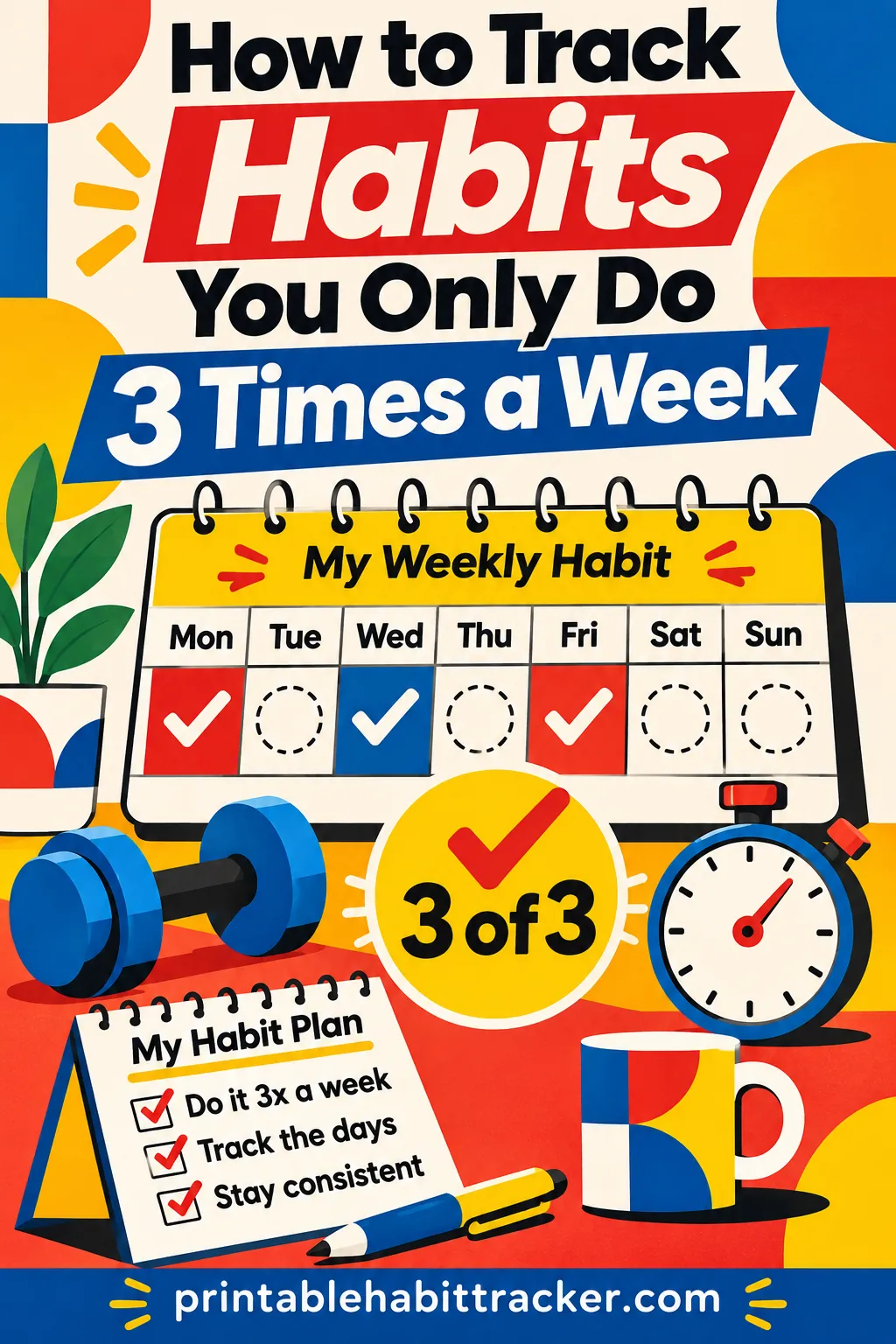
To track habits 3 times a week, use a weekly grid instead of a daily one, write the target right into the habit name (like "Gym (3 a week)"), and count the week as a win as soon as any three boxes are checked, no matter which days they land on. Rest days stay blank on purpose, and a blank box stops meaning "failed." You can build this exact tracker in the free printable habit tracker maker and print it in a couple of minutes.
Below you'll find why daily trackers fight against frequency goals, how to set up a weekly page that doesn't, the exact tool settings, sample layouts for different goals, and what to do when a week goes sideways.
✅ Try this tracker for one week
Tap a box each day you do the habit. Your ticks stay on this device.
Why Daily Trackers Make Rest Days Look Like Failure
Most habit trackers are built around a simple idea: one row per habit, one box per day, and you try to fill every box. That works beautifully for daily habits like drinking water, taking a vitamin or making your bed.
It works badly for anything you're not supposed to do every day.
Say your goal is three workouts a week. On a standard daily tracker, a great week looks like this: check, blank, check, blank, check, blank, blank. Four empty boxes. Your eye goes straight to the gaps, and the page tells you that you missed more days than you hit. You didn't. You hit your goal perfectly.
That mismatch causes real problems:
- It feels like failing when you're succeeding. Over a few weeks, a page full of blanks can wear down your motivation even though you're doing exactly what you planned.
- It tempts you to overdo it. Some people start working out on rest days just to fill in boxes, which can leave them sore, tired or burned out.
- It breaks streak thinking. "Don't break the chain" is a powerful idea for daily habits, but a three-times-a-week habit has built-in breaks. A chain that breaks every other day isn't motivating.
- It hides the real question. What you actually want to know is "Did I hit three this week?" A daily grid makes you count across the row and work it out each time.
The fix isn't to try harder. It's to change what the page measures. When the tracker counts weeks instead of days, rest days become part of the plan instead of holes in it. There's a deeper look at this idea in streaks vs. flexibility; this guide is the hands-on, printable version.
Which Habits Work Best on a Weekly Target
Lots of good habits don't belong on a daily schedule. Here are common ones that fit naturally into a "some days a week" goal.
| Habit | Typical weekly target | Why not daily? |
|---|---|---|
| Strength workout | 2 to 3 times | Muscles need recovery days between hard sessions |
| Running or cycling | 3 times | Many beginner plans build in rest days |
| Yoga or a class | 2 to 3 times | Class schedules and life don't line up every day |
| Meal prep | 1 to 2 times | One or two big sessions cover the week |
| Deep cleaning a room | 1 to 2 times | Daily tidying covers the rest |
| Language lessons | 3 to 4 times | Short, spaced practice fits busy weeks |
| Practicing an instrument | 3 to 5 times | Daily is great, but a realistic target keeps it going |
| Calling a parent or friend | 1 to 2 times | Regular, not constant |
| Date night or family game night | 1 time | A weekly ritual, not a daily one |
| Creative project time | 2 to 3 times | Needs longer blocks of time |
| Batch errands | 1 time | Saves trips when grouped |
| Long walk or hike | 2 to 3 times | Fits around weather and schedule |
If a habit has a natural rhythm that isn't "every day," it's a candidate for a weekly target. Health and exercise habits are the most common, but chores, hobbies and relationships fit this pattern just as well.
A quick note on exercise goals
If you're starting a new exercise plan after an injury, during pregnancy, or with a health condition, follow your doctor's or physical therapist's guidance on how often to train and how much rest you need. Your tracker should match their plan, not the other way around.
How a Weekly Target Tracker Works
The idea is simple. Instead of asking "Did I do it today?" the page asks "How many times did I do it this week?"
Here's the basic setup:
- One row per habit, with seven boxes for Monday through Sunday.
- The target written into the habit name, like "Gym (3 a week)" or "Meal prep (2x)." That way the goal is visible on every row, every day.
- A check in any box when you do the habit. Which days doesn't matter.
- A weekly tally at the end of the row or in the notes space: "3 of 3."
- A weekly win mark when you hit the target. A star, a circle, a highlight, whatever feels good.
The magic is in step 3. You don't plan your workouts on a fixed Monday-Wednesday-Friday schedule unless you want to. If Monday falls apart, you go Tuesday. If you work out Saturday and Sunday, those count too. Any three days add up to a successful week.
Fixed days vs. any days
Some people like a fixed schedule: Monday, Wednesday and Friday, every week. That's fine. Fixed days can make a habit easier to remember. If that's you, you can still use the weekly grid; just mark your planned days with a small dot before the week starts, then check them off.
Other people need flexibility because their weeks are unpredictable. Shift workers, parents of young kids and anyone who travels often tend to do better with "any three days." The weekly grid works for both, which is why it's the better choice for frequency-based habits.
| Approach | How it looks on the grid | Best for |
|---|---|---|
| Fixed days | Planned days dotted in advance, then checked | Steady schedules, people who like routine |
| Any days | Blank week, check whichever days you do it | Shift work, parenting, travel, unpredictable weeks |
| Minimum plus bonus | Target of 3, with room for a 4th as extra credit | People who sometimes feel like doing more |
| Spaced rule | Any 3 days, but no two hard sessions back to back | Strength training, running plans with recovery days |
How to Make It in the Free Tool (Exact Settings)
Open the free habit tracker maker and set it up like this:
- Title: type something like
My 3x a Week Habits,Weekly GoalsorTrain 3, Rest 4. - Template chips: tap Fitness if your main habits are workouts, then edit the list. Otherwise, skip the chips and type your own.
- Your habits (one per line): write the target into each habit name. For example:
- Gym session (3 a week)
- Long walk (3 a week)
- Language practice (3x)
- Meal prep (2 a week)
- Call family (1 a week)
- Stretch 10 min (daily)
- Layout: choose Weekly. This gives you a clean grid with one column for each day of the week, which is exactly what a frequency goal needs.
- Style: choose Checkbox. Checkboxes are quick and tidy when you're counting to three. Pick Color-in if you'd rather shade boxes with markers.
- Color theme: Classic B&W prints fast and clean. Ocean or Sage look calm on the wall.
- Options: turn on
- Color-code habits so each row has its own color and you can find the gym row at a glance,
- Notes/goals for your weekly tallies ("Gym 3/3, Walk 2/3"),
- Reflection for one line on what helped or got in the way,
- Reward box if you want a small treat for hitting every target. Leave Streak boxes off for this tracker. Daily streaks don't fit a three-a-week goal. You'll track weekly wins instead (more on that below).
- Paper: Letter or A4, and Portrait works well for a weekly page. Choose Landscape if you have long habit names.
- Tap 🖨️ Print / Save PDF, and print four or five copies so you have a month ready to go.
Want to skip the typing? Build this exact tracker with these habits, the weekly layout and the checkbox style already set. Then swap in your own habits and targets.
For more ideas on weekly layouts in general, the weekly habit tracker page shows several variations.
Why mixing daily and weekly habits on one page is fine
You might notice the sample list includes "Stretch 10 min (daily)." That's on purpose. Putting the target in the name means daily and weekly habits can share one page without confusion. A daily habit aims to fill every box. A three-a-week habit aims for three. Each row tells you its own goal.
Just keep the total manageable. Five to seven habits on a weekly page is plenty for most people. If you're unsure how many to take on, how many habits to track at once offers a simple way to decide.
Count Weekly Wins Instead of Daily Streaks
Streaks are motivating, and you don't have to give them up. You just move them up a level. Instead of counting days in a row, count weeks in a row where you hit your target.
A weekly win is any week you reach the number you set. Three workouts, three walks, two meal preps. Hit the number, and that week gets a star.
Here's why weekly streaks work so well for frequency habits:
- Rest days can't break them. A blank Tuesday doesn't matter as long as you hit three by Sunday.
- They're forgiving in the right way. A sick Monday or a busy Wednesday doesn't ruin anything. You still have the rest of the week.
- They still feel like a chain. "Eight weeks in a row of three workouts" is a streak worth protecting.
- They match how the habit actually works. You planned a weekly rhythm, so measuring weekly makes sense.
How to record weekly wins on paper
Pick one of these simple methods:
- Star in the corner. At the end of each week, draw a star next to every habit that hit its target. Count the stars on Sunday.
- Tally line in the notes space. Write "Gym 3/3 ✓, Walk 2/3, Meal prep 2/2 ✓." It takes ten seconds.
- A separate monthly strip. Print a Monthly page from the tool with your weekly habits listed, then shade one box per week you hit the target. It's a quick visual of the whole month.
- A yearly view. For a long-term goal like "strength training 3x a week all year," a Yearly page lets you mark each winning week and watch the whole year fill in.
A simple weekly win scorecard
At the bottom of the page or in the notes space, write a tiny scorecard like this each Sunday:
| Habit | Target | Done | Weekly win? |
|---|---|---|---|
| Gym session | 3 | 3 | Yes ★ |
| Long walk | 3 | 2 | Close |
| Language practice | 3 | 4 | Yes ★ (bonus day) |
| Meal prep | 2 | 2 | Yes ★ |
| Call family | 1 | 1 | Yes ★ |
Notice the "Close" entry. Two out of three is still two more walks than zero. Write it down honestly, but don't treat it like failure. It's information for next week.
A Sample Week, Filled In
Here's how a real week might look for someone with three workouts as their main weekly goal, plus a couple of supporting habits. A check means done; a dash means planned rest.
| Habit | Mon | Tue | Wed | Thu | Fri | Sat | Sun | Tally |
|---|---|---|---|---|---|---|---|---|
| Gym session (3 a week) | ✓ | – | – | ✓ | – | ✓ | – | 3/3 ★ |
| Long walk (3 a week) | – | ✓ | – | – | ✓ | – | ✓ | 3/3 ★ |
| Language practice (3x) | ✓ | – | ✓ | – | – | – | ✓ | 3/3 ★ |
| Meal prep (2 a week) | – | – | – | – | – | – | ✓ | 1/2 |
| Call family (1 a week) | – | – | ✓ | – | – | – | – | 1/1 ★ |
| Stretch 10 min (daily) | ✓ | ✓ | ✓ | – | ✓ | ✓ | ✓ | 6/7 |
On a daily tracker, this page would look like a mess of gaps. On a weekly target tracker, it shows four out of six habits hit their goal, one came close and the daily stretch nearly made a full week. That's a strong week.
The single meal prep miss tells you something useful too: maybe Sunday alone isn't enough, and a midweek top-up session belongs in next week's plan.
Notice also that the gym days aren't Monday-Wednesday-Friday. Wednesday got busy, so the second session moved to Thursday and the third to Saturday. That flexibility is exactly why the weekly approach works.
Scheduling Tips for Habits You Do 3 Times a Week
Freedom to pick any three days is great, until it's Friday and you've done zero. These simple habits help you get your three in without a last-minute scramble.
Plan on Sunday, stay flexible on Tuesday. Take two minutes on Sunday to pencil a small dot in the boxes where you expect to do each habit. Treat the dots as a plan, not a promise. If a day falls through, move the dot.
Get one in early. The first session of the week is the most important. If you do one by Monday or Tuesday, the rest of the week feels easy. If you wait until Thursday, you're suddenly trying to fit three into four days.
Use anchor days. Pick one day you'll almost always do the habit, like Saturday morning for a long walk. That's one of three handled before the week even starts.
Have a "minimum version." On a hectic day, a 15-minute workout or a 10-minute walk still counts. Decide your minimum ahead of time so you're not negotiating with yourself when you're tired.
Pair it with something you already do. Language practice on your commute. A walk right after dinner. A workout before your morning shower. Linking the habit to an existing routine makes it easier to remember.
Leave space for rest. For workouts especially, try not to stack all three hard sessions on back-to-back days unless your plan allows it. A rest day between sessions helps your body recover, and your tracker should make room for that.
The Thursday check-in
Thursday is a great day for a quick look at the page. Count how many checks each habit has so far and ask:
- On track (2 or more by Thursday): keep going, you're in good shape.
- Behind (1 by Thursday): pick your two remaining days now and dot them in.
- At zero: decide whether you can realistically get two or three in. If not, aim for two and call it a learning week.
This tiny midweek habit prevents most of the "it's Sunday night and I'm at zero" weeks.
What to Do When a Week Goes Sideways
Even with a flexible tracker, some weeks just don't work out. Illness, travel, deadlines, family stuff. Here's how to handle the most common situations without throwing the whole tracker out.
| Situation | What to do on the page | What to do next week |
|---|---|---|
| Hit 2 out of 3 | Write "2/3" and mark it "Close" | Keep the same target; plan your first session earlier |
| Hit 0 because you were sick | Write "Sick week" across the row | Restart gently; a lower target for one week is fine |
| Traveling all week | Write "Travel" and note anything you did manage | Plan a travel minimum next time, like bodyweight moves or walks |
| Tempted to cram 3 into the weekend | Do what's safe and reasonable; 2 good sessions beat 3 rushed ones | Get one in earlier in the week |
| Did 5 instead of 3 | Celebrate, but note how you felt | If you felt great, keep 3 as the target and treat extras as a bonus |
| Missed target 3 weeks in a row | Look at the notes for patterns | The target may be too high for now; try 2 for a month |
Don't make up for missed weeks by doubling up. If you only managed one workout last week, don't try for five this week. That's a quick path to burnout or soreness. Just start fresh with your regular target.
A missed week doesn't erase your progress. If you hit your target for six weeks, missed one, then hit it again, you've had seven strong weeks out of eight. That's what to remember. There are more ideas for getting back on track in what to do when you miss a day, and they work just as well for missed weeks.
Is the target too high or too low?
After three or four weeks, look back at your tallies.
- Hitting it easily every week, feeling good? You could bump it up by one, or keep it and enjoy the consistency. There's no rush.
- Hitting it most weeks, with the occasional miss? That's the sweet spot. Keep it.
- Missing it most weeks? Lower it. Two workouts a week that you actually do are worth far more than three that only exist on paper. You can raise it again later.
Ready-Made Habit Lists With Weekly Targets
Copy any of these straight into the "Your habits" box in the tool. Each list mixes a few weekly targets with one or two daily habits, which is the balance most people find easiest to keep.
Fitness beginner - Workout (3 a week) - Walk 20 min (3 a week) - Stretch 5 min (daily) - Bed by 10:30 (5 a week)
Strength and running mix - Strength session (2 a week) - Run (2 a week) - Long easy walk (1 a week) - Mobility 10 min (daily) - Rest day taken (2 a week)
That last habit, "Rest day taken," is worth a closer look. Giving rest its own row turns a blank box into a checked one. Recovery becomes something you do on purpose, not something you feel guilty about.
Busy parent - Move 20 min (3 a week) - Meal prep (2 a week) - Me-time 30 min (2 a week) - Read to kids (5 a week) - Family walk (1 a week)
Student - Review notes (3 a week) - Practice problems (3 a week) - Gym or sport (3 a week) - Call home (1 a week) - Laundry (1 a week)
Creative or hobby - Practice instrument (4x) - Sketch 15 min (3 a week) - Write 300 words (3 a week) - Share or post work (1x)
Home and chores - Vacuum (2 a week) - Bathroom clean (1 a week) - Laundry (2 a week) - Groceries and plan (1x) - Quick tidy (daily)
Relationships and wellbeing - Date night (1 a week) - Call a friend (2 a week) - Time outside (3 a week) - Journal (3 a week) - Screen-free evening (2x)
Keep each habit name short so it fits neatly on the printed row. The tool's habit lines work best when they're a few words plus the target in parentheses.
Variations for Different Situations
The basic weekly target setup works for almost anyone. These tweaks help it fit your life even better.
If you follow a training plan
Many beginner running and strength plans give you specific sessions on specific days, with rest days built in. Write each session type as its own row: "Easy run (2 a week)," "Long run (1 a week)," "Strength (2 a week)." Dot in the planned days on Sunday, then check them off as you go. If your coach or physical therapist gave you a plan, follow their schedule and spacing; the tracker is just there to record it. For more on building the habit itself, see how to build an exercise habit.
If your schedule changes every week
Shift workers and people who travel often should lean fully into "any days." Don't dot in plans at all. Just check boxes as you go and do the Thursday check-in. You might also set a slightly lower target, like two guaranteed workouts plus a bonus third when the week allows.
If you're tracking as a family or couple
A weekly target page works well on the fridge for a household. Give each person their own row for shared goals: "Walk (me, 3 a week)," "Walk (partner, 3 a week)." Add a household row like "Family game night (1 a week)." Turn on Color-code habits in the tool so each person's rows stand out.
If you have ADHD or struggle with routines
Weekly targets can be a relief when daily habits feel impossible to keep up with. Fewer boxes to fill means less pressure, and "any three days" removes the stress of a fixed schedule. Keep the list short, use bright colors and put the page somewhere you'll see it every day. If you're working with a doctor or therapist on routines, build your tracker around their suggestions.
If you're coming back after a break
Start lower than you think. If you used to work out four times a week, begin with two. Hit two for a few weeks, then move to three. The tracker will show your consistency growing, and that steady progress feels much better than missing a target that was set too high.
Weekly Page vs. Monthly Page: Which Should You Print?
The free tool can make either a weekly or a monthly layout. Here's how to choose for frequency-based habits.
| Weekly layout | Monthly layout | |
|---|---|---|
| Best for | Habits with a weekly target (3x a week, 2x a week) | Daily habits, or tracking weekly wins across a month |
| How to read it | Count checks per row each week | Count checks per row, or per week block |
| Rest days | Easy to see as part of the plan | Can look like gaps |
| Planning | Fresh page each Sunday invites a quick plan | One page covers the whole month |
| Paper use | One sheet per week | One sheet per month |
| Good combo | Weekly page for doing, monthly page for weekly wins | Monthly page with weekly targets in the habit names |
The combo that works best for many people: a weekly page for day-to-day tracking, plus one monthly or yearly page where you shade a box each time you hit your weekly target. You get the flexibility of weekly tracking and the satisfying big-picture view.
If you prefer one page a month, that works too. Use the Monthly layout, write targets into the habit names, and draw a light line under every seventh day so each week is easy to count. It's not quite as clean as a weekly grid, but it keeps everything on one sheet.
Common Mistakes With Frequency-Based Habits
Using a daily tracker anyway. This is the big one. If your goal isn't daily, the tracker shouldn't be either.
Leaving the target off the page. If the habit just says "Gym," your brain defaults to "every day." Writing "Gym (3 a week)" changes how the whole row looks to you.
Saving it all for the weekend. Three sessions crammed into Friday, Saturday and Sunday is hard on your body and easy to miss. Aim to get one in early.
Setting the target too high. A goal you rarely hit isn't motivating. Pick a number you can reach most weeks.
Forgetting to count rest as part of the plan. Rest days are when your body recovers and your schedule breathes. They're not failures, and your tracker shouldn't treat them that way.
Never reviewing. Spend two minutes on Sunday looking at the tallies. That's where you'll notice which days work and which targets need adjusting.
When you're ready to try it, build this exact tracker, swap in your own habits and targets, and print a month's worth of weekly pages. You can also start from a blank page in the habit tracker maker and set it up your way.
Frequently Asked Questions
How do I track a habit I only do 3 times a week?
Use a weekly tracker with seven boxes per habit and write the target into the habit name, like "Workout (3 a week)." Check any box on the days you do it, then count the checks at the end of the week. Three checks on any days means the week is a win.
Should I schedule fixed days or keep it flexible?
Both work. Fixed days, like Monday, Wednesday and Friday, are easier to remember if your schedule is steady. Flexible "any three days" works better if your weeks are unpredictable. You can also pencil in planned days on Sunday and move them as the week changes.
How do I keep a streak with a weekly habit?
Count weeks instead of days. Each week you hit your target, add a star or shade a box on a monthly or yearly page. "Ten weeks in a row of three workouts" is a streak, and rest days can't break it.
What if I only get 2 out of 3 this week?
Write "2/3" honestly and keep going. Two is still progress. Next week, try to get your first session in earlier. If you miss the target several weeks in a row, it may be worth lowering it for a while.
Can I mix daily and weekly habits on the same tracker?
Yes. Write the target into each habit name, like "Stretch (daily)" and "Gym (3 a week)," so each row tells you its own goal. A weekly page with five to seven habits handles a mix comfortably.
Should rest days be on my habit tracker?
You can add a row like "Rest day taken (2 a week)" if you tend to skip recovery or feel guilty about it. Checking that box turns rest into an intentional part of your plan. If you're following a training plan, use the rest days it recommends.
Is it okay to do the habit more than 3 times in a week?
Usually yes, as long as you feel good and your plan allows it. Treat extra days as a bonus rather than raising your target right away. For exercise, make sure you still leave time to recover, and follow your doctor's or trainer's advice if you have one.
Which layout should I print from the habit tracker maker?
Choose the Weekly layout with Checkbox style for day-to-day tracking of three-times-a-week habits. Add a Monthly or Yearly page if you'd like to mark each week you hit your target and see your consistency over time.